
Many digital marketers unknowingly launch campaigns with broken or inaccurate tracking, leading to misattributed conversions and wasted spend. Regular audits improve ROI by 20% by catching errors before they distort your analytics and decision making. This article provides a comprehensive 2026 checklist to ensure tracking accuracy, compliance, and optimized marketing performance across your entire digital ecosystem.
Table of Contents
- Why Regular Digital Marketing Audits Matter In 2026
- Key Selection Criteria For Your Digital Marketing Audit Checklist
- Essential Audit Items For Accurate Tracking Implementation
- Using Automation And AI Tools To Enhance Audit Efficiency
- Compliance And Privacy Checks In Your Marketing Audit
- How Often To Conduct Audits And Implement Findings
- Summary Comparison Of Top Audit Framework Elements For 2026
- Situational Recommendations: Choosing Your Audit Approach Based On Needs
- How Trackingplan Can Streamline Your Digital Marketing Audits In 2026
- Frequently Asked Questions
Key takeaways
| Point | Details |
|---|---|
| Audit frequency drives ROI | Companies performing regular audits achieve significantly higher returns and reduce wasted spend. |
| Accuracy and compliance are non-negotiable | Checklist criteria must emphasize tracking precision, GDPR/CCPA compliance, and automation integration. |
| AI tools accelerate error resolution | Platforms like Trackingplan provide continuous monitoring and cut resolution time by up to 50%. |
| Comprehensive scope prevents blind spots | Include GA4 configurations, pixel health, UTM accuracy, event tracking, and privacy controls. |
| Strategic timing maximizes value | Quarterly or biannual deep audits combined with monthly quick checks maintain data quality. |
Why regular digital marketing audits matter in 2026
Data errors silently corrupt marketing attribution, causing teams to double down on underperforming channels while starving high-value opportunities. Companies performing regular audits report 20% higher ROI compared to those relying on sporadic checks or no systematic review process.
Broken pixels represent one of the most common yet devastating tracking failures. A single misconfigured Facebook pixel can render thousands of dollars in ad spend invisible to your analytics, creating attribution black holes. When marketers make budget decisions based on incomplete data, they perpetuate cycles of inefficiency that compound over quarters.
Proactive audit cultures align tracking accuracy with budget optimization in three critical ways:
- Revealing shadow failures that standard dashboards never surface
- Identifying schema drift as teams update tags without documentation
- Catching compliance gaps before they trigger regulatory penalties
The alternative to structured audits is reactive firefighting. Teams discover tracking breakdowns only after noticing inexplicable performance drops, by which time weeks of corrupted data have already poisoned attribution models. This pattern of prioritizing marketing over analytics creates technical debt that grows exponentially harder to resolve.
“Most marketing teams operate with 15 to 30% attribution inaccuracy without realizing it, making strategic decisions on fundamentally flawed data foundations.”
Regular audits transform analytics from a lagging indicator into a predictive advantage. When you catch configuration errors within days instead of months, you preserve the integrity of year-over-year comparisons and maintain confidence in your attribution models.
Key selection criteria for your digital marketing audit checklist
Effective audit checklists balance comprehensiveness with actionability, ensuring every item drives measurable improvements in data quality or compliance posture. Tracking accuracy, privacy compliance coverage, and automation integration form the foundational criteria that separate superficial reviews from transformative audits.

Accurate error detection prevents the cascading failures that occur when one misconfigured tag corrupts downstream analytics. Your checklist must include validation steps for pixel firing, event parameter accuracy, and cross-platform consistency. Generic checklists often miss platform-specific nuances like GA4’s measurement protocol requirements or server-side tracking authentication.
Compliance with GDPR, CCPA, and emerging privacy regulations is mandatory, not optional. Fines average hundreds of thousands per violation, making privacy audit items among the highest ROI components of your checklist. Verify consent management implementations, data retention policies, and third-party processor agreements with the same rigor you apply to conversion tracking.
Automation and AI dramatically enhance audit speed and scalability. Manual spreadsheet reviews take days and still miss intermittent failures. AI-powered tools detect anomalies in real time, alerting teams to broken pixels or traffic drops within minutes via Slack or Teams integrations.
Integration with existing Martech stacks determines audit feasibility for busy teams. Choose campaign tracking checklist steps that work within your current analytics ecosystem rather than requiring parallel tracking infrastructures.
Pro Tip: Prioritize checklist items by impact and detection difficulty. High-impact, hard-to-detect issues like schema drift should trigger automated monitoring, while low-impact items can rely on quarterly manual reviews.
Audit duration affects adoption rates across organizations. A checklist requiring three full days discourages regular use, while overly simplified 15-minute reviews miss critical errors. Target 60 to 90 minutes for core monthly checks, reserving deeper quarterly audits for comprehensive validation.
Essential audit items for accurate tracking implementation
GA4 property configurations form the foundation of modern analytics accuracy, yet property misconfigurations lead to misleading attribution reports discovered only during audits. Start by verifying data stream settings, ensuring measurement IDs match across all deployment locations and that cross-domain tracking captures complete user journeys.
Conversion and attribution settings require meticulous validation:
- Confirm conversion events fire on correct triggers with proper parameter values
- Verify attribution models align with business reality and marketing mix
- Check that conversion windows match customer decision cycles
- Validate enhanced measurement settings capture scroll depth and outbound clicks
- Test debug mode to identify events failing to register
Pixel performance audits catch the silent killers of attribution accuracy. Verify every campaign pixel fires correctly across devices and browsers, checking for:
- Missing pixels on critical conversion pages
- Duplicate pixel fires inflating conversion counts
- Pixels blocked by ad blockers or privacy tools
- Server-side pixels failing authentication
- Pixels firing on wrong events or with incorrect parameters
UTM and campaign tagging accuracy aligns with defined schemas to prevent attribution chaos. Audit actual landing page URLs against campaign tracking documentation, flagging inconsistencies in source, medium, or campaign naming conventions. A single typo in utm_source transforms paid traffic into direct, distorting channel performance comparisons.
Event and conversion tracking consistency across platforms prevents the attribution fragmentation that occurs when GA4, Meta, and Google Ads report wildly different conversion totals for identical campaigns. Use a website audit checklist approach to systematically verify event schemas match across platforms.
Configuration errors cause up to 30% attribution inaccuracies in typical implementations. Common culprits include:
- Mismatched event names between tracking plan and implementation
- Missing required parameters on custom events
- Incorrect data layer structure preventing tag firing
- Filter settings excluding legitimate traffic
- Timezone mismatches between platforms creating temporal attribution errors
Pro Tip: Create a tracking truth table documenting expected behavior for each conversion path, then audit actual implementation against this baseline quarterly to catch drift before it compounds.
Using automation and AI tools to enhance audit efficiency
AI-powered monitoring tools enable instant alerts to Slack or Teams the moment tracking anomalies emerge, transforming audits from periodic snapshots into continuous data quality assurance. Real-time detection catches broken pixels within minutes of deployment rather than weeks later during manual reviews.
Automated root-cause analysis accelerates troubleshooting by tracing errors to specific code changes, tag manager updates, or third-party script conflicts. Instead of spending hours isolating why conversion tracking stopped working, AI-powered monitoring reduces resolution time by 50% by pinpointing exact failure points.
Continuous monitoring reduces manual workload by up to 40% while improving coverage. Human auditors check samples; AI tools validate every single event, every pixel fire, every parameter value across millions of sessions. This comprehensive coverage surfaces edge cases and intermittent failures that slip through manual spot checks.
The operational benefits compound over time:
- Automated schema validation catches drift as developers update tracking
- Traffic anomaly detection flags sudden drops indicating broken implementations
- Cross-platform consistency checks ensure attribution alignment
- Historical baselines enable AI to detect subtle degradation patterns
Real-time monitoring increases confidence in marketing decisions by ensuring the data informing budget allocations accurately reflects campaign performance. When you trust your tracking, you can act decisively on performance signals rather than second-guessing whether analytics reflect reality.
“The difference between monthly manual audits and continuous AI monitoring is like comparing annual physicals to real-time health tracking. Both have value, but only one prevents emergencies.”
Platforms like Trackingplan integrate seamlessly into existing Martech stacks, connecting with digital analytics tools and marketing automation platforms without requiring parallel tracking infrastructure. This native integration means audit insights feed directly into remediation workflows rather than creating separate documentation silos.
Pro Tip: Layer AI automation for routine monitoring with quarterly human audits for strategic context. Machines excel at detecting deviations from expected patterns; humans excel at determining whether those deviations matter for business outcomes.
Compliance and privacy checks in your marketing audit
Consent management platform implementations require verification that cookie banners actually block tracking until users consent, not just display notices while continuing to collect data. Audit actual network requests in privacy mode to confirm tracking scripts respect user choices across all consent states.
Compliance failures average $400,000 in fines per infraction, making privacy audits among the highest ROI components of your overall review process. Beyond financial penalties, compliance failures erode consumer trust and trigger PR crises that damage brand value for years.
Data minimization and anonymization practices within tracking deserve systematic audit attention:
- Verify personally identifiable information never enters analytics platforms
- Check that IP anonymization applies before data storage
- Confirm user IDs employ one-way hashing preventing re-identification
- Validate data retention policies automatically purge old records
- Audit cross-device tracking for compliance with consent requirements
Third-party tags create compliance exposure because you inherit liability for processor violations. Audit vendor data processing agreements, verify sub-processors maintain adequate safeguards, and confirm tags only fire with appropriate consent levels. A single non-compliant affiliate tracking pixel can expose your entire organization to regulatory action.
Cookie policies must accurately reflect actual tracking implementations. Audit your privacy documentation against real cookie deployments, flagging undisclosed trackers or outdated policy language. Regulatory scrutiny increasingly focuses on transparency gaps between stated and actual data collection practices.
Privacy compliance integrates into holistic audit processes rather than existing as a separate compliance exercise. Use your privacy compliance checklist to verify tracking accuracy and regulatory adherence simultaneously, ensuring data quality efforts never compromise user privacy.
How often to conduct audits and implement findings
Quarterly or biannual comprehensive audits suit most dynamic digital marketing environments, balancing thoroughness with resource constraints. High-velocity organizations launching campaigns weekly may need monthly deep audits, while stable environments can extend to annual reviews supplemented by continuous automated monitoring.
Audit scorecards streamline review processes and prioritize fixable errors efficiently:
- Categorize findings by severity (critical, high, medium, low)
- Estimate remediation effort for each issue
- Calculate impact score based on traffic volume affected
- Sequence fixes to maximize quick wins before tackling complex repairs
- Assign ownership and deadlines to prevent audit findings from languishing
Structured scorecards applied in 60 minutes can uncover critical weaknesses without requiring full-day audit marathons. Focus monthly quick checks on high-impact areas like conversion pixel health, recent campaign tag accuracy, and compliance posture.
Immediate remediation priorities include:
- Broken pixels causing complete attribution loss
- Misconfigured tags sending incorrect parameter values
- Compliance gaps exposing regulatory risk
- Cross-domain tracking failures fragmenting user journeys
- Filter settings excluding legitimate conversion traffic
Map audit findings to budget reallocations and campaign optimizations for measurable ROI lift. When audits reveal a channel’s conversions are overcounted by 40%, shifting budget to accurately measured alternatives immediately improves efficiency. Document these reallocations to demonstrate audit program value to stakeholders.
| Audit Frequency | Coverage Depth | Typical Duration | Best For |
|---|---|---|---|
| Monthly quick check | High-impact areas only | 60 minutes | Ongoing monitoring |
| Quarterly comprehensive | Full tracking stack | 4-6 hours | Dynamic environments |
| Biannual deep dive | Infrastructure + strategy | 8-12 hours | Stable implementations |
| Continuous automated | 100% event coverage | Real-time | All organizations |
Use your marketing audit scorecard as a living document that evolves with your Martech stack, adding new checklist items as you adopt platforms and removing obsolete checks as you deprecate tools.
Summary comparison of top audit framework elements for 2026
Traditional manual audits rely on analysts reviewing analytics dashboards and tag manager configurations on fixed schedules, typically quarterly or annually. This approach offers deep contextual understanding but suffers from limited coverage, high labor costs, and delayed error detection. Manual reviews catch obvious misconfigurations but miss intermittent failures and subtle schema drift.
Automated AI-driven tools provide real-time monitoring of every tracking event, instantly alerting teams to anomalies via Slack or email. These platforms excel at comprehensive coverage and rapid detection but may generate false positives requiring human triage. AI automation works best for routine validation of known good states rather than strategic assessment of whether you’re tracking the right things.
Hybrid approaches combine manual oversight with AI automation to deliver customization and scalability. Quarterly human audits establish strategic direction and validate business alignment, while continuous automated monitoring ensures tactical execution accuracy between reviews. This combination maximizes coverage while preserving strategic judgment.
| Framework Type | Automation Level | Compliance Focus | Coverage | Typical Duration | Error Detection Speed |
|---|---|---|---|---|---|
| Manual audit | Low | Variable | 20-30% sample | 4-8 hours | Days to weeks |
| AI continuous monitoring | High | Built-in privacy checks | 100% events | Real-time | Minutes |
| Hybrid approach | Medium | Comprehensive | 100% automated + strategic manual | 2-4 hours quarterly | Minutes to hours |
| Quick scorecard | Low | Basic | Critical paths only | 60 minutes | Days |
Compliance audit focus varies dramatically among frameworks. Basic manual reviews may check only for obvious GDPR violations like missing cookie banners, while comprehensive automated platforms continuously validate consent implementation, data retention, and processor agreements. Choose frameworks matching your regulatory exposure and risk tolerance.
Audit duration ranges from 60-minute scorecards focusing on critical weaknesses to full-day deep dives examining every tag and parameter. Resource-constrained teams should layer quick monthly checks on high-impact areas with less frequent but thorough quarterly reviews.
Use audit framework comparisons to match your organizational maturity and resources with appropriate review cadences, balancing thoroughness against practical execution constraints.
Situational recommendations: choosing your audit approach based on needs
Small businesses with limited analytics resources should focus on fundamental tracking accuracy and basic compliance, prioritizing conversion pixel health and consent management over advanced attribution modeling. A monthly 60-minute scorecard reviewing critical paths plus biannual comprehensive audits provides adequate coverage without overwhelming small teams.
Enterprises managing complex Martech ecosystems across multiple brands and regions benefit from AI-powered continuous monitoring to detect issues across thousands of tracking implementations. The scale and complexity of enterprise analytics make manual-only approaches impractical and increase the ROI of automated platforms that provide unified visibility.
Marketing agencies serving multiple clients need scalable audit processes that balance customization with efficiency. Standardized checklists combined with automated monitoring enable agencies to deliver consistent quality across client portfolios while surfacing client-specific anomalies requiring custom attention. Agency-focused audit approaches typically combine templated reviews with flexible investigation capabilities.
Highly regulated industries like healthcare, finance, and legal services must prioritize privacy compliance and integrate audits with legal review processes. These organizations should implement continuous compliance monitoring with quarterly attestation reviews suitable for regulatory documentation. The cost of non-compliance far exceeds the investment in comprehensive audit programs.
Martech ecosystem maturity determines appropriate audit sophistication:
- Emerging stacks (1-3 tools) need basic accuracy validation
- Growing stacks (4-8 tools) require cross-platform consistency checks
- Mature stacks (9+ tools) demand automated monitoring and schema governance
- Enterprise stacks (15+ tools) necessitate AI-powered continuous assurance
Pro Tip: Start with manual quarterly audits to establish baselines and understand your specific failure patterns, then automate the most frequent error categories you discover. This progression ensures automation addresses real problems rather than theoretical concerns.
Resource availability should drive frequency rather than scope. Running superficial monthly audits provides less value than thorough quarterly reviews. If you can only allocate four hours quarterly, focus that time on comprehensive validation of critical paths rather than spreading thin across daily monitoring you cannot act upon.
How Trackingplan can streamline your digital marketing audits in 2026
Manual audits consume hours reviewing analytics dashboards and tag configurations, yet still miss intermittent failures and edge cases. Trackingplan automates this entire process with AI-powered continuous monitoring that validates every tracking event in real time, instantly alerting your team to broken pixels, schema drift, or configuration errors via Slack or Teams.
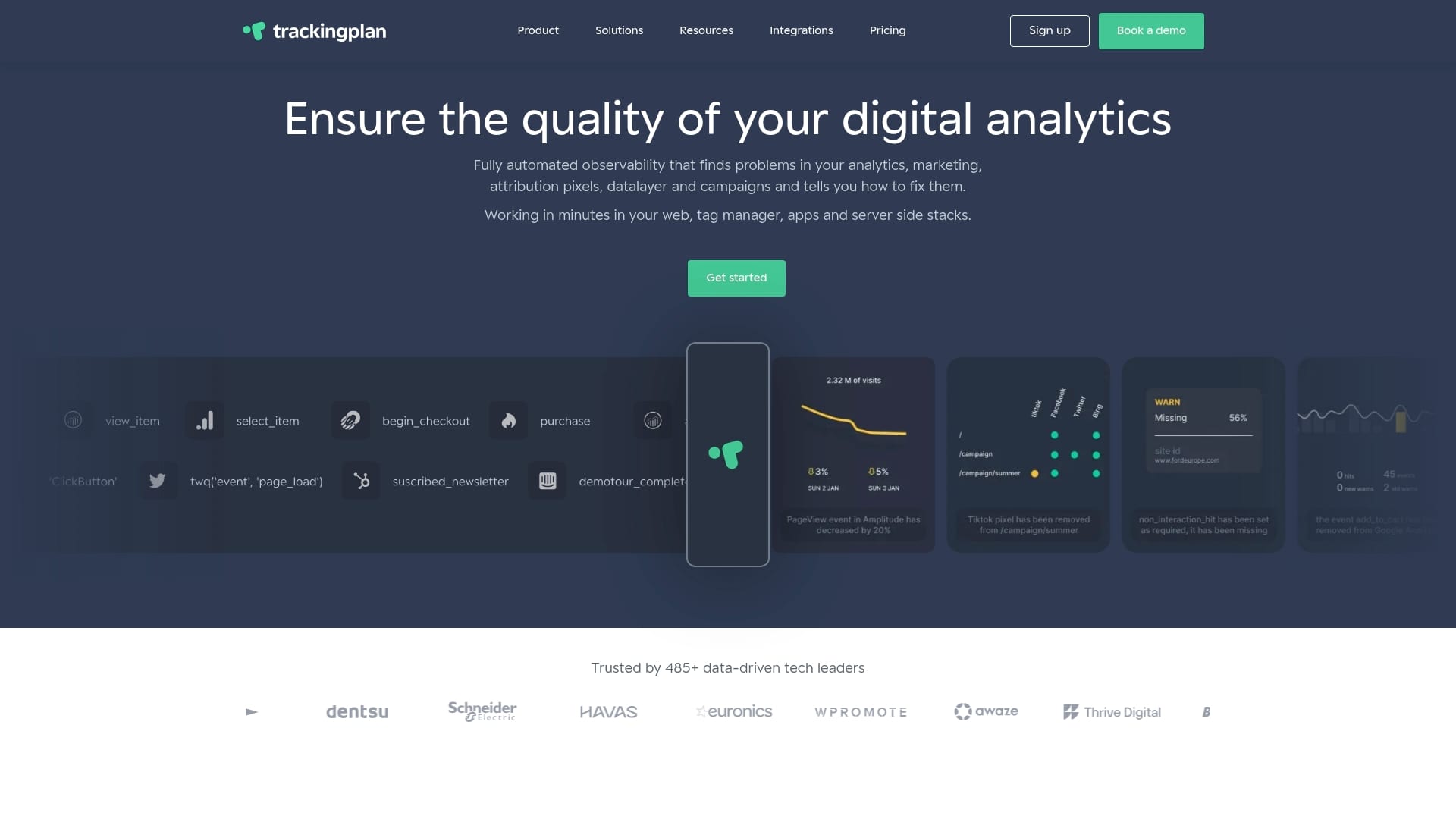
The platform integrates seamlessly with your existing analytics tools and Martech stack, requiring no additional tracking infrastructure. Automated root-cause analysis traces errors to specific code changes or tag updates, reducing resolution time by up to 50% compared to manual troubleshooting.
Built-in privacy controls ensure GDPR and CCPA compliance by monitoring consent implementation and flagging data collection that violates user preferences. Instead of quarterly compliance spot checks, Trackingplan validates every session against privacy policies in real time.
The accessible dashboard provides unified visibility across your entire digital ecosystem, from web tracking to mobile apps to server-side implementations. This comprehensive view surfaces cross-platform inconsistencies that fragment attribution and distort channel performance comparisons. Teams using Trackingplan spend less time auditing and more time optimizing campaigns based on data they can trust.
Frequently asked questions
What makes a digital marketing audit checklist essential in 2026?
Modern audit checklists provide actionable steps tailored to evolving tracking technologies like GA4, server-side tagging, and privacy-first measurement. They ensure data accuracy by systematically validating pixel health, event schemas, and cross-platform consistency. AI-powered tools automate error detection and root-cause analysis, reducing manual effort while improving coverage. Updated checklists include compliance verification aligned with current GDPR and CCPA requirements, protecting against regulatory penalties. Strategic audit frameworks recommend frequency and prioritization approaches that balance thoroughness with resource constraints.
How often should digital marketing audits be performed for best results?
Quarterly comprehensive audits suit most dynamic marketing environments launching regular campaigns and testing new channels. Supplement deep quarterly reviews with monthly 60-minute scorecards focusing on critical conversion paths and recent campaign deployments. High-velocity organizations may need monthly comprehensive audits, while stable environments can extend to biannual reviews. Layer any manual schedule with continuous automated monitoring to catch issues between formal audits.
What are common tracking issues discovered during audits?
Broken or missing pixels represent the most frequent critical error, causing complete attribution loss for affected campaigns. Misconfigured GA4 properties and incorrect campaign tag parameters create attribution inaccuracies averaging 20 to 30%. Event tracking inconsistencies where schemas drift from documentation prevent cross-platform comparisons. Compliance failures in consent management expose regulatory risk, while filter settings sometimes exclude legitimate conversion traffic from analytics.
Can automation fully replace manual audit efforts?
Automation excels at detecting deviations from expected patterns and provides comprehensive coverage across all events and sessions. However, manual review adds strategic context and business judgment about whether detected anomalies actually matter for marketing decisions. Hybrid approaches combining automated continuous monitoring with quarterly human strategic audits deliver optimal results, leveraging machine speed and coverage alongside human insight and prioritization.
How do tracking audits directly improve marketing ROI?
Accurate tracking enables confident budget allocation decisions based on reliable attribution data rather than guesswork. Audits identify underperforming channels receiving excessive budget due to overcounted conversions, allowing immediate reallocation to better opportunities. Catching broken pixels quickly prevents wasted spend on unmeasurable campaigns. Regular audits reduce the attribution errors that cause marketers to double down on ineffective tactics while starving high-value channels, directly translating improved data quality into better marketing efficiency.