
TL;DR:
- A marketing governance plan is a dynamic operating model that aligns strategy, execution, content, lead management, and analytics with clear ownership and continuous oversight. Automation tools like Trackingplan enable real-time monitoring, anomaly detection, and error resolution to ensure tracking accuracy and prevent data corruption. Proper governance, with assigned ownership and automated processes, improves marketing performance and reduces operational risks.
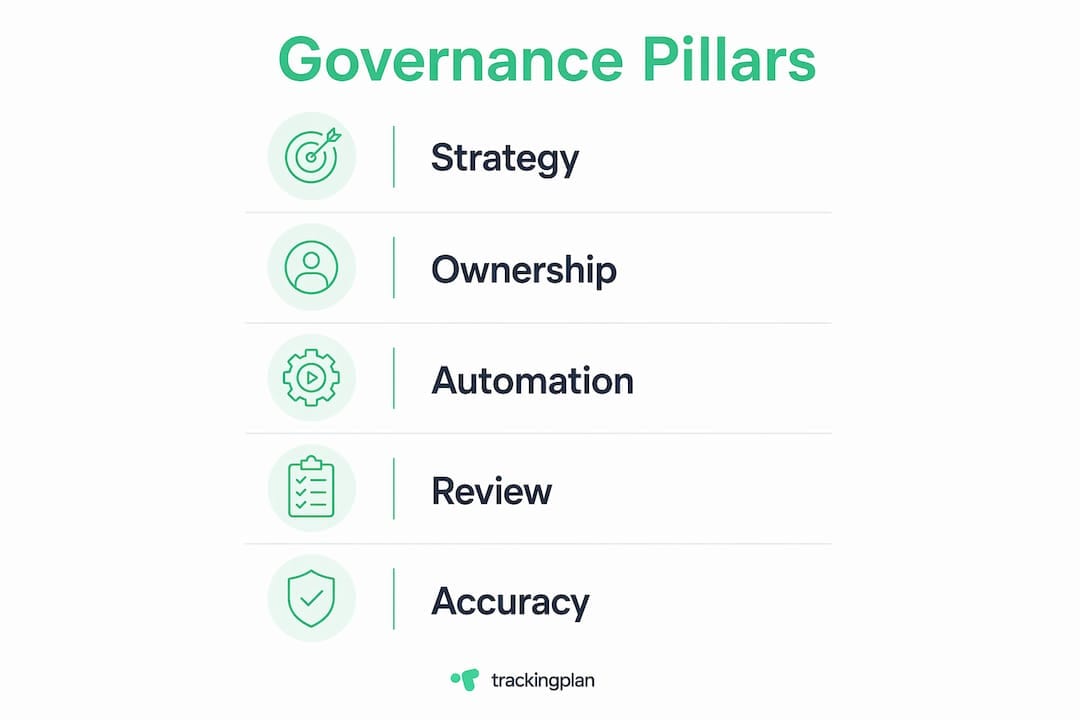
A marketing governance plan is a living operating model that defines how your marketing strategy, execution, content, lead management, and analytics are structured, owned, and continuously improved. It is not a static policy document you file away after launch. Done right, it prevents data fragmentation, clarifies who makes which decisions, and gives distributed teams a shared operating standard they can actually follow. For digital marketing and analytics teams, the stakes are especially high: without governance, tracking errors accumulate silently, attribution breaks down, and ad spend decisions rest on corrupted data. Automation tools like Trackingplan make it possible to enforce governance at scale by detecting anomalies and auditing tracking implementations in real time. The core pillars of any effective plan include:
- Strategy and alignment — connecting marketing activity to business objectives
- Execution and channel control — standardizing workflows across teams and platforms
- Content and brand governance — enforcing consistency in messaging and assets
- Lead and customer management — defining data flows, scoring logic, and handoff rules
- Analytics and continuous improvement — monitoring performance and correcting course
Table of Contents
- What are the core pillars of a marketing governance plan?
- Who actually owns what in enterprise marketing governance?
- How do you shift from manual oversight to automated governance loops?
- Why do most teams misunderstand what governance actually does?
- How does Trackingplan operationalize your governance framework?
- Key Takeaways
- Governance is the infrastructure most marketing teams are missing
- FAQ
What are the core pillars of a marketing governance plan?
A digital marketing governance framework only holds together when each operational dimension is explicitly addressed. Miss one pillar and the gaps compound quickly.
Strategy and alignment anchors every downstream decision to a business objective. Without it, teams optimize for channel metrics that have no bearing on revenue. Execution and channel control standardizes how campaigns are built, approved, and launched, which directly reduces the misconfiguration errors that corrupt tracking data. Content and brand governance ensures that every asset, from a paid ad to a landing page, reflects approved messaging and complies with brand standards, preventing the kind of inconsistency that erodes attribution models.
Lead and customer management defines the rules for data capture, enrichment, scoring, and CRM sync. When these rules are undocumented, lead scoring models drift, sync errors go undetected, and sales teams act on stale data. Analytics and continuous improvement closes the loop: it sets the KPIs, defines how metrics are calculated, and establishes the review cadence that keeps the whole framework current. These pillars are interdependent. A gap in execution control, for instance, will surface as noise in your analytics pillar within weeks.

Who actually owns what in enterprise marketing governance?
System ownership is the mechanism that converts governance from aspiration into behavior. Assigning named owners to critical systems, rather than leaving accountability diffuse across “the team,” is what prevents governance drift.
In practice, ownership assignments should cover:
- CRM and marketing automation sync — a named owner monitors sync errors and resolves them within defined SLAs
- Lead scoring model — quarterly calibration reviews, with every model change documented and dated
- Database hygiene — deduplication and suppression reviews run on a defined cadence
- Program template library — new program types are templated before they scale
- Reporting stack — metric definitions are written down, agreed upon, and updated before any change reaches stakeholders
As Lisa Welchman, author of Managing Chaos: Digital Governance by Design, frames it: digital governance is “a discipline that focuses on establishing clear accountability for digital strategy, policy, and standards.” The point is not micromanagement. It is giving people clarity about who decides what, so decisions scale without constant escalation.
Governance review cadences keep ownership assignments from drifting: monthly operational reviews cover sync errors and open issues; quarterly strategic reviews address scoring model calibration and database health; annual architecture reviews assess whether the current system design still fits the organization’s scale.
How do you shift from manual oversight to automated governance loops?
Manual governance breaks at scale. When a team manages dozens of campaigns across multiple platforms, a spreadsheet-based audit process cannot catch a broken pixel before it corrupts a week of attribution data. The shift toward automated monitoring is not optional for teams operating at enterprise volume.
AI-driven governance loops work by continuously monitoring the marketing tech stack for anomalies, schema mismatches, and configuration errors, then surfacing alerts before those errors affect reporting. Key capabilities in an automated governance model include:
- Real-time anomaly detection — flags traffic spikes, drops, or broken tracking events as they happen
- Automated audit trails — logs every change to tracking configurations for root-cause analysis
- Proactive error notification — pushes alerts via Slack, email, or Teams so the right person acts immediately
- AI agent guardrails — define which actions agents can execute autonomously versus which require human approval, with all actions logged for compliance
Pro Tip: Treat your AI governance guardrails the way you would onboard a new team member under probation: define their scope explicitly, require sign-off on high-risk actions, and log everything. The same logic applies to autonomous marketing agents.
The practical result is that governance stops being a periodic audit event and becomes a continuous background process. Teams catch issues in hours rather than discovering them during a monthly review.
Why do most teams misunderstand what governance actually does?
The most persistent misconception is that governance is administrative overhead, a set of rules that slows execution. It is the opposite. As Lisa Welchman argues, strong governance facilitates scalability by providing clarity across distributed teams, not just administrative control.
Governance failures rarely announce themselves. Instead, they show up as campaigns built from scratch when a template already existed, as two teams reporting different revenue numbers from the same data source, or as a lead scoring model that nobody has reviewed in eighteen months. The enterprise marketing governance literature is consistent on this point: governance transforms fragmented marketing efforts into coordinated systems that align data, technology, and strategy. The teams that resist it are usually the ones already drowning in the problems it would solve.
How does Trackingplan operationalize your governance framework?
A governance plan without enforcement tooling is a document. Trackingplan turns the analytics and continuous improvement pillar into an automated, always-on process.
Trackingplan’s core capabilities directly support marketing governance at the tracking layer:
- Automated discovery — maps every tracking event, pixel, and tag across websites, apps, and server-side environments without manual inventory work
- Continuous monitoring — watches for missing or broken pixels, schema mismatches, and campaign misconfigurations in real time
- Anomaly detection — identifies traffic spikes or drops and surfaces the probable cause before the issue reaches a reporting cycle
- Root-cause analysis — provides the audit trail needed to diagnose exactly when and where a tracking error was introduced
- Privacy compliance checks — flags data collection that may conflict with consent requirements, supporting the compliance dimension of governance
- Comprehensive dashboards — give analytics teams a single view of martech stack health, reducing the time spent chasing data quality issues across tools
For agencies managing multiple client sites, Trackingplan’s digital analytics monitoring scales governance oversight across accounts without proportional increases in manual effort. The result is better attribution, more reliable campaign data, and faster correction cycles when something breaks.
Key Takeaways
A marketing governance plan works only when strategy, ownership, and automated monitoring operate together as a single system, not as separate initiatives.
| Point | Details |
|---|---|
| Governance is a living model | A marketing governance plan must be reviewed monthly, quarterly, and annually to stay accurate and relevant. |
| Named ownership is non-negotiable | Assigning specific people to CRM sync, lead scoring, and reporting prevents accountability from becoming diffuse. |
| Automation closes the gap | Tools like Trackingplan detect tracking errors and anomalies in real time, replacing periodic manual audits. |
| Misconceptions cost teams | Governance is a performance enabler that reduces duplication and misalignment, not an administrative burden. |
| Pillars must work together | Gaps in execution control surface as noise in analytics; every pillar depends on the others functioning correctly. |
Governance is the infrastructure most marketing teams are missing
The conversation around marketing governance has shifted. A few years ago, teams could treat it as a maturity-stage aspiration. Now, with AI agents executing campaigns autonomously and martech stacks spanning dozens of tools, ungoverned marketing operations carry real financial risk. A broken pixel that goes undetected for two weeks does not just corrupt a dashboard; it misdirects budget and invalidates the attribution model you are using to make spend decisions.
What I find underappreciated is how much governance accelerates execution rather than slowing it down. When ownership is explicit and monitoring is automated, teams stop spending cycles on “what changed?” and start spending them on optimization. The data governance best practices that underpin reliable analytics are not separate from marketing performance; they are the foundation of it.
The teams that will outperform in the next few years are not the ones with the most tools. They are the ones who have built the operational discipline to know when their tools are working correctly. Trackingplan’s ongoing investment in automated audit and anomaly detection is precisely the infrastructure that makes that discipline scalable. Governance embedded into daily workflows, enforced by automation, is not a project. It is a competitive position.
FAQ
What is a marketing governance plan?
A marketing governance plan is a documented operating model that defines how marketing strategy, execution, content, lead management, and analytics are structured, owned, and monitored to ensure consistency and tracking accuracy.
How does governance improve marketing tracking accuracy?
By assigning named owners to tracking systems and using automated monitoring tools like Trackingplan, governance ensures that broken pixels, schema mismatches, and campaign misconfigurations are detected and resolved before they corrupt reporting data.
How often should a marketing governance plan be reviewed?
Governance frameworks require a monthly operational review, a quarterly strategic review covering scoring models and database health, and an annual architecture review to assess whether the system design still fits the organization’s current scale.
Is marketing governance only relevant for large enterprises?
No. Any team running campaigns across multiple channels or platforms benefits from defined ownership and standardized workflows. The complexity that makes governance necessary scales with the number of tools and stakeholders involved, not just company size.
What roles are responsible for marketing governance?
Governance requires named owners for CRM sync, lead scoring, database hygiene, program templates, and the reporting stack. A policy steward ensures the right policies exist, while senior marketing operations leads sign off on high-risk system changes.
Recommended
- Unlock Reliable Data: 7 Proven Data Governance Best Practices | Trackingplan
- Data governance best practices: Unlock reliable insights in your martech stack | Trackingplan
- What is tracking governance? Ensure data accuracy and compliance | Trackingplan
- What is tracking governance? Ensure data accuracy and compliance | Trackingplan