
Let's get straight to the point: there is no official Google Tag Manager certification from Google. It simply doesn't exist. While Google Skillshop offers a whole suite of certifications, GTM isn't on the list, which often sends marketers and analysts on a wild goose chase.
The Myth Of An Official GTM Certification

The reason you can't find an official GTM certification is that Google has made a strategic choice to focus on its core analytics platform, Google Analytics 4 (GA4). It helps to think about it this way:
Think of GA4 as the house you’re building and GTM as your specialized toolbox. Google wants to certify your ability to design and analyze the house (GA4), not just your skill in using one specific toolbox (GTM).
This makes perfect sense from their perspective. GTM is a powerful enabler—the vehicle that sends data to GA4, Meta Ads, and countless other platforms. But Google's main goal is to validate your expertise in interpreting that data within their flagship tool. To really get a handle on GTM's role, you first need a solid grasp of what Google Tag Manager is and how it actually works.
Official Google Certifications vs Third-Party GTM Courses
Here’s a quick comparison of what Google offers versus the specialized training available from third-party providers for Google Tag Manager.
While a Google certification in GA4 is valuable, it doesn't prove you can actually implement the tracking that feeds it. That’s where third-party courses come in.
Where The Real Opportunity Lies
The lack of an official Google credential isn't a dead end. In fact, it has created a massive opportunity for those willing to look beyond Google's own offerings. Top-tier, third-party GTM certifications have stepped up to fill this crucial knowledge gap.
These specialized programs are designed to teach the practical, in-demand skills that employers are desperate for. They go far beyond theory to show you how to solve real-world tracking challenges.
Here’s what you actually gain from these courses:
- Practical Application: Learn to implement sophisticated tracking for e-commerce, lead generation, and complex user behavior.
- Data Accuracy: Master the techniques to ensure the data flowing into your analytics platforms is clean, reliable, and trustworthy.
- Technical Proficiency: Get your hands dirty with the Data Layer, custom event tracking, and even advanced server-side tagging.
So, while you won’t find a GTM badge in Google's Skillshop, the market offers something far more valuable: proof of practical mastery. These certifications show you can manage the sophisticated data infrastructure that modern businesses run on, making you a much stronger candidate than someone with only high-level theoretical knowledge.
Why Hands-On GTM Certifications Are Essential
While an official Google certificate for GTM doesn't exist yet, high-quality, third-party certifications have more than filled the void. These programs are thriving because they deliver what a simple overview can't: deep, practical, hands-on experience. They're not about theory; they're built to solve urgent, real-world business problems.
Think about the common nightmares in digital marketing—broken e-commerce tracking that kills sales reports, campaign attribution crediting the wrong channels, or accidental data compliance violations that put a company at serious risk. These aren't abstract issues; they have direct and painful financial consequences.
A certified GTM professional is the one who steps in to prevent these costly data errors. When a company invests thousands in a campaign, they need to know if it’s actually working. If the tracking is a mess, that money is as good as gone.
This is where the true value of a Google Tag Manager certification emerges. It transforms you from someone who simply knows about GTM into a professional who can build, manage, and troubleshoot the sophisticated data layers that modern analytics demand.
These certifications aren't just badges to pad your resume. They are definitive proof of your competence.
Moving Beyond Theory to Tangible Business Outcomes
The demand for skilled GTM pros has absolutely exploded. The industry's shift toward more complex tracking, especially with the rise of server-side tagging, has created a major skills gap. Companies are now actively hunting for experts who can navigate these new challenges and deliver measurable results.
The proof is in the numbers. The popularity among digital analysts is undeniable, with over 9,000 students enrolling in just one provider's paid GTM courses. This demand is directly tied to the ROI that certified experts bring to the table. In one case, a Danish manufacturer reported a staggering 62% increase in tracked revenue after implementing server-side GTM. This shows just how much revenue is left on the table when tracking isn't set up to capture everything, a trend you can explore further in this analysis of GTM certification trends.
This is precisely why a hands-on certification is so crucial. It provides a structured path to mastering the technical skills needed to produce these kinds of powerful outcomes.
Building Your Foundational Expertise
A solid certification program builds your skills progressively. You won’t just learn what a data layer is; you’ll learn how to structure one from scratch to capture every critical user interaction. You won't just learn what a trigger is; you'll master complex trigger conditions to fire tags with surgical precision. To truly get there, you need a firm grasp of the fundamentals, and a practical guide on how to use Google Tag Manager is the perfect place to start building that hands-on foundation.
Ultimately, these courses arm you with the confidence to tackle real-world scenarios head-on, such as:
- Fixing Broken Tracking: Debug and resolve frustrating issues with e-commerce transaction data, making sure every single sale is recorded accurately.
- Ensuring Data Privacy: Implement consent mode and manage tags to comply with regulations like GDPR and CCPA, protecting the business from risk.
- Improving Campaign Attribution: Set up precise tracking to finally understand which marketing channels are truly driving conversions.
By focusing on these practical applications, a GTM certification validates your ability to protect and enhance a company's most valuable asset: its data. This makes you an indispensable part of any data-driven organization.
The Best GTM Courses and Certifications for 2026
Since Google hasn't rolled out an official, branded GTM certification, a whole world of high-quality third-party courses has sprung up to fill the gap. If you’re looking for a verifiable Google Tag Manager certification, these programs are your best bet. They’re built to give you job-ready skills, taking you from the absolute basics to advanced, real-world implementations.
The trick is finding a program that fits where you are now, where you want to go, and how you learn best. Some courses are intensive, self-paced video libraries, while others feature live workshops and direct access to instructors.
Choosing Your GTM Certification Path
This decision tree cuts right to the chase, visualizing the first simple step in your GTM learning journey.
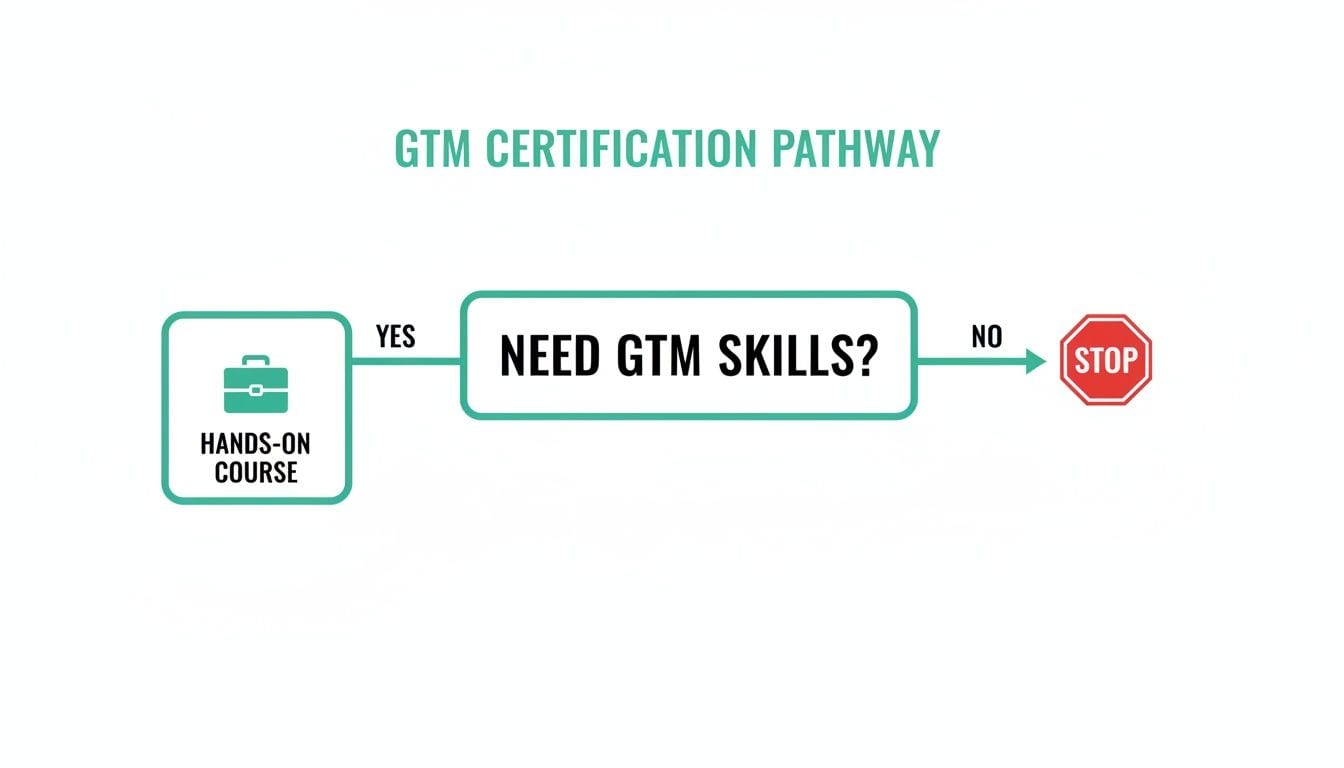
If you need to build professional GTM skills, the most direct route is a dedicated, hands-on course. This path bypasses purely theoretical learning and gets you into the tool right away.
Top-Tier GTM Courses for Every Skill Level
To help you sort through the options, we’ve grouped the best GTM courses by skill level and focus.
1. Foundational and Beginner Courses
When you're just starting, the goal is to build a rock-solid foundation. These courses zero in on GTM's core components: tags, triggers, variables, and setting up basic GA4 event tracking.
- Analytics Mania - GTM Masterclass for Beginners: Widely considered the gold standard for anyone new to GTM, this course offers a clear, logical path from zero to hero. It really shines in teaching you how to create reliable tracking workflows you can actually trust.
- Loves Data - Google Tag Manager Course: This program is fantastic for its straightforward, well-paced lessons that cover GA4 setup and data layer fundamentals. It’s a great fit for learners who want to start applying what they learn immediately.
2. Intermediate and Advanced Courses
Once you've got the basics down, it’s time to master more complex setups and concepts. These courses get into the weeds of custom templates, advanced debugging, and sophisticated tracking strategies.
- CXL - Google Tag Manager Courses: CXL provides a full learning path with both beginner and advanced tracks taught by respected industry leaders. It’s the perfect choice for anyone wanting a deep, skill-focused curriculum that covers everything from tag architecture to the GTM API.
A critical skill you'll build at this level is preventing data loss. Misconfigurations are incredibly common, and advanced training gives you the tools to spot and fix issues that cause 40-50% of data to be lost—a figure that pops up all too often in global martech audits.
3. Specialized Server-Side GTM Courses
Server-side tagging is the future of data collection, bringing with it better data accuracy and privacy compliance. These courses are designed for professionals looking to specialize in this high-demand skill.
- Stape Academy - Server-Side GTM Training: Stape offers a free, practical course that’s all about server-side GTM. You’ll learn how to set up a tagging server and send data to destinations like GA4 and Meta, sidestepping many of the limitations of browser-side tracking.
- Simmer (by Simo Ahava) - Server-side Tagging Course: Taught by one of the most renowned experts in the GTM world, this course is for those who crave a deep technical understanding of server container architecture. It's an ideal fit for developers and advanced analysts.
A Closer Look at Online Learning Platforms
It’s not just individual experts, either. Major educational platforms are also hosting some seriously valuable GTM courses. Coursera, for example, has emerged as a key player, proving that a quality certification in Google Tag Manager is no longer limited to niche providers.
Platforms like Coursera now offer structured programs, such as the 'Google Tag Manager: Advanced Tracking & Analytics' course. This specific program packs in modules on GA4 and Facebook Pixel integration, custom event tracking, and debugging. It all culminates in a shareable certificate that’s perfect for adding to your LinkedIn profile. You can explore how this course helps build advanced GTM skills on Coursera to see if it’s for you. These platform-based courses are excellent for learners who like a guided path with quizzes and formal credentials.
Core Skills You Will Master In A GTM Certification
A good Google Tag Manager certification isn’t just about getting a piece of paper. It’s about building a practical skill set that turns you into a hands-on problem solver. These courses are designed to move you past the theory and into the real world, focusing on the core skills businesses need to collect accurate, compliant, and actionable data.
You’ll start with the fundamentals—tags, triggers, and variables. But instead of just memorizing definitions, you'll learn to configure them for everyday business scenarios. This means deploying essential third-party tags like the Meta Pixel or Google Ads conversion tags, and setting up precise trigger conditions to control exactly when they should fire.
From Data Layer Theory To Practical Implementation
Any reputable GTM certification will have a heavy focus on the data layer. Think of the data layer as a structured information hub that acts as a vital bridge between your website and Google Tag Manager. You won't just learn what it is; you'll learn how to build one from the ground up.
A classic exercise you'll work through is building a data layer for an e-commerce website. This typically involves:
- Capturing Transaction Data: You'll learn to push
purchaseevent information—includingtransaction_id,value,currency, and item details—into the data layer the moment a customer checks out. - Tracking User Interactions: You’ll get hands-on practice capturing
add_to_cartevents, complete with product names and prices, to better understand what users are doing before a sale. - Structuring Data for GA4: You'll learn to format this information so Google Analytics 4 can easily read it, ensuring your e-commerce reports are both accurate and complete.
This kind of hands-on work takes what often seems like a complex, developer-only task and makes it approachable.
Mastering Container Architecture And Debugging
Modern GTM skills go beyond just the client-side container. A quality certification will introduce you to different container architectures, especially the increasingly important world of server-side tagging. While a web container runs in the user's browser, a server container operates on your own cloud server, giving you far more control over your data. You can learn more by checking out our guide on the Google Tag Manager server-side setup.
Quality assurance is another cornerstone skill. You'll master GTM's Preview mode, using it to debug your setups, verify that tags are firing correctly, and confirm that the right data is being sent to your analytics platforms before you publish any changes.
This demand for certified professionals is a direct reflection of major industry shifts. The growth in GTM course enrollments has followed the martech boom, with platforms listing top-rated courses that certify users in data layers, event tracking, and tag deployment. This was largely fueled by the GA4 mandate and privacy changes, which impacted an estimated 30-40% of global ad tracking and forced countless professionals to upskill. You can discover more insights about these GTM certification trends and see how the market has evolved.
Ultimately, finishing a GTM certification provides you with a versatile toolkit. You’ll be able to confidently implement custom GA4 event tracking, deploy marketing pixels, build resilient data layers, and troubleshoot issues with precision, making you a valuable asset for any data-driven team.
Accelerate Your GTM Skills With Trackingplan

While a great Google Tag Manager certification teaches you the theory, you still need to see how it all works in a live environment. This is where you bridge the gap between textbook exercises and real-world mastery, turning what you’ve learned into confident practice. Trackingplan gives you the visibility to seriously level up your practical GTM skills.
Let's say you just finished a module on implementing a custom data layer. In a typical course, you’d test it in a controlled sandbox. But with Trackingplan, you can deploy that new data layer in a live or staging environment and get immediate, real-world feedback on your work.
This creates a powerful learning loop. You won't have to guess if your implementation is working correctly—you’ll know right away.
Validate Your Implementations Instantly
As you put your new certification skills to use, Trackingplan becomes your automated QA partner. It works behind the scenes, continuously discovering and monitoring your entire analytics setup, from the data layer all the way to its final destination.
This means you can immediately:
- Spot missing variables: Did you forget to include the
item_brandproperty in anadd_to_cartevent? Trackingplan will flag it for you. - Catch schema errors: If your data layer structure doesn’t match what was planned, you'll get an instant alert.
- Validate data types: It ensures a
priceproperty is sent as a number instead of a string, preventing reporting headaches down the line.
By automatically validating your work, you reinforce good habits and build the muscle memory needed for deploying flawless tracking. The video above shows exactly how you can validate your GTM data layer with Trackingplan.
Think of it as having an expert QA analyst looking over your shoulder 24/7. It gives you the confidence to experiment and apply more advanced techniques, knowing any mistake will be caught before it pollutes your analytics data.
From Learning Theory To Building Trust
A GTM certification proves you understand the principles of solid tracking. Using a tool like Trackingplan in your workflow proves you can execute those principles perfectly. This automated oversight helps you master the skills needed to prevent common but costly data issues.
The platform continuously monitors for problems such as:
- Broken Pixels: Get alerted the moment a critical marketing pixel from Meta or Google Ads stops firing on key pages.
- Rogue Events: Discover unauthorized or unexpected events that could be skewing your data and throwing off your reports.
- PII Leaks: Receive warnings if Personally Identifiable Information is accidentally exposed in your tracking calls, helping you maintain compliance.
This level of automated governance is essential for any serious GTM professional. It allows you to move beyond the basics of tag deployment and focus on building a data ecosystem your entire organization can actually trust. If you're interested in a deeper dive, you can learn more about enhancing data observability with Trackingplan and Google Tag Manager.
By combining the structured knowledge from a certification with the real-time validation of an observability platform, you’ll fast-track your journey from a student to an indispensable GTM expert.
Frequently Asked Questions About GTM Certification
When you start looking into GTM training, a few questions always come up. Here are some straightforward answers to help you figure out the best path forward for getting a Google Tag Manager certification.
How Much Does A Google Tag Manager Certification Cost In 2026?
Since Google doesn't offer an official certification, the cost really depends on who you learn from. The price tag is a direct reflection of how deep the course goes, its format, and the instructor's reputation in the analytics community.
Generally, you’ll find costs in these two buckets:
- Specialized Courses: Programs from well-respected names like Analytics Mania or Stape Academy usually fall between $299 and $499. These are laser-focused on specific skills, like GTM fundamentals or advanced server-side tagging.
- Comprehensive Subscriptions: If you're looking for an all-in-one package, subscriptions like those from CXL can run over $1,499 per year. These bundle GTM with a whole library of other advanced marketing and analytics courses.
How Long Does It Take To Get Certified In Google Tag Manager?
The time you'll need to invest comes down to the course's depth and what you already know. Most programs are self-paced, so you can fit the learning around your own schedule.
Here’s a rough idea of the timeline:
- Foundational Courses: If you’re building from the ground up, you can often knock out a beginner-focused masterclass in a solid weekend (8-10 hours of study).
- Advanced or Server-Side Courses: For the more comprehensive stuff covering complex setups or server-side GTM, set aside 20-40 hours for both learning and hands-on practice.
Is A GTM Certification Worth It For My Career?
Absolutely. While you won't get a badge directly from Google, a certification from a reputable provider sends a powerful message to employers. It proves you have practical, sought-after skills that go way beyond just knowing the theory.
A certification shows you can confidently tackle complex tracking implementations, guarantee data accuracy, and solve the kind of real-world problems businesses face every day. This expertise can open doors to higher-paying, more senior roles in digital analytics, performance marketing, and technical SEO, making it a smart investment in your career.
Can I Learn GTM For Free Without A Certification?
Yes, you can definitely teach yourself the basics of GTM without paying a dime. Resources like Google's own documentation, industry blogs, and countless YouTube tutorials offer a ton of information to get you started. The catch is that this route demands a lot of self-discipline and can feel pretty fragmented.
A paid certification course offers a structured learning path, hands-on projects to build your skills, access to expert support, and a credential you can actually verify. This guided approach is much more efficient for mastering GTM at a professional level and is what we recommend for anyone serious about using it in their career.
When you combine the knowledge from a certification with automated QA, you build a truly resilient analytics practice. Trackingplan gives you the real-time visibility and validation needed to ensure your GTM implementations are always accurate and trustworthy. Start a free trial today to see what's really happening with your data.