Trackingplan

fig. gantt

For developers

Your QA engineer for the dataLayer, the SDKs and every release.

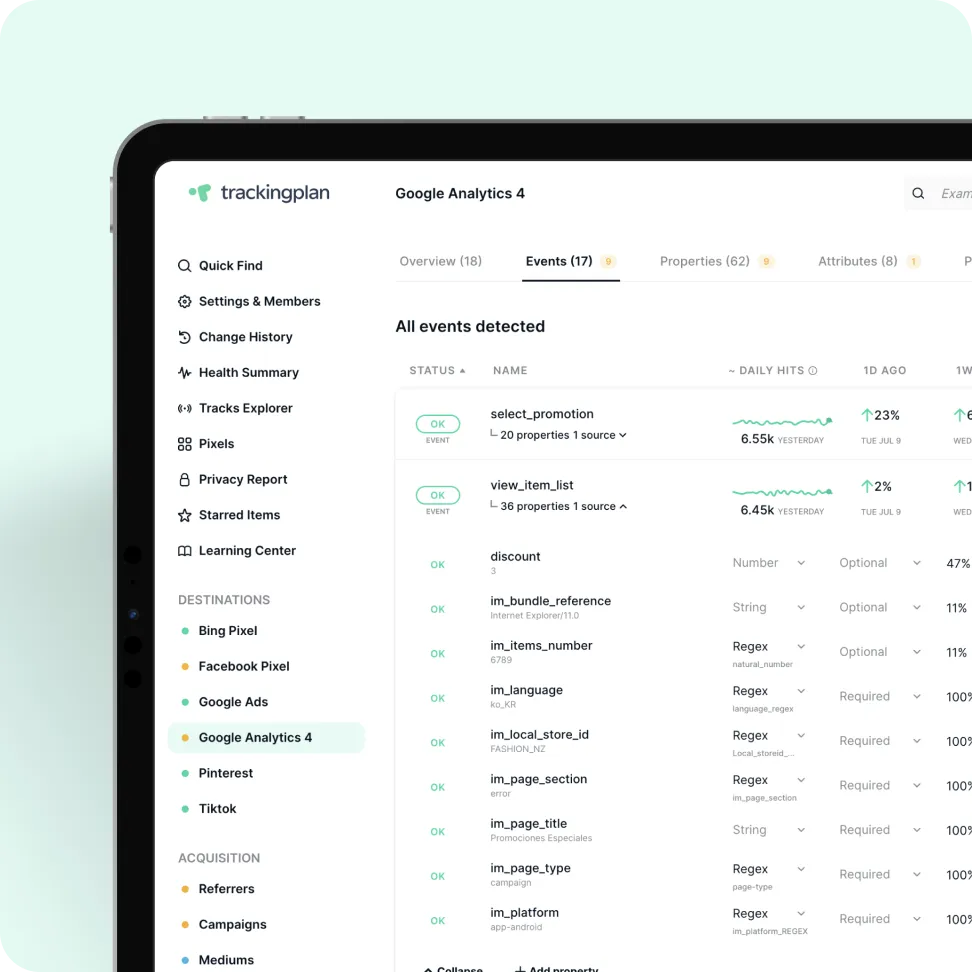
Every push to production gets reviewed. Trackingplan sees every hit and tells you what the schema actually looks like in the wild — casing duplicates, missing keys, orphan events, dead pushes — with the offending hits and the change that caused them.

Start asking your data Book a demo

Ask it

Every release, reviewed

The agent works from your real traffic, investigates before it answers, and shows the evidence. Two threads a developer would open here.

Thread
Trackingplandemo workspace
You · Developer

Review the dataLayer and the main events — tell me if you see any implementation problem.

inspect_datalayer · 24h · web, ios, androidschema_diff · vs last week
Trackingplan

Overall healthy: 31 events, two problems worth fixing.

1 · purchase.value arrives as a string (“129.90”) on the new checkout — GA4 accepts it, Google Ads doesn’t count it.
2 · view_item is missing item_category on 18% of Android hits since SDK 3.1.

The dataLayer itself is consistent: same event names and property types across web, iOS and Android, no duplicates, consent state present on 100% of hits.

31 events · 2 issues · 3 platforms consistent
Continue this thread with the agentSend
Another thread
Trackingplandemo workspace
You · Developer

Did the last release drop any parameter on checkout?

compare_releases · v94 → v95 · checkout*query_property_coverage · 48h
Trackingplan

One. Release v95 (yesterday 17:02) dropped coupon from checkout_step on web — coverage went from 41% to 0% in the same minute. begin_checkout, add_payment_info and purchase are unchanged.

Cause: the variable DL – coupon now points to ecommerce.coupon_code, which the checkout doesn’t set.

v95 · checkout_step · coupon 41% → 0%
Continue this thread with the agentSend

AI at the core

Analytics intelligence that never sleeps

Replace manual QA workflows with specialized AI agents automating every stage of analytics quality, from discovery to governance.

In the product

What it does for your releases

Book a demo

Let’s see if we’re a match, data-style.

This isn’t a sales call. It’s a chance to understand what matters most to you, discuss any data quality concerns you may have, and share practical ways Trackingplan could support your goals, if it makes sense.

FAQ

Some answers before the answers.

?How long does it take for Trackingplan to work?
tp

Trackingplan starts monitoring your data in real time immediately after installation — no lengthy setup, no code changes to your existing tracking. Depending on your traffic volume, your dashboard can be ready in as little as one hour. For lower-traffic sites, it may take up to a week. You will receive an email notification as soon as enough data has been collected and your dashboard is ready.

?Will Trackingplan affect my site's visitor experience or performance?
tp

Not at all. Trackingplan is designed to have a minimal impact on your site. Our lightweight tag, only 10kb in size, has no significant effect on page load times. Additionally, our SDKs are optimized to ensure that your app's performance remains unaffected.The Trackingplan tag loads asynchronously with the page content, responding in less than 500ms.

This means that it won't slow down your site's loading speed. Furthermore, once the configuration is stored in the browser cache, it won't be reloaded during subsequent page views for a period of 24 hours.With Trackingplan, you can gather the data you need without compromising the visitor experience or your site's performance.

?What are the problems Trackingplan will notify me about?
tp

Trackingplan automatically detects and alerts you about missing or dropped events, unexpected traffic drops or spikes, property type mismatches (e.g. a string where a number is expected), naming convention violations in events and UTMs, broken pixels (Meta, TikTok, Google Ads), consent and PII leaks, schema changes introduced by third-party tools, and regressions between releases. All monitoring runs continuously 24/7 in the background, with no manual checks required.

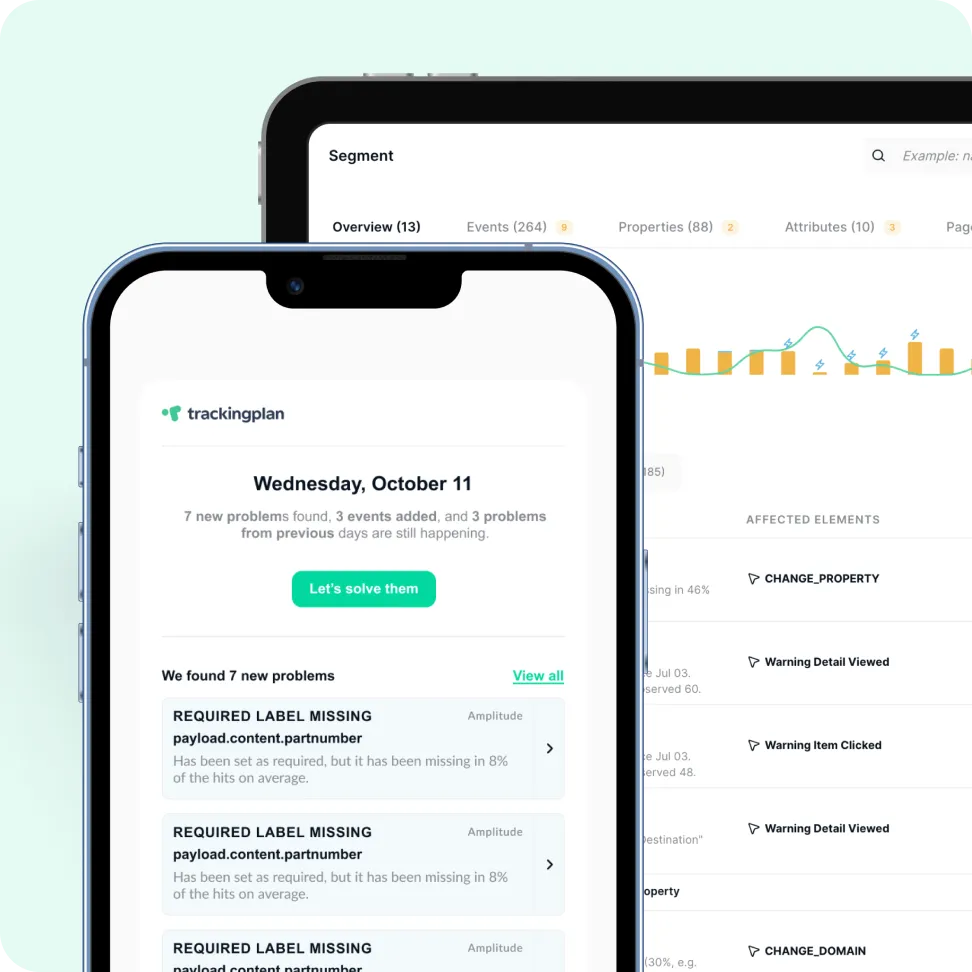
Moreover, Trackingplan's Digests will notify your team with all you need to know about the state of your data at the beginning of your work day so that you can work on what you do best instead of having to find those errors by yourself.

?How does Trackingplan's AI Debugger identify the root cause of analytics errors?
tp

When Trackingplan detects an anomaly, its AI debugging engine analyzes the affected events, properties, and context to automatically pinpoint the root cause. Instead of a generic alert, you get a structured diagnosis: a plain-language summary of the issue, the most likely root cause hypothesis, recommended actions to fix it, and the conditions under which it occurs - with sample hits to reproduce the problem.

What makes this especially powerful is the Potential Impact analysis. Rather than framing issues as purely technical, Trackingplan estimates the business consequences of leaving them unresolved - such as the effect on ROAS, conversion tracking, campaign attribution, or data reliability. This makes it significantly easier to prioritize fixes and communicate their value to stakeholders, clients, or leadership.

?How do I know if Trackingplan is for me?
tp

Trackingplan is built for digital analysts, developers, and marketing teams who deal with data quality issues. If your team spends time manually auditing tracking implementations, debugging broken events, or discovering data errors after they have already affected reports or ad spend, Trackingplan automates that entire process. It detects errors in real time, so you can focus on insights, not data firefighting. You can get started for free with no credit card required.

?Is there any free trial?
tp

Yes. The Growth plan includes a 14-day free trial with no credit card required. For Enterprise plans, a free Proof of Concept (PoC) period is also available so you can evaluate the solution against your specific business needs before committing.

?How do I get started?
tp

Getting started with Trackingplan takes three simple steps:

1. Create a free account to generate your Trackingplan snippet. Install it via Google Tag Manager, by adding a lightweight code snippet to your site's head section, or via iOS and Android SDKs for apps — no code changes to your existing tracking required.

2. Trackingplan automatically starts discovering and documenting all analytics traffic sent to your integrations. No manual configuration needed.

3. Once your dashboard is ready, explore all events, pixels, UTMs, and campaigns automatically discovered. Invite your team, customize your alerts, and start resolving the issues Trackingplan has already spotted.

More of Trackingplan