
Poor data quality costs organizations an average of $12.9 million annually, and poor data accounts for 12% of total corporate revenue loss globally. In analytics teams, that loss rarely starts with a dramatic system failure. It usually starts with ordinary mistakes: a missing purchase event after a checkout redesign, inconsistent UTM values across campaigns, or a schema mismatch that breaks a dashboard.
A growth team might launch paid campaigns on Monday, review results on Wednesday, and only discover on Friday that one pixel stopped firing on Safari, the app SDK sent a different property name than the website, and server-side events duplicated conversions. Nobody intended to create bad data. The problem is that numerous teams still treat quality as something to inspect after collection instead of something to govern before, during, and after implementation.
That's why data quality governance belongs in the core operating model of analytics, not in a dusty policy document. If you want a useful primer on the engineering side that supports trustworthy pipelines, a guide to data engineering's true impact is a good companion read. For a broader business view of governance in analytics programs, Trackingplan's overview of data governance adds helpful context.
Introduction to Data Quality Governance
Data quality governance is the system a company uses to define what good data looks like, who owns it, how it gets checked, and what happens when it fails those checks. In analytics, that means governing event names, parameter formats, consent handling, destination mappings, and the logic that connects browser, app, and server-side tracking.
Teams often confuse governance with bureaucracy. They picture approvals, committees, and blocked launches. In practice, good governance does the opposite. It reduces avoidable rework because people stop debating basics like whether add_to_cart, AddToCart, and cart_add are the same event.
Good governance doesn't slow analytics down. It removes the ambiguity that slows teams down.
For digital teams, the stakes are practical. If campaign tags are inconsistent, attribution goes soft. If required fields are empty, audiences break. If event structures drift between environments, BI teams waste time reconciling reports instead of using them.
A working governance model gives analysts, marketers, developers, and QA teams one shared answer to a simple question: can we trust this data enough to act on it?
Understanding Data Quality Governance Concepts
A useful way to think about data quality governance is to compare it to quality control in manufacturing. A factory doesn't wait until the final product is boxed to discover that a key component is missing or the wrong size. It defines standards first, checks parts during production, and rejects defects before they move downstream.
Analytics should work the same way.
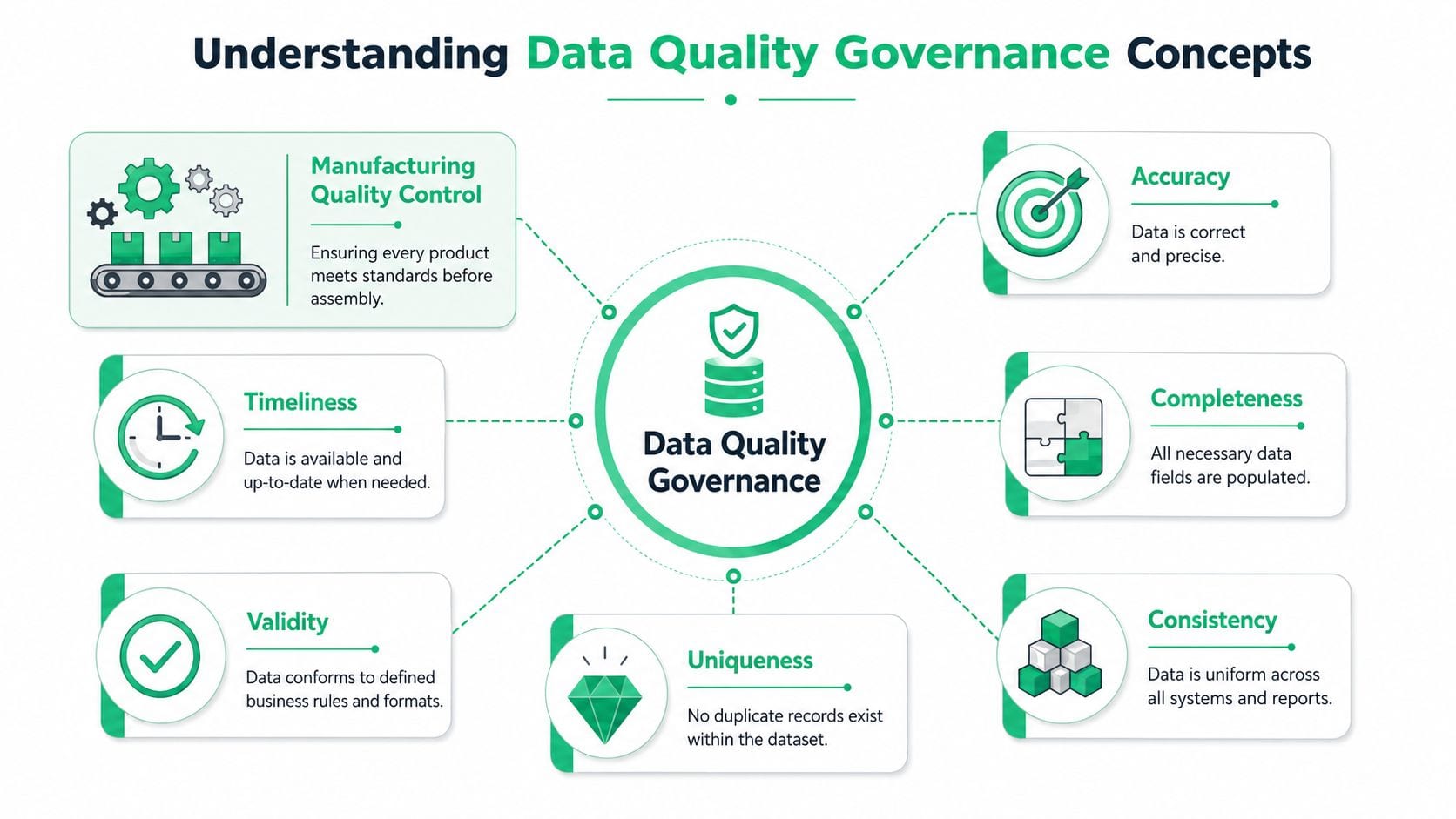
The dimensions that matter most
Several data quality dimensions come up repeatedly in analytics work. Trackingplan's comparison of data governance vs data quality is helpful if your team mixes those terms together.
Here's how the main dimensions show up in day-to-day implementation:
- Accuracy means the data reflects reality. If a purchase event fires before payment is confirmed, the event exists, but it isn't accurate.
- Completeness means required fields are present. A session event without campaign parameters may still arrive, but it won't support campaign analysis well.
- Consistency means values match across systems. If the web team uses
product_idand the app team usesskufor the same concept, reporting becomes messy. - Timeliness means data is available when teams need it. A daily dashboard loses value if yesterday's data lands too late for budget decisions.
- Validity means data follows defined rules. If a country field accepts free text, you'll eventually get mismatched spellings and unusable segmentation.
- Uniqueness means the same event or record isn't sent twice when it should only exist once.
A related set of metrics often used in governance programs includes completeness, accuracy, consistency, integrity, timeliness, validity, and duplicates, as outlined in Alation's guide to data quality metrics.
Governance is more than rules
Rules alone don't create trust. A functional framework also needs operating parts. According to Acceldata's framework for audit-ready compliance, a functional data quality governance framework requires four core components: data policies and standards defining acceptable quality thresholds; clear ownership structures; regular automated auditing procedures; and metadata documentation tracking data origins and transformations.
That last piece often gets overlooked in Martech. Teams may document warehouse tables while leaving the dataLayer, mobile event map, and ad platform pixels only partially defined. That gap is where many analytics issues begin.
Practical rule: If a field matters in a dashboard, it needs a definition before implementation, not after the anomaly appears.
Building a Data Quality Governance Framework and Roles
Governance fails when everybody is involved but nobody is accountable. It also fails when policy lives in slides while implementation lives in browsers, tag managers, SDKs, and release pipelines.
A usable framework connects policy to actual team behavior.
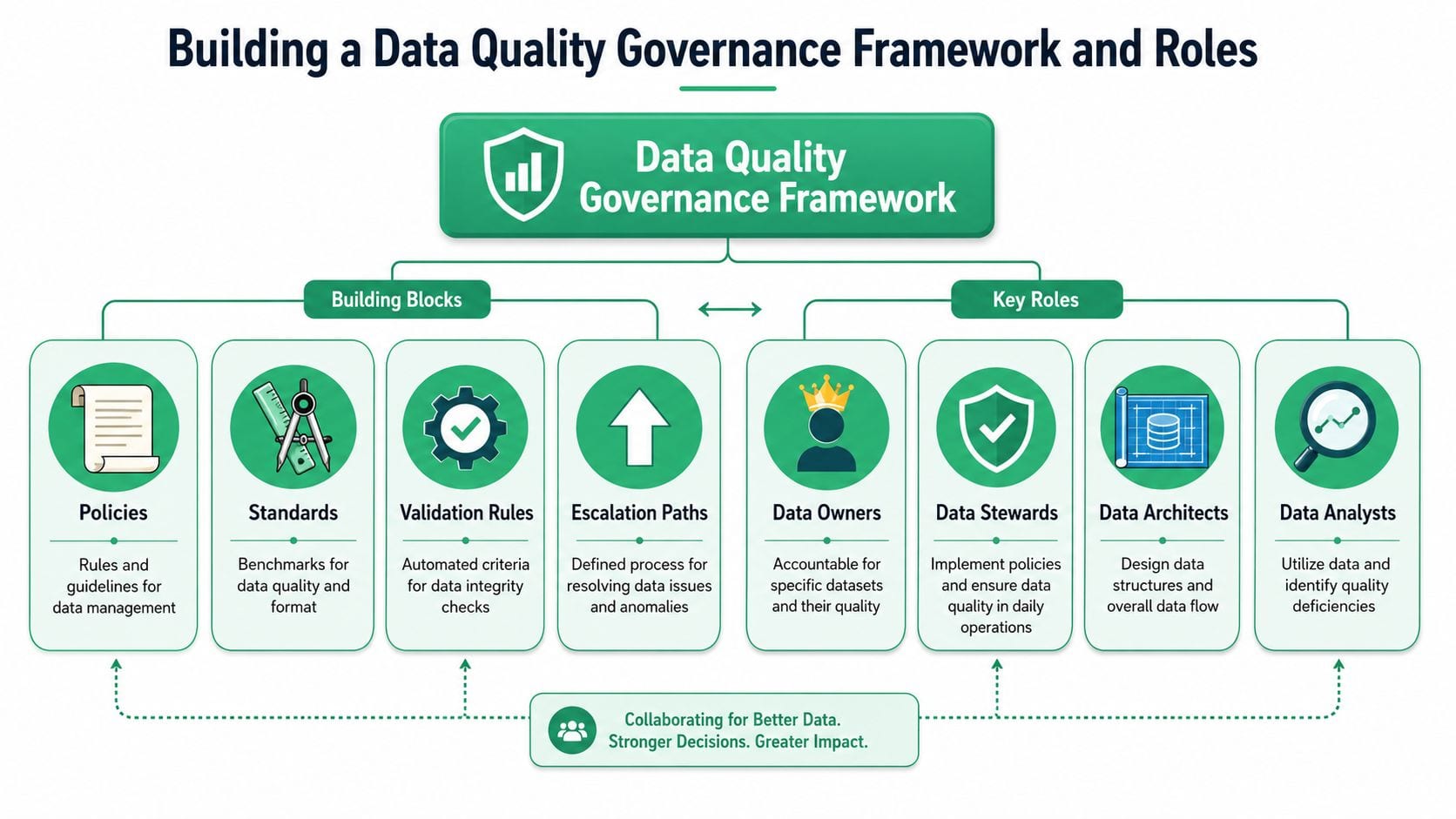
The framework building blocks
At the working level, most analytics teams need four things in place:
| Building block | What it answers | Analytics example |
|---|---|---|
| Policies | What must happen | Purchase events must include currency and value |
| Standards | How data should be formatted | Event names use snake_case and approved verbs |
| Validation rules | How systems check conformance | Reject or alert when utm_source is missing |
| Escalation paths | What happens when something breaks | Route PII leak alerts to analytics lead and privacy owner |
Validation matters most when it happens at the point of entry and before publication. Wisepim's governance guidance emphasizes that validation rules should automatically check data against defined standards for formats, ranges, relationships, and business logic.
The people behind the framework
Titles vary, but responsibilities shouldn't.
- Data owners decide what a dataset or event family is supposed to represent. In a retail brand, the ecommerce lead may own purchase and cart tracking requirements.
- Data stewards maintain standards and coordinate remediation. In a digital agency, this may be the analytics manager who reviews naming conventions across clients.
- Data architects or engineers design flows between collection, transformation, and destinations. They make sure schema updates don't break downstream models.
- Data analysts and marketers are often the first consumers to notice defects. They should report issues, but they shouldn't have to invent the standards they report against.
A common source of friction is the gap between governance owners and analytics consumers. Acceldata's discussion of governance challenges notes that unclear ownership and inconsistent standards create practical problems, especially when central governance and marketing speed collide.
Why ownership pays off
Organizations with mature data governance programs report a 65% improvement in data quality metrics and a 315% ROI over three years, alongside 48% fewer security incidents and 34% faster data retrieval speeds. Those outcomes come from making governance operational, not aspirational.
If your team wants a concise checklist of the structural pieces involved, this explanation of key components in a robust data governance strategy is a practical reference.
In an in-house team, ownership might be simple. One analyst owns implementation specs, one engineer owns collection pipelines, and one marketer approves campaign taxonomy. In an agency environment, ownership needs an extra layer because client stakeholders, media teams, and developers often touch the same signals.
Without explicit responsibility, the same issue gets passed around. With it, broken tracking gets fixed by the right person faster.
Setting KPIs and Measurement Processes
Governance gets ignored when it sounds abstract. It becomes real when teams can measure whether the data is improving, whether policy violations are dropping, and whether operational friction is going down.
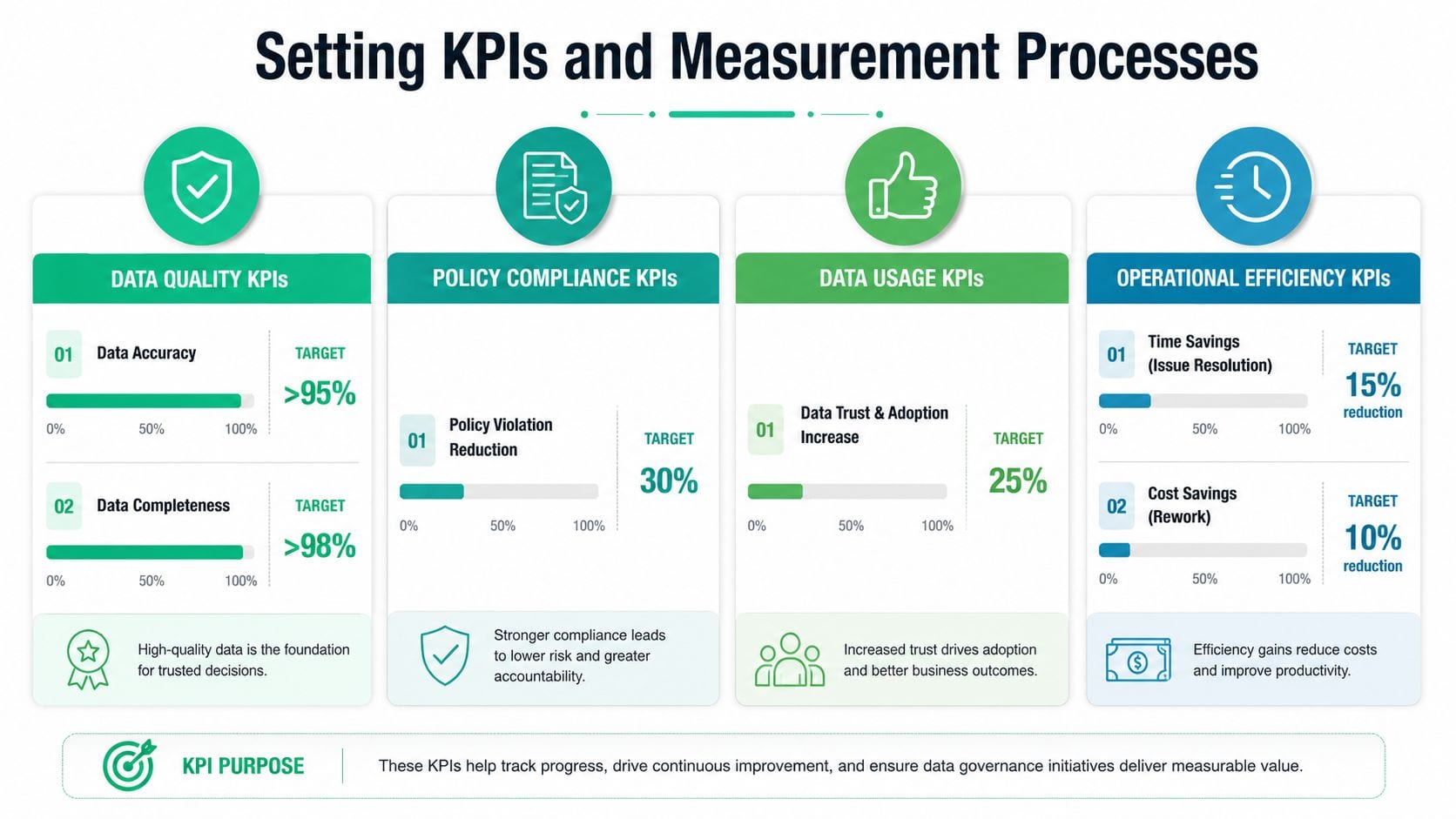
The four KPI categories
Acceldata's guide to measuring governance ROI recommends defining metrics across four key dimensions: data quality, policy compliance, data usage, and operational efficiency. It also recommends that teams start small with three to four key metrics, measure for at least a month to determine their baseline, and then define quantitative goals targeting incremental improvements.
For analytics teams, those categories can translate into questions like these:
- Data quality: Are required event properties present and correctly formatted?
- Policy compliance: How often do teams violate naming conventions or consent rules?
- Data usage: Do stakeholders trust the dashboard enough to use it for decisions?
- Operational efficiency: How long does issue resolution take from detection to fix?
Scrut's breakdown of governance metrics and KPIs makes an important distinction here. KPIs reflect strategic outcomes, while metrics track operational activity. You need both.
What to measure in practice
A small analytics governance scorecard might include:
- Critical field completeness: Track whether required campaign, product, and transaction fields arrive populated.
- Schema conformance: Monitor whether implemented events match the approved tracking plan.
- Issue response time: Measure how quickly teams move from alert to root-cause identification.
- Stakeholder trust signal: Review whether teams rely on the governed dataset for recurring reporting.
If your team spends a lot of time trying to evaluate advertising performance, governance metrics matter more than they first appear. Campaign effectiveness analysis is only as strong as the consistency of campaign tagging, conversion capture, and attribution logic underneath it.
If a marketing team doesn't trust the tags, they won't trust the ROAS report either.
A simple measurement process
You don't need a large committee to get started. You need a routine.
- Choose a narrow scope. Start with one web property, one app flow, or one event family such as ecommerce.
- Define the checks. Required fields, approved values, duplicates, freshness, and routing to destinations.
- Run audits automatically. Daily checks work well for active implementations because they catch drift quickly.
- Review exceptions, not everything. Governance meetings should focus on failures, patterns, owners, and due dates.
Validio's guide to data quality processes emphasizes root cause analysis and actionable reporting. That's the difference between governance theater and governance operations.
Phased Data Quality Governance Implementation Roadmap
Attempting to govern everything at once often leads to failure. A better path is to govern the layer where bad analytics data first enters the system, then expand outward.
That shift-left approach matters because 70% of analytics data issues originate at implementation, as highlighted in this discussion of upstream governance in analytics. In Martech, that implementation layer includes the dataLayer, SDK instrumentation, tag manager logic, consent behavior, and destination-specific pixels.
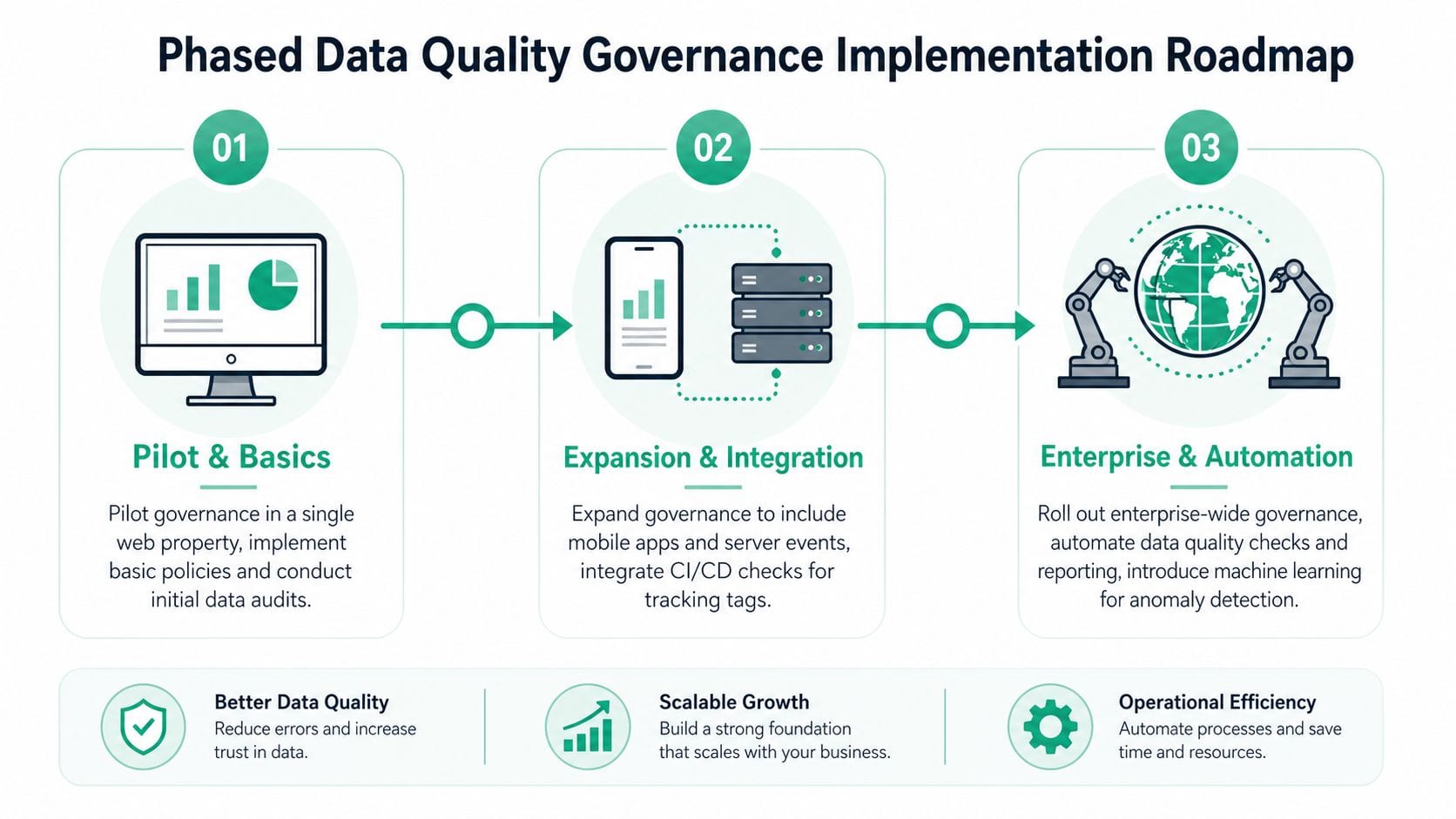
If your team wants a visual walkthrough before formalizing the roadmap, this video from Trackingplan's channel is a useful starting point:
Phase 1 Pilot and basics
Start with a single web property. Pick a scope where business impact is visible, such as lead generation or ecommerce.
Core deliverables should include:
- A lightweight tracking policy covering event naming, required parameters, and consent behavior
- An owner map showing who approves changes and who fixes issues
- Automated baseline checks for missing events, empty critical fields, duplicate fires, and destination mismatches
- A living tracking plan that reflects what is implemented
This phase works best when teams keep the policy short. If the rules require a workshop to understand, launch teams will bypass them.
Phase 2 Expansion and integration
Once the web pilot is stable, bring mobile apps and server-side collection into the same governance model. At this stage, many teams discover that “the same event” isn't really the same across channels.
Use this phase to align:
| Area | Common mismatch | Governance response |
|---|---|---|
| Web vs app | Different property names | Shared schema and versioning |
| Client vs server | Duplicate conversions | Deduplication rule and ownership |
| Campaign tagging | Inconsistent UTMs | Controlled naming standard |
| Consent states | Different enforcement logic | Central validation policy |
At this stage, integrate checks into release processes. A schema change should trigger review before production, not after analysts notice broken reporting.
Phase 3 Shift-left validation in the Martech layer
This is the most important phase for analytics teams. Put governance checks as close to implementation as possible.
That means validating:
- DataLayer structure before developers ship frontend changes
- Pixel behavior before campaigns launch
- SDK payloads before app releases go live
- Consent and privacy settings before data reaches analytics and ad platforms
This phase turns governance into something executable. Instead of asking people to remember standards, you let systems compare real payloads against approved definitions.
The fastest fix is the one that happens before the bad event reaches your warehouse.
ISO 8000-51:2023 supports this mindset by establishing a technical requirement for automated conformance testing of datasets against policy-referenced specifications, described in the ISO 8000-51:2023 standard listing. The useful idea for analytics teams is simple: policy should be testable, not just documented.
Phase 4 Enterprise scale and access control
After the Martech layer is governed reliably, scale the model across business units, brands, and platforms. At this stage, centralized visibility and controlled access become more important.
Databricks' overview of governance platforms highlights four foundational capabilities: automated data quality monitoring, end-to-end lineage visualization, role-based and attribute-based access controls, and integration with existing infrastructure.
For analytics operations, that means teams should know not only that an event is wrong, but also where it originated, who can change it, and which reports or destinations it affects.
Addressing Common Pitfalls and Policy Templates
Many data quality problems start long before anyone opens a dashboard. They begin in the Martech layer, where campaign links are created, tags are configured, and event payloads are pushed into analytics tools. If governance starts only after data lands in the warehouse, teams spend their time cleaning up avoidable mistakes instead of preventing them.
A useful way to frame this is simple. Policy is the rulebook. QA is the referee. Observability gives you the replay system that catches what human review misses.
Teams often assume stronger rules will produce better data. In practice, rules only work when people can follow them during real campaign launches and site releases. A naming standard that looks tidy in a document can still fail in production if marketers need a new UTM value today, an agency ships tags without review, or developers do not know who approves schema changes.
Common mistakes teams make
Several patterns show up again and again:
- Schemas that are strict but hard to use: Teams need standards and a defined request path for new events, parameters, or campaign values.
- Ownership that stops at documentation: If nobody owns the live implementation, defects become meetings instead of fixes.
- Periodic audits instead of continuous checks: A monthly review will not catch the broken pixel from Tuesday's release.
- Tracking plans that drift from production: The document says
signup_completed, while the site sendssign_up_complete. - Policies with no enforcement point in Martech: Rules exist, but they are not tested in tag managers, SDK releases, or campaign QA.
That last issue causes more confusion than teams expect. People hear "governance" and think of a data catalog, warehouse controls, or stewardship committees. Those matter, but analytics quality often breaks earlier. Shift-left governance means putting validation closer to where the data is created, before bad values spread across GA4, Adobe Analytics, Mixpanel, ad platforms, and downstream reports.
Policy snippets teams can actually use
A policy template should read like a checklist a busy team can apply during implementation, not like a legal document.
Event naming convention
- Use lowercase snake_case for custom event names
- Start event names with an action verb where possible
- Reuse approved event names across web, app, and server when the business meaning is the same
- Document the owner for each event family, such as acquisition, checkout, or lead generation
UTM validation rules
- Require
utm_source,utm_medium, andutm_campaignfor paid traffic - Restrict values to approved naming patterns
- Flag unknown, malformed, or retired values for review
- Define who can approve a new value and how quickly that approval should happen
Consent and privacy checks
- Confirm analytics tags respect consent status
- Verify ad pixels do not fire before required consent where applicable
- Check that sensitive fields and possible PII are excluded from payloads
- Record the system owner responsible for fixing violations
Remediation workflow
- Assign an owner for each alert type
- Define severity levels based on business impact
- Set response windows for broken events, missing parameters, and privacy issues
- Log the root cause so the same defect does not reappear under a new campaign or release
The remediation part is where many policies fall apart. A rule without a response path is just documentation. Teams need to know who fixes the issue, how fast they need to act, and whether the problem should block a release, trigger an alert, or create a follow-up task.
The DAMA DMBOK overview from SAP describes governance as a mix of policies, roles, processes, and controls. For analytics teams, the practical lesson is that a naming rule is only one piece. The control matters just as much. In the Martech layer, that control often takes the form of automated validation before and after release.
Turn templates into team behavior
A simple example makes the gap clear. Suppose a paid social team launches a campaign with utm_medium=paid-social, while the approved convention is paid_social. The policy already defines the allowed format. If the rule lives only in a spreadsheet, the mistake reaches analytics, attribution reports split the traffic into two buckets, and someone fixes it after performance data is already messy.
If the same rule is checked continuously in the implementation layer, the issue is caught while it is still small. An observability QA tool such as Trackingplan can compare live payloads against the approved convention, alert the owner, and help teams correct the problem before it spreads across multiple destinations.
That is the shift-left mindset in practice. Write policies that people can use. Attach them to specific owners. Then make the Martech implementation test those rules continuously, so governance becomes part of release QA instead of a cleanup project.
Leveraging Observability Tools for Continuous Governance
Manual governance is fragile because modern analytics implementations change constantly. New landing pages launch. SDK versions shift. Tag manager containers get edited by multiple people. Agencies and internal teams work in parallel. Static documentation can't keep up on its own.
Observability tools help by watching the implementation continuously instead of relying on occasional audits. They can discover events and destinations across web, app, and server-side environments, compare real payloads to expected schemas, and alert teams when something important changes.
One option is Trackingplan's data quality monitoring approach. It continuously discovers dataLayers and pixels, supports custom validations, and alerts teams through channels like Slack or email for issues such as missing events, schema mismatches, UTM convention errors, broken pixels, potential PII leaks, or consent misconfigurations. For teams using Google Analytics, Adobe Analytics, or Mixpanel alongside ad platforms, that matters because the same implementation issue often affects several tools at once.
What continuous governance looks like
A realistic workflow looks like this:
- Detection: A campaign pixel stops firing after a site release.
- Alerting: The analytics owner gets notified quickly instead of waiting for a reporting drop.
- Diagnosis: The team compares current behavior with the last known-good implementation.
- Remediation: A developer or tag manager owner fixes the issue and confirms the event is back.
Continuous governance works best when the tracking plan updates with the implementation, not months later in a shared document.
That's the practical advantage of observability in the Martech layer. It brings governance into the place where errors happen.
Conclusion and Next Steps
Data quality governance works best when teams treat the Martech layer as the front door, not the cleanup room. That is the lasting shift. Quality improves fastest when the first checks happen where tags fire, payloads change, consent gets applied, and campaign parameters enter the system.
A good way to remember it is simple: you do not improve a factory by inspecting only the boxes at the loading dock. You improve it by catching defects on the assembly line. Analytics data follows the same pattern. If governance starts only after dashboards look wrong, the business is already working with damaged inputs. If governance starts earlier, teams can catch implementation mistakes before they spread into attribution, experimentation, audience building, and reporting.
That changes the role of governance. It stops being a policy exercise that lives in a document and becomes an operating habit tied to releases, QA, and change management.
For the next step, keep the scope narrow. Pick one journey that matters, such as lead submission, checkout, or paid campaign landing pages. Define what "correct" looks like, add automated checks in the Martech layer, and assign one owner to review alerts and close the loop with developers or tag managers. A small, working system teaches more than a large policy deck.
If you want to put this into practice, Trackingplan offers a factual, lightweight way to monitor analytics implementations across web, apps, and server-side environments, detect issues continuously, and keep tracking plans aligned with what is shipping.