
A dashboard looked solid on Monday. By Wednesday, the paid media team had paused the wrong campaigns, the product team was challenging conversion drops that never happened, and the analyst was tracing the issue back to a renamed event, broken UTMs, and a pixel that stopped firing after a release.
That sequence is common because most analytics problems don't come from one dramatic failure. They come from a mismatch between how data should be collected and used and what lands in the stack. In practice, that's the difference between governance and quality.
For digital analysts and marketers, this isn't a theoretical debate. It shows up in GA4 events, Adobe variables, Segment mappings, consent flags, campaign naming, server-side forwarding, and the daily question every stakeholder asks before acting on a report: can we trust this?
The Hidden Conflict Behind Every Broken Dashboard
A familiar pattern plays out in marketing teams. Someone spots a sudden improvement in ROAS, another person questions whether attribution changed, and within minutes the meeting turns into a forensic review of tags, channel groupings, landing pages, and missing events. Nobody is arguing about strategy anymore. They're arguing about whether the numbers are real.
That usually gets labeled as a tracking bug. Often it isn't just that.
The deeper problem is that two separate disciplines got split apart. One team treated data governance as a policy topic for leadership. Another treated data quality as cleanup work for analysts and engineers. The result is predictable. People write rules in one place, break them in another, and discover the damage only after it reaches the dashboard.
A global IDC survey found that 42% of organizations cite a lack of data governance as the primary barrier to trusting their data, while 37% named poor data quality as the main obstacle to leveraging analytics, according to the IDC survey summary. Those two numbers explain why broken dashboards keep surfacing in teams that already have smart analysts, decent tools, and plenty of reporting.
What this looks like in a Martech stack
In digital analytics, the conflict is easy to recognize:
- Campaign teams use different UTM conventions, so acquisition reports fragment traffic into dozens of near-duplicate values.
- Developers rename or remove properties during releases, so downstream reports stop matching historical logic.
- Pixels fire inconsistently across pages or consent states, which distorts attribution and audience building.
- Analysts patch reports manually, which makes this week's deck usable but leaves the root cause untouched.
Trust breaks long before a dashboard goes blank. It breaks the moment a team starts second-guessing every chart.
If that sounds familiar, it's worth reviewing the practical warning signs in these signs your analytics is broken. Organizations often recognize several of them immediately.
Why this matters to business decisions
When governance and quality drift apart, every downstream activity gets harder. Budget allocation slows down. Experiment readouts become debates. Agency reporting takes longer because someone has to explain anomalies that should never have made it into production.
That's why the main question isn't data governance vs data quality as if one should win. The useful question is which job each one does, and how they work together inside the analytics stack you already run.
Data Governance and Data Quality Defined
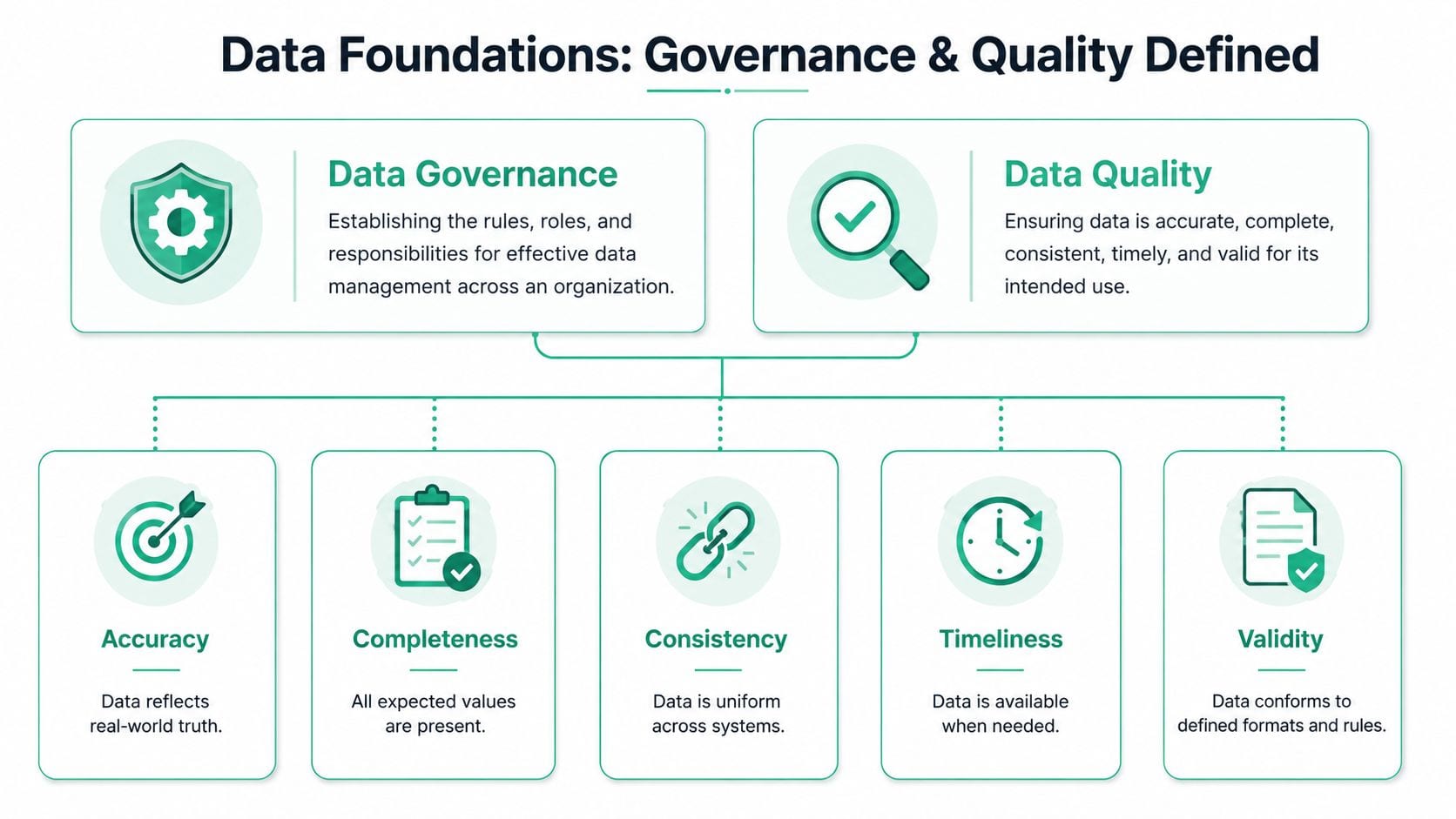
The cleanest way to separate these terms is simple. Governance is the rulebook. Quality is the scorecard. One sets expectations. The other measures whether the data meets them.
The DAMA Dictionary of Data Management formally defines data governance as “the exercise of authority, control, and shared decision making over the management of data assets,” while data quality is “the degree to which data is accurate, complete, timely, and consistent with all requirements and business rules,” as summarized in this DAMA-based explanation.
Governance is the operating model
In a digital analytics environment, governance answers questions like these:
- Who owns the event taxonomy?
- Which team approves new tracking requests?
- What counts as acceptable UTM structure?
- Where is PII prohibited?
- How is consent status passed to analytics and ad platforms?
- Which destinations are allowed to receive which fields?
Those are governance decisions because they define authority, standards, and accountability. They tell teams what the rules are before anyone opens Google Tag Manager, writes a dataLayer spec, or updates a warehouse model.
A strong practical starting point is to treat your tracking plan as a living governance artifact, not just implementation notes. That idea is explored further in this guide to what data governance is and why you need it.
Quality is the lived outcome
Data quality shows up in the evidence:
- Are required event properties present?
- Are timestamps arriving when expected?
- Do campaign tags match the agreed taxonomy?
- Are purchase events duplicated?
- Do web, app, and server-side payloads stay consistent?
- Are consent flags and user identifiers valid for the rules in place?
A useful way to think about quality in analytics is through dimensions such as accuracy, completeness, reliability, consistency, and timeliness, with measurable thresholds and issue-resolution workflows, as described in this overview of data quality dimensions.
Governance says, “all paid traffic must use standardized campaign tags.” Quality tells you whether that's actually happening today.
Why teams confuse the two
Teams often call everything “data quality” because quality problems are visible. Broken dashboards, null fields, rogue events, and bad channel labels all hurt immediately. Governance feels slower because it lives in decisions, approvals, roles, and standards.
But quality without governance is just inspection. Governance without quality is paperwork. In digital analytics, you need both because the stack changes constantly. New pages launch, tags get edited, apps update, agencies publish campaigns, and connectors move data downstream whether your standards were followed or not.
A Side by Side Comparison
The fastest way to understand data governance vs data quality is to compare what each one is responsible for. They overlap, but they don't do the same job.
| Criterion | Data Governance | Data Quality |
|---|---|---|
| Scope | Strategic and organizational. It defines how data should be managed across teams, tools, and lifecycle stages. | Operational and measurable. It evaluates whether the data currently meets expectations in systems and reports. |
| Primary goal | Establish authority, ownership, policies, and standards. | Confirm that data is fit for use in analysis, activation, and decision-making. |
| Key stakeholders | Leaders, data stewards, governance committees, legal, privacy, analytics owners. | Analysts, engineers, QA teams, implementation specialists, channel managers. |
| Core processes | Policy setting, ownership assignment, access decisions, taxonomy approval, change management. | Profiling, validation, anomaly detection, cleansing, issue triage, monitoring. |
| Key metrics | Policy adherence, ownership coverage, control adoption, documented standards. | Error rates, missing values, duplicate events, schema mismatches, timeliness failures. |
| Typical Martech example | Defining the canonical list of event names and campaign conventions. | Detecting that a release introduced Checkout_Complete instead of checkout_completed. |
| Failure mode | Teams don't know the rules, or different teams follow different rules. | Teams know the rules, but bad data still gets through because nobody is checking. |
Strategy versus execution
Governance decides what “good” means. Quality checks whether reality matches it.
That distinction matters in daily analytics work. If your organization hasn't decided which parameters are mandatory on a conversion event, analysts can't consistently audit completeness. If nobody owns a naming standard for campaigns, quality checks will only expose chaos that was never prevented.
Different owners, shared responsibility
Data governance frameworks establish roles like data stewards and governance committees, which define policies and maintain integrity across the data lifecycle, according to this explanation of governance roles. In digital teams, those roles don't always carry formal titles, but the responsibilities still exist.
That usually looks like this in practice:
- Marketing ops or analytics leads own naming standards and implementation requirements.
- Developers and tag managers control what gets deployed.
- Privacy or legal teams define restrictions around consent and PII.
- Analysts and QA teams detect when incoming data fails the agreed rules.
What each discipline should produce
Governance should leave you with clear artifacts:
- A tracking taxonomy
- A campaign tagging standard
- Rules for identity and consent handling
- Named owners for core data domains
- A change process for new events and vendors
Quality should leave you with evidence and action:
- Validation results
- Exception logs
- Issue severity
- Root-cause tracing
- A record of fixes and recurring failures
When teams compare data governance vs data quality as if one is more important, they usually have pain in one area and neglect in the other. The better approach is to ask a sharper question: are the rules clear, and are we measuring compliance with them continuously?
How Governance and Quality Create a Virtuous Cycle
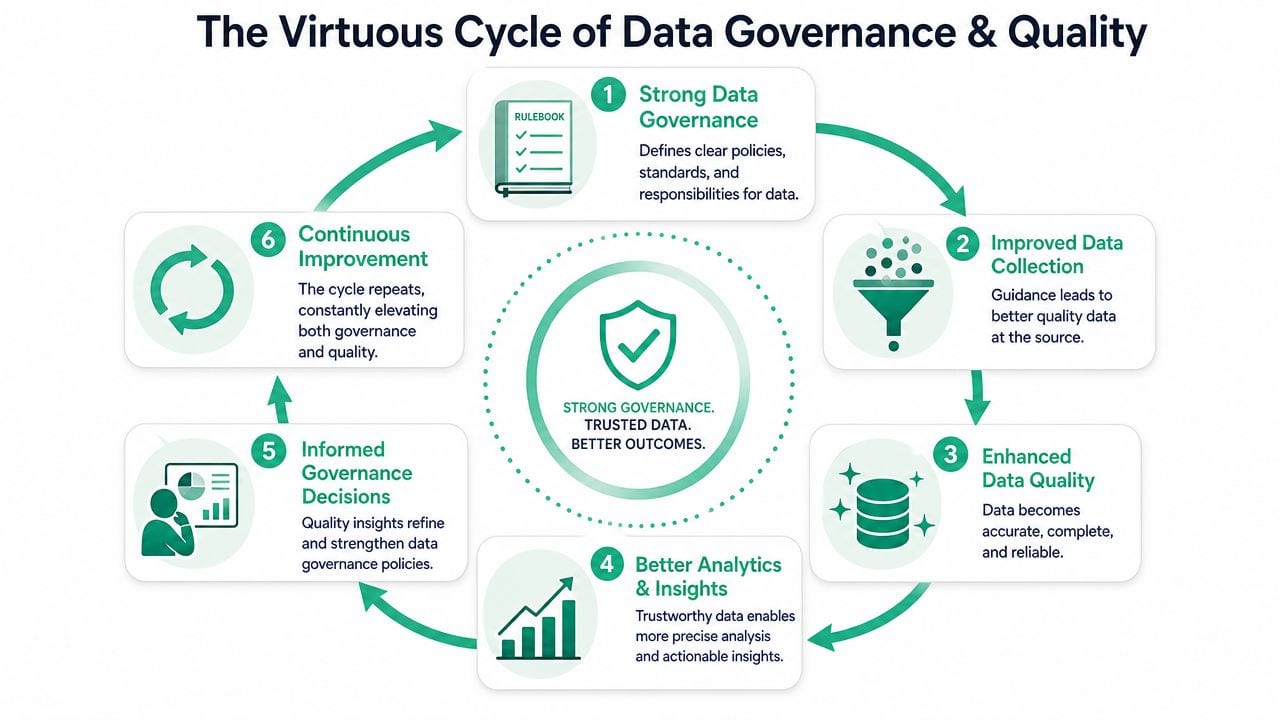
The strongest analytics teams don't treat governance as a document and quality as a cleanup queue. They treat them as a loop.
A practical example starts with campaign tagging. Governance defines the convention. It might specify source, medium, campaign naming, casing, approved values, and who can create exceptions. Quality then checks live traffic against those rules. Once the team sees where noncompliant UTMs are entering the stack, they can fix templates, retrain channel owners, and close the issue at the source.
Rules become measurable controls
At this point, the relationship gets productive. Governance by itself tells people what should happen. Quality by itself tells people what did happen. Put them together, and you get feedback that can improve both.
A benchmark study found that organizations embedding data quality rules directly into governance policies saw trust in analytic outputs rise from 34% to 61% over a 24-month period, as noted in this benchmark summary. That result is useful because it reflects a real operational pattern. Quality checks work better when they are derived from agreed policy, not improvised after data breaks.
What the flywheel looks like in analytics
A practical cycle usually follows this pattern:
Set a standard
The team defines acceptable event names, property formats, and campaign tags.Instrument checks
Validations flag missing parameters, schema drift, consent mismatches, or rogue pixels.Review exceptions
Analysts and implementers triage failures by business impact, not by noise.Fix the source
Teams update templates, code, tag rules, release processes, or vendor configurations.Refine the policy
If the rule was unclear or unrealistic, governance gets adjusted.
Good governance gives quality checks context. Good quality monitoring gives governance proof.
For teams that want to operationalize that loop, a practical next step is to work from governance rules directly into validations and monitoring. The checklist in these data quality best practices is useful because it pushes teams away from one-off cleanup and toward repeatable controls.
Why the cycle matters
Without the loop, governance becomes stale and quality becomes reactive. With the loop, standards improve because they're tested in production, and production gets cleaner because people can see where standards fail. That's the shift from policy to operational trust.
Common Pitfalls and Real World Examples
Many teams don't fail because they chose the wrong concept. They fail because they overinvest in one side and assume the other will take care of itself.
Governance without quality
A company has a polished tracking specification, approval workflows, ownership charts, and a naming standard nobody can argue with. The document is complete. The implementation isn't.
Developers ship updates without validation. Paid teams launch campaigns from spreadsheets with copied UTMs. A new consent banner changes behavior in one region, but nobody checks the downstream impact on analytics or ad pixels. On paper, governance exists. In production, nobody is measuring whether reality still matches it.
That's policy theater. The organization feels controlled because the rules are documented, but dashboards keep breaking.

Quality without governance
Another team has the opposite habit. Analysts are vigilant. They catch bad event names, fix inconsistent dimensions in Looker or Power BI, maintain custom channel mappings, and keep a running list of tag issues in Jira or spreadsheets.
The work is real, and it's exhausting.
Every week, someone cleans incoming data because there's no stable agreement on what should be collected, which fields are mandatory, who approves new naming, or what to do when an agency introduces new tagging conventions. Problems keep returning because no policy, ownership, or change process exists upstream.
If your analysts spend their week normalizing campaign names by hand, you don't have a data quality program. You have a recurring rescue operation.
The hidden cost in digital teams
Both failure modes create the same business symptoms:
- Reporting delays because no one trusts first-pass numbers
- Attribution disputes because tracking behavior changes unnoticed
- Manual rework in spreadsheets, BI layers, and ad platform reconciliations
- Cross-team friction because nobody agrees on ownership
In the Martech stack, this gets worse as complexity rises. Web and app tracking diverge. Server-side forwarding introduces another layer. Agencies touch paid metadata. Product releases alter event schemas. Privacy rules shape what can be collected and where it can go.
The fix isn't bigger documentation or more heroic cleanup. It's tighter alignment. Teams need clear rules that are enforced in the flow of data collection, not discovered after the board deck is already built.
Aligning Governance and Quality with Analytics Observability
Digital teams need a working model that fits how analytics is managed. That means releases happen often, vendors change, campaigns launch fast, and very few people have time for manual audits.
A useful operating model starts by turning governance into testable controls. Research on governance maturity shows that companies with defined governance policies and automated monitoring controls are 2 to 3 times more likely to report their data as fit for purpose for analytics, with technical controls leading to a 15 to 30% improvement in data completeness and consistency, according to this research summary on governance maturity and technical controls.
Near the start of that effort, understanding the role of data observability in analytics operations is beneficial. It closes the gap between written standards and what your stack is emitting right now.
Start with the tracking plan
Your tracking plan should do more than list events. It should define:
- Canonical event names
- Required and optional properties
- Allowed value sets
- PII restrictions
- Consent requirements
- Destination-specific rules
If those aren't explicit, quality monitoring can only catch generic anomalies. It can't tell you whether the data is wrong for your business rules.
Convert rules into validations
The next step is operational. Teams should translate policy into machine-checkable conditions across web, app, and server-side collection.
That usually means validating for:
- Schema drift such as renamed events or removed properties
- Completeness failures such as missing revenue, campaign, or content metadata
- Convention errors such as mixed-case UTMs or unapproved mediums
- Pixel health issues such as missing or duplicate marketing tags
- Privacy violations such as unexpected PII in analytics payloads
- Consent mismatches where collection behavior doesn't match declared consent state
The point isn't to create a giant test suite nobody maintains. The point is to make the most important governance decisions visible in production.
Build an issue workflow people will use
A good workflow is cross-functional and boring in the best possible way. It tells teams what happens after a failure is detected.
Detection
An automated check finds a broken event, rogue parameter, or tagging issue.Classification
The issue gets categorized by business impact. Revenue events and consent problems don't belong in the same queue as cosmetic naming inconsistencies.Assignment
The right owner gets it. Marketers fix campaign templates. Developers fix implementation logic. Analysts update definitions only when the business rule changed.Resolution and verification
The team confirms the fix in the collection layer and downstream destinations.
A short product walkthrough makes this operational model easier to visualize in practice:
What works and what doesn't
What works is specific. Teams define a small set of mandatory rules, automate validation, route failures to the right people, and review recurring issues for policy gaps.
What doesn't work is relying on dashboards as your first alerting layer, or expecting analysts to catch every implementation problem manually after release. By then, bad data has already reached attribution models, reports, and activation tools.
Frequently Asked Questions
Which should a team fix first, governance or quality
Start where the pain is visible, but don't stay there. If dashboards are already unreliable, begin with a few high-impact quality controls around revenue events, UTMs, consent handling, and core marketing pixels. Then document the rules those controls depend on so the fixes don't remain ad hoc.
If you begin with governance only, teams often produce standards that never get enforced. If you begin with quality only, teams stay stuck in cleanup mode. The practical answer is to start with one business-critical data flow and build both at the same time.
Who should own this in a digital analytics team
One person rarely owns all of it. The best model is shared ownership with clear boundaries.
- Analytics or measurement leads define taxonomy and reporting requirements.
- Developers or implementation specialists own deployment fidelity.
- Marketing ops or channel teams own campaign tagging discipline.
- Privacy stakeholders define collection boundaries.
- Analysts or QA teams monitor failures and verify fixes.
You don't need a formal council before you begin. You do need named decision-makers and a clear escalation path when a rule is broken.
How do you know your governance is actually working
Look for operational proof, not presentation quality. Good governance shows up in fewer recurring implementation surprises, faster issue resolution, cleaner release cycles, and less manual normalization in reporting.
A practical check is simple: can your team answer these questions quickly?
- Which events are mandatory for our core funnel
- Which parameters are allowed or prohibited
- Who approves changes
- How do we detect violations
- Who fixes each category of issue
If those answers live only in people's heads, governance is weak even if the documentation looks polished. If the answers are clear but nobody monitors compliance, quality will still drift.
If your team is tired of finding broken analytics after the dashboard is already wrong, Trackingplan helps turn governance rules into continuous monitoring across your web, app, and server-side stack. It gives analysts, marketers, developers, and agencies a shared way to catch tagging issues, schema drift, UTM errors, missing pixels, and privacy risks before they distort decisions.