
You can have a dashboard that looks healthy and still be steering the business with the wrong signal. A satisfaction score rises, the meeting gets easier, and nobody notices that the question itself pushed people toward a nicer answer. The problem isn't always the sample, the channel mix, or the product. Sometimes it's the wording.
That's why the biased question definition matters outside research teams. In a survey, a biased question can distort what people say. In an analytics workflow, the same mistake can leak into a feedback widget, a post-onboarding prompt, a campaign survey, or even a consent banner, then travel into reporting, attribution, and roadmap decisions. If your team has ever trusted a metric that felt oddly clean, this topic will feel familiar.
Why Your Survey Results Looked Right But Felt Wrong
The meeting starts with good news. The customer satisfaction line has climbed for two quarters, leadership is pleased, and a product manager points to the dashboard tile as proof that the onboarding flow is improving. Then support keeps hearing the same complaints, churn stays stubborn, and the “win” starts to look suspicious.
That tension usually isn't a mystery about sample size. It's a wording problem. A question can produce responses that hang together neatly while still pushing people in one direction, so the numbers look stable even when they're built on a nudge.
The trap is precision without truth
A biased question doesn't just create messy feedback. It can create a consistent shift in one direction, which is far more dangerous than random noise because the error repeats itself. Statistics Canada describes statistical bias as a systematic difference between measured statistics and reality, and that idea is the heart of the problem here, the measured value can be confidently wrong even when it feels polished and repeatable. Statistics Canada on statistical bias
That's why teams get misled. A dashboard can show movement quarter after quarter, and the movement can still be an artifact of the question's tone, assumptions, or answer structure. The result is a clean-looking metric that sends people toward the wrong decision.
Practical rule: If a metric improves but frontline feedback doesn't match it, inspect the question before you inspect the product.
The confusion gets worse because wording problems often hide in plain sight. Nobody sees a broken chart. Nobody gets an error alert. The survey just keeps returning answers that sound reasonable enough to pass a quick review.
That's the moment where a definition becomes useful. Once you can name the pattern, you can separate “response quality” from “question quality,” and those are not the same thing.
The Core Definition and Where Bias Enters a Survey
A biased question is a question whose wording, tone, or context systematically influences the answer. In survey work, that creates a deviation from neutral measurement, a shift in results or inferences away from the truth. The problem is methodological, not just editorial. Quirks glossary on biased questions
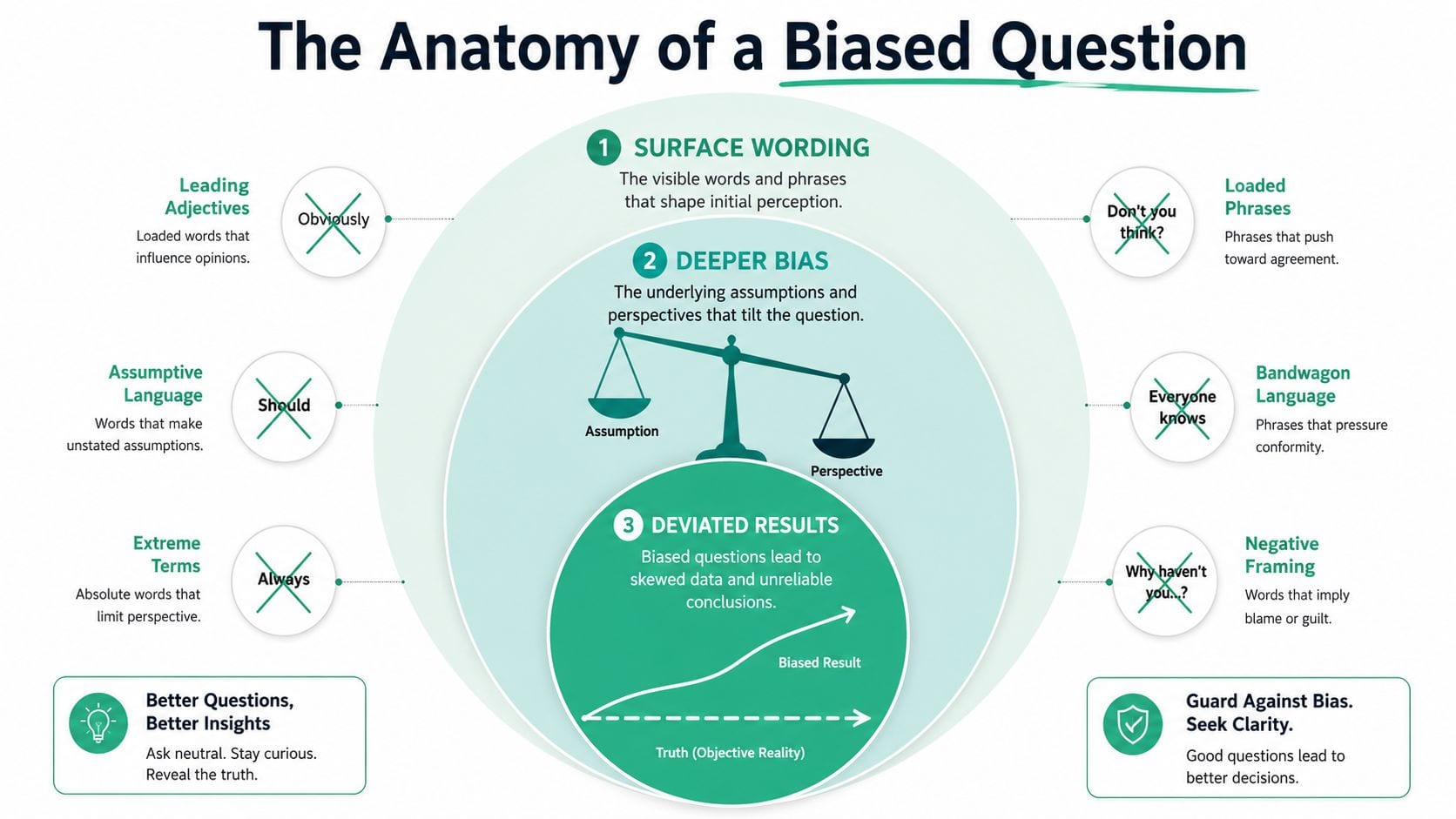
A common way to see the issue is in a simple survey prompt that sounds friendly but points the respondent toward a preferred answer. The wording may look clean in a spreadsheet review, yet it still steers people before they have a chance to respond on their own terms. That is why the definition matters in day-to-day QA, whether you are reviewing a customer survey, a product feedback form, or a launch checklist in data integrity checks for analytics workflows.
Surface wording is only the first layer
The easiest version to spot is the obvious one, a leading sentence like “Don't you agree our service is great?” The wording points at the answer, so the respondent is not meeting the question as a blank slate. That is the surface layer, and it is only part of the story.
The deeper concept is questionnaire bias, which the research literature describes as a deviation from the truth caused by communication barriers between researcher and respondent. That can enter through one item, the whole questionnaire, or the way the survey gets administered or completed, so the error may start small and still contaminate the final dataset. Bias and communication barriers in survey measurement
Systematic error is the key distinction
Statistics people separate systematic error from random error for a reason. Random error adds scatter. Systematic error bends the result in a predictable direction. A biased question belongs in the second category, which means more responses do not necessarily fix the problem.
That matters in QA because a large sample can still be wrong if every respondent gets nudged by the same wording. The metric may look precise, but it is precisely off target.
From a workflow perspective, bias can enter at three levels:
- Individual question design, where one item uses leading or loaded language.
- Questionnaire design as a whole, where ordering or framing changes interpretation.
- Administration or completion, where the way the survey is shown, routed, or answered changes the data.
Pew Research Center's guidance matches this view. Questions need to be clear and specific and free of ambiguity so people interpret them the same way. Pew Research Center on writing survey questions
In analytics and marketing QA, the same pattern shows up in event names, UTM values, and dataLayer fields. A label that sounds close enough in review can still split one action into several meanings once it reaches production, which is why wording checks belong in the same pre-launch review as mapping checks and tracking validation.
A biased question is a deviation from neutral measurement. It pulls the answer away from the underlying truth in a consistent direction.
Five Common Types of Biased Questions with Examples
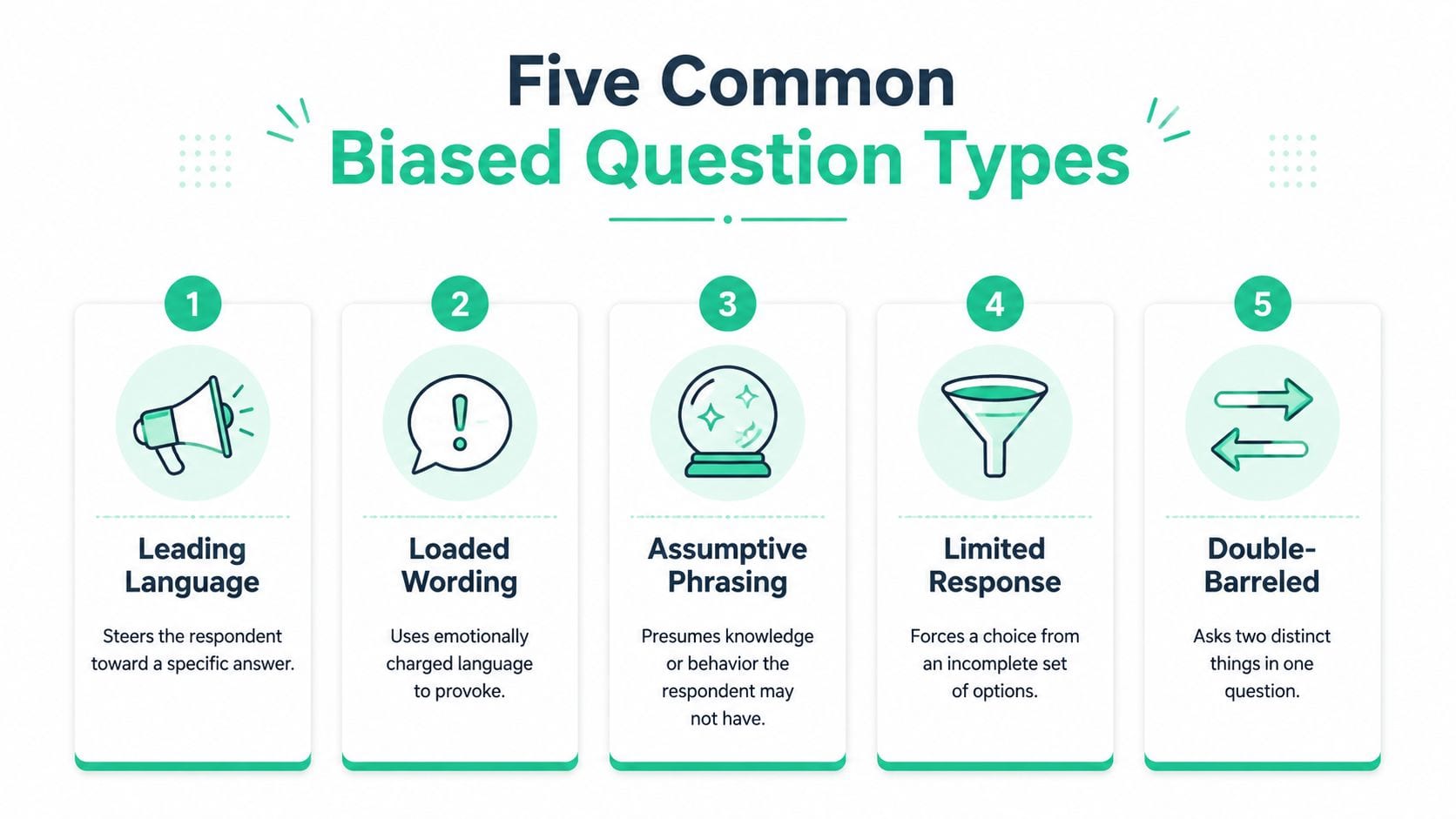
A survey can look clean in review and still steer people into answers that do not reflect what they think. That happens because wording changes interpretation before a respondent even starts weighing the question, much like a tracking rule that looks fine in a spreadsheet but splits one event into several meanings after launch.
These five patterns show up again and again in surveys, interviews, and product research. If you review forms, feedback prompts, or NPS follow-ups, the same failures keep appearing under different labels.
Leading language
A leading question points the respondent toward one answer.
- Biased: “How much do you love our new onboarding flow?”
- Neutral: “How would you rate our new onboarding flow?”
The first version assumes a positive feeling before the respondent even starts. The second asks for an evaluation without telling them what that evaluation should be. In survey research, that small shift can change the answer distribution.
Loaded or emotional wording
A loaded question uses praise, criticism, or pressure.
- Biased: “What do you like most about our brilliant support team?”
- Neutral: “What is your opinion of our support team?”
Loaded wording can also sound negative, not just flattering. A question that uses emotionally charged labels pushes people to react to the label instead of the underlying topic. Genroe on biased questions
Assumptive phrasing
A biased question assumes the respondent has done or felt something.
- Biased: “What made you choose our product after your free trial?”
- Neutral: “If you used the free trial, what influenced your decision?”
The problem is straightforward. Not everyone used the trial, and not everyone made a choice for the same reason. A question that assumes behavior creates false agreement or forces a guess. That is a methodological problem rather than an editorial one.
Limited response options
A question can be biased even when the wording sounds neutral.
- Biased: “How satisfied are you, dissatisfied or satisfied?”
- Neutral: “How satisfied are you, very dissatisfied, somewhat dissatisfied, neutral, somewhat satisfied, or very satisfied?”
When the response set is incomplete, the question squeezes people toward the nearest available choice. That does not capture their view, it compresses it.
Question-order effects
Earlier questions can change how later ones are read.
- Biased sequence: Ask about a recent outage, then ask “How reliable is the platform?”
- Neutral sequence: Ask the reliability question before any outage-specific prompts.
The survey material on question design treats ordering, framing, and anchoring as hidden bias mechanisms, and this is the one teams miss most often because each item looks harmless on its own. AskAttest on biased survey questions A related example from TrackingPlan's questionnaire and survey examples shows how the same wording issue can surface in product flows, where sequence affects the answer as much as the words do.
Useful shortcut: If a respondent can only answer your question by accepting your framing, the question is not neutral.
A good resource for checking how these patterns show up in market research is Sota Proxy market research, especially if your team works across regions or respondent groups and needs a wider lens on question design. The point is not to memorize labels, it is to train your eye to spot the shape of the bias before it ships.
A Real Example of Bias Flowing Into Your Analytics
A B2B SaaS team ships a post-onboarding survey after product activation. The item looks polished enough for leadership review, it asks, “How much did our onboarding help you get value faster?” The dashboard tile tied to that item shows a steady rise, so the growth team begins treating onboarding as a solved problem.
Then the retention review gets uncomfortable. Sales keeps hearing that new users still feel confused, support tickets don't go down, and the product team can't reconcile the praise with the complaints. The issue is not the dashboard. The question already assumed the onboarding was efficient and helpful, so the metric was measuring agreement with that frame.
One sentence changed the decision
The biased wording did two things at once. It praised the onboarding, and it framed speed to value as the expected outcome. That combination made positive responses easier to give, so the score climbed even though the underlying experience hadn't materially improved.
The harm showed up downstream. Marketing used the rising score to justify keeping the same onboarding promise in campaign copy, and product used it to delay a flow redesign that users needed. A single question line shaped a roadmap conversation.
The clearest failure point was this phrase, “How much did our onboarding help you get value faster?” The assumptions are all embedded in the sentence. It presumes the flow is efficient, presumes help happened, and presumes the value outcome is already real.
That is the governance lesson. A biased question is not just a research flaw, it can become a decision input rather than merely a research flaw. Once that wording gets copied into a dashboard tile, a weekly review, or a campaign claim, it starts behaving like accepted evidence instead of a flawed prompt. The same mistake can travel farther than a broken event property ever would, which is why teams should check wording the same way they check event names, UTMs, and dataLayer mappings.
For analytics and marketing teams, the pattern should feel familiar. A misconfigured UTM tag can misstate campaign source. A biased survey item can misstate user sentiment. Both produce reporting that looks systematic while drifting away from reality, and both deserve the same kind of pre-launch review. A useful reference point is TrackingPlan's guide on how do you ensure data integrity, because the same review habit that catches broken tracking also helps catch wording that pushes respondents toward the answer you hoped to see.
How to Detect Biased Wording Before It Reaches Production
The fastest way to catch bias is to review the question as if you didn't write it. That sounds obvious, but teams often skip it because the copy already reads smoothly. Smooth copy can still be skewed copy.
Run a three-pass review
First, scan for obvious triggers, words like “don't you agree,” “obviously,” “excellent,” or “why do you love.” Those are the easy tells. If a sentence already sounds argumentative or flattering, rewrite it before anyone sees it.
Second, hand it to a teammate who doesn't know the draft. Ask them to read the question aloud and answer it immediately. If they hesitate, laugh, or reinterpret the item, the wording is doing too much work.
Third, pilot the question with a small respondent set and watch the shape of the answers. The source material recommends pilot testing because subtle bias often appears as skewed or overly uniform responses, which is a sign that the question is pushing rather than measuring. AskAttest on pilot testing for survey bias
Use neutral rewrites that are easy to reuse
A few patterns help teams move faster:
- Replace “don't you agree” with “what is your view.”
- Replace “our excellent service” with “our service.”
- Replace “how much do you love” with “how would you rate.”
- Split one compound prompt into two separate questions if it mixes ideas.
- Add response balance when the answer set leaves out neutral or negative options.
Pew's guidance on clarity and specificity matters here because ambiguity is what lets wording bias survive review. If each respondent can read the question the same way, your pilot test is much more informative. Pew Research Center on writing survey questions
Practical rule: If you need a long explanation to defend a question, the question probably isn't clean enough yet.
A useful internal reference for test design discipline is shifting left your analytics testing, because the same habit that catches bad event names early also catches bad question wording early. Both are pre-launch problems, and both get more expensive after shipping.
Best Practices for Analytics and Marketing Teams
Analytics and marketing teams do not need a separate rulebook for survey bias. They need the same QA habits they already use for tags, events, and destinations, applied to any prompt that asks a user to express an opinion. A rating widget, a consent banner, a campaign survey, and a feedback form all become measurement instruments the moment they ask a question.
A bad question can distort a dashboard just as quickly as a bad event name. If the wording nudges people toward praise, complaint, or a forced choice, the result looks neat on the page and wrong in practice. That is why wording review belongs in the same release process as tracking review.
Treat questions like tracked events
If your team audits dataLayer pushes, UTM conventions, and event-name consistency, use the same discipline on wording. A campaign tag with inconsistent source values creates distorted attribution. A question with inconsistent framing creates distorted sentiment. The failure mode is different, but the governance logic is the same.
That review should include the microcopy itself. A prompt like “How amazing was our feature?” functions as an instrument design choice, not merely copywriting. It can mislead the same way a mislabeled event or a swapped parameter can mislead analysis.
Fold wording checks into the existing QA runbook
Use the same cadence you would use for schema validation or destination checks:
- Review tracking text before release: inspect survey items, rating prompts, and feedback widgets for loaded or leading phrasing.
- Check response structure: make sure answer options are balanced and complete.
- Validate one clear idea per item: do not combine pricing and support, or speed and quality, in one response field.
- Watch for consistency across channels: if a campaign is tagged one way in the ad platform and another way in the form copy, the story will not line up.
- Test the full journey: a prompt can be technically tracked and still be analytically weak if the wording shapes the answer.
For teams building a broader quality habit, best practices for survey design 2026 reinforces the same themes survey researchers keep returning to, clear wording, balanced choices, and pre-launch review. The value for analytics teams is translation, not theory.
Keep one rule at the center
A biased question and a broken UTM parameter both create systematic distortion. Monitoring tools can catch the latter quickly, but they will not tell you that the sentence itself is steering users. Wording QA has to sit beside instrumentation QA, because the phrase, the field name, and the event payload all shape what you think happened.
A practical way to make that real is to pair survey review with release discipline. The same checklist mindset that supports how do you ensure data integrity also helps catch vague prompts, uneven response options, and assumptions hidden in a sentence. That is the bridge between survey-methodology bias and day-to-day analytics QA.
For a companion to that workflow, analytics data quality checklist for martech teams is a useful reference point when you align form reviews with the rest of your launch checks.
QA Checklist and Frequently Asked Questions
A survey question can look clean in a draft and still tilt the result once it reaches users. The same happens in product analytics, where a field name, a UTM label, or an event title can look acceptable in review but still push the team toward a distorted read.
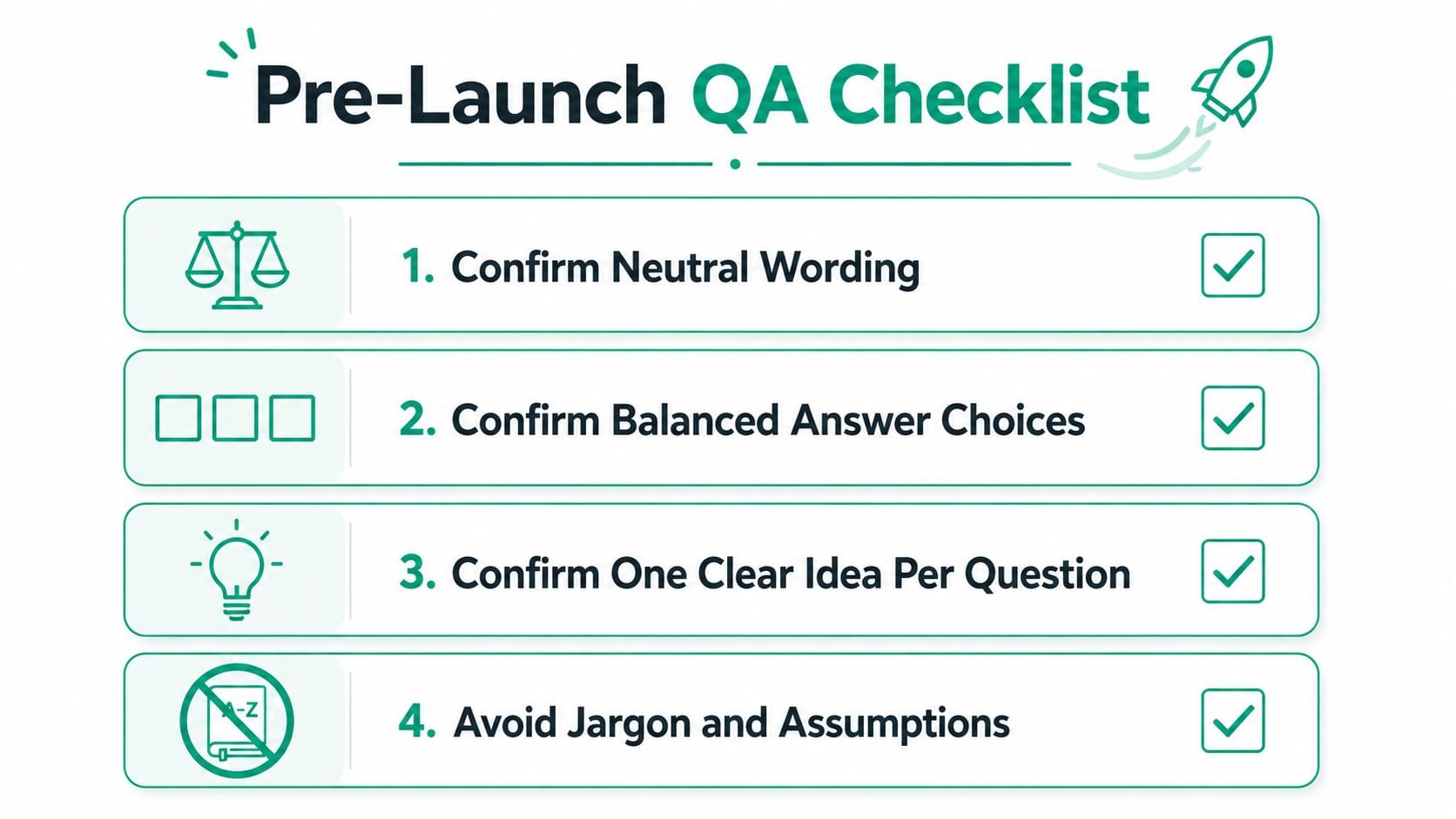
Use this checklist before any survey, feedback widget, or in-product prompt goes live.
- Confirm neutral wording: remove praise, criticism, and leading verbs.
- Confirm balanced answer choices: include a fair range of options, including neutral where needed.
- Confirm one clear idea per question: split mixed topics into separate items.
- Avoid jargon and assumptions: use plain language and do not presume the user already completed the action.
For teams that already review launches with a structured QA runbook, analytics data quality checklist for martech teams is a useful companion. It gives the same launch discipline a place to live, so wording checks sit beside event-name, dataLayer, and UTM review instead of getting added as an afterthought.
How is a biased question different from a leading question
A leading question is one common form of biased question. It is one form among several, and that distinction matters when you review survey copy or product prompts. Biased question is the broader category that encompasses leading language as one mechanism, along with loaded phrasing, assumptions, limited choices, and question order effects.
Can a small pilot still reveal wording bias
Yes. A small pilot can show that respondents pause, re-read, or keep choosing the same direction because the item points them there. That kind of signal is easy to miss in a spreadsheet, but it shows up quickly when a question feels awkward in actual use.
You are looking for friction, not perfection. If people interpret the prompt in different ways, or if they answer with the same tone of hesitation every time, the wording needs another review before production.
How do I flag biased wording in an ongoing analytics QA platform
Treat the question text as a tracked asset, the same way you treat an event name or campaign parameter. Add review checks for loaded language, assumptions, unbalanced scales, and microcopy that asks for a rating or opinion. If a release changes wording but leaves the event name untouched, that still changes the meaning of the data and deserves review.
A practical QA workflow should flag that change beside the rest of the launch checklist. For teams already working from a martech data quality checklist, the survey review can sit in the same pass as dataLayer validation, UTM checks, and event naming audits.