
Ensuring data integrity isn't just a technical task; it's a commitment to maintaining the accuracy, consistency, and completeness of your data across its entire journey. Think of it as a strategic blend of defining clear data standards, putting robust validation checks in place, and keeping a constant eye on your data pipelines to catch any corruption or loss.
At the end of the day, it’s all about making your data trustworthy.
Why Data Integrity Is the Bedrock of Reliable Analytics
Imagine your marketing team pouring thousands into a campaign that your dashboard says is a top performer. Weeks later, you discover a broken tracking implementation meant the attribution data was completely wrong. This isn't a hypothetical—it's the expensive reality of poor data integrity.
When your data is unreliable, the consequences ripple out. It's not just about a dashboard showing the wrong numbers. It’s about the strategic misfires that hit the bottom line hard.
Data integrity isn't just a chore for the engineering team. It's the absolute foundation for confident decision-making, operational efficiency, and sustainable business growth. Without it, you’re flying blind.
This breakdown in trust can paralyze a company. Suddenly, every report is suspect, and every strategic meeting gets bogged down in debates over whether the numbers are even real.
The Real-World Impact of Bad Data
This problem is more common than you'd think. A 2023 survey from Drexel University’s LeBow College of Business found that 53% of analytics professionals say data quality is their single biggest challenge. What's worse, only 37% of organizations report having mature data quality practices. That’s a massive gap between ambition and reality.
When you don’t actively protect your data integrity, you're opening the door to serious business risks. For a deeper dive into the core principles, you can learn more about what data integrity is and why it matters in our detailed guide.
The fallout is tangible:
- Misallocated Budgets: You end up investing in the wrong marketing channels or product features, all based on faulty data.
- Eroded Stakeholder Trust: When leadership can't rely on the numbers, confidence in the data team and its insights plummets.
- Poor User Experience: Flawed data leads to product decisions that frustrate or alienate your customer base.
- Compliance and Privacy Risks: Inaccurate data management can easily lead to unintentional privacy violations and costly legal trouble.
This guide will cut through the jargon and give you a practical, actionable playbook for building a resilient data culture. We'll connect the dots between broken tracking and its business impact, setting you up with a system powered by modern, automated solutions.
Build Your Single Source of Truth with a Tracking Plan
Before you can validate, monitor, or even think about fixing your data, you have to define what “good” data actually looks like. Trying to ensure data integrity without that definition is like building a house without a blueprint. It’s all guesswork and inconsistency, and you know how that ends.
This is exactly where a tracking plan comes in. Think of it as the constitution for your entire analytics program.
A tracking plan is a living document that spells out every single event, property, and naming convention you intend to track. It gets everyone on the same page, from marketing to engineering, eliminating the ambiguity that so often leads to broken analytics. It's the ultimate reference for developers, analysts, and marketers alike.
This document bridges the frustrating gap between what the business wants to measure and what engineers actually need to build. For anyone figuring out how to build a data pipeline, the tracking plan provides the exact specifications for what data should flow through it.
Why You Cannot Skip This Step
Without a tracking plan, every team operates on its own set of assumptions. A developer might implement an event called addToCart, but a marketer is in their reports searching for product_added. This simple mismatch creates data silos and makes accurate reporting flat-out impossible.
The plan enforces consistency right from the start. By standardizing naming conventions (like using snake_case for all events) and defining a clear taxonomy, you prevent the kind of chaos that renders entire datasets useless.
A tracking plan isn't just a spreadsheet you create and forget. It's a dynamic, collaborative agreement that serves as the single source of truth for your data, making every subsequent data integrity effort possible and meaningful.
This simple shift in process turns your data from a jumble of random signals into a structured, reliable asset. To really dig into this foundational document, check out our guide on what a tracking plan is and why it matters.
Deconstructing a Critical Event
Let's make this practical. Take a classic e-commerce event: product_added_to_cart. Just tracking the event itself isn't nearly enough. To make it useful, your tracking plan has to specify exactly which properties are required and what their data types should be.
Here’s a snapshot of what that looks like in a real tracking plan:
- Event Name:
product_added_to_cart - Description: Fired when a user clicks the "Add to Cart" button on a product page.
- Trigger: Click on the primary CTA button.
Required Properties:
Getting these details right is non-negotiable. If the price is sent as a string ("$19.99") instead of a number (19.99), you can't run calculations like summing the total value of items in carts. If product_id is missing, the event is completely useless for product performance analysis.
This level of detail ensures every piece of data you collect is clean, consistent, and ready for analysis the moment it arrives. It's the first—and most important—step toward achieving real data integrity.
Implement Proactive Data Validation and QA Workflows
A solid tracking plan is your blueprint for what good data should look like. But a blueprint alone doesn't build a house—you need quality control on the job site to make sure everything is built to spec. It's the same with your data. To ensure real integrity, you have to move beyond just defining standards and start actively validating your data against them.
Too often, teams get stuck in a reactive cycle. An analyst finds a broken dashboard, files a ticket, and weeks later, engineers finally trace the problem back to a faulty event from an old release. This process is slow, expensive, and erodes trust in your data with every incident.
A much better way forward is to build proactive, layered validation workflows that catch errors before they ever pollute your analytics tools. This means shifting QA from a final, manual checklist before a release to a continuous, automated process that helps developers from the very beginning.
This proactive approach is fast becoming the industry standard. The global market for data integration and integrity software hit USD 16.4 billion in 2023 and is projected to explode to USD 47.72 billion by 2032. This isn't surprising—enterprises can no longer afford the risk of bad data, especially as cloud migrations and new tech add layers of complexity. You can dig into the numbers in this comprehensive market report.
A Developer-First Approach to Prevention
Your first line of defense is right in the code. A few simple developer best practices can wipe out a huge number of common tracking errors, like typos and inconsistent naming.
One of the most powerful moves you can make is using constants for event and property names instead of raw strings. When a developer types "product_viewed" directly into the code, a tiny typo like "product_viwed" creates a brand new, incorrect event that manual QA could easily miss.
By defining all event names in a central file or library, developers reference a constant like EVENTS.PRODUCT_VIEWED. This simple change allows the IDE to autocomplete names and flag any references to non-existent events, stopping typos before they're ever committed.
Moving from Manual Spot-Checks to Automated Observability
Developer best practices are a great start, but they won't catch everything. Manual QA has been the default for testing analytics for years, but for modern, fast-paced development, it's fundamentally broken. It’s slow, impossible to scale, and can only ever cover a tiny fraction of user paths and edge cases.
Picture a QA tester manually clicking through a new feature, using browser dev tools to check if the right events fire.
- They can only test a handful of happy paths.
- They can't see what's happening on different devices or browsers.
- They have zero visibility into what happens after the data leaves the browser, especially with server-side tracking.
This is where automated analytics observability platforms change the game. Instead of relying on brittle, manual test scripts, these tools continuously and automatically discover your entire data flow—from the dataLayer to every single marketing and analytics destination. They act as a 24/7 watchdog, validating every event against your tracking plan in real-time. For a closer look at this modern approach, check out our guide on how to bulletproof your digital analytics with data validation.
This diagram illustrates the simple but powerful flow that underpins a reliable tracking and validation strategy.
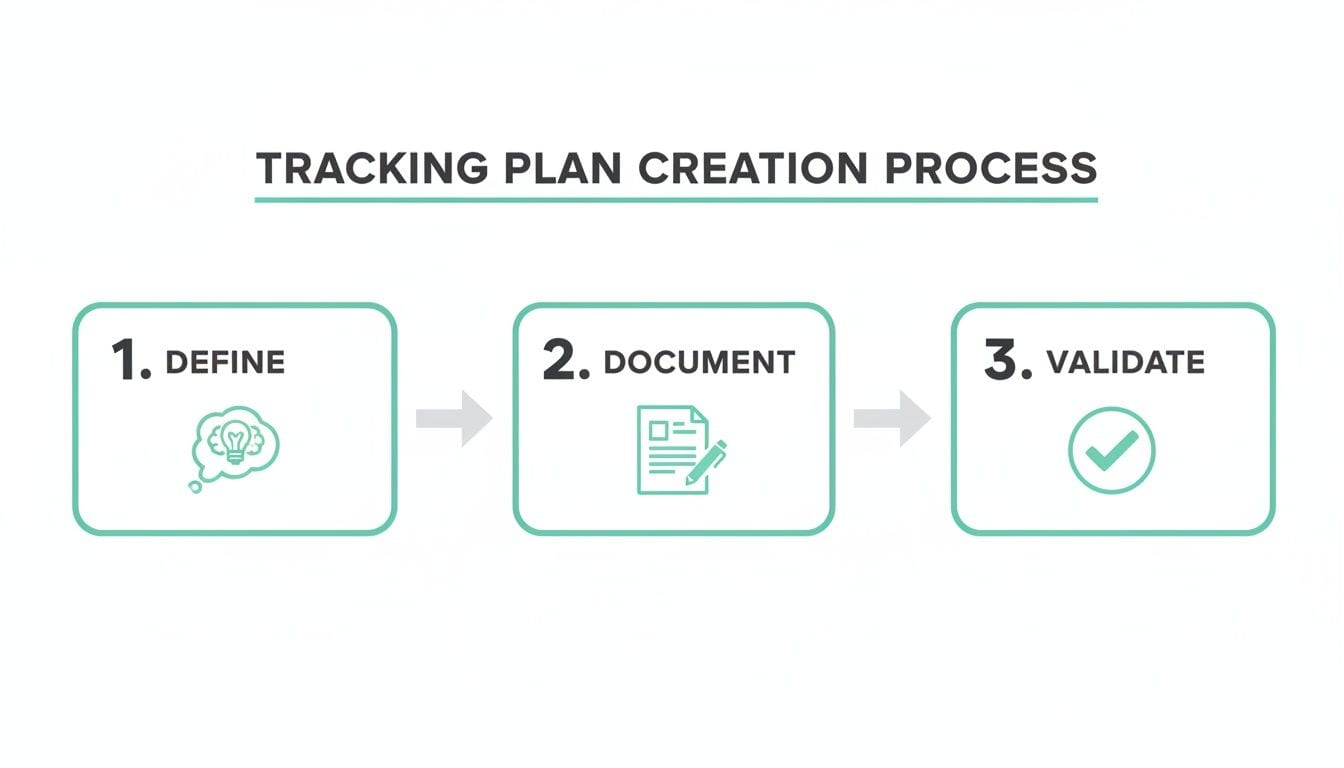
It all comes down to a clear lifecycle: define your requirements, document them in a tracking plan, and then continuously validate everything against that plan.
The table below breaks down just how different these two approaches are.
Manual QA vs Automated Analytics Observability
As you can see, the shift to automation isn't just an improvement—it's a complete transformation of how teams can ensure data quality.
Transforming QA into a Supportive Process
With an automated system watching your back, you can set up real-time alerts for the issues that matter most.
The goal is to transform QA from a development bottleneck into a seamless, supportive process. When developers get instant, specific feedback on tracking errors they just introduced, they can fix problems in minutes, not weeks.
This automated workflow builds confidence with every single release. Instead of just hoping your analytics aren't broken, you know they're being monitored.
Here are a few critical issues you can get alerted on immediately:
- Schema Mismatches: A
purchaseevent fires without the requiredtransaction_idproperty. - Missing Properties: The
priceproperty on a product event is suddenly null across the board. - Rogue Events: A stray event like
test_event_123appears in production, meaning some debug code was accidentally deployed. - Data Type Violations: A user ID is sent as a number instead of the required string, breaking user identification in your analytics platform.
Catching these issues the moment they happen means your team avoids the long, painful process of data backfills or, even worse, making critical business decisions based on corrupted information. This is how you truly achieve data integrity at scale.
Automate Monitoring and Alerting Across Your Data Pipeline
Once your validated data goes live, the job isn't over—it’s just getting started. A successful deployment is only the first step. True data integrity requires constant, vigilant oversight to protect against the inevitable entropy of software development, where new releases, A/B tests, and infrastructure changes are always threatening to break things.
This is where automated monitoring and alerting become your most powerful allies. Relying on manual checks or waiting for an analyst to notice a broken dashboard is a recipe for disaster. You need a system that acts as a 24/7 watchdog for your analytics health, catching issues the moment they appear.
An automated system shifts your team from a reactive, fire-fighting posture to a proactive, problem-solving one. It’s the difference between discovering a data issue weeks after the fact versus getting an alert within minutes of a bad deployment.
What to Monitor for Unbreakable Data Integrity
To really lock down data integrity, your monitoring strategy has to go way beyond simple uptime checks. You need to watch for the subtle but critical signals that your data quality is degrading. A solid monitoring setup should track several key areas.
First, keep an eye on event volume and traffic anomalies. A sudden, unexplained drop in user_signup events could mean a broken form on a key landing page. On the flip side, a massive spike might indicate bot traffic or a duplicated tracking implementation that’s polluting your entire dataset.
Next up is data latency. If your real-time personalization engine depends on events arriving within seconds, but they suddenly start taking minutes to process, the whole user experience can fall apart. Monitoring the time it takes for data to travel from source to destination is crucial.
Finally, and most importantly, you have to monitor for validation failures against your tracking plan. This is the heart and soul of analytics QA. Your system should be constantly checking if live data follows the rules you’ve defined, looking for things like:
- Schema violations, such as missing required properties.
- Data type mismatches, like a price being sent as a string instead of a number.
- "Rogue" events that aren’t even defined in the tracking plan.
Creating Intelligent Alerts That Drive Action
The whole point of alerting isn't to create more noise; it's to deliver the right signal to the right person at the right time. A constant stream of low-priority warnings just trains your team to ignore them. Intelligent, context-aware alerting is the only way to go.
A robust system lets you configure rules based on severity and business impact. This is how you cut through the clutter and make sure every single notification is actionable.
An effective alerting strategy doesn't just tell you that something is broken. It tells you what broke, how severe it is, and gives your team the context needed to fix it fast, turning a potential crisis into a manageable incident.
Think about how you can route alerts to different channels based on urgency. For example, you could set up a workflow where minor warnings, like a new non-critical event popping up in a staging environment, are batched into a daily email digest for the data team.
But a high-severity issue, like a broken purchase_completed event on your e-commerce site, should trigger an immediate, high-priority alert. This might be a direct message to a specific Slack channel, like #ecommerce-dev-alerts, instantly notifying the on-call engineers. This targeted approach ensures the big problems get immediate attention without causing alert fatigue.
A Real-World Scenario in Action
Let’s walk through a classic scenario. An e-commerce company pushes a new release to update its checkout flow. Unbeknownst to the development team, a change in a JavaScript library conflicts with the analytics implementation, causing the checkout_step_completed event to stop firing for all users on Safari.
Without automated monitoring, this silent failure might go unnoticed for days or even weeks. The product manager might eventually spot a dip in the conversion funnel report, kicking off a long and painful investigation. By then, the company has lost a huge amount of valuable data needed to understand user behavior and optimize its checkout process.
With an automated system like Trackingplan in place, the story is completely different. The monitoring platform, which is constantly validating live traffic against the tracking plan, detects the anomaly within minutes. The volume of checkout_step_completed events has cratered, triggering a pre-configured, high-severity alert.
The alert is instantly pushed to the #dev-alerts Slack channel, complete with details pointing to the recent deployment and the affected browser. The engineering team sees the notification, quickly identifies the problematic library, and rolls back the change. The entire incident, from detection to resolution, takes less than an hour. Thousands in potential lost revenue are saved, and the integrity of their analytics is preserved. This is how you ensure data integrity in a fast-moving environment.
Establish a Robust Data Governance and Privacy Framework
True data integrity goes way beyond just accuracy. It drills deep into security, privacy, and compliance. Your tracking plan defines what you collect and validation confirms you're getting it right, but a data governance framework is what dictates who can touch that data and how it must be handled.
Without solid governance, even perfectly clean data is a ticking time bomb. Think of it as the rulebook for your data—a clear set of roles, processes, and policies that ensures your data is not only correct but also used legally and ethically.
This framework is the organizational armor that protects customer trust and shields you from some pretty scary legal and financial risks.
Implementing Role-Based Access Controls
A cornerstone of any good data governance strategy is role-based access control (RBAC). Let's be honest: not everyone in your company needs to see everything. RBAC is the simple but powerful practice of ensuring people can only view or modify the specific data they need to do their jobs.
A marketing analyst, for example, probably needs aggregated campaign performance data but has no business seeing raw user records full of personally identifiable information (PII). In the same way, a developer might need to inspect event payloads to debug an issue, but they shouldn't have free rein over the entire customer database.
Putting RBAC into practice boils down to a few key steps:
- Defining Roles: Map out the different user types in your organization (e.g., Analyst, Developer, Marketer, Admin).
- Assigning Permissions: Decide which datasets, dashboards, and tools each role is allowed to access.
- Regular Audits: Periodically review who has access to what. People change roles, and their permissions need to change with them.
This isn't complicated, but it drastically shrinks your risk profile for both accidental data leaks and intentional misuse.
Embedding Privacy and Compliance into Your Workflow
With regulations like GDPR and CCPA, privacy is no longer optional—it's table stakes. Staying compliant isn't a one-and-done project; it’s an ongoing process that has to be woven directly into your data pipelines and your company culture.
A smart move here is to use automated tools that scan for and block sensitive information before it ever hits your analytics platforms. For instance, automated PII scans can catch things like email addresses, phone numbers, or credit card details that might have been accidentally captured in an event property.
A strong governance framework turns privacy compliance from a reactive, stressful scramble into a proactive, systematic process. It ensures your data practices are designed for privacy from the ground up, not as an afterthought.
For any business working with AI, full compliance is even more critical. There are some great resources out there on achieving GDPR-compliant AI integration that can help shape your strategy.
The market data tells a clear story. The global data governance market is on track to hit USD 19.38 billion by 2033, with a blistering CAGR of 15.69%. And when you learn that 55% of consumers list data theft as their top cyber concern, it’s easy to see why. The demand for tools that prevent PII leaks and manage consent is exploding for a reason. You can dig into the numbers in this extensive data governance market report.
The Role of a Governance Committee
For any of this to stick, your framework can't just be a document collecting dust on a shared drive. A cross-functional data governance committee is the key to making it a living, breathing part of your organization. This group oversees policies, settles disputes, and keeps the framework current as new regulations emerge.
Your committee should be a mix of stakeholders from across the business:
- Legal: To keep everyone honest on compliance and privacy laws.
- Engineering: To provide a reality check on what's technically possible.
- Product: To voice the data needs for building and improving features.
- Marketing: To make sure campaign data is handled correctly.
- Data/Analytics: To act as the champions for data quality and usability.
This group becomes the central nervous system for all data-related decisions. By bringing these different perspectives to the table, you build a practical governance strategy that protects the business without stifling the data-driven decisions that help it grow.
Data Integrity FAQs: Your Questions Answered
When you're deep in the weeds of data integrity, questions always come up. As teams start building out more robust strategies, certain hurdles and concepts inevitably need a second look. Here are some straightforward, expert answers to the most common questions we hear from the field, designed to help you apply these principles with confidence.
What's the Real First Step to Improving Data Integrity?
Before you can monitor or validate a single thing, you need a tracking plan. It’s the single most critical first step. Think of it as the architectural blueprint for your data; it defines exactly what data you're collecting, what it should look like, and where it's coming from.
This document gets your marketing, product, and engineering teams speaking the same language. It provides a clear map for implementation and creates the baseline for any automated QA you want to run later. Trying to validate data without a tracking plan is like trying to inspect a building's construction without the blueprints—it’s just guesswork. Start small by documenting your most critical user funnels, then build it out from there.
How Can We Maintain Data Integrity Without Killing Development Speed?
The trick is to ditch manual, stop-and-go QA processes and embrace automated, continuous observability. Manual testing is a natural bottleneck, forcing a painful choice between moving fast and maintaining quality. An automated platform, on the other hand, runs quietly in the background, constantly monitoring your implementation without making developers change a thing about how they work.
When you integrate this kind of monitoring into your CI/CD pipeline, you start catching issues before they hit production. Real-time alerts on live data mean QA becomes a supportive, parallel track instead of a roadblock. This proactive approach actually speeds up development by slashing the time spent hunting down analytics bugs post-release. A week-long investigation can turn into a ten-minute fix.
The goal is to make data quality a seamless part of the development lifecycle, not a gate that holds it back. Automation empowers developers with immediate feedback, making them the first line of defense for data integrity.
This completely changes the dynamic. It helps build a culture where clean data is a shared responsibility, not just a headache for analysts to discover weeks later.
What Are the Most Common Data Integrity Issues You See?
Hands down, the most frequent problems we encounter are schema violations and implementation drift. These two buckets cover a huge range of issues that can quietly poison your analytics and lead to some seriously flawed business decisions.
Schema violations happen when the data you’re sending doesn’t play by the rules you set in your tracking plan. We see it all the time:
- Missing required properties: A
purchaseevent fires but thetransaction_idis nowhere to be found. - Wrong data types: The
priceproperty gets sent as a string ("29.99") instead of a number (29.99), which breaks any attempt at calculation. - Inconsistent naming: The same exact identifier shows up as
user_id,userId, andUser_IDacross different events.
Implementation drift is what happens over time as new features ship and old code gets tweaked. Suddenly, your live tracking no longer matches what's documented. This is how you end up with "rogue" events—undefined or test events that sneak into production and clutter up your data. Other classic problems include broken marketing pixels, messed-up UTM parameters that destroy attribution, and even unintentional PII leaks.
How Does Server-Side Tracking Change the Game for Data Integrity?
Moving to server-side tracking has some major upsides, like getting around ad-blockers and improving accuracy by not relying so much on the client's browser. But it also adds a whole new layer of complexity and potential points of failure. To keep your data clean, you have to validate it not just on the client-side, but also as it’s being processed and passed along from your servers to all its final destinations.
This is where an end-to-end observability solution becomes non-negotiable. You need something that can monitor the data payload from the moment it’s created on a user's device, follow it through your server infrastructure, and confirm it lands correctly in platforms like Google Analytics, Amplitude, or your data warehouse.
Without that complete line of sight, perfectly good client-side data could still get corrupted, reformatted incorrectly, or just plain lost in the server-side shuffle. For example, your server might fail to pass along campaign parameters, breaking all your marketing attribution even if the client sent them flawlessly. True integrity in a server-side world demands a holistic view of the entire data journey.
Ready to stop chasing data fires and start preventing them? Trackingplan provides a fully automated observability platform that acts as your 24/7 watchdog for analytics health. Get real-time alerts on everything from schema violations and rogue events to broken marketing pixels and PII leaks, so you can fix issues in minutes, not weeks. Discover how Trackingplan can help you build trust in your data.