
You know the feeling. A growth lead gets budget, hires a consultant, sits through a polished workshop, and leaves with a deck full of smart-looking options. Then the team tries to act on it, the numbers don't line up, the tracking is muddy, and three months later nobody can prove which recommendation moved revenue.
That failure isn't caused by a lack of ideas. It's caused by treating growth strategy consulting like a presentation artifact instead of a decision system. The market is too mature for that approach anyway, with the global strategy consulting market valued at $38.4 billion in 2021 and projected to reach $111.4 billion by 2031 at 11.6% CAGR according to the market outlook cited here. Buyers aren't paying for slides. They're paying for sharper choices.
If you want a practical way to tie growth goals to measurable outcomes, the OKR lens is useful, especially when strategy has to turn into execution fast. A good place to start is grow your business with OKRs, because growth work without explicit targets usually turns into optimism dressed up as planning.
The Growth Strategy Engagement Teams Regret Starting Too Late
A founder thinks the company has a channel problem. A VP of Growth thinks the pipeline is weak. A CFO thinks the margin profile is getting ugly. They all bring in a consultant expecting clarity, and too often they get a polished story with no dependable way to tell whether the plan deserves funding.
The better engagement starts by treating growth strategy consulting as a decision system. It begins with a data audit, then moves through market, customer, and financial analysis, then ends with a prioritized roadmap that names milestones, KPIs, and resource asks. That order matters because weak data usually exposes the bottleneck before the team commits to a direction.
Practical rule: if the data cannot support the recommendation, the recommendation is not ready.
Good growth work feels disciplined because it is. The market also shows that buyers pay for specificity, not generic advice. One global report says large enterprises held 62.32% of strategic consulting services revenue in 2025, and project-based advisory accounted for 54.05% of the market, which points to enterprise buyers paying for clear decisions rather than broad encouragement in the consulting.us market summary.
The right question is simple. Do not ask whether a firm can make a deck that sounds smart. Ask whether it can help your team choose, test, and defend a growth path with numbers that still hold after launch. If it cannot, you are buying confidence theater.
A useful benchmark is to grow your business with OKRs when the strategy has to turn into execution fast. Growth work without explicit targets usually turns into optimism dressed up as planning.
What Growth Strategy Consulting Actually Is
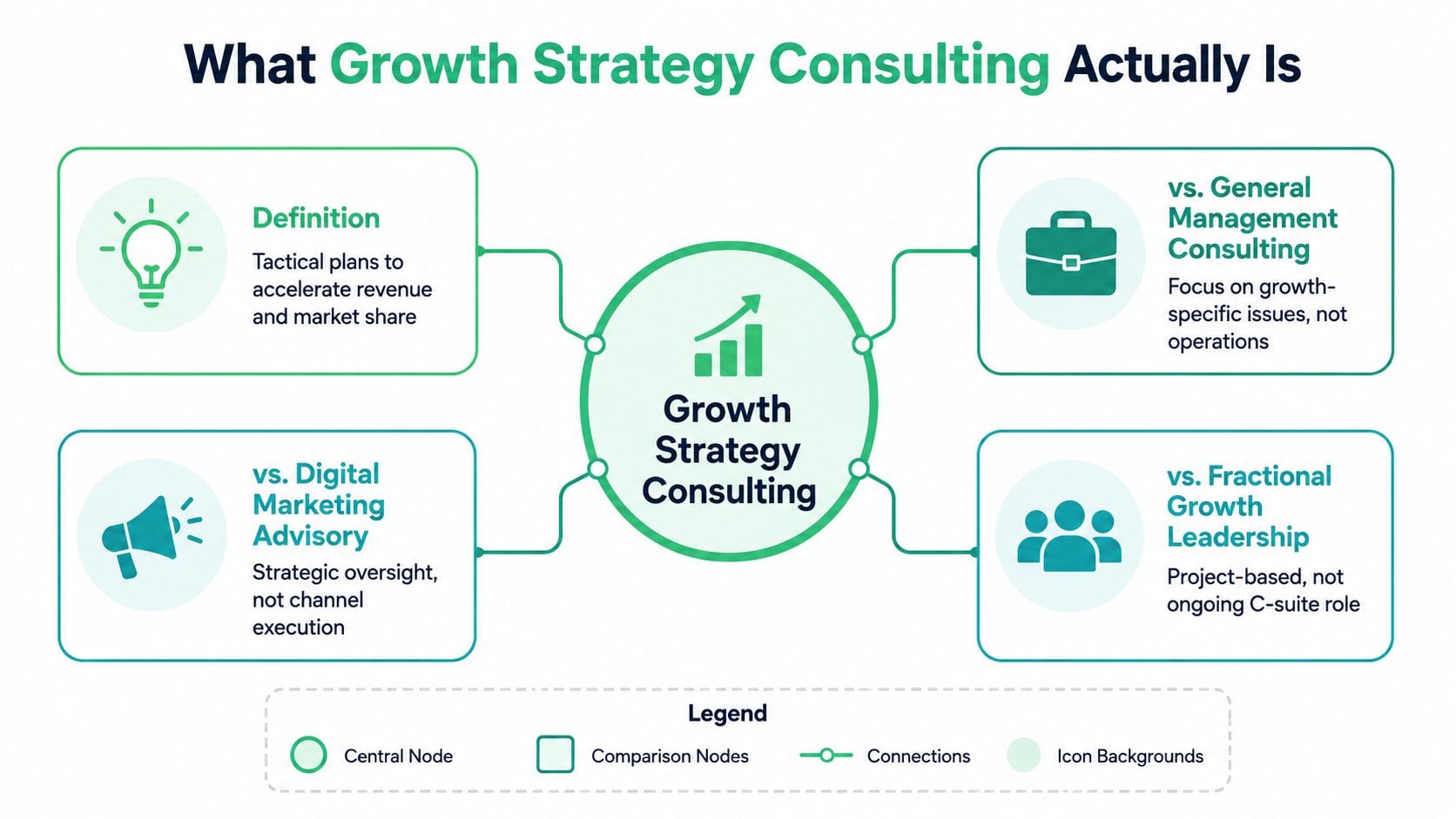
Growth strategy consulting is the work of choosing where a company should grow, how it should win there, and what it should stop funding. It's not general management consulting, because the focus is narrower and more commercial. It's not digital marketing advisory, because the job isn't to run channels or tweak campaigns. It's not fractional leadership either, because you're buying a project-based strategic intervention, not an ongoing C-suite role.
A competent engagement usually includes market sizing, segmentation, growth option generation, prioritization, and a roadmap that names milestones, KPIs, and resource requirements. In practice, that often lands in a 6 to 12 week diagnostic cycle, long enough to gather evidence and short enough to keep decisions moving. The output should make trade-offs explicit. If a consultant can't tell you what gets funded, what gets paused, and what assumptions would change the answer, the work isn't strategy.
The clean boundary between strategy and execution
Strategy answers what should happen. Execution answers who does it, when, and with what systems. Firms blur this line when they sell “strategy” but deliver a loose bundle of implementation ideas, or when they promise transformation without making the underlying choices explicit.
A buyer should expect the strategy layer to define the opportunity, the risks, the sequencing, and the decision gates. It should not pretend to replace marketing operations, sales leadership, or product management. That distinction matters because many stalled initiatives were never under-strategized, they were under-owned.
For a useful contrast with execution-heavy growth tactics, the article on full-funnel marketing tactics for SaaS is a good companion read. It's useful precisely because it sits one layer closer to implementation than strategy does.
Frameworks and Deliverables That Actually Drive Growth
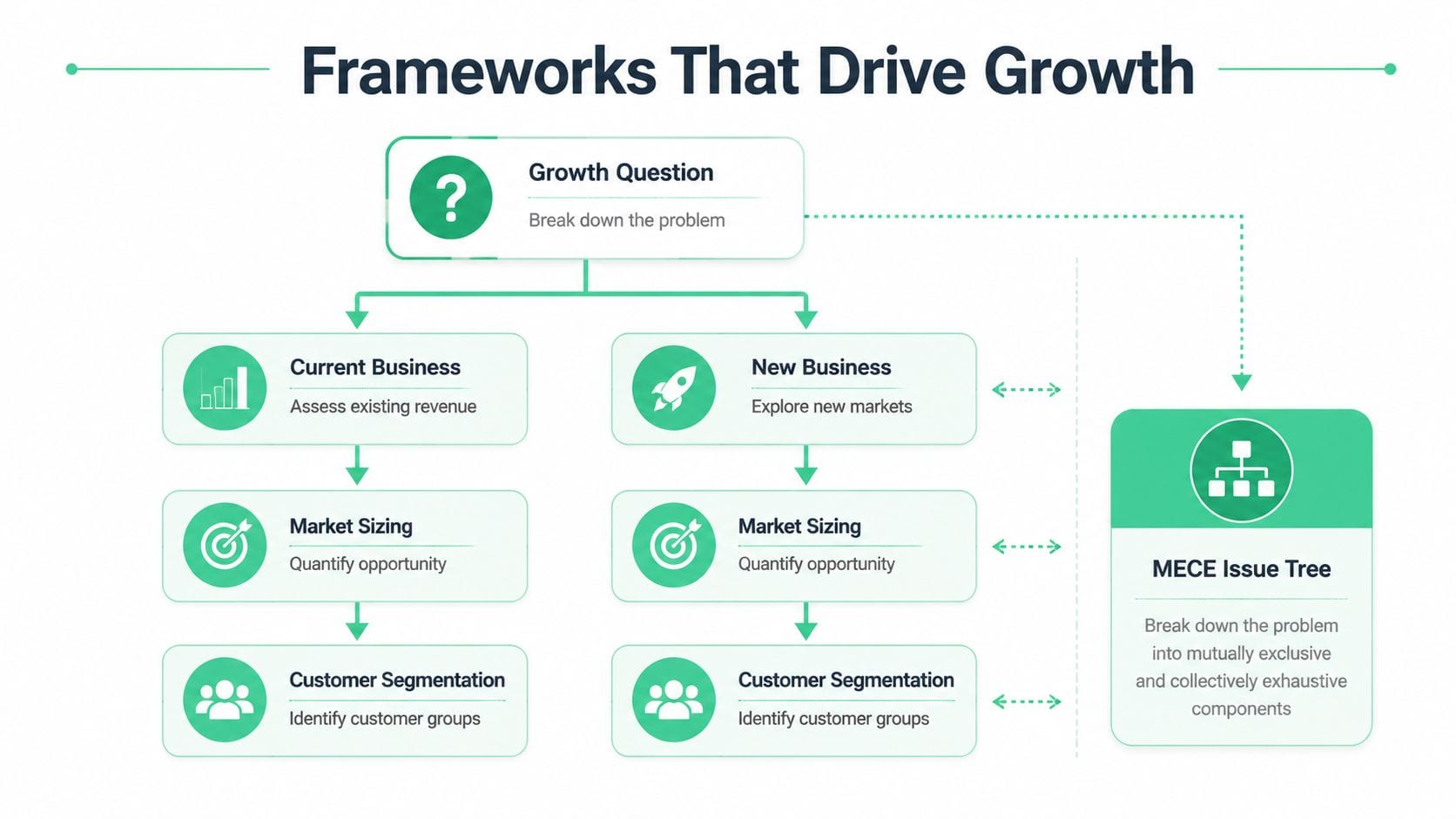
The best consultants don't start with a list of ideas. They start by breaking the growth problem apart so the company can see where the greatest potential lies. A standard MECE issue tree is the cleanest way to do that. It forces the team to ask whether growth is coming from current business or new business, whether the company is growing below, at, or above market rate, and whether the opportunity is organic or inorganic as described in the growth framework reference.
How a real issue tree changes the conversation
Take a stalled SaaS funnel. A lazy team says, “We need more leads.” A better team decomposes the problem. Is the issue acquisition, activation, conversion, retention, or expansion? Is the core problem pricing, qualification, product fit, or channel quality? That tree tells you where to spend time, and where not to waste it.
A solid roadmap comes next. One published consulting process lays out internal data collection, strategic issue framing, market sizing and attractiveness analysis, recommendation development, and roadmap creation, with the roadmap spanning a 12 to 36 month timeline in the Rework strategy consulting process guide. That's the right shape of output. It makes time explicit, and it shows when decisions should be revisited.
Why unit economics should sit at the center
Growth without unit economics is just expensive activity. A rigorous model uses CAC, CLTV, conversion rates, pipeline value, margin, and cash flow to test whether the plan is scalable and profitable as outlined in the growth metrics guidance. If a recommendation improves volume but destroys contribution margin, it's not a growth strategy. It's a burn strategy.
Practical rule: every growth bet should survive a scenario where the market is slower, the CAC is worse, or the sales cycle stretches.
A simple table makes the comparison clearer:
| Framework | Best Used For | Typical Deliverable |
|---|---|---|
| MECE issue tree | Decomposing an ambiguous growth question | Structured hypothesis tree |
| Market sizing and attractiveness | Choosing which opportunity deserves attention | Opportunity assessment |
| Unit-economics scenario planning | Testing whether growth is profitable | Base, upside, and downside model |
| Phased roadmap | Translating the choice into action | Milestones, KPIs, and resource plan |
For a practical measurement angle, the guide to build a marketing measurement plan that drives results is useful because it shows how the numbers behind growth work need to be designed before the campaign launch, not patched afterward.
How Analytics and Observability Protect the Strategy
A growth strategy is only as good as the tracking underneath it. If attribution is broken, events are missing, or campaign tags are inconsistent, the team will argue about the numbers instead of the decision. That's how strategy degrades after launch, not because the logic was bad, but because nobody trusted the measurement layer long enough to keep steering.
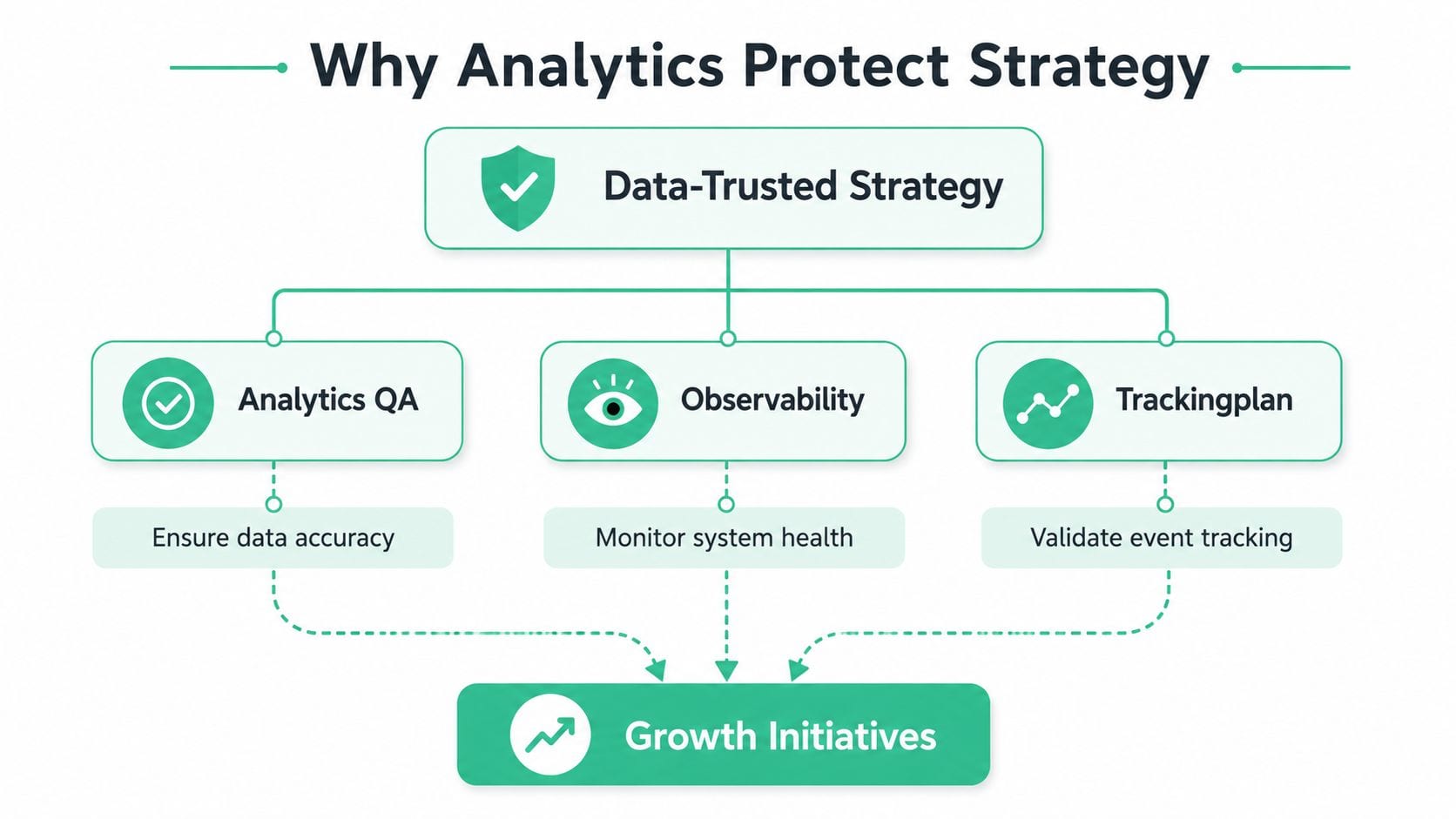
Analytics QA and observability matter. A strong operating model keeps watch on marketing tags, pixels, attribution, and event schemas so teams can catch traffic anomalies, broken pixels, UTM mistakes, and consent misconfigurations before they poison the dashboard. The point isn't to generate more reports. It's to preserve the integrity of the growth system once the recommendations hit production.
Strategy and measurement have to move together
A clean tracking plan should act as the shared source of truth between marketing, analytics, and development. If the growth team says a new funnel is live but the event schema changed without warning, the strategy team starts optimizing the wrong thing. That's why observability platforms exist, they give teams a way to monitor data quality continuously instead of auditing it manually after the damage is done.
The consulting market is moving in that direction because automation is changing the work itself. Recent market research says 78% of organizations reported using AI in at least one business function in 2025, up from 55% a year earlier, and 71% reported regular use of generative AI in the market research cited by Simon-Kucher. More automation means more speed, but it also means more ways for bad data to slip through unnoticed.
For a deeper view of the observability side, the article on marketing observability is worth reading. It reinforces a point too many learn too late: measurement is not a reporting function, it's a control system.
Engagement Models and Pricing Structures Explained
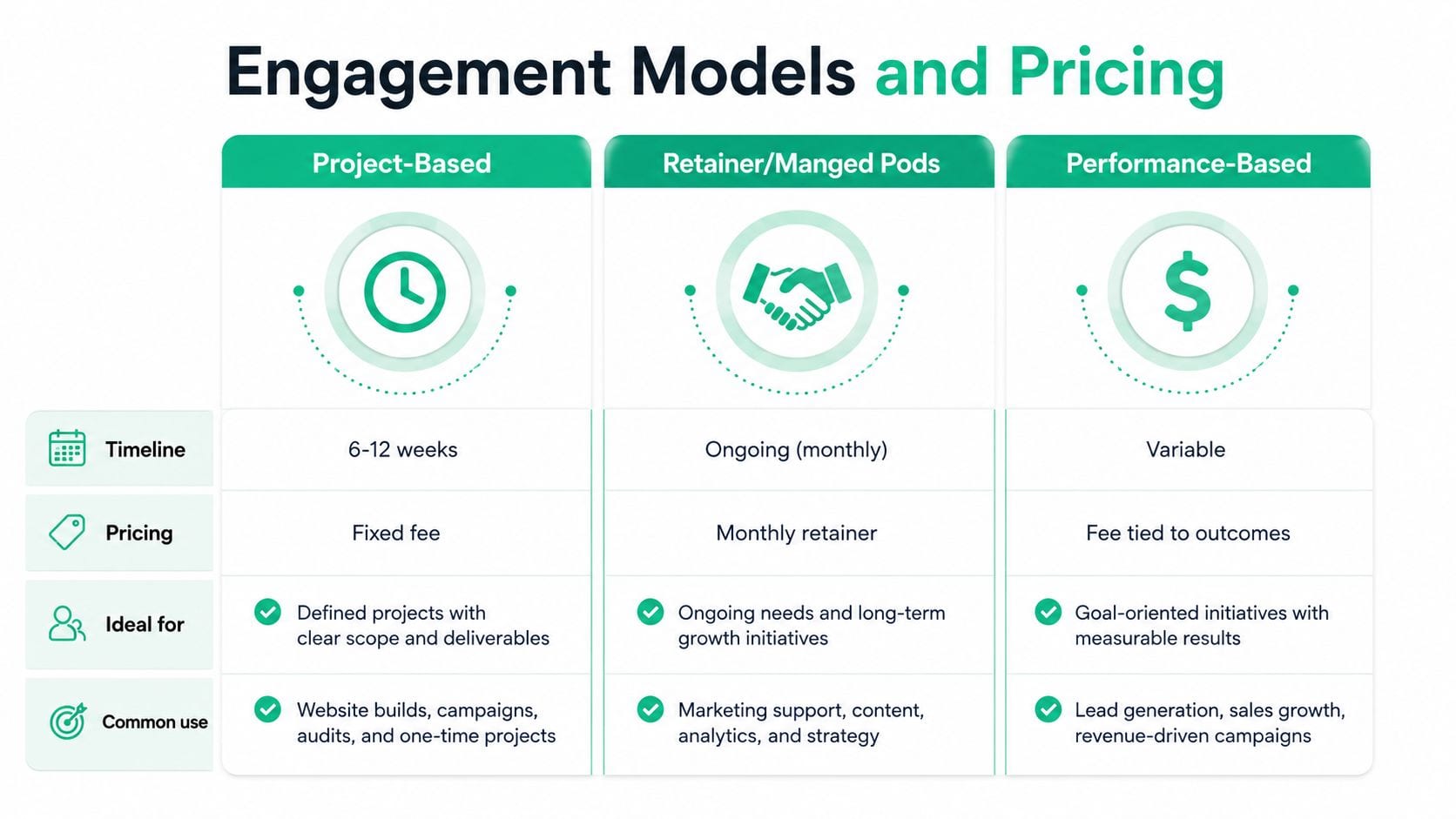
A growth strategy engagement should match the decision the business needs to make. If the work is about getting to a clear answer quickly, a project-based advisory model is usually the right fit. If the business needs ongoing pressure, iteration, and coordination across teams, a retainer or managed pod is a better fit. If the result can be measured cleanly and both sides agree on the levers, outcome-based pricing can work.
Match the model to the decision, not to the pitch
Use project-based work when the scope is tight and the question is specific. It works well for market entry, growth diagnosis, and prioritization, because the consultant can dig in, make the call, and hand back a decision-ready recommendation. The upside is focus. The risk is execution drift if the client does not take ownership after the recommendation is delivered.
Retainers and managed pods make sense when the business needs repeated testing, cross-functional coordination, or ongoing analytical support. They work when the strategy has to stay close to the operating team long enough to be used, not just approved. The risk is dependency. If the consultant becomes the only person who understands the logic, the business has not learned enough.
Performance-based structures sound attractive because payment tracks results. They only work when the outcome is measurable in a clean way and the parties agree on which inputs affect it. If attribution is muddy, the pricing model becomes a dispute before the work even starts. For a closer look at how advisory work can connect to agency execution, the performance marketing agency guide is a useful reference.
A simple decision rule helps.
- Choose project-based advisory when you need diagnosis and direction.
- Choose a retainer or pod when you need momentum and continuous refinement.
- Choose outcome-based pricing when the metric is clean, the time horizon is clear, and both sides trust the measurement.
For agencies, the partner resources for agencies show why measurement discipline matters across client accounts. Growth consulting only helps when the data stays trustworthy enough to support the recommendation.
The market reflects that reality. Buyers use consultants for different kinds of decisions, from one-off strategic questions to longer operating support, which is why the pricing model has to fit the job instead of the other way around.
How to Choose and Work With the Right Consultant
Start with the work, not the logo. A strong firm can explain the problem it solved, the data it relied on, and the decision that changed because of the analysis. If the case studies stay vague and lean on generic uplift language, keep moving.
A consultant worth hiring should show how it turns messy growth questions into decisions the team can act on. That means clear hypotheses, clean inputs, and a path from recommendation to ownership. It also means the firm can explain how it checks the measurement layer before it trusts the answer. For examples of work that translates into action, see the customer stories.
What to ask before you sign
Ask who will do the work. Partners sell the engagement, but managers and analysts shape the output, and that is the team you need to evaluate. Ask how the firm controls scope, how it protects the historical data set, and how it keeps the client team aligned when the work gets messy.
The scoping standard should be tight. A good consulting process from the Portuguese guide says discovery should identify 3 to 5 core strategic questions and should use 2 to 3 years of historical data across revenue by product line, customer segment, and geography, plus gross margin, contribution margin, customer acquisition cost, and retention rates in the Rework Portuguese guide. That is not bureaucracy. It is how you avoid a sprawling engagement that cannot be tested, owned, or defended when the numbers change.
Ask how the consultant treats analytics QA. If event definitions are inconsistent, pixels are broken, or reporting logic shifts after the fact, the strategy will be built on sand. A real advisor should want the measurement layer checked early, because growth recommendations only matter if the data can support them.
The client's job is not to admire the consultant's process. The client's job is to make decisions and assign owners.
How to run the kickoff the right way
Kickoff should lock down decision rights, data access, and the exact deliverable that counts as done. If the consultant is asked to own the work while the client stays passive, the project will stall the moment a hard trade-off appears. Treat it as a joint engagement from day one.
If you want a practical lens on how growth-oriented service firms package this work, the performance marketing agency guide is a useful complement because it shows how client-side demand for execution and strategy often overlaps.
You should also ask how knowledge transfer happens. A good engagement leaves behind a roadmap the internal team can use, not a PDF that sits in a shared drive. The firm should be able to point to a customer story that shows the work translated into action, not just approval.
Pitfalls, Red Flags, and How to Avoid Them
The first red flag is a strategy built on vanity metrics. If the deck celebrates traffic, impressions, or raw leads without tying them to margin, pipeline quality, or retention, the team is probably decorating the problem instead of solving it. The symptom shows up fast, everyone is busy, but revenue doesn't move in the way the forecast promised.
The second is a roadmap with no owner and no budget line. That usually means the consultant optimized for agreement, not execution. The recommendation sounded balanced in the room, but nobody was prepared to pay for it or run it.
The third is a model that assumes attribution is trustworthy when the stack hasn't been checked. Broken pixels, consent changes, and rogue events can make a good plan look bad and a bad plan look good. Once that happens, the team debates dashboards instead of decisions.
A quick checklist before you greenlight an engagement
- Demand a clear decision question. If the problem statement is fuzzy, the strategy will be fuzzy too.
- Insist on the source data. If the consultant won't show what it used, don't trust the recommendation.
- Check for ownership. Every initiative needs a named owner, not just a slide title.
- Verify tracking before launch. The measurement layer should be validated before the plan starts driving spend.
- Ask what would change the answer. A real strategy has assumptions, and they should be explicit.
The cheapest insurance against post-strategy decay is a strong tracking plan and continuous QA. Without that, recommendations rot after launch, and nobody can tell whether the problem was the idea or the instrumentation.
If you want growth decisions that survive contact with production, build the measurement layer first and keep it under control after launch. Trackingplan helps teams do exactly that, with automated analytics QA, observability, and tracking-plan governance across web, app, and server-side stacks. Visit Trackingplan if you want your next growth strategy to stay trustworthy after the deck is gone.