
Key Takeaways
Why measurement plans fail: Myths and realities
Most teams stumble before they even start. They open a spreadsheet, list some metrics, build a dashboard, and call it a measurement plan. What they have built is a reporting layer, not a measurement strategy for marketing. The distinction matters because a reporting layer answers “what happened last month,” while a true measurement plan answers “did our marketing drive business outcomes and how do we know?”
A few myths keep teams stuck in that reporting layer:
- “Last-click shows all.” Last-click attribution is a starting point, not a conclusion. It systematically ignores every touchpoint before the final click, which means brand campaigns, content, and mid-funnel channels look useless even when they are doing the heaviest lifting.
- “More data means more insight.” More data without a clear question attached to it produces noise. Teams that collect every possible event without a plan for using that data spend more time debugging dashboards than making decisions.
- “Attribution proves causation.” Attribution models show correlation patterns across touchpoints. They do not prove that a channel caused a conversion. Confusing the two leads to budget decisions based on coincidence.
- “One methodology is enough.” Modern measurement requires a portfolio approach combining attribution, marketing mix modeling (MMM), and incrementality testing, because no single method answers every question.
“The biggest risk in marketing measurement is not measuring the wrong thing. It is measuring the right thing incorrectly and trusting it anyway.”
The reality is that analytics-driven ROI gains only materialize when teams connect every metric to a business goal and account for the blind spots in every model they use. If you cannot explain what business question a metric answers, it should not be in your plan. Learning how to measure marketing effectiveness starts with that discipline.
The essential building blocks of a marketing measurement plan
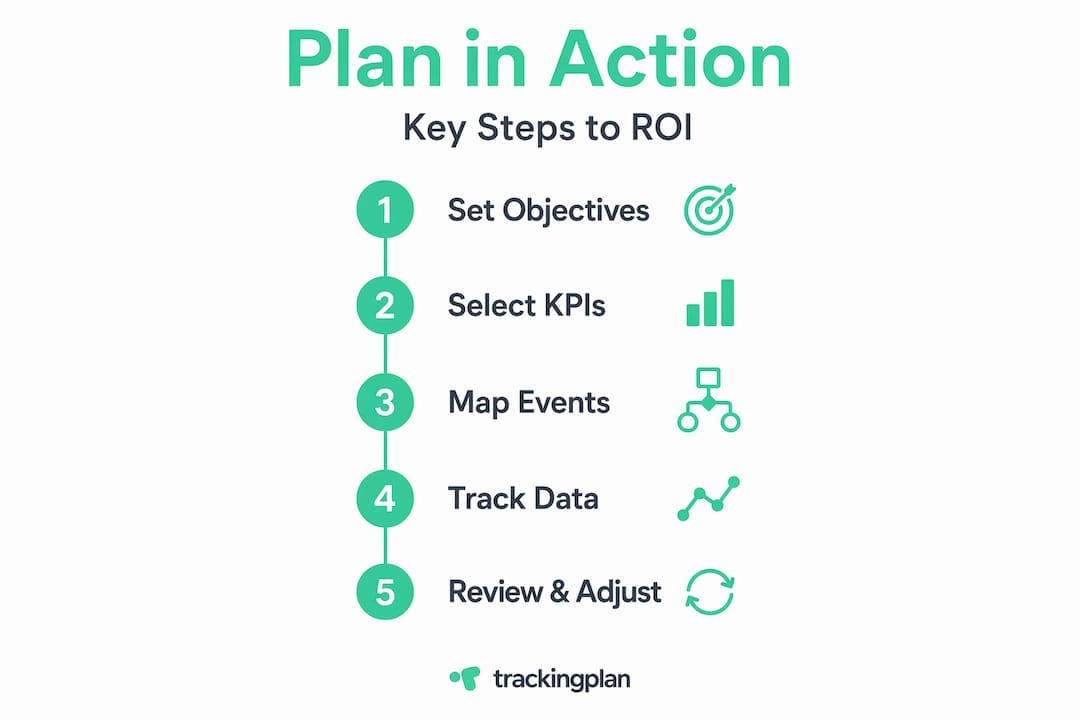
Every solid marketing measurement plan shares the same structural DNA, regardless of company size or channel mix. Here is the sequence that works:
- Define business objectives. Start at the top. Revenue growth, customer acquisition, retention, market share expansion. Every measurement decision flows from here.
- Map objectives to measurable KPIs. Each objective needs at least one KPI that can be tracked reliably. “Grow revenue” maps to customer lifetime value and new revenue by channel. “Improve retention” maps to churn rate and repeat purchase rate.
- Identify required data sources. Determine which systems must contribute data: first-party web and app analytics, CRM, paid media platforms, email tools, and offline conversion feeds.
- Define your event and parameter taxonomy. Document exactly which events fire on which pages or actions, what parameters each event carries, and what naming conventions apply across platforms.
- Set a reporting cadence. Weekly operational reviews, monthly channel performance reviews, and quarterly strategic reviews serve different audiences and different decisions. Build all three into the plan.
- Assign ownership. Every metric needs an owner who is responsible for its accuracy and its interpretation.
A practical measurement plan that aligns to business objectives from the start avoids the most common failure mode: a collection of metrics nobody acts on. Connecting this to marketing observability fundamentals ensures your tracking infrastructure supports the plan rather than undermining it.
The strategic marketing roadmaps that perform best treat measurement as a core part of strategy, not an afterthought. Your tracking setup must be built to support the plan, which means accurate digital tracking is not optional.
Pro Tip: Build your event taxonomy in a shared document before you touch any analytics platform. Naming inconsistencies introduced early compound into months of data cleanup later. A tracking dictionary with event names, parameter definitions, and expected values is the single most underrated asset in any analytics team.
Choosing and connecting KPIs: The hierarchy that matters
KPIs without a hierarchy are just a list. A list does not tell you which number matters most when two metrics move in opposite directions. A hierarchy does.
The three-tier structure that works best:
- North-star KPIs. One or two metrics that represent overall marketing health and connect directly to business outcomes. Examples: marketing-sourced revenue, customer acquisition cost (CAC) relative to lifetime value (LTV). BCG research confirms that aligning on a small set of shared north-star KPIs resolves the contradictory reports that emerge when different teams use different measurement systems.
- Campaign and channel KPIs. Metrics that explain performance at the channel or campaign level: cost per lead by channel, return on ad spend (ROAS), email-to-pipeline conversion rate. These connect directly to the north-star but sit one level down.
- Tactical KPIs. Operational metrics that diagnose execution quality: click-through rate, landing page conversion rate, ad frequency, bounce rate. These are useful for troubleshooting but should never drive budget decisions on their own.
The table below shows how each tier connects:
Vanity metrics live at the tactical tier but get promoted to the campaign tier all the time. Impressions, followers, and raw traffic numbers feel good in a report but rarely connect to revenue. The discipline of measuring effectiveness requires resisting the pull of metrics that are easy to move but hard to connect to outcomes.

One more thing: KPIs go stale. A metric that was meaningful in 2023 may be irrelevant now because your product, your customer, or your channel mix has changed. Build a quarterly KPI review into your plan. Website KPI selection follows the same logic, where the metrics you track should reflect your current business model, not the one you had two years ago.
Attribution, modeling, and incrementality: Building a portfolio approach
Attribution is where most measurement plans get overconfident. A single attribution model feels definitive. It assigns credit, produces numbers, and creates the illusion of certainty. But no single methodology answers every measurement question, which is why a portfolio approach is the standard for teams serious about marketing ROI analysis.
Here is how the three core methods divide the work:
- Attribution modeling (last-click, linear, data-driven) maps touchpoints to conversions. It is fast, always-on, and useful for conversion optimization. Its weakness is that it measures correlation, not causation, and it systematically biases toward last-click when purchase cycles span multiple touchpoints.
- Marketing mix modeling (MMM) uses statistical regression across historical spend and revenue data to estimate channel contribution. It captures offline effects and long-term brand impact. Its weakness is that it requires significant data history and does not update in real time.
- Incrementality testing runs controlled experiments (holdout groups, geo-based tests) to measure the actual lift a channel or campaign produced. It is the closest thing to causal proof in marketing. Its weakness is that it takes time and requires careful experimental design.“The question is not which model is best.
The question is which model answers the specific business question you are asking right now.”
The right way to use these together: use attribution for day-to-day optimization, MMM for quarterly budget allocation, and incrementality testing to validate assumptions before major spend decisions. Understanding the marketing attribution guide for modern marketers helps clarify where each method fits. For a deeper look at how models differ, the attribution modeling overview covers the tradeoffs clearly.
Multi-channel funnel strategies that ignore this portfolio logic tend to over-invest in bottom-funnel channels and starve the demand-creation activities that fill the top. Your attribution workflow setup should reflect which questions each method is built to answer.
Pro Tip: Before running an incrementality test, write down your hypothesis and the minimum detectable effect you care about. Teams that skip this step often run tests too short or too small to produce statistically meaningful results, then make budget decisions on inconclusive data anyway.
Technical tracking: Mapping events, parameters, and data sources
A measurement plan is only as good as the data feeding it. This is where strategy meets implementation, and where most plans quietly fall apart. You can have a perfect KPI hierarchy and a sophisticated attribution model, but if your events are misfiring, your parameters are inconsistently named, or your CRM data is not connected to your analytics platform, none of it holds up.
Here is the hands-on process for getting the technical layer right:
- List every business-critical event. Start with conversions (purchases, form submissions, sign-ups), then work backward to micro-conversions (add to cart, product view, content download) and engagement signals (scroll depth, video plays, session duration).
- Define parameters for each event. Every event should carry the context needed to answer your measurement questions. A purchase event needs value, currency, product ID, and source/medium at minimum. A lead form submission needs form name, page URL, and campaign ID.
- Establish technical mappings. Document how each event in your plan maps to your analytics platform (GA4, for example), your tag management system (Google Tag Manager), and your CRM. A measurement plan should define this event and parameter taxonomy explicitly, not leave it to developer interpretation.
- Include consent and conversion value signals. Measurement reliability depends on first-party signals, connected CRM and website data, consent-aware enhanced conversions, and accurate conversion value signals. These are not optional extras. They are foundational to defensible data.
- Maintain a tracking dictionary. A living document that lists every event, its parameters, expected values, firing conditions, and the team member responsible for it. This is your single source of truth for troubleshooting and onboarding.
GA4 event setup and anomaly detection go hand in hand. When an event stops firing or a parameter value changes unexpectedly, you need to know immediately, not three weeks later when a campaign report looks wrong. Following GA4 tracking best practices keeps your data foundation solid as platforms and traffic sources evolve.
Our perspective: The measurement plan most teams are missing is not a dashboard
Here is an uncomfortable truth. Most teams that think they have a measurement plan actually have a reporting schedule. They have a dashboard that refreshes weekly, a monthly review meeting, and a set of metrics everyone has agreed to watch. That is not a measurement plan. That is a surveillance system for data that may or may not be accurate.
The real gap is not in the metrics chosen or the tools used. It is in the connection between data and decisions. A genuine performance measurement framework forces you to answer three questions before you ever look at a number: What decision will this metric inform? Who is responsible for acting on it? And what would we do differently if this number moved up or down?
We see this constantly in teams using sophisticated analytics stacks. They have GA4, a CDP, a BI tool, and a paid media platform all connected. But when a campaign underperforms, nobody can agree on which number to trust or what it means for next month’s budget. The data is there. The plan is not.
The best marketing analytics strategy we have seen treats measurement as a decision-making protocol, not a reporting exercise. Every metric in the plan has a pre-agreed response. If CAC rises above a threshold, here is what we do. If ROAS drops below a target, here is the escalation path. If a channel’s incrementality test comes back flat, here is how we reallocate. That level of specificity turns a measurement plan from a document into a genuine operating system for marketing.
The other thing most articles will not tell you: your tracking infrastructure will break. Events will stop firing. Parameters will get renamed in a platform update. A developer will push a change that silently drops a conversion tag. Building a measurement plan without a monitoring layer is like building a navigation system without GPS signal checks. You need automated alerts, regular audits, and a clear process for diagnosing and fixing tracking issues before they corrupt your data and your decisions.
Keep your measurement plan honest with automated monitoring
Building a measurement plan is the strategic work. Keeping it accurate is the operational work, and it never stops. Tracking errors, broken pixels, and schema mismatches do not announce themselves. They quietly corrupt your data while your reports keep running.

Trackingplan monitors your entire analytics and attribution implementation in real time, alerting your team the moment something breaks, drifts, or fires incorrectly. From pixel monitoring and GA4 anomaly detection to campaign misconfiguration alerts and privacy compliance checks, Trackingplan gives marketing and analytics teams the confidence that the data feeding their measurement plan is actually reliable. If you have invested the time to build a proper measurement plan, automated monitoring is what protects that investment every single day.
Frequently asked questions
What is the first step in creating a marketing measurement plan?
Start by aligning measurement to your business objectives, then identify the specific outcomes you need to track before selecting any metrics or tools.
How often should a marketing measurement plan be updated?
Plans should be reviewed at least quarterly, since leading marketers update MMM frequently and use AI-assisted refreshes to keep models current as business conditions change.
Why is last-click attribution not enough for most businesses?
Last-click misses the full journey and shows correlation rather than causation, which distorts budget decisions for any business with a multi-step or multi-day purchase cycle.
What data sources are most important to connect for reliable measurement?
First-party signals, CRM data, website and app analytics, and enhanced conversion signals are the core data sources that make measurement defensible and accurate.
What’s the role of incrementality testing in a measurement plan?
Incrementality testing proves whether a marketing activity caused actual results rather than simply coinciding with them, making it the most reliable tool for validating major budget decisions.