
Your dashboard says there were fewer signups this week. Product analytics says the number is stable. Marketing has a third figure, and engineering insists the implementation is working. After some digging, you find signup_completed, Signup Completed, and a mistyped variant collecting the same behavior in different places.
That isn't primarily a dashboard problem. It's a data-model problem. A durable event taxonomy gives teams a shared, machine-readable system for naming events, defining their properties, assigning ownership, and controlling how the schema changes over time. The strongest taxonomies don't sit untouched in a planning document. They behave more like maintained software, with versioning, validation, release controls, privacy boundaries, and regular decay audits.
Why Event Taxonomy Matters for Analytics Quality
A product team can make one small tracking mistake and create a large measurement dispute. One implementation example contains 7 tracked events, with volumes ranging from 1,240,000 page views to 62 instances of a mistyped signup event. That contrast shows how a typo doesn't need high volume to cause trouble. It can still create a parallel metric for the same behavior and leave analysts debating which event represents reality. The figures and example appear in this autogenerated event taxonomy document.

The immediate temptation is to rename the bad event and update the dashboard. That fix is incomplete. Historical data still contains the old name, destination mappings may treat the two events differently, and another team can recreate the same inconsistency unless the organization has a controlled vocabulary and a review mechanism.
Event taxonomy is the structured naming and categorization layer that makes user-action data machine-readable across products. It defines what an event means, which properties describe it, how those properties are typed, and who is responsible for its definition. A tracking plan is the operational expression of that taxonomy, not a substitute for one.
The cost of ambiguous meaning
Consider a checkout flow. One team records a button click, another records an order confirmation, and a third records a payment response from the server. All three may use a name resembling purchase, yet they represent different business moments. Analysts can't safely build a funnel until they understand the distinction.
A useful taxonomy separates the business entity, the action, and the context. It also distinguishes events that signal user intent from events that confirm a completed system outcome. Resources covering event data categories can help teams think more clearly about the kinds of activity they collect, but the final vocabulary must reflect the product's own domain.
Practical rule: If two analysts can interpret the same event name differently, the taxonomy hasn't finished its job.
Naming discipline also supports implementation quality across tools. A clear guide to event tracking is useful when teams need to connect the taxonomy to actual instrumentation, destinations, and validation. The goal isn't a longer dictionary. It's a shared contract that lets product, marketing, engineering, and analytics answer the same question with the same data.
Auditing Your Current Event Inventory
Don't design a new naming convention from a blank page if your stack is already producing data. Start with an inventory of what fires today, including events from browser code, mobile applications, backend services, data layers, server-side forwarding, and marketing destinations.
The practical audit begins by counting every event that fired during the last 90 days, then grouping the results by exact event name, source, destination, owner, and apparent business purpose. The event taxonomy design methodology recommends using that inventory and decay review to find events that are no longer active before mapping the survivors into a controlled model.
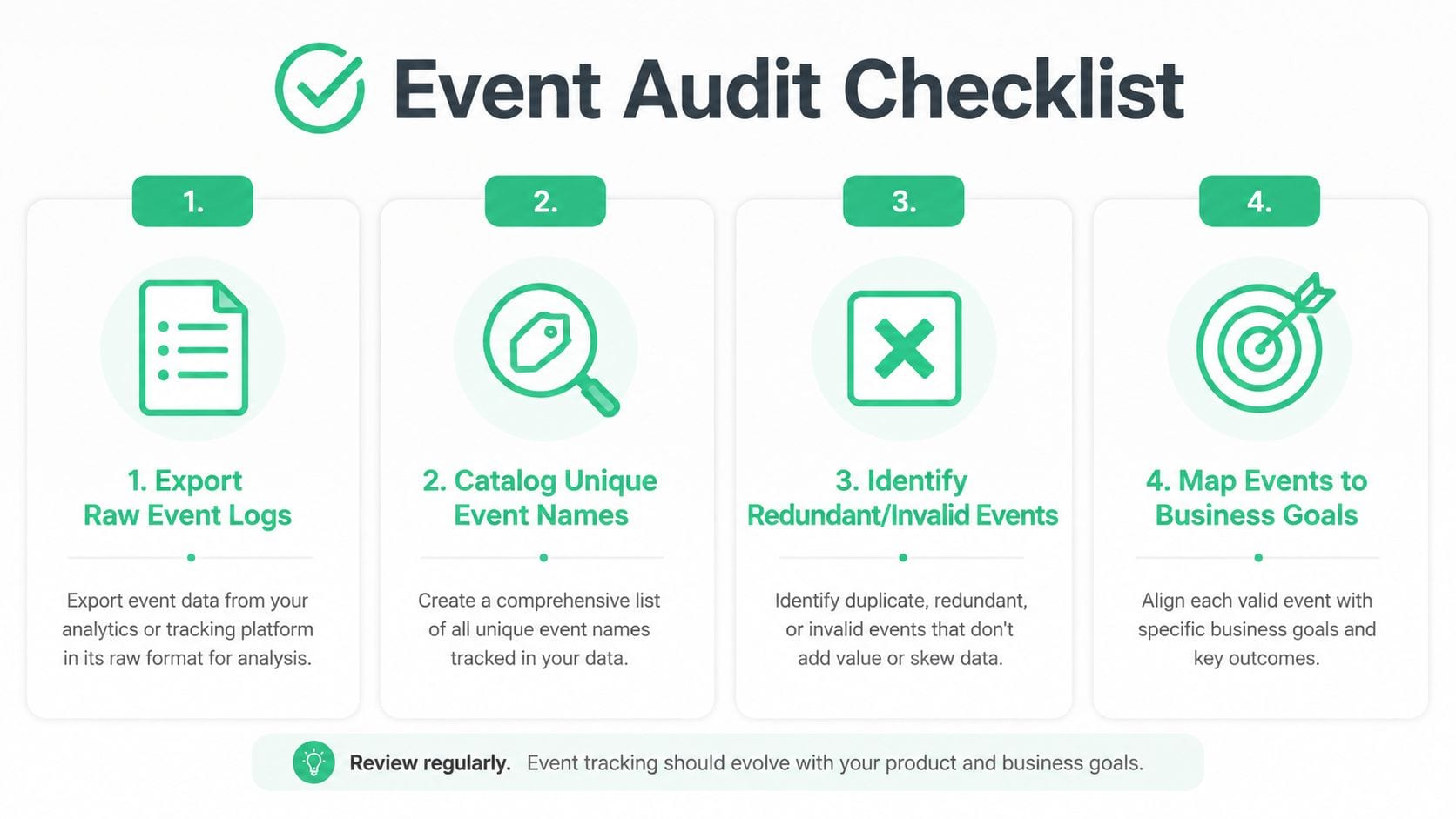
A practical audit sequence
-
Export raw event logs. Preserve the original names and payloads before applying cleanup logic. You need the raw layer to distinguish a true duplicate from an event that only looks similar.
-
Catalog unique names. Normalize the inventory for analysis, but keep the original spelling visible. Group case variants, punctuation differences, platform prefixes, and obvious typos into candidate families.
-
Identify redundant or invalid events. Mark stale events, test events, malformed payloads, and events that duplicate a more authoritative server or product event. Don't delete data before you understand downstream dependencies.
-
Map survivors to business goals. Assign each retained event to a product behavior, funnel stage, operational outcome, or reporting need. An event without a clear use should face deprecation rather than automatic preservation.
A taxonomy becomes harder to manage as an ad hoc namespace grows. The methodology recommends moving to a controlled entity model when a team has roughly more than 30 events, and mapping the remaining events into 5 to 12 canonical entities using an object-action-context approach. Those are design signals, not reasons to create artificial categories. A small product may need fewer entities, while a complex product may require a carefully governed extension.
Remove before you rename
The most common cleanup mistake is preserving every historical event “just in case.” That turns the new taxonomy into a second layer over the old one, leaving analysts to choose between duplicate names and keeping stale integrations alive.
Create explicit statuses such as active, deprecated, and removed. Assign an owner to every retained event, record its source, and document the replacement for anything deprecated. A focused analytics data quality checklist for martech teams can complement the inventory by checking whether the implementation still matches the intended measurement design.
The audit should end with a smaller, explainable event set. Only then should naming rules become the next implementation target.
Designing Naming Conventions That Scale
A scalable name tells a reader what happened without requiring a meeting. The most practical structure uses three tiers: Category, Object, and Action. A common snake_case form is {category}_{object}_{action}, which creates a predictable namespace across product areas.
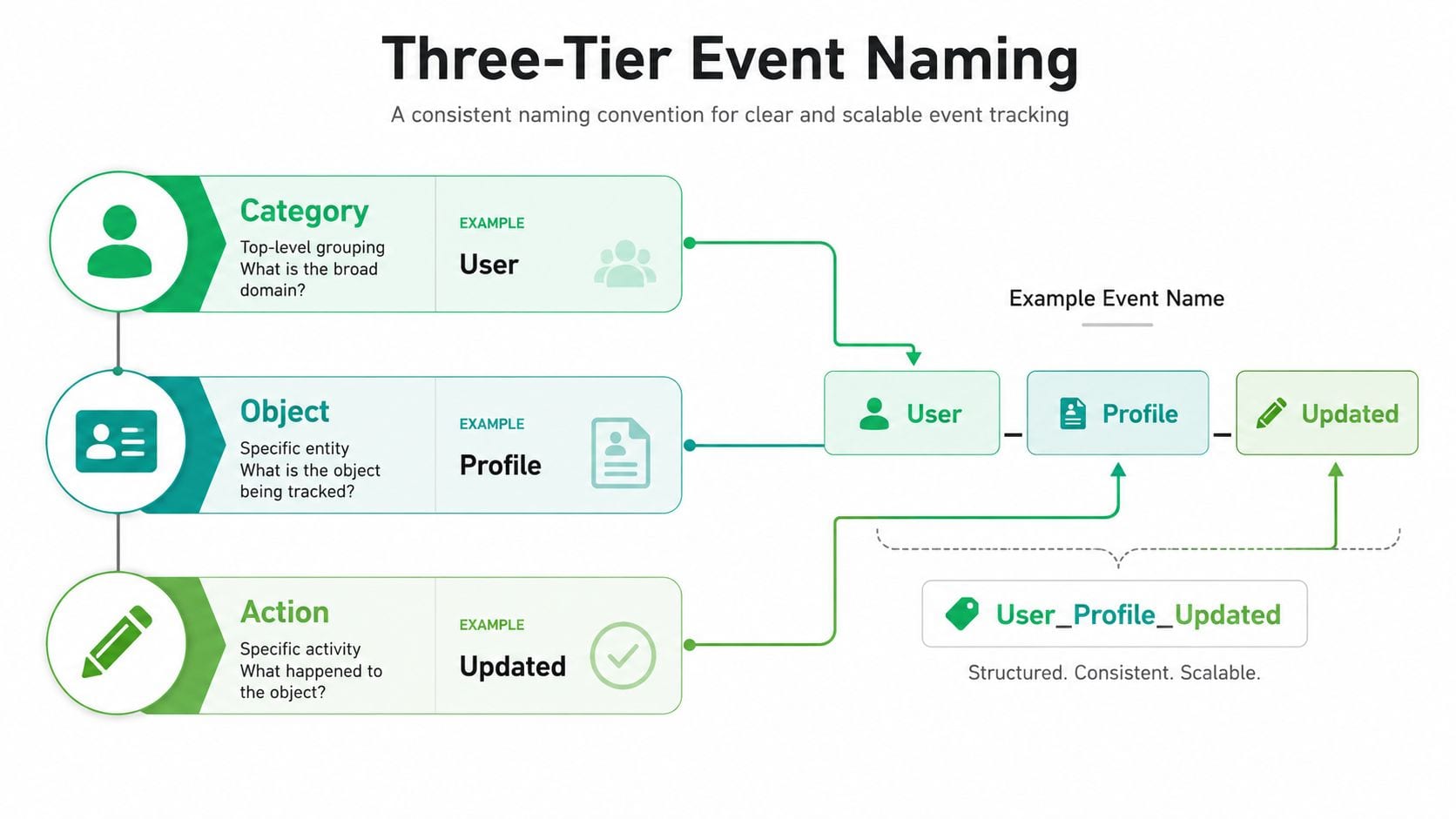
Use the hierarchy consistently
Suppose a user changes a profile. An ad hoc implementation might produce:
Profile UpdatedprofileUpdateuser_profile_changeweb_profile_saved
These names mix capitalization, tense, vocabulary, and platform context. A governed taxonomy could standardize the event as user_profile_updated, with the event name fixed and the relevant details carried in properties.
The hierarchy should be meaningful rather than decorative:
- Category groups the domain, such as
user,billing, orcontent. - Object identifies the entity being acted on, such as
profile,invoice, orarticle. - Action describes the completed behavior, such as
updated,paid, orpublished.
Use lowercase snake_case, avoid abbreviations, and don't add platform prefixes such as web_ or ios_ when the source belongs in metadata. The scalable naming guidance also recommends adding a schema_version property to every event from the beginning, rather than trying to retrofit version awareness after consumers depend on the payload.
Keep event names stable
Dynamic event names are a long-term maintenance trap. A user ID, product name, campaign value, or error message belongs in a property, not in the event name. Otherwise, the namespace expands with data values and becomes impossible to govern.
The same principle applies to tense and vocabulary. Choose whether actions describe completed behavior, then use approved verbs consistently. profile_updated and profile_saved may both sound reasonable, but if they represent the same business outcome, keeping both creates unnecessary ambiguity.
A naming convention also needs examples that developers can copy safely. A campaign naming convention guide can help extend the same discipline beyond events to campaign and attribution fields, where inconsistent labels create similar reporting problems.
A good event name should be boring to implement and easy to find in a catalog.
Naming alone won't protect the data if the payload underneath changes without review. The next layer is the property schema.
Building a Property Schema With Governance Built In
An event name tells you what happened. Properties explain the circumstances, and poorly governed properties can make a clean event namespace analytically unreliable.
Start each property definition with its business meaning, data type, required status, allowed values, sensitivity classification, owner, and example payload. Every property should receive a sensitivity tag before the taxonomy moves into a versioned schema repository. That tag might distinguish public operational data from restricted identifiers or fields that require consent review.
Separate required and optional context
Required properties should be limited to information necessary to interpret the event. Optional properties can enrich analysis, but they shouldn't be allowed to change meaning from one implementation to another. For example, currency may be mandatory for a monetary event, while promotion_code may be optional when no promotion applies.
| Attribute | Purpose | Example |
|---|---|---|
| Property name | Provides a stable field identifier | order_id |
| Type | Prevents incompatible values | string |
| Required status | Defines the minimum valid payload | Required for an order event |
| Sensitivity tag | Marks privacy and access expectations | Restricted identifier |
| Allowed values | Limits uncontrolled variations | trial, paid, cancelled |
| Owner | Assigns accountability for meaning | Billing analytics |
| Example payload | Makes implementation unambiguous | {"status":"paid"} |
Types need enforcement, not just documentation. If one service sends a quantity as a number and another sends it as text, warehouse models may coerce the values differently, and downstream calculations become fragile. Type generation from the schema can give developers safer interfaces, while runtime validation catches malformed payloads that compile-time checks can't see.
Control cardinality before reports degrade
Property-cardinality drift occurs when teams keep adding highly variable values to a field that was meant to support grouping. Reports can then collapse values into an aggregated (other) bucket, leaving analysts unable to interpret the distribution.
Use value constraints where a controlled set is appropriate. If a property needs free text, confirm that it belongs in event payloads rather than logs, session context, or a separate diagnostic system. This is also where teams can connect taxonomy governance to efforts to improve RevOps with data quality, especially when marketing, sales, and product systems depend on shared lifecycle fields.
Documentation should answer three questions quickly: what does this event mean, what properties does it carry, and who owns it? A data governance framework for analytics becomes useful when those definitions need to survive team changes, new destinations, and multiple implementation languages.
The repository should store the schema, examples, sensitivity tags, and change history together. A spreadsheet can be a helpful editing surface, but it shouldn't be the only enforcement layer.
Versioning and Validation for Long-Term Stability
A taxonomy without versioning forces teams to treat every change as if it were harmless. Adding a clearly optional field may be compatible, while changing a property type, removing a required field, or redefining an event can invalidate existing consumers.
Give each event a lifecycle record containing its owner, status, example payload, source, and schema version. The event taxonomy glossary frames taxonomy as more than naming, including ownership, validation, privacy boundaries, and the separation between entity-event modeling and the user-facing tracking plan.
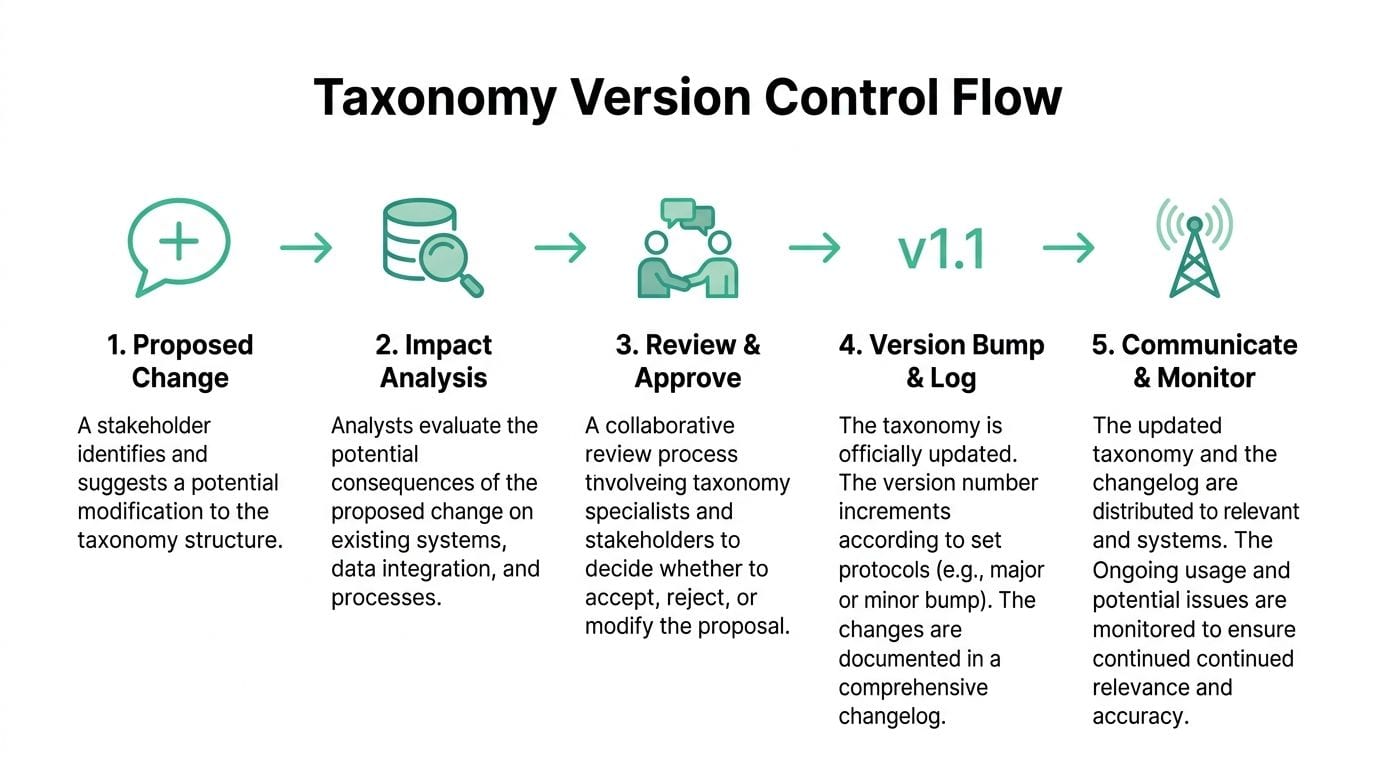
Make changes pass through a gate
A workable change flow looks like this:
- Proposed change: The implementer explains the new event or modification and identifies the business need.
- Impact analysis: The owner checks dashboards, warehouse models, destinations, audience definitions, and downstream automations.
- Review and approval: Analytics, engineering, product, and privacy stakeholders review the effect and decide whether the change is compatible.
- Version bump and log: The repository records the new version, rationale, effective date, and migration path.
- Communication and monitoring: Consumers receive the change, while validation and volume monitoring check the live result.
Runtime validation should reject or quarantine payloads with missing mandatory properties, invalid types, unapproved values, or unauthorized sensitive fields. Whether the system blocks the event or routes it for review depends on business criticality, but accepting malformed data is the worst option.
Treat deprecation as a migration
Renaming an event isn't a cleanup if historical and current data need to be compared. Keep the old event in a deprecated state while consumers migrate, document the replacement, and remove it only after its dependencies have been addressed.
Release rule: No tracking change should ship without an owner, a schema decision, and a clear compatibility statement.
The repository is the source of truth, but automated checks are what keep production aligned with it. Run schema validation in CI, test representative payloads, and use release gating to stop unapproved changes before they spread across destinations.
Governance Across Privacy and Cross-Stack Measurement
Modern measurement crosses browser code, mobile apps, backend services, data layers, and advertising pixels. Each layer can introduce a missing event, an unexpected property, a schema mismatch, or a consent error. A taxonomy that only documents names in an analytics platform can't govern the full path.
The stronger approach treats taxonomy as an enforcement layer. It defines which entities and events are allowed, which properties can be collected, which fields are sensitive, and when consent is required before a payload reaches a destination.
Put privacy boundaries in the schema
PII decisions should happen before data is written, not after sensitive values have propagated into warehouses and marketing tools. Mark properties with sensitivity classifications, prohibit direct identifiers where they aren't necessary, and validate payloads at write time.
The taxonomy should distinguish the entity-event model from the user-facing tracking plan. The model describes the stable business concepts and their relationships. The tracking plan describes how each implementation expresses those concepts in a particular application or destination. Keeping those layers separate lets teams adapt implementation details without redefining the underlying business meaning.
Consent adds another dimension. A valid event may still be unauthorized for a particular destination when a user hasn't granted the required permission. Destination routing therefore belongs in governance discussions, alongside event naming and property typing.
Coordinate the entire stack
Assign owners by event and by data layer where responsibility differs. A product engineer may own the client implementation, a backend engineer may own the server confirmation, and a privacy or governance team may control destination eligibility. Those responsibilities need to be visible in the schema repository.
Cross-stack checks should compare what the product intends to send with what each destination receives. That catches rogue events, missing properties, mismatched versions, and consent misconfigurations that a static tracking plan can't reveal.
The result is a taxonomy that protects both analytical meaning and data boundaries. It doesn't merely tell teams what to call an event. It constrains what they can collect, where they can send it, and how changes are approved.
Phased Rollout Timeline and Common Failure Modes
A governance-heavy rollout needs enough structure to prevent chaos without turning every tracking change into a committee exercise. A practical sequence uses discovery for about 2 weeks, design for 2 to 4 weeks, implementation over 1 to 2 sprints, and validation for roughly 1 week per wave, followed by weekly or monthly audits and quarterly retrospectives. These phases and durations are outlined in the event taxonomy governance framework.
A rollout that preserves delivery speed
During discovery, export the event inventory, identify owners, locate duplicates, and list destination dependencies. Design then produces the canonical entities, naming rules, property definitions, sensitivity tags, lifecycle statuses, and migration decisions.
Implementation should begin with a representative product surface rather than every team at once. Build the schema repository, generated types, runtime checks, and release gates around that wave. Validation should compare the intended payloads with live traffic and confirm that dashboards, warehouse models, and destinations still receive the expected fields.
Ongoing audits prevent the rollout from becoming another abandoned document. Review event volume, unused names, owner coverage, property completeness, and schema violations. A quarterly retrospective can address whether the vocabulary still reflects the product and whether teams are creating workarounds outside the governed path.
Failure modes to catch early
- Over-instrumentation: Teams track every interaction without separating diagnostic detail from business events. The catalog becomes difficult to navigate, so analysts choose inconsistently.
- Cardinality drift: Developers add uncontrolled values to grouping properties. Reports move values into
(other), and the original analytical purpose weakens. - Unreviewed changes: An engineer modifies a required field or changes a type without checking consumers. Dashboards may continue running while their interpretation changes.
- Stale ownership: An event remains active after its original owner changes teams. Nobody can explain its meaning or approve its evolution.
- Unmanaged deprecation: A new name replaces an old one without a migration period. Time series split, and historical comparisons become harder.
Mandatory properties, value constraints, sensitivity checks, and release gating address these risks at the point of change. Decay audits address the risks that accumulate afterward. The combination is what turns an event taxonomy into maintained infrastructure rather than a naming exercise.
A practical next step is to export your current event inventory, select a small implementation wave, and create the first pull-request gate around names, properties, ownership, and compatibility. Trackingplan can continuously discover analytics schemas across web, app, and server-side traffic, monitor events and properties across destinations, and alert teams to anomalies, mismatches, rogue events, consent issues, and potential PII leaks. Visit Trackingplan to evaluate how that observability layer could support your taxonomy governance.