Discover how marketing observability differs from data observability. Compare tools, use cases, and features to protect your analytics and ad spend.
You can launch a campaign, watch the dashboards light up, and still miss the one thing that matters. The pixel can break, the server event can rename a field, consent can suppress half your traffic, and nobody notices until someone asks why attribution went dark or why a clean funnel suddenly looks empty. That's the operational pain behind marketing observability, and it's why the category has moved from a nice-to-have to a real control layer for digital teams.
The market movement is hard to ignore. One observability estimate places the global tool market at USD 3.40 billion in 2026 and USD 7.13 billion by 2033 at 11.1% CAGR, while another forecasts USD 3.35 billion in 2026 to USD 6.93 billion by 2031 at 15.62% CAGR. Data-specific observability is also scaling fast, with estimates ranging from USD 2.14 billion in 2023 to USD 4.73 billion by 2030 at 12.2% CAGR, and USD 2.94 billion in 2025 to USD 6.02 billion by 2030 at 15.4% CAGR. Those numbers matter because they show observability isn't confined to infrastructure teams anymore, it's becoming part of how companies protect measurement quality across the stack. observability tool market forecast
When Your Tracking Breaks at 2 AM
A campaign goes live on Monday morning. Ads are spending, the landing page looks fine, and the daily report still shows traffic. By Wednesday, an analyst notices that the purchase event is missing from a segment of users, the attribution model has gaps, and one of the tags started sending malformed payloads after a mobile app release. The team didn't see a hard outage, they saw a slow leak in trust.
The failure mode is usually silent
That silence is what makes tracking validation so important. Broken pixels, renamed event properties, consent misconfigurations, and missing parameters rarely announce themselves in a way that a normal dashboard can catch quickly. If you've ever had to cross-check campaign health manually, the difference between a clean launch and a quiet failure is often a few hours of validation that never happened. A practical companion check for the same problem is an email spam checker when your campaign relies on email-triggered traffic, because bad deliverability can look like a tracking problem until you separate the sources.
Marketing observability starts with the layer where the customer interaction is collected, validated, and routed. Data observability lives downstream, where pipelines, warehouses, and transformations are inspected after data has already moved into the system. The terms sound similar, but the operational surface is different.
Practical rule: if the event never fired correctly, warehouse checks won't save you. If the event fired correctly but got mangled later, marketing-layer checks won't catch that either.
That distinction is why this topic is showing up in broader observability conversations at all. The question is no longer whether a team can monitor systems, it's where the failure first appears, and who owns the fix. If you want a deeper look at the silent-failure side of the problem, see Trackingplan's guide to silent tracking errors.
Marketing Observability vs Data Observability Comparison
The cleanest way to think about this comparison is by failure domain. Marketing observability watches the collection layer, where pixels, tags, SDK events, and server-side hits are supposed to reflect what users did. Data observability watches the pipeline layer, where already-collected data is expected to move through transformation and storage without corruption. CDP monitoring sits between those worlds, focused on delivery and routing inside a customer data platform.
Different tools, different root causes
Trackingplan's strength is automatic identification of broken tracking events, which is a different job from anomaly detection in a warehouse pipeline. Monte Carlo is built for data observability and warehouse root-cause analysis, so it fits teams whose problems show up as schema drift, freshness issues, or pipeline anomalies. Segment is a strong fit for users who need CDP delivery monitoring, because the core question there is whether data is reaching the right destinations reliably. For a broader explainer on the warehouse side, this data observability overview is a useful companion read.
| Capability | Marketing Observability (Trackingplan) | Data Observability (Monte Carlo) | CDP Monitoring (Segment) |
|---|---|---|---|
| AI-powered debugging | Automatic root-cause identification for broken events and tracking defects | Anomaly detection in pipelines and downstream data behavior | Data delivery monitoring inside the CDP |
| Real-time monitoring | Client-side and server-side tracking validation at collection time | Often oriented toward downstream pipeline inspection | Delivery and routing checks tied to CDP flow |
| Privacy compliance | PII leak prevention and consent validation | Generic data quality checks, not usually marketing-specific | Governance support inside the CDP context |
| Primary users | Marketing teams, growth teams, agencies | Data engineers, analytics engineering teams | CDP users and platform teams |
| Best fit | Broken pixels, missing events, UTM mistakes, attribution gaps | Warehouse anomalies, transformation failures, freshness problems | Customer data routing, destination reliability, CDP orchestration |
Monte Carlo excels when the question is, “Why is the warehouse behaving strangely?” Segment excels when the question is, “Did the CDP deliver the data where it needed to go?” Trackingplan sits at the front of the chain, where the actual marketing interaction is being collected and validated. That's the specialist distinction that matters more than vendor category labels.
The biggest practical split is timing. Marketing observability validates the signal as it's collected, while many data observability workflows look at the signal after it has already moved. That difference changes who can act and how fast they can act.
Core Components of Marketing Observability
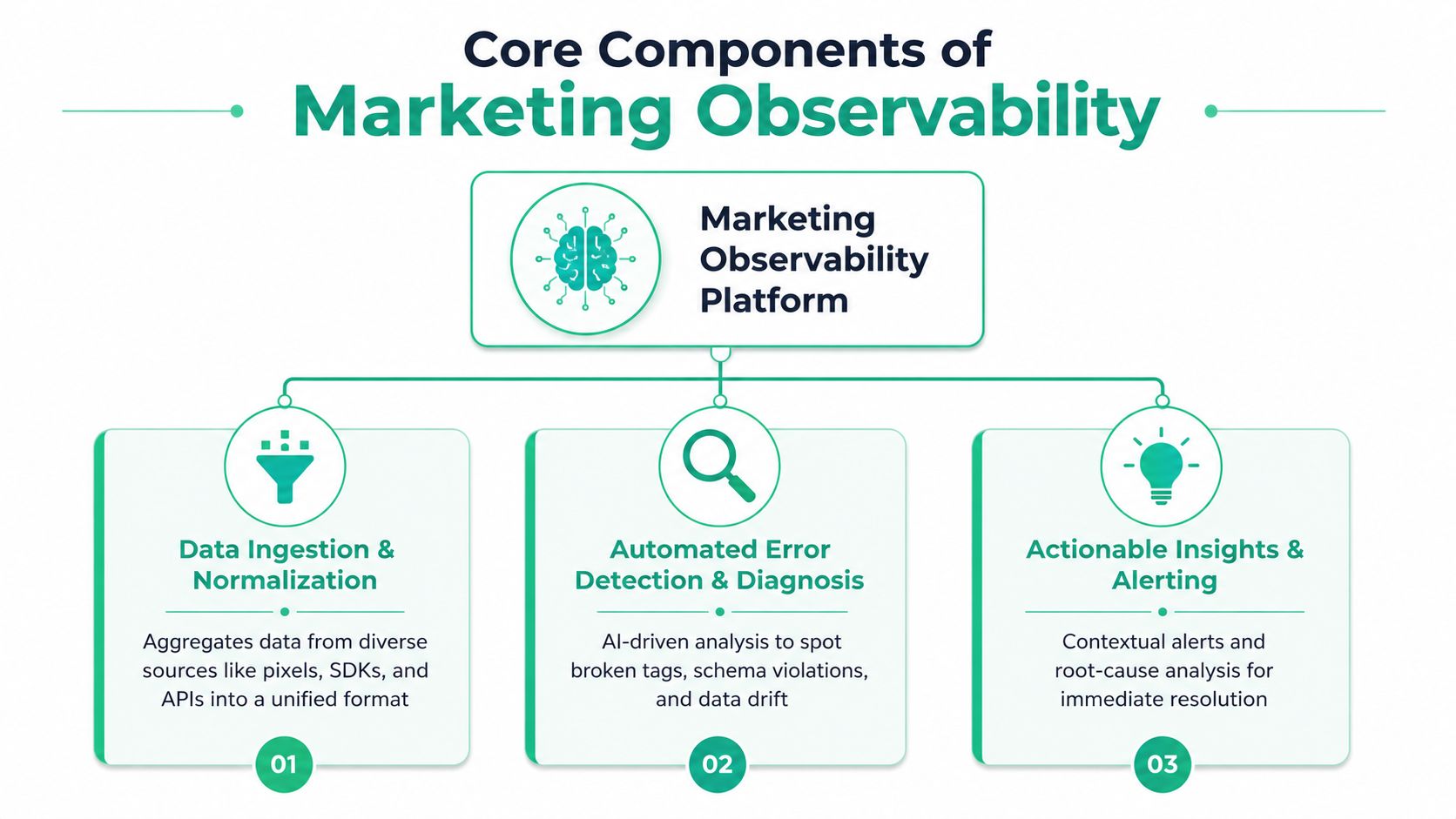
Marketing observability works only when it treats the marketing stack like an operational system, not a reporting layer. That means watching the whole path from collection to destination, then flagging problems before broken data starts shaping budget decisions. In practice, the useful layers are lineage, detection, alerting, and prevention.
What the system has to see
Lineage matters because events don't begin in the warehouse, they start in the browser, app, or server, then flow through a tag manager, then out to analytics and ad destinations. If a property is renamed in the app but not in downstream mapping, the break might not be obvious until audience suppression or attribution logic is already wrong. That's why a marketing observability stack needs to know where each event came from and where it was supposed to go. For a practical look at pixel-level monitoring, see Trackingplan's overview of marketing pixel monitoring.
The detection layer needs to watch freshness, volume, distribution, schema, and lineage together, not as isolated checks. A sudden event-volume drop can indicate a tag stopped firing. A field that flips to almost entirely null can mean a mapping changed. A schema mismatch can break downstream logic without crashing any visible dashboard. The point isn't to count errors, it's to catch the causal chain early enough that the mistake never reaches decision-making.
Alerts that lead to action
A useful alert tells the team what changed, where it changed, and what downstream reporting is likely to suffer. That's very different from a generic “something is wrong” message. In production, the best alerts are narrow enough to act on and contextual enough to assign quickly, which is why integrations with Slack, email, or Teams matter more than fancy dashboards alone.
A broken tracking implementation is usually a chain of small misses, not one dramatic failure.
Privacy and compliance monitoring belongs in the same architecture, not as a separate afterthought. If a tag starts leaking PII or consent settings drift, that's not just a governance issue, it's a measurement issue too. Marketing observability only earns its keep when it catches those problems before they spread into attribution, remarketing, and reporting.
Choosing the Right Observability for Your Team
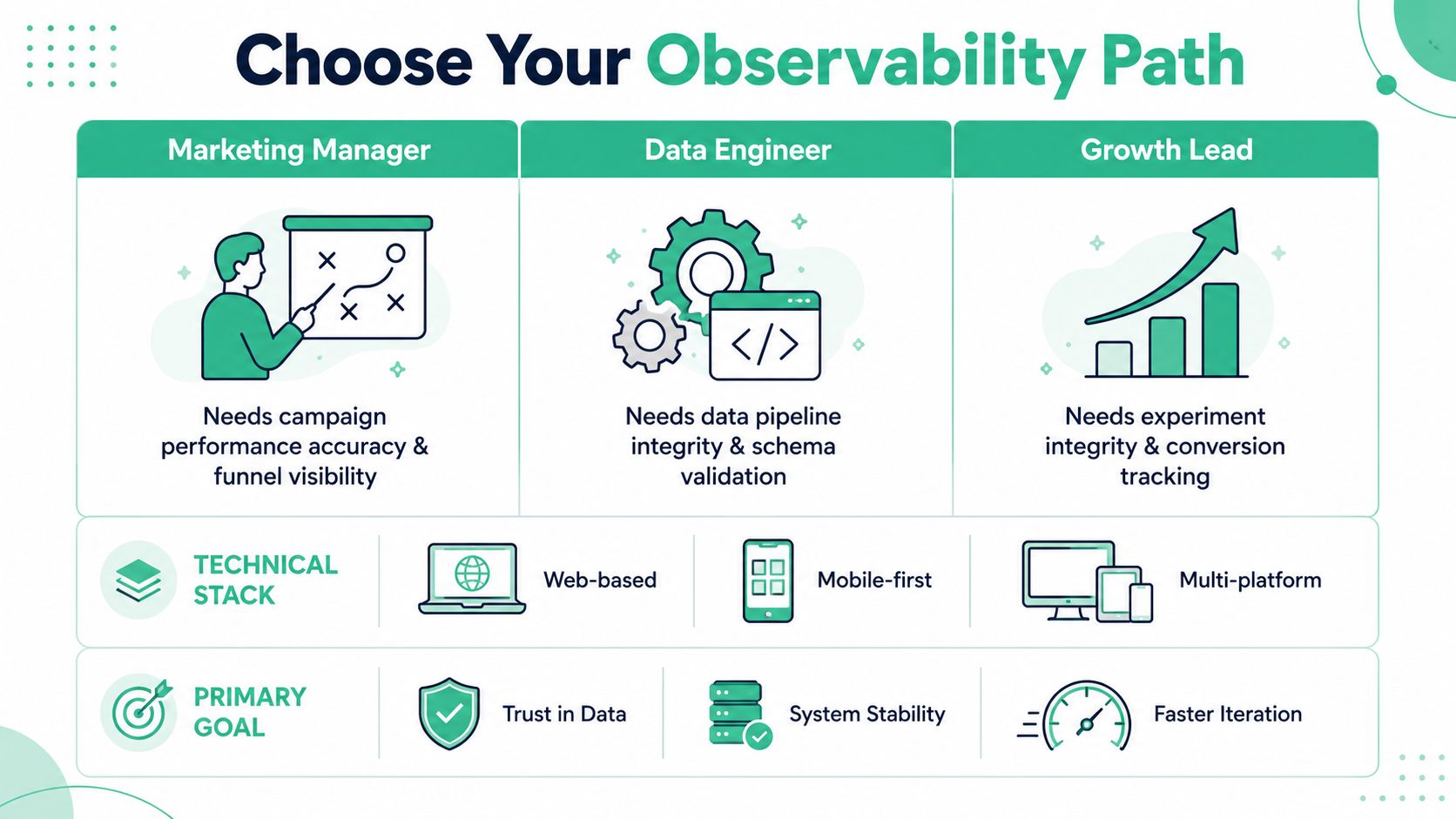
The easiest way to choose is to start with the failure you feel. If your pain is broken pixels, missing events, UTM mistakes, or campaign data that goes dark after launch, you need marketing observability. If your pain is stale warehouse data, broken transformations, or pipeline delays, you need data observability. If your pain is whether a CDP is reliably delivering data to destinations, you need CDP monitoring.
Ask the right questions
Before you buy anything, ask who is staring at the problem at 9 AM. Marketing teams and agencies usually care about campaign accuracy, funnel visibility, and cross-client consistency. Data engineers care about ingestion reliability, schema stability, and pipeline health. Growth teams care about experiment integrity, conversion tracking, and how fast they can trust results.
- What broke first? If the event itself is missing or malformed, start at the marketing layer.
- Where do we learn about it? If the problem shows up only after data lands in the warehouse, pipeline observability is the better fit.
- Who has to fix it? If a marketer or analyst can validate the issue in the browser or tag manager, marketing observability shortens the loop.
- What is the stack? If most of the risk lives in pixels, SDKs, server-side events, and ad platforms, collection-time validation matters more than downstream anomaly detection.
A careful team usually ends up with a layered approach rather than a single-tool answer. That's not indecision, it's matching the control surface to the failure surface. One layer catches collection defects, another catches transport and transformation defects.
For teams that want a concrete implementation reference, monitoring live web performance is a useful mental model because the same logic applies, problems are easiest to fix when you see them close to the moment they happen.
How Marketing and Data Observability Work Together
The two layers are not competitors, they're handoff points in the same operational chain. Marketing observability protects the front of the funnel by validating that events, pixels, and server-side hits are correct at collection time. Data observability protects what happens after ingestion by checking whether transformations, freshness, and downstream routing stay healthy.
The clean handoff
A mature stack uses marketing-layer validation to stop bad data from entering the system in the first place. If the schema is wrong, the property name changed, or consent settings suppress a key field, the issue should be caught before the event becomes part of reporting logic. Once the data is in motion, warehouse-oriented observability takes over and checks whether the downstream systems still preserve the signal.
That handoff matters because the two layers answer different questions. Marketing observability asks whether the signal is valid at the source. Data observability asks whether the system still respects that signal after processing. If both teams see the same alert stream, they can separate collection failures from transformation failures faster and stop blaming the wrong layer.
This is also where workflow discipline beats tool shopping. A browser-side defect should go to the team that owns tracking implementation. A warehouse anomaly should go to analytics engineering or data platform owners. A CDP delivery issue should go to the team managing routing and destinations. The fastest organizations don't try to make one platform do every job, they make each layer accountable for the right part of the chain.
The Privacy-First Observability Challenge
The hardest tracking problems today aren't always technical, they're constrained by what you're allowed to see. Consent mode, server-side tagging, and regulated data flows reduce client-side signal by design. That means observability can't just mean “see everything,” because in many environments you never should see everything.
Observability under constraint
Traditional monitoring assumes the full signal is available. Marketing stacks increasingly don't work that way. Browser restrictions and consent choices create blind spots, so teams have to verify measurement quality without relying on complete client-side visibility. That makes consent validation and server-side tracking checks part of observability, not separate compliance work.
A good practical reference for teams dealing with this shift is the cookieless tracking guide from Trackingplan's blog, because the measurement challenge changes once the browser stops being the primary source of truth. Another helpful discussion of the operational trade-offs appears in SourceLoop's practical cookieless tracking guide, especially for teams trying to preserve attribution quality under stricter privacy rules.
Practical rule: don't measure what you wish you still had, measure what you're legally and technically able to collect, then validate that it's consistent.
The most effective teams treat server-side routing, consent configuration, and destination behavior as part of the same validation flow. That's the only way to prove measurement quality when some of the signal is intentionally missing. In privacy-heavy environments, the goal is not perfect visibility, it's trustworthy coverage.
Implementation Roadmap and Success Metrics
Start small and make the first win obvious. Install lightweight tracking validation, catch obvious pixel failures, and fix the top broken conversion tags before the next campaign cycle. That alone usually shifts the conversation from “analytics feels unreliable” to “we can see what changed.”
A rollout that actually sticks
The next step is to wire in real-time alerting and connect it to the team's existing workflow. Slack, email, or Teams alerts are only useful if they reach the person who can fix the issue quickly. Then extend coverage to consent monitoring, server-side events, and the analytics tools the business already uses, including Google Analytics, Adobe Analytics, and major ad platforms. For an operational reference point on launch-time quality checks, this Trackingplan FAQ on detecting silent tracking errors is the right internal anchor.
- Quick wins: validate critical tags, catch missing events, and remove broken properties before launch.
- Foundation: map lineage for key events, standardize naming conventions, and train analysts and developers on the same dashboard.
- Optimization: add regression checks, review recurring defects, and keep the tracking plan current as the stack changes.
You'll know the program is working when tracking problems are found earlier, campaign launches require fewer manual audits, and the team spends less time reconciling dashboards. The best KPI set is simple, mean time to detection, percentage of campaigns launched with validated tracking, reduction in data quality incidents, and time saved on manual QA. Those measures speak to business trust, not just technical activity.
If your team keeps losing confidence in event quality, start with a layer built for marketing tracking, not a warehouse check that's always one step too late. Explore Trackingplan to see how automated tracking validation, privacy checks, and root-cause detection fit into a marketing observability workflow, then use that to decide where your stack needs collection-time protection and where it needs downstream data observability.
.avif)



.avif)