
The campaign launched on Monday. By Tuesday morning, the conversion dashboard showed a sharp decline, paid media teams were questioning attribution, and the marketing lead was asking whether the landing page had failed. The answer was less dramatic and more dangerous: a developer had renamed a dataLayer property two sprints earlier, nobody had updated the tracking plan, and the dashboards were still accepting incomplete data as if nothing had changed.
This is the hidden cost of tribal knowledge in analytics stacks. The person who knows why an event is named purchase_complete, which pixels receive it, or why one acquisition channel uses a custom attribution rule may be the only person who understands the decision. When that knowledge stays in private messages, tickets, or memory, every release creates operational risk.
Knowledge sharing for analytics teams means making tracking specifications, event schemas, attribution logic, implementation decisions, and validation rules visible and usable across marketing, engineering, analytics, and governance. It isn't an HR slogan. It's an operating discipline for keeping business data trustworthy while teams, tools, and campaigns change.
When Tribal Knowledge Breaks Your Dashboards
The first response to a broken dashboard is usually investigative. An analyst checks the reporting layer, a marketer checks campaign settings, and an engineer searches recent deployments. Each person sees a fragment of the problem, but nobody has the complete chain from business requirement to implementation to destination.
That fragmentation turns a small tracking change into a long incident. A renamed property can prevent an audience from qualifying, alter a funnel calculation, or stop an advertising platform from receiving the signal it expects. A pixel can remain present on the page while sending the wrong value. A UTM convention can drift gradually until channel reporting no longer reflects how campaigns were planned.
The knowledge that actually matters
In analytics and marketing, knowledge sharing isn't just forwarding a dashboard link. Teams need access to the reasoning behind the measurement system:
- Measurement intent: What business question does the event answer?
- Implementation detail: Which dataLayer object, SDK call, tag, or server-side request creates it?
- Transformation logic: How do pipelines clean, join, rename, or filter the data?
- Attribution rules: Which source, campaign, conversion, or touchpoint receives credit?
- Destination behavior: Which analytics, advertising, CRM, or experimentation tools consume the signal?
- Validation expectations: What should happen when the event is missing, malformed, delayed, or blocked by consent?
A static spreadsheet may document some of this, but it rarely proves that production behavior still matches the specification. That distinction matters because analytics stacks change continuously. Marketing teams add destinations, engineers refactor front-end code, privacy teams adjust consent settings, and vendors update their collection requirements.
Practical rule: Documentation describes what should happen. Observability checks what is happening.
The organizational case for solving this problem is well established. A 2017 organizational review defines knowledge sharing as exchanging information, skills, or expertise among employees and connects it with culture, informal workplace learning, performance support, and knowledge management (organizational review on knowledge sharing). A 2023 systematic review synthesized 110 articles and organized the field around enablers, processes, and outcomes, showing that researchers now treat knowledge sharing as a measurable organizational capability rather than an abstract cultural ideal (2023 systematic review).
For analytics teams, the practical conclusion is straightforward. If only one person knows how attribution works, the organization doesn't own that capability. It rents access to it until the person changes roles, takes leave, or leaves the company.
Why Analytics Teams Struggle with Knowledge Silos
Analytics work crosses ownership boundaries by design. Marketing defines what it needs to learn, engineering instruments the experience, analytics interprets the data, and governance teams determine what collection is permitted. Each group can complete its task while missing the dependencies that keep the measurement system reliable.
A request to “track qualified leads” can produce an ambiguously named event, a different definition in the reporting layer, and no destination mapping in the tracking plan. A data engineer may preserve a field in a warehouse model after the website stops sending it. None of these failures necessarily reflects poor technical ability. The underlying problem is missing shared context, and the cost appears later as broken dashboards, incorrect attribution, or pixel drift that no owner notices.
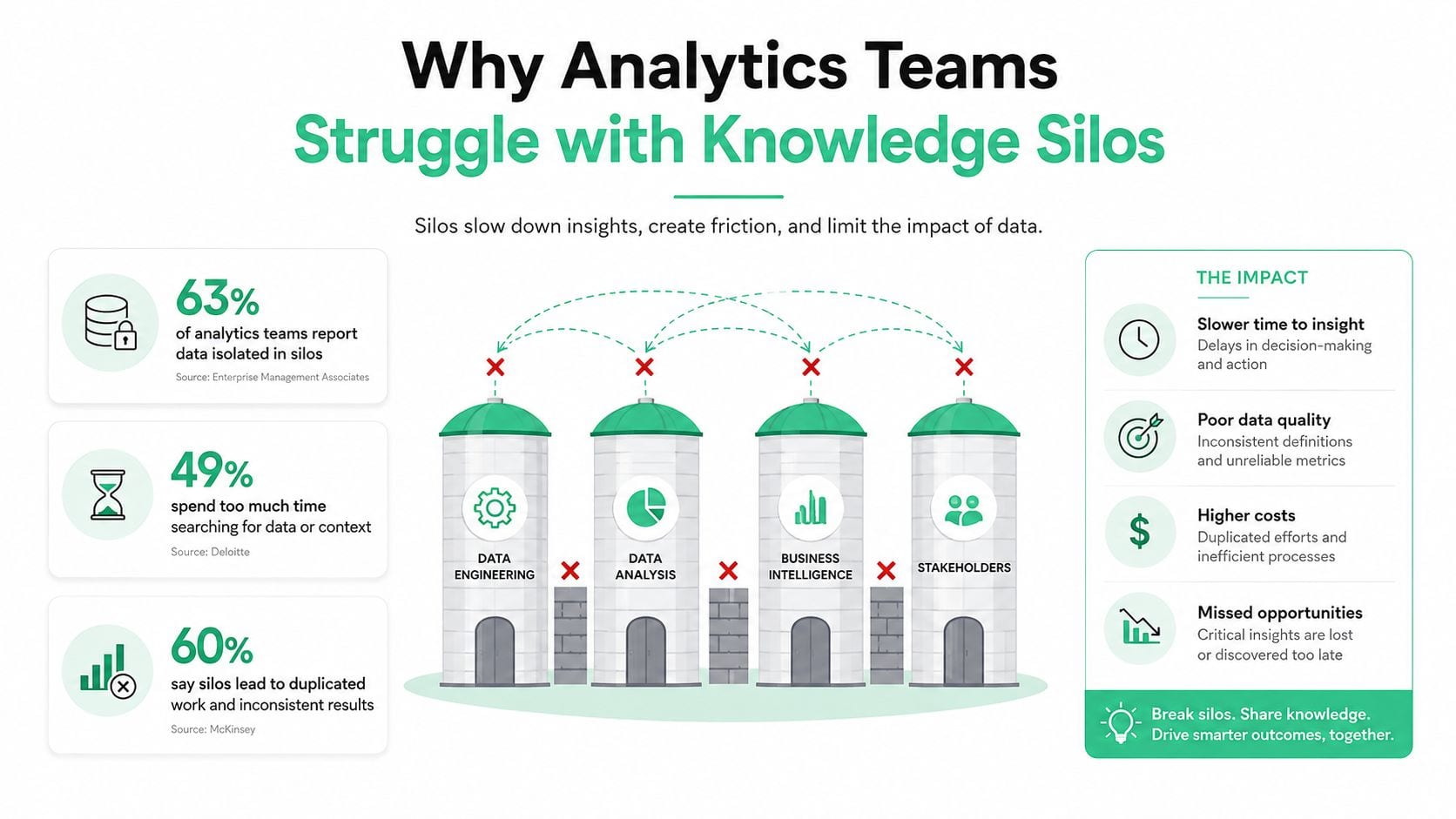
Four sources of knowledge decay
Ownership is distributed. No single team sees every layer of a tracking implementation. Marketers understand campaign intent, developers understand code, and analysts see reporting behavior. Without a shared artifact, each view remains locally accurate while the full implementation stays incomplete.
Delivery cycles reward shipping. Sprint work often treats instrumentation as a small implementation detail instead of a product contract. A property rename can pass application tests because the feature works for users, even though the measurement contract has failed.
Tool sprawl hides dependencies. One conversion may pass through a tag manager, consent layer, analytics platform, warehouse, CRM, and advertising destinations. Documentation in one system cannot reliably explain changes across all of them. Observability adds a separate control by detecting when production behavior diverges from the documented contract.
Distributed work removes informal recovery. Office-based teams can recover context through overheard product discussions or quick questions to an engineer after a release. Remote and hybrid teams lose those exchanges, so ownership, explicit artifacts, and automated feedback must carry more of the load.
The research links these conditions with operational outcomes. A meta-analysis of 72 independent studies, covering 4,795 groups and 17,279 participants, found information sharing to predict team performance, cohesion, decision satisfaction, and knowledge integration (meta-analysis of information sharing). In multinational virtual teams, knowledge sharing and trust together explained 65.2% of the variance in team performance, while knowledge sharing alone remained a significant positive predictor (study of multinational virtual teams).
Expectations shape individual behavior as well. A 2025 longitudinal diary study found that knowledge-sharing expectations had a positive same-day effect on employee sharing over 10 workdays. Co-worker expectations produced the strongest effect, and the model reported 37% of variance between people and 63% within person (2025 longitudinal diary study). A separate post-pandemic study found workplace loneliness was negatively associated with knowledge sharing, with correlations of r = -0.41 and r = -0.39 across its two samples (study on workplace loneliness and knowledge sharing).
The better diagnostic question is which handoff has no owner, no shared artifact, and no feedback when production behavior changes. That is where undocumented dataLayer changes, attribution rules, and pixel drift become operational failures rather than isolated documentation gaps.
What Tracking Knowledge Must Be Shared
Start with an inventory of artifacts, not a repository. A knowledge base filled with disconnected pages won't solve the problem if teams can't identify which decisions must remain synchronized.
Build the shared tracking contract
DataLayer specifications should define object names, property types, allowed values, required fields, and the user action that triggers each event. Engineering usually owns implementation, but marketing and analytics must be able to read the specification without translating code.
Event naming conventions prevent semantically similar actions from becoming separate metrics. Document whether form_submit, lead_created, and qualified_lead represent distinct stages or inconsistent labels for the same action. Include examples of valid and invalid payloads.
Tracking plans connect business requirements to events, properties, owners, and destinations. A living plan should record status, rationale, implementation notes, and change history. Static spreadsheets often become stale because they don't receive updates automatically when production behavior changes.
Attribution logic needs explicit definitions for source precedence, conversion windows, direct traffic treatment, campaign grouping, and model-specific exceptions. Analytics typically owns the logic, but marketing must approve whether the result reflects how campaigns are evaluated.
UTM standards should specify accepted naming, casing, source values, medium values, and campaign taxonomy. Marketing owns the convention, while analytics validates whether incoming traffic follows it.
Consent configurations must explain which signals are allowed under each consent state, which tags depend on consent, and how regional rules affect collection. Privacy or governance teams may own the policy, but implementation teams need a usable mapping.
Destination mappings show where each event travels, including analytics tools, ad platforms, CRM systems, warehouses, and experimentation services. Silent breakage often appears in these mappings, because the source event can remain healthy while one downstream destination stops receiving it.
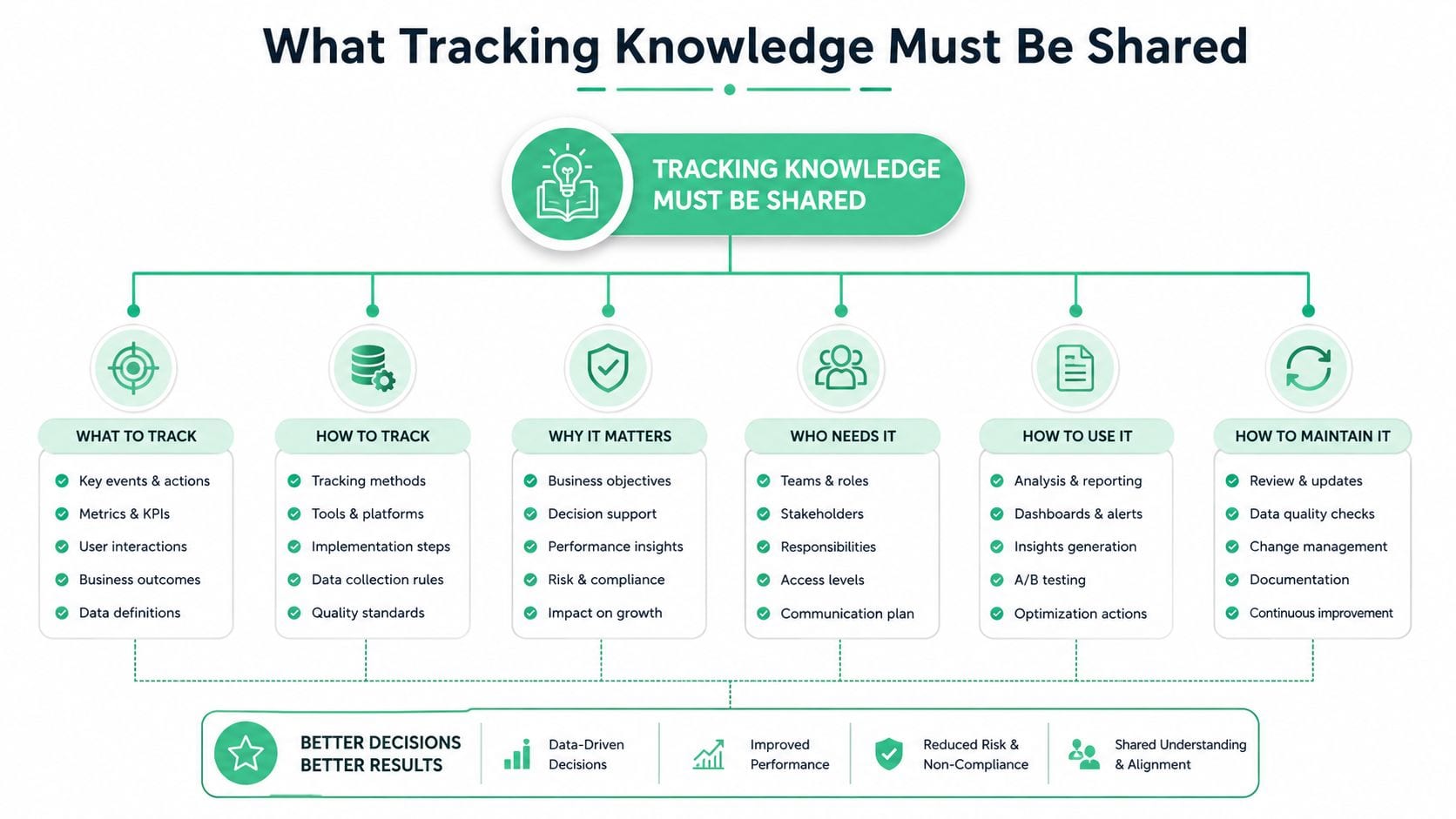
A useful way to identify missing knowledge is to involve the people who perform the work, not only the people who maintain the documentation. The exercise on building collective intelligence with United We Transform offers a practical prompt for surfacing knowledge held by different contributors.
Your single source of truth should be version-controlled, searchable, permission-aware, and accessible to non-technical stakeholders. A data dictionary can support that structure when it covers definitions, formats, ownership, and usage. Tracking teams can use this overview of the key components of a comprehensive data dictionary as a reference point.
The owner isn't necessarily the person who executes every update. Assign a business owner for meaning, a technical owner for implementation, and an operational owner for validation. That separation prevents the common failure where everyone is consulted but nobody is accountable.
Governance Processes That Make Sharing Stick
Documentation fails when it depends on memory after the work is complete. Governance works better when knowledge sharing becomes an output of the work itself.
A tracking change request should include the business purpose, event or property affected, owner, destinations, consent implications, validation criteria, and rollback plan. The request doesn't need to become a bureaucratic form. It needs enough structure to preserve the decisions that another team will need during implementation or diagnosis.
Put controls at the points where errors enter
Before deployment, reviewers should confirm that the event fires under the intended user action, uses the approved schema, respects consent, and reaches every required destination. After deployment, the team should check traffic, payloads, and downstream processing rather than assuming a successful release means successful measurement.
A lightweight review cadence gives these checks a home. Marketing, engineering, analytics, and privacy representatives can review new requirements, recurring anomalies, unresolved ownership questions, and changes to the measurement model. The aim isn't to approve every minor edit. It's to make high-impact decisions visible before they become reporting incidents.
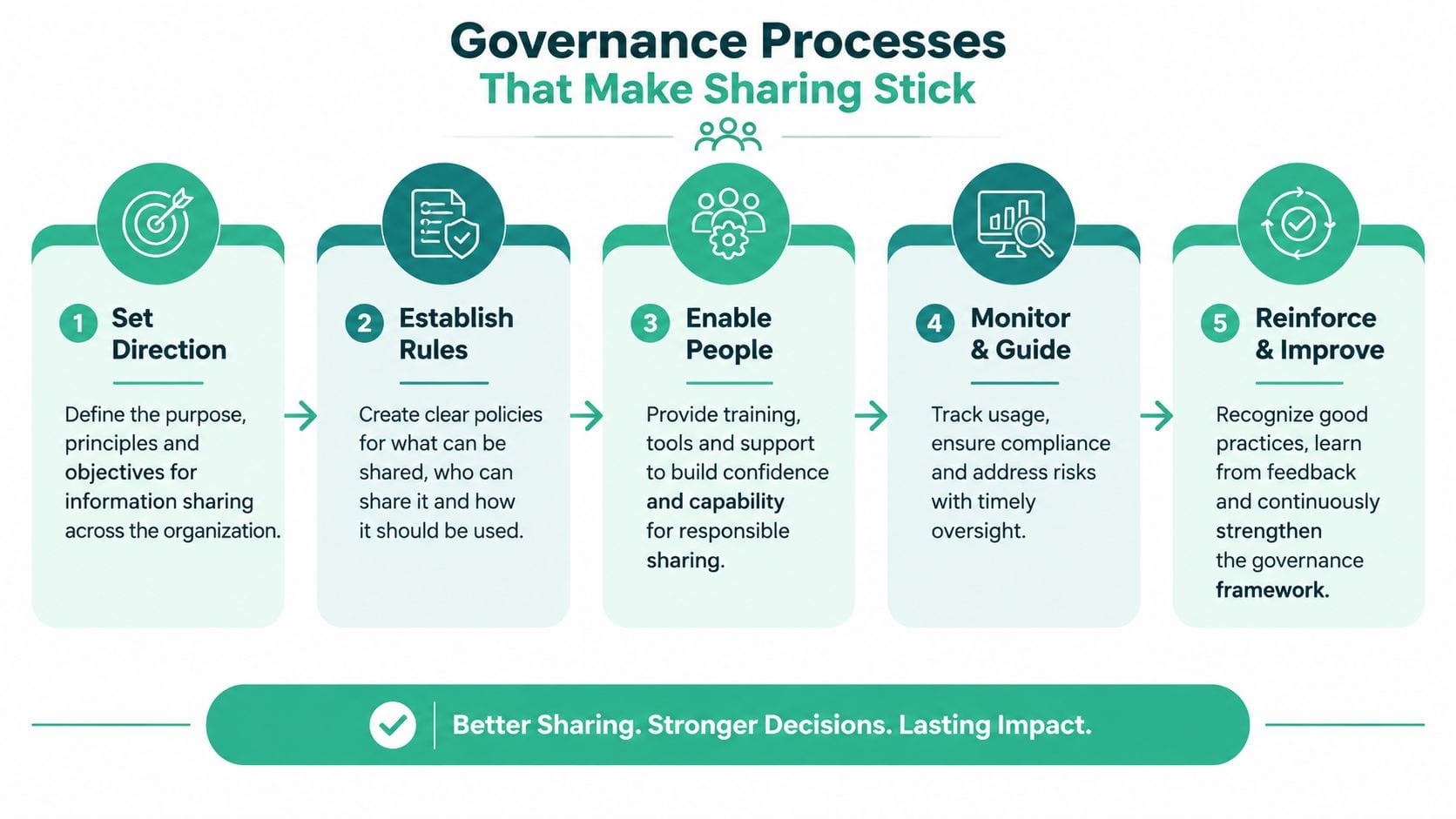
Replace manual audits with continuous evidence
Manual audits are useful for investigation, but they're a fragile primary control. They depend on someone remembering to inspect the right pages, devices, consent states, and destinations after every meaningful change.
An observability platform such as Trackingplan can make the control continuous. It can discover Martech implementations across dataLayer events and destinations, monitor analytics and marketing pixels, detect missing or rogue events, identify schema and property mismatches, flag campaign tagging and UTM errors, and alert teams through Slack, email, or Microsoft Teams. Automated root-cause analysis and current tracking plans connect a live anomaly with the shared knowledge teams need to resolve it.
Governance earns adoption when it helps the person shipping the change, not just the person auditing it later.
The strongest workflow links the alert to the relevant event, owner, specification, and deployment context. A schema mismatch then becomes a shared teaching moment. The team can decide whether the implementation is wrong, the documentation is outdated, or the business definition has changed. Guidance on data governance best practices can help teams formalize those controls without turning every request into a meeting.
Building Your Knowledge Sharing Program Step by Step
A workable program starts small and targets operational pain. Don't begin by migrating every document from every workspace. Begin with the tracking failures that consume analyst time and undermine confidence in reporting.
Phase one identifies the expensive gaps
Review recent dashboard incidents, support requests, failed launches, and unexplained attribution changes. Select the top three knowledge gaps causing tracking errors. They might be missing dataLayer definitions, unclear ownership of paid conversion events, or undocumented consent behavior.
Write each gap as a failure statement: “The team can't determine which implementation sends this event to the advertising destination.” This wording exposes the missing relationship rather than producing another generic documentation task.
Phase two assigns ownership
Create an artifact register with the business owner, technical owner, reviewer, repository location, and review trigger. Choose one central location for definitions and link out to code, tickets, dashboards, and vendor configurations. Teams starting from scratch can use this guide to start their knowledge base creation while keeping the scope focused on operational knowledge.
Phase three connects documentation to production
Add automated monitoring for the events and properties that matter most. Compare live payloads with approved schemas, watch destination delivery, and route alerts to the team that can act. A monitoring rule without an owner is just another notification, so every important check needs an escalation path.
The practical collaboration model can look like this:
- Marketing defines intent: The team states the decision the measurement must support.
- Analytics defines meaning: Analysts specify dimensions, metrics, attribution treatment, and expected reporting behavior.
- Engineering implements the contract: Developers connect the event to the product experience and preserve the agreed schema.
- Governance validates conditions: Privacy and QA reviewers confirm consent and release requirements.
- Everyone learns from drift: Teams update the artifact when production evidence reveals a gap.
Phase four and five create repetition
Use onboarding checklists, release templates, monthly tracking reviews, and short incident write-ups. Embed relevant Trackingplan tutorials from the Trackingplan YouTube channel into onboarding so new team members can see how the stack behaves, not just read definitions.
Use alerts as teaching prompts rather than blame sessions. Review which assumption failed, who needs access to the missing context, and what control would prevent the same confusion. For teams using Notes Templates, this resource on tracking plan notes and templates for team collaboration can help standardize the information attached to events and properties.
Choosing the Right Tools for Analytics Knowledge Sharing
A dashboard can look stable while its inputs have changed. A developer renames a dataLayer event, attribution logic shifts in a campaign workflow, or a pixel stops firing on one checkout path. Without connected documentation, implementation records, and production monitoring, teams spend hours reconstructing what changed and which reports it affected.
No single tool handles every form of tracking knowledge. Build an architecture that connects documentation, implementation, metadata, and production evidence, so teams can verify context without relying on tribal knowledge.
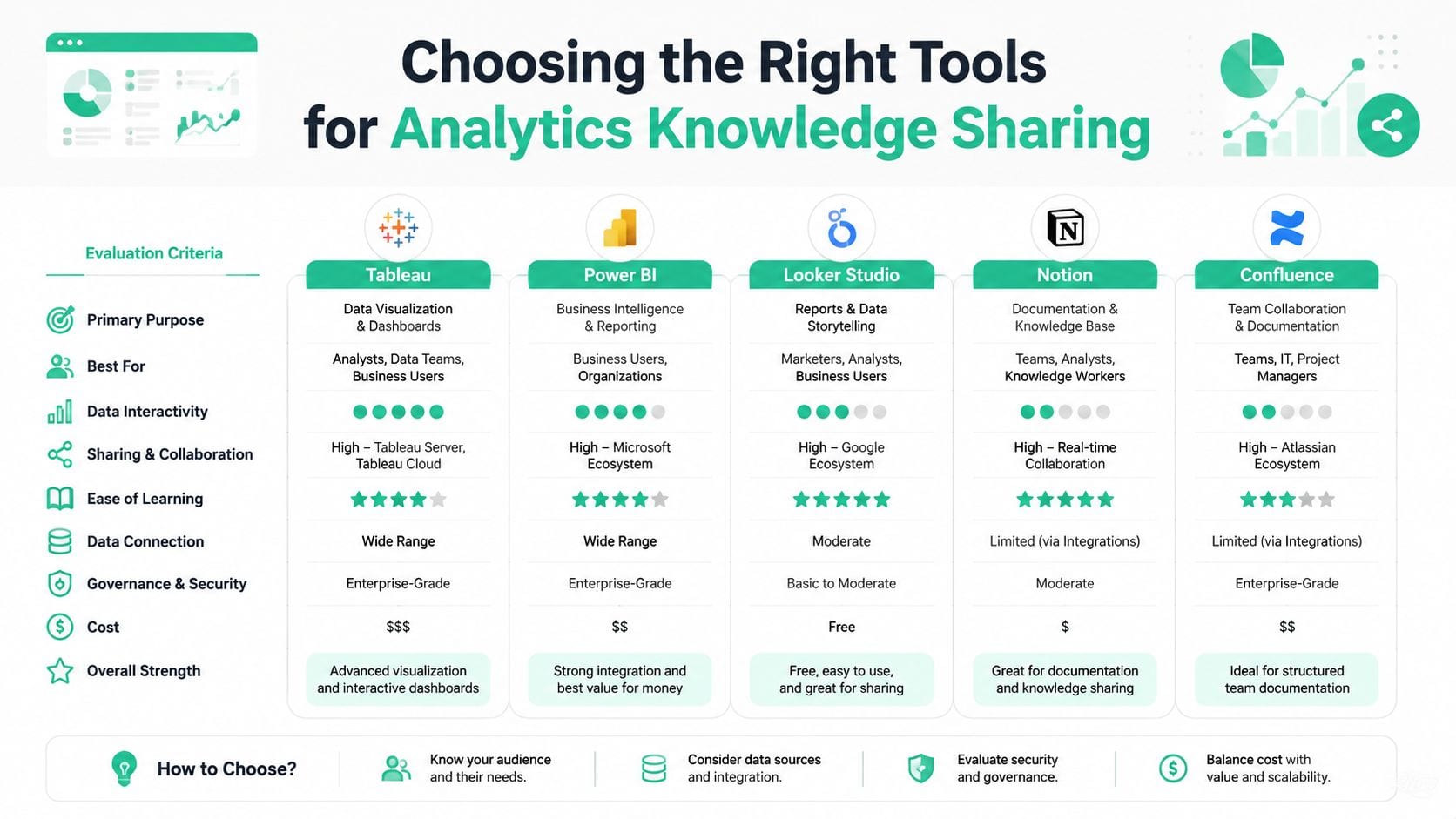
Where each category fits
| Tool category | Strong use | Main limitation |
|---|---|---|
| Documentation platforms | Notion and Confluence make decisions, definitions, and operating procedures accessible across teams. | They do not prove that a page still matches production behavior. |
| Tag management systems | GTM and Tealium centralize tag deployment and can support implementation workflows. | They manage configured tags, not the complete business meaning or downstream reporting impact. |
| Data catalogs | Catalogs organize datasets, ownership, lineage, and definitions for analysts and data engineers. | They may not expose front-end pixel behavior or campaign tagging drift. |
| BI platforms | Tableau, Power BI, and Looker Studio distribute dashboards and recurring metrics. | A dashboard can reveal a symptom without explaining which implementation decision caused it. |
| Observability platforms | These platforms compare live analytics behavior with expected schemas, destinations, and validation rules. | They still need clear ownership and business definitions to produce useful controls. |
Static documentation, tag managers, and data catalogs each serve important roles in the analytics stack. A tracking plan records why a metric exists, who owns it, and how stakeholders should interpret it. Tag managers support deployment, while catalogs help analysts and engineers find warehouse assets, definitions, and lineage.
The missing control is validation between the documented contract and live behavior. Trackingplan can auto-discover Martech implementations, monitor pixels and dataLayer events, detect implementation drift, and maintain tracking plans without recurring manual audits. It also supports shareable tracking-plan and event views, Notes Templates, customizable validations, and integrations with analytics, product, segmentation, and advertising tools.
Evaluate each tool with four practical questions:
- Accuracy: Does it reflect current production behavior?
- Accessibility: Can marketers, analysts, engineers, and governance teams use the information?
- Maintenance: Who updates it when a release changes the implementation?
- Detection: Does it identify drift before a stakeholder notices a broken dashboard?
A repository answers where information lives. Observability verifies whether the implementation still matches it.
Measuring Success and Real World Outcomes
Knowledge sharing earns continued investment when it changes operational behavior. Measure failure and recovery, not page views or document counts. In analytics, an undocumented dataLayer change, altered attribution rule, or drifting pixel can leave a dashboard looking credible while decisions rely on broken inputs.
Track tracking-related support tickets, time to resolve data anomalies, important events covered by automated monitoring, and stakeholder confidence in dashboard accuracy. These indicators show whether teams can find the right context and whether observability catches problems before they affect decisions.
Use an outcome scorecard
| Signal | What it tells you |
|---|---|
| Tracking support volume | Whether recurring questions and implementation failures are declining |
| Time to resolution | Whether owners can move from alert to diagnosis without reconstructing context |
| Monitoring coverage | Whether critical events, properties, pixels, and destinations have active controls |
| Dashboard confidence | Whether stakeholders trust the numbers enough to act on them |
| Documentation freshness | Whether definitions change alongside implementation and business decisions |
Set a baseline before claiming success. An e-commerce team might use automated observability to identify repeated broken-pixel incidents. An agency might standardize tracking-plan templates to make client onboarding more consistent. These scenarios help define a measurement plan, but the result must come from your own records.
Efficient knowledge access also has a productivity rationale. Microsoft research cited in 2025 and 2026 knowledge-management coverage indicates that efficient access to knowledge can save employees five to eight weeks of productivity per year (APQC knowledge-management research). Use that figure as a business-case reference, then test its relevance against your own time-to-resolution and repeated-question data. Teams can also use this guide to reduce mean time to resolution.
AI increases the cost of weak knowledge controls. Recent coverage identifies AI as a top knowledge-management priority for 41% of surveyed practitioners, while also highlighting funding and buy-in challenges (APQC knowledge-management research). AI can retrieve and transform information quickly, but stale schemas, incomplete definitions, and unreviewed tacit knowledge can amplify errors. Human review, provenance, and clear ownership remain necessary.
Trackingplan gives analytics, marketing, engineering, and governance teams a shared view of live tracking behavior, including dataLayer events, schemas, pixels, destinations, campaign tags, and consent signals. Visit Trackingplan to see how automated observability can turn knowledge sharing into a continuously validated process rather than a document updated after a dashboard breaks.