
Most advice about ads lead generation starts in the wrong place. It treats lead volume as the prize, then wonders why sales teams hate the pipeline, attribution looks muddy, and campaigns that “won” in-platform don't survive contact with the CRM. The failure usually isn't creative fatigue or audience overlap, it's that the measurement stack is broken, so the account is being optimized on corrupted data.
That's why the first job isn't more ads, it's proving that the leads being counted are real, attributable, and worth following up on. Google's own lead-generation guidance stresses the difference between raw submissions and qualified leads, and LinkedIn's guidance pushes advertisers to connect channels to CRM outcomes so spend ties back to revenue instead of vanity conversions. If the tracking is wrong, every downstream decision gets distorted, including keyword expansion, audience exclusions, and bid strategy. For a practical starting point on the funnel side, the guide to generating quality leads is worth reading alongside your own internal QA checklist, and your naming discipline should stay consistent with a campaign naming convention that survives reporting across platforms and CRMs.
Why Most Lead Generation Campaigns Fail Before They Start
The common mistake is treating the ad as the point of failure. In practice, the campaign often breaks before the first lead is ever qualified. The platform can show healthy submission volume while the sales team sees duplicate records, missing source fields, or leads that cannot be tied back to any usable path.
Volume looks good until qualification breaks
The first place this goes wrong is usually the handoff into the CRM. Source data gets stripped, overwritten, or mapped inconsistently, and the lead record arrives with just enough information to inflate reporting but not enough to support follow-up. UTM parameters disappear during redirects, cross-domain journeys split one visit into multiple sessions, and attribution models hand credit to the wrong touchpoint. By the time scoring runs, the original ad may look successful even when the record itself is incomplete.
Practical rule: If sales cannot tell where a lead came from in the CRM, the campaign is already failing, even if the ad platform says otherwise.
That is the problem with optimizing to raw cost per lead. Paid channels reward whatever gets the form fill, while the business only gets value when someone qualifies the lead, routes it correctly, and works it. Google's lead-gen guidance and LinkedIn's CRM-focused advice both point in the same direction: submission volume is not the metric that matters most.
Tracking has to be treated like part of the offer. If source data is inconsistent, every report turns into an argument instead of a decision tool. Strong creative cannot fix that, because the account is being tuned toward the wrong signal. The result is usually more spend, more submissions, and a cleaner-looking dashboard that hides a broken pipeline.
For teams that want a structured way to evaluate lead quality before scale, the operational checklist in the guide to generating quality leads helps anchor the funnel around outcomes, not just clicks. Naming discipline should also stay consistent with a campaign naming convention that holds together across platforms and CRMs. The point is simple. Do not scale until the data is trustworthy.
Building Campaign Strategy Around Qualified Leads
Campaign strategy gets better when you stop asking, “How do I get more clicks?” and start asking, “Who is ready to buy?” On search, that means separating research intent from purchase intent. On social, it means building audiences from CRM truth, not just website traffic.
Segment for intent, not just demographics
For B2B, the cleanest structure usually layers intent signals with firmographic data. Someone searching a solution keyword and matching your ideal company profile is a much stronger prospect than a broad interest audience. CRM-based lookalikes are also more useful than visitor-based audiences because they mirror actual buyers, not just browser behavior.
Negative audiences matter just as much. Exclude existing customers, applicants, students, job seekers, and people who've already converted. That's not just a budget-saving move, it protects your reporting from polluted lead pools that inflate volume and depress sales acceptance.
Test the offer, not only the headline
Different offers pull different lead types. A gated tool usually attracts higher-intent researchers, while a demo request filters more heavily toward near-buyers. Free trials can work well when product experience sells the next step, but they also invite tire-kickers if the targeting is loose.
A strong testing frame compares both form-fill rate and downstream lead quality. A headline that lifts submissions but sends low-fit leads to sales is a bad win. A message that produces fewer leads but better pipeline is often the better business choice.
Useful habit: Keep one campaign group for high-intent buyers and another for people still educating themselves. Blending those audiences makes CPQL hard to trust and bid decisions even harder.
A clean budget split follows the same logic. Put more spend behind keywords and audiences that are closest to revenue, then keep a separate test lane for exploration. The goal isn't perfect efficiency on day one, it's building a structure where you can tell whether a lead is worth the acquisition cost.
Landing Page and Form Optimization That Actually Converts
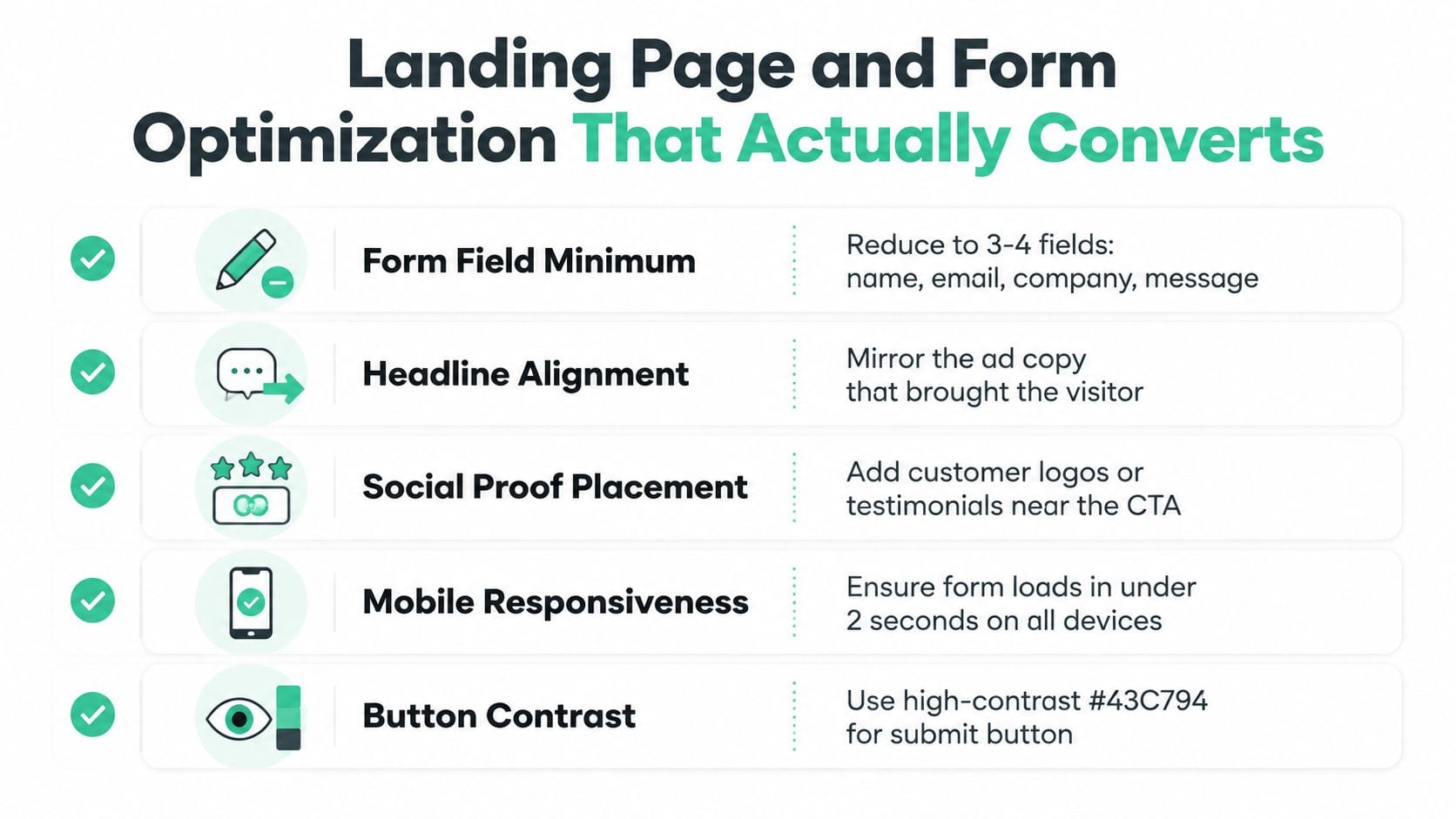
Most landing page advice stops at headlines and button color. That's too shallow. Conversion usually lives or dies on how much friction the form creates, whether the page feels consistent with the ad, and whether the page works cleanly on mobile.
Reduce friction without destroying quality
Shorter forms often convert better because they ask less of the visitor up front. But shorter isn't always better for the business. If you remove fields that help qualify the lead, you may increase submissions while lowering the number of records sales will work.
A better pattern is progressive profiling. Ask the minimum first, then collect more detail later through follow-up, enrichment, or a second step in the flow. Conditional logic can also tighten the experience by adapting questions based on earlier answers, which keeps the form relevant without forcing every user through the same friction.
The landing page itself should mirror the ad promise. If the visitor clicked on a specific offer, the headline and supporting copy should match that intent closely. When the page feels generic, people hesitate. When the CTA feels like a natural continuation of the ad, the form gets more completions.
Design for mobile and follow-through
Mobile behavior matters because ad clicks often arrive on small screens, where load time and layout issues quickly kill intent. If the page is slow or the form fields jump around, the lead disappears before submission. Trust signals help here too, especially when they sit near the CTA instead of buried in the footer.
Thank-you pages deserve more attention than they usually get. They can capture extra intent, direct the visitor to a calendar, or route the lead into a better next step. They can also reinforce tracking by confirming that the submission event fired correctly.
If you want a deeper operational checklist for page behavior and structure, the landing pages best practice resource is a useful companion. One thing I've seen repeatedly is that cleaner forms help, but only if your CRM can still separate a good lead from a convenient one.
Technical Tracking Setup for Accurate Attribution
A lead-gen account doesn't need more pixels. It needs a tracking setup that survives redirects, consent choices, browser restrictions, and CRM handoff. That usually means hybrid measurement, not blind faith in client-side tags.
Build a stack that records the full journey
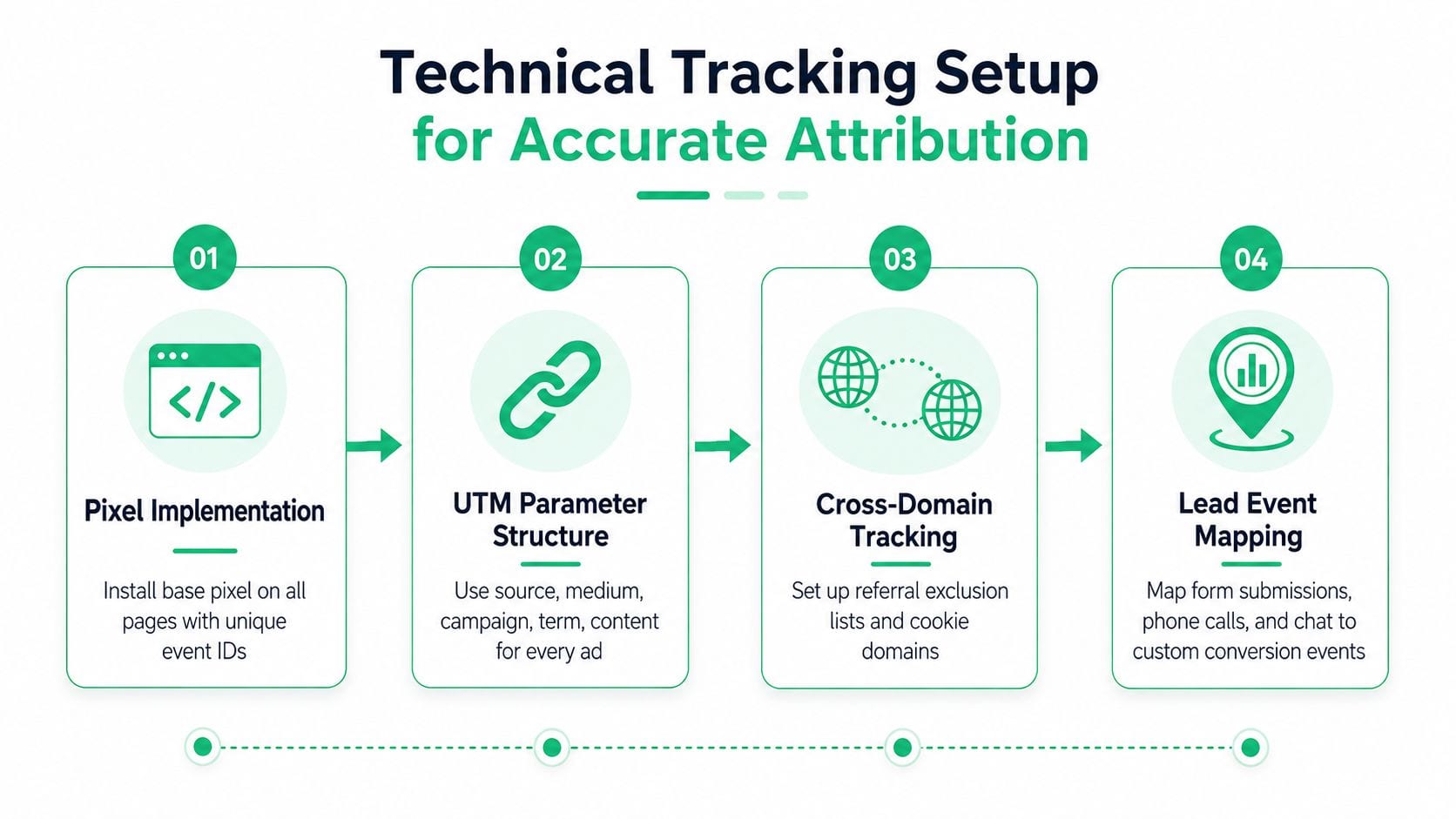
Start with the base pixel on every page, then make sure event IDs are unique and consistent across channels. Use a strict UTM structure, and keep it stable across campaigns so source, medium, campaign, term, and content don't drift into a mess of mismatched labels. Cross-domain tracking also matters when the journey moves between the main site and subdomains, because that's where attribution often splinters.
Server-side tracking helps fill in the gaps that browser-based tags miss. That's especially relevant in environments where ad blockers, privacy settings, and browser restrictions interfere with client-side pixels. Google Tag Manager can handle form submission triggers cleanly when the event rules are well defined, and Meta's Conversions API can pass server-side events that the browser never sends reliably.
Pass quality back into the ad platforms
Google Ads, Meta, and LinkedIn all optimize better when the conversion signal is cleaner. The problem is that many advertisers still send only the first form submit and never feed back what happened afterward. If a lead is rejected, disqualified, or turns into an opportunity, that signal should shape the optimization loop.
That's where event mapping becomes critical. Form fills, calls, chats, and qualified outcomes shouldn't all look identical if they mean different things to the business. If they do, the platform will keep finding more of the wrong people.
Real-world test: If one platform says a campaign is scaling and sales says the lead source is nonsense, trust the CRM first and the ad dashboard second.
For teams that want a more detailed implementation lens on conversion signals, the enhanced conversions Google Ads article is a useful reference point. The bigger lesson is that tracking quality is part of media buying, not a separate technical chore.
Automated Monitoring and Quality Assurance Workflows
Manual audits catch problems late. By the time someone notices a drop, a broken event may have already poisoned a week or two of optimization decisions. Continuous monitoring solves that by treating analytics and marketing instrumentation like production systems, not one-time setups.
Watch the stack before the metrics drift
Trackingplan's value in this context is straightforward. It automatically discovers analytics and marketing implementations across web properties, monitors pixels and event firing patterns, and flags anomalies when conversion behavior changes unexpectedly. That means you can catch a broken form event, a missing UTM parameter, or a schema mismatch before the account manager starts scaling the wrong campaign.
Slack or email alerts matter because they shorten the time between failure and response. If a critical event stops firing after a deployment, the fix can happen before the next reporting cycle. Root-cause analysis is even more useful when the issue could be in the site, the tag manager, the consent layer, or the payload itself.
Build validation rules that protect data quality
A good QA workflow checks more than whether a tag exists. It should validate UTM completeness, look for PII leaks in event payloads, and confirm schema compliance across the data layer. It should also run regression tests after site changes so a new release doesn't break an existing conversion path.
Dashboards should show tracking health by property, not just traffic by channel. That makes it easier to separate a real performance decline from an instrumentation failure. When teams can identify the cause quickly, they stop wasting budget on false fixes.
Operational rule: If a conversion drop appears after a deployment, verify the tracking chain before touching bids, targeting, or creative.
For organizations managing multiple properties, automated observability is often the difference between confidence and guesswork. The automated marketing observability guide is relevant if you need a closer look at how continuous QA fits into campaign operations.
Testing Frameworks and KPIs That Predict Revenue
The best testing program doesn't ask which ad got more clicks. It asks which change improved the chance that a lead became revenue. That means the dashboard has to move beyond surface conversion rate and into the metrics that sales feels.
Measure the right outcomes
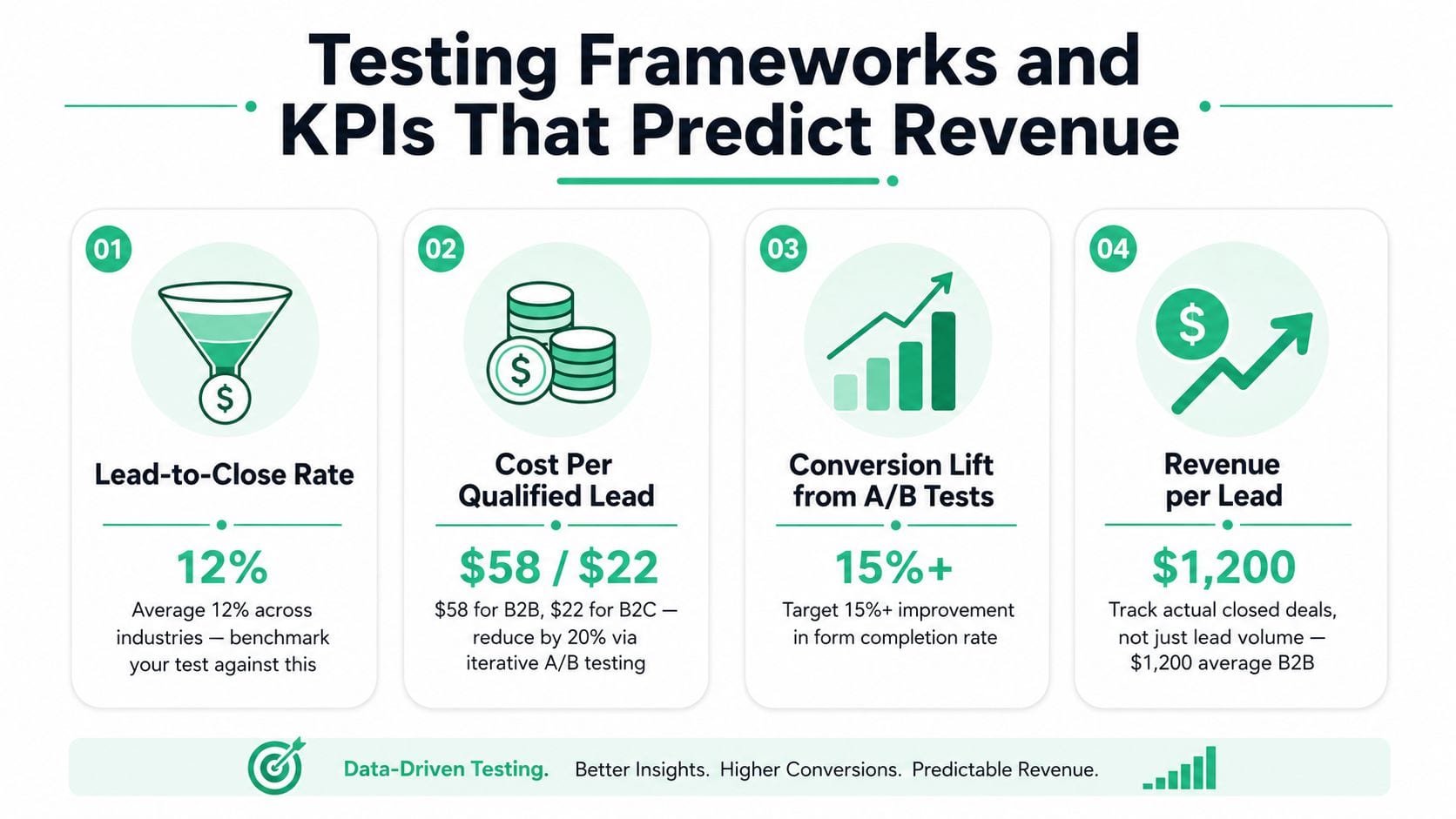
Cost per qualified lead is more useful than cost per lead when quality varies across audiences and offers. So is lead-to-opportunity conversion rate, because it shows whether the funnel is producing real sales conversations. Pipeline velocity helps as well, since fast-moving opportunities usually reveal cleaner targeting and better follow-up.
Speed-to-lead is one of the sharpest operational levers in the stack. One benchmark source reports that responding within 1 minute can drive a 391% higher conversion rate than waiting 2 minutes (Leadgen Economy), and another says the odds of making contact are 100x greater when you respond within 5 minutes rather than 30 minutes (Sci-Tech Today). The exact number you use matters less than the operating principle, which is that delay destroys value.
Test fast, but tie tests to business truth
A/B tests on ads, landing pages, and forms should be judged downstream, not just at the conversion button. If one variant generates more forms but worse sales acceptance, it's not the better variant. If a slightly slower test produces cleaner leads, it's the smarter one.
Companies with a documented lead generation strategy generate 47% more leads than companies without one, and teams publishing 16 or more blog posts per month generate up to 4.5x more leads than teams publishing 0–4 posts per month (SearchLab). Those numbers are about content, but the takeaway carries into paid media, too. A strategy and enough supporting material give paid traffic a better chance to convert into something usable.
If your team is still optimizing lead gen by looking only at raw submissions, you're flying blind. Trackingplan helps you monitor pixels, UTMs, and conversion events continuously, so you can trust the data before you scale spend. Visit Trackingplan if you want to catch tracking failures before they turn into bad bidding decisions and wasted budget.