
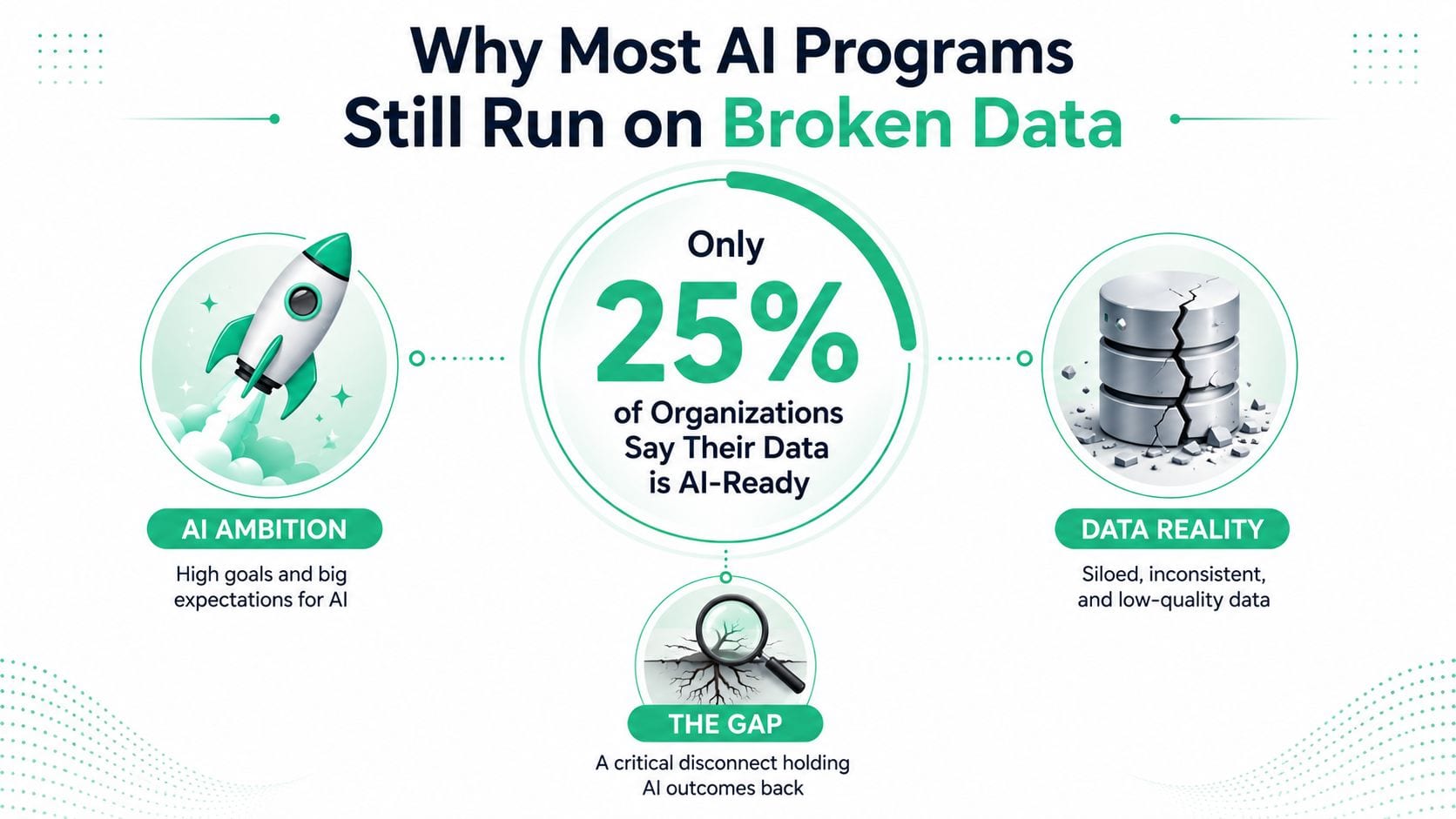
Only 12% of organizations say their data has the quality and accessibility required for effective AI implementation, according to the 2024 Precisely and University research survey. That gap is especially visible in analytics and martech, where a single missing property, altered tag, duplicate identifier, or consent failure can distort the numbers teams use to make decisions.
AI for data quality works best when it sits close to the event stream, not only at the warehouse. It can learn normal traffic patterns, identify schema drift, connect related failures, and surface suspicious payloads across web, mobile, and server-side implementations. It also has limits. Models need reliable definitions, careful thresholds, privacy controls, and human review when the context is ambiguous.
Why Most AI Programs Still Run on Broken Data
In the same survey, 77% of organizations rated their data quality as average or worse, compared with 66% in the previous year, while only 12% considered their data sufficiently accessible and reliable for effective AI implementation (Precisely and University research summarized by DBTA). For analytics and martech teams, that gap shows up before data reaches a warehouse. A missing event property, changed tag, or blocked consent signal can alter the inputs used by attribution models, audiences, dashboards, and AI features.
The failures are usually operational. A checkout refactor drops transaction_id. An SDK release changes a payload shape. One page view generates duplicate events. A regional consent state suppresses marketing events while other regions continue sending them. Each defect can travel from a web or mobile implementation into downstream transformations and reporting.
Three seams where analytics data leaks
An AI model depends on clean telemetry. Incomplete, duplicated, delayed, or mislabeled events teach the model an inaccurate operating environment and make its output harder to interpret.
- Instrumentation seams: Tags, pixels, SDKs, and dataLayer pushes can diverge from the tracking plan.
- Identity seams: Multiple identifiers can split one customer journey or combine unrelated users.
- Governance seams: Consent, retention, ownership, and destination rules can differ between teams and tools.
The issue affects integration work as well as model performance. The survey found that 64% identified data quality as their top data integrity challenge, up from 50% the prior year, and 50% said data quality was the number-one issue affecting data integration initiatives. Teams assessing the operational and financial exposure can review this analysis of the business risks of poor data quality.
Manual QA cannot keep pace with event streams changing across products, campaigns, devices, and destinations. Periodic audits find only the scenarios someone anticipated. Continuous monitoring can flag deviations in event volume, payload structure, consent behavior, and destination delivery while the issue is still traceable.
For teams working on structured business information and answer engines, Qoory intelligence engine explained offers related context. The practical response is a living baseline, continuous detection, source diagnosis, and enough evidence for an owner to decide whether to fix, suppress, or accept the signal.
What AI for Data Quality Actually Means
AI for data quality is the use of machine learning and statistical methods to detect, diagnose, and help remediate data problems across the AI lifecycle. IBM defines AI data quality as the degree to which data is accurate, complete, reliable, and fit for use during training, validation, and deployment (IBM's definition of AI data quality). In an analytics stack, that definition applies to events, sessions, identities, consent states, campaign parameters, and the transformations that carry them downstream.
Traditional validation starts with explicit rules. A purchase event must contain a property. A page view must use an approved name. A parameter must match a format. Those checks remain valuable, but they become brittle when a vendor changes a payload, a product introduces a new flow, or traffic behaves differently during a campaign.
The three jobs an AI quality layer performs
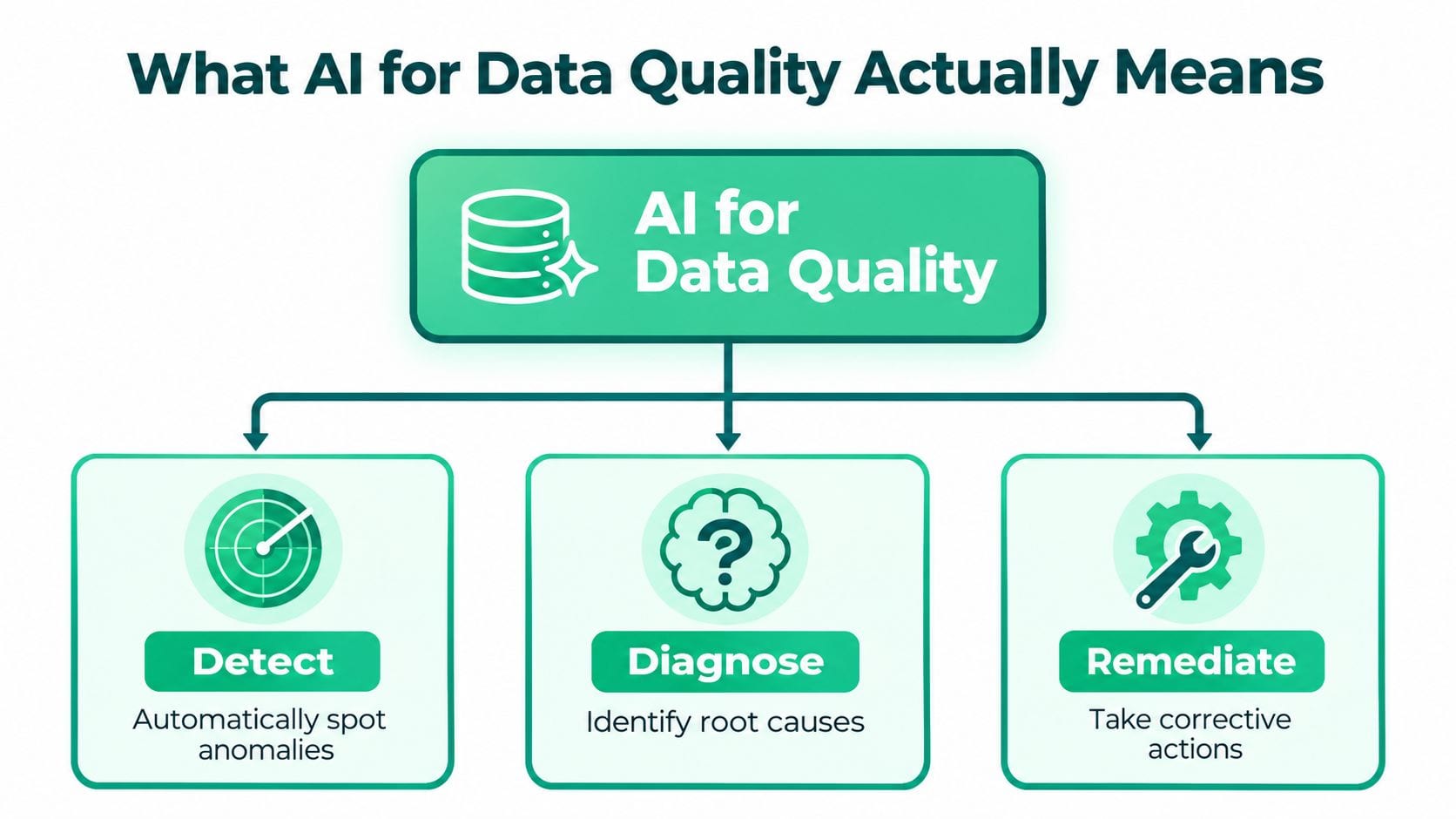
Detect means learning expected behavior and identifying a meaningful deviation. An anomaly might be a sudden event-volume change, an unusual property distribution, or a new payload shape.
Diagnose means connecting the signal to context. The useful question isn't only, “What changed?” It's, “Which deployment, tag, consent rule, SDK version, or upstream transformation most likely caused the change?”
Remediate means taking a controlled action. That might involve quarantining records, opening an incident, updating an approved definition, or sending a finding to a human reviewer. Automatic correction is appropriate only when the transformation is well understood and reversible.
The practical analogy is a nervous system alongside the pipeline. It senses normal patterns, notices deviations, and routes the signal to someone who understands the business context. It doesn't replace the tracking plan. It makes the tracking plan enforceable across the places where implementation changes.
This also shifts the operating model from reactive cleanup to continuous assurance. Teams can monitor ingestion, transformation, modeling, and reporting as one connected lifecycle, which aligns with Trackingplan's perspective on the AI data analyst.
Five AI Techniques That Catch Quality Issues Early
No single model covers the analytics and martech stack. The strongest implementations layer several techniques, then apply deterministic rules where the expected behavior is explicit.
| Technique | What It Catches | How It Learns | Production Failure Mode |
|---|---|---|---|
| Anomaly detection | Traffic spikes, silent dropouts, unusual property values | Usually unsupervised or semi-supervised baselines | False positives during campaigns, launches, or seasonal behavior |
| Entity resolution | Duplicate profiles and fragmented cross-device journeys | Supervised, probabilistic, or hybrid matching | Over-merging identities when identifiers are weak |
| Schema inference | New, missing, renamed, or malformed event properties | Unsupervised pattern learning plus tracking-plan constraints | Cold starts and incorrect assumptions about optional fields |
| Noise filtering | Bot traffic, test events, retry storms, and low-value activity | Supervised classification or hybrid heuristics | New bot behavior and legitimate high-volume automation |
| PII detection | Emails, phone numbers, addresses, and sensitive identifiers in payloads | Pattern recognition, language models, and rules | Language drift, obfuscation, and context-dependent false positives |
1. Anomaly detection
Anomaly detection is the first line of defense for event volume and distribution. A model can learn expected behavior for a purchase stream, then flag a sharp change in counts, missing values, or source composition. It works well when the baseline includes useful context, such as weekday behavior, app releases, and campaign periods.
It breaks when the baseline is too short or the team treats every deviation as an incident. New properties and planned launches need a review path, not automatic suppression. Research on log anomaly detection highlights incorrect timestamps, event-order problems, missing events, duplicates, and mislabeled events as common failure modes, while limited training data can increase false alarms. Production systems therefore need thresholding, drift-aware retraining, and human review for edge cases (survey on log anomaly detection).
2. Entity resolution
Entity resolution helps connect identifiers across browser, mobile, and authenticated environments. For example, it can identify that a visitor ID and a logged-in customer ID are likely related, while preserving uncertainty when evidence is weak.
The model may learn from confirmed matches, deterministic keys, or a combination of both. It fails when teams reward match volume instead of match precision. A new ID namespace, shared device, or cross-domain implementation can create convincing but incorrect links. Keep ambiguous matches separate from trusted joins, and send borderline decisions to review.
3. Schema inference
Schema inference observes the payloads arriving from a dataLayer, SDK, or server endpoint. It can surface a new event name, a missing property, a changed data type, or an unexpected nested object before the change reaches a KPI model.
Inference is useful for discovery, but it mustn't become the source of truth. A model can observe that a field is common without knowing whether the field is required for revenue reporting. Pair learned patterns with a versioned tracking plan and explicit ownership.
4. Noise filtering
Noise filtering separates meaningful user activity from bots, test traffic, retries, and implementation artifacts. A classifier might use event sequences, user-agent context, timing, and source behavior rather than relying on one brittle exclusion rule.
The failure mode is over-filtering. Automated jobs, internal monitoring, or accessibility tools can resemble unwanted traffic. Keep the original signal available, record why a record was filtered, and allow analysts to inspect the decision.
5. PII detection
PII detection scans event names, properties, URLs, and free-text fields for personal information before data reaches downstream platforms. Rules catch obvious patterns, while language-aware models can identify less structured values.
Language drift and obfuscation make this a hybrid problem. Use known-good and known-bad test payloads, redact before model input where possible, and treat a possible leak as an escalation rather than deleting evidence. For teams evaluating real-time anomaly detection for analytics, the same principle applies: fast detection only helps when the alert carries enough context to support a safe decision.
Evaluation Metrics and Governance That Hold Up in Production
A quality score without an action behind it is decoration. Production teams need metrics that answer a practical question: should this data be promoted, quarantined, or reviewed?
Start with the behavior of the stream, then evaluate the model's decisions. Population Stability Index and Kullback-Leibler divergence can describe distribution drift, while null-rate trajectories show whether a property is gradually degrading. Schema conformance measures whether incoming events match the approved contract. Entity resolution should be evaluated against a held-out golden set, using precision and recall rather than a single blended score.
Match the metric to a decision
| Metric | What It Measures | Threshold Pattern | Triggered Action |
|---|---|---|---|
| Distribution drift | Change in event or property composition | Compare with a learned baseline and campaign context | Promote, investigate, or quarantine the affected slice |
| Null-rate trajectory | Missingness over time | Escalate sustained movement, not one isolated record | Notify the property owner and inspect the deployment |
| Schema conformance | Agreement with the tracking contract | Separate required-field failures from optional changes | Block, quarantine, or allow with a warning |
| Entity match precision and recall | Quality of identity joins | Validate against reviewed reference pairs | Keep trusted joins and route uncertain matches to review |
Synthetic-data validation needs the same discipline. Published guidance recommends combining distribution comparisons, correlation preservation, and Train-on-Synthetic/Test-on-Real evaluation rather than relying on one score. That guidance describes a common acceptability target of synthetic performance reaching about 85% of the real-data baseline in TSTR and TRTR comparisons (PubMed guidance on synthetic-data validation).
Governance makes the signal auditable
Use tracking-plan-as-code reviews for changes to event names, properties, consent behavior, and destinations. Capture lineage so an analyst can trace a bad dashboard metric back to the source event and deployment. Version the model and its baseline, preserve alert evidence, and periodically re-annotate confirmed incidents.
ISO/IEC 5259-5:2025 provides a governance framework for data quality in analytics and machine learning, including oversight across the data lifecycle (ISO/IEC 5259-5:2025). A practical scorecard can expose green, yellow, and red status for each data product in Slack or an email digest. The important part isn't visual polish. It's that each color maps to a named owner and a documented response.
For an accessible treatment of the operating model, see this guide to data quality governance for analytics teams.
A Practical Roadmap to Implement AI Data Quality
Implementation should begin with observability and ownership, not a heavyweight model platform. Analytics engineers can deliver useful coverage in phases while preserving the existing tag manager, SDKs, loaders, and warehouse.
Phase one, discover
Inventory events, properties, tags, pixels, destinations, and consent states across web, mobile, and server-side sources. Capture the actual traffic shape instead of relying only on documentation. This baseline gives anomaly models something to learn and reveals where the written tracking plan has already diverged from reality.
Phase two, define the contract
Turn the tracking plan into a versioned contract. JSON Schema can describe payload structure, while dbt tests can validate modeled tables and transformations. Add ownership to every critical event and property. A contract without an owner becomes an archive, not a control.
Phase three, monitor continuously
Monitor volume, distribution, freshness, required fields, and schema drift. Let baselines account for normal differences between weekdays, releases, and campaigns. Keep deterministic checks for hard requirements, then use AI to identify patterns that rules can't express efficiently.
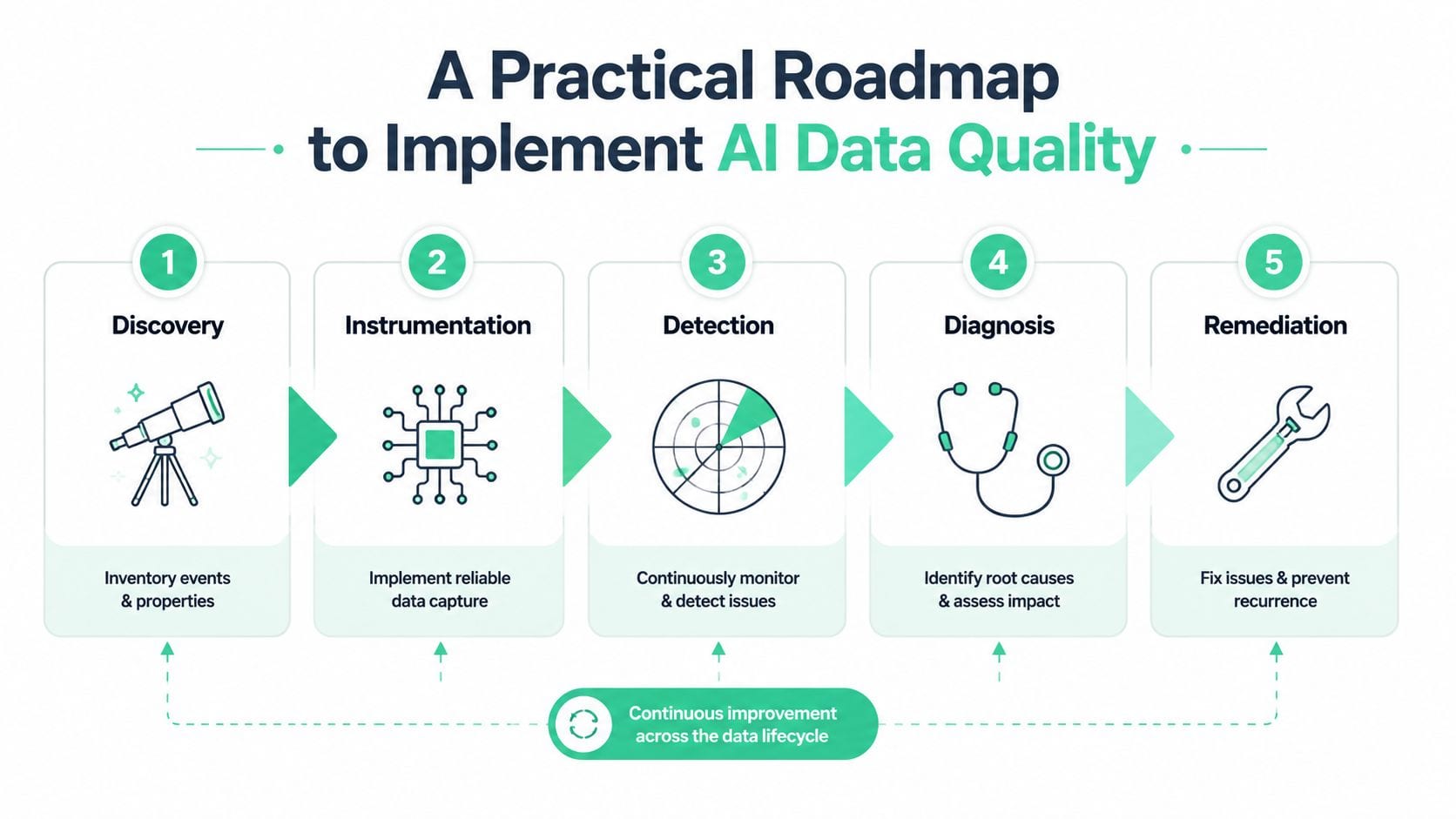
Phase four, alert with context
Send findings to the owning squad through Slack, Jira, PagerDuty, or the team's existing incident path. Include the event name, affected property, before-and-after payload shape, first observed time, likely source, downstream destinations, and a link to the tracking-plan version. A raw error code forces the engineer to reconstruct the incident. A contextual alert lets them test the suspected cause.
Phase five, remediate and learn
Quarantine unsafe records when downstream contamination would be worse than delayed data. Fix the instrumentation, update the contract when the change is intentional, and feed confirmed incidents back into the training set and tracking-plan linter. Don't auto-correct values that may carry business meaning unless the transformation is reversible and approved.
This phased approach keeps trust ahead of complexity. Teams can start with discovery and contract enforcement, then add model-driven detection as lineage and ownership improve.
How This Looks Inside a Real Analytics Stack
A growth team releases a checkout refactor. The purchase event still arrives, but transaction_id is missing. The web implementation uses a Google Tag Manager trigger and a dataLayer push, while the same purchase flow reaches mobile through a Segment SDK and Snowplow tracker. Server-side events arrive through the Segment HTTP API and move through a Snowflake loader.
The AI quality layer sits between those sources and the downstream destinations. It compares incoming payloads with the versioned tracking plan and schema registry, then flags the missing property as a breaking change. The alert doesn't stop at “schema mismatch.” It identifies the affected event, shows the payload diff, names the release or surface where the change appeared, and traces the property to the revenue transformation.
The evidence chain
A useful incident contains concrete artifacts:
- Versioned tracking plan: Shows whether
transaction_idis required for the purchase event. - Schema registry: Records the expected type, nesting, and compatibility rules.
- Quarantine table: Holds affected records when downstream reporting must remain protected.
- Alert payload: Includes source, destination, observed change, suspected cause, and owner.
- Lineage reference: Connects the event to the KPI model and executive dashboard.
The model can identify a pattern, but the tracking plan supplies business meaning. If transaction_id is optional for an informational event but mandatory for a purchase, the contract determines the severity. This is why AI shouldn't replace explicit definitions. It should enforce them consistently where implementation is distributed.
Web, mobile, and server-side behavior
On web, the monitoring layer checks whether the dataLayer push contains the expected properties before Google Tag Manager forwards the event. On mobile, it compares payloads from the Segment SDK and Snowplow tracker, accounting for platform-specific naming and release timing. On the server, it validates the Segment HTTP API payload and confirms that the Snowflake loader preserves the field.
A human reviewer still decides whether the refactor was intentional, whether backfill is safe, and whether the dashboard should be marked incomplete. The AI reduces investigation time by assembling the evidence. It doesn't invent a business rule or approve a privacy-sensitive change.
Privacy, Bias, and Consent in AI-Driven Quality Work
AI quality controls can reduce privacy risk, but they can also create new exposure. Entity resolution may join identifiers too aggressively. PII detection may copy sensitive payloads into a model's training or logging environment. Anomaly detection may perform better for heavily represented geographies and miss failures affecting smaller populations.
Consent must be a first-class tracking-plan property, not a note in a privacy document. A consent-aware validator should check whether an advertising, analytics, or personalization tag fired after opt-out, whether the destination received identifiers without the required state, and whether a server-side event preserved the user's consent decision.
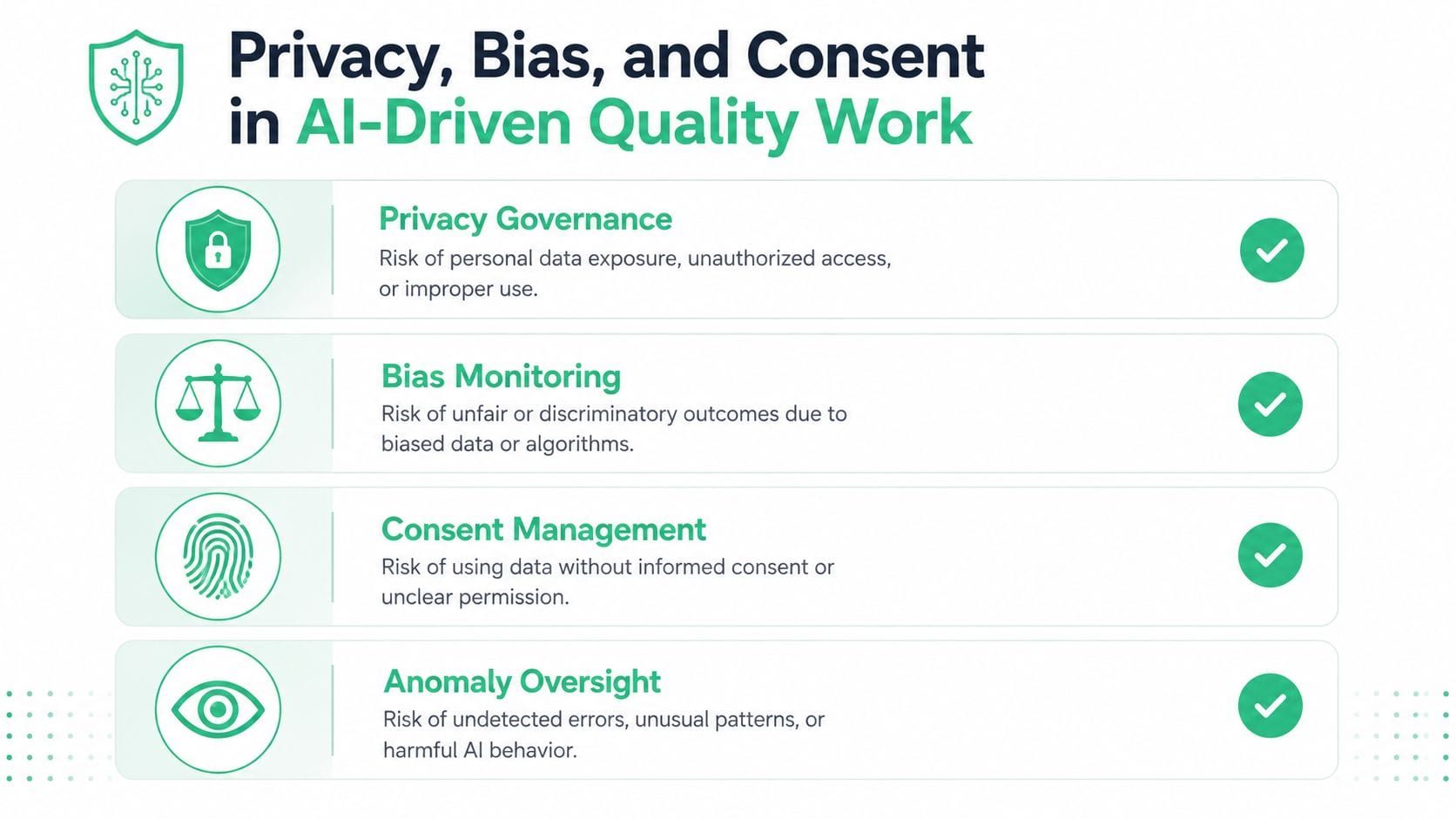
Four controls belong in the implementation
- Scoped training data: Restrict model input to the fields and environments needed for the quality task.
- Consent-aware redaction: Remove or mask personal values before they enter model input, logs, or review queues.
- Fairness checks: Compare detection thresholds and error patterns across relevant populations without exposing unnecessary identity data.
- Human oversight: Require review for ambiguous identity matches, possible PII leaks, and changes that could affect regulated reporting.
The same monitoring layer that detects a broken tag can detect a tag firing after opt-out. That makes AI for data quality both a risk multiplier and a mitigation mechanism. The outcome depends on whether teams govern the model, its inputs, and its retention boundaries.
Privacy principles aren't limited to marketing analytics. Teams handling housing or tenant information can also review practical resources such as privacy for NYC renters when designing user-facing data practices. The operational rule remains the same: collect only what the stated purpose requires, and make the consent state observable.
Troubleshooting Tips and Frequently Asked Questions
Start with the alert, then test its context.
- False-positive anomaly: Check releases, campaigns, weekday patterns, and source mix before changing a threshold.
- Planned rename: Add the event or property to the tracking plan, preserve a compatibility mapping, and retrain the schema baseline after approval.
- New identity namespace: Keep uncertain joins separate, validate trusted pairs, and avoid merging records based only on timing or device signals.
- PII detection check: Send known-good and known-bad payloads through the detector. Confirm masking occurs before logging and model input.
Frequently asked questions
What latency should real-time validation have?
Set the budget by event role. A consent-sensitive destination may justify stricter validation than a non-critical diagnostic event. Measure end-to-end impact before placing a model in the synchronous path.
What happens when there are no labeled incidents?
Start with unsupervised baselines, deterministic contracts, and human confirmation. Confirmed incidents can become labels for later refinement.
Can this work with existing tag managers?
Yes. Keep Google Tag Manager, dataLayer pushes, SDKs, and server-side loaders in place. Monitor their inputs and outputs before replacing them.
How do I explain a quality score to executives?
Tie it to a decision. Identify the affected data product, the change, the potentially unreliable KPI, and the owner of the next action.
The operating checklist is short: monitor event definitions, set evidence-based thresholds, maintain remediation playbooks, and enforce consent boundaries.
Trackingplan provides an automated analytics QA and observability layer across web, mobile, and server-side stacks. It monitors events, properties, pixels, campaign tags, anomalies, schema mismatches, potential PII leaks, and consent misconfigurations. Review the Trackingplan platform to connect live tracking-plan enforcement with the data quality controls your analytics team already operates.