
Axeptio
At a glance
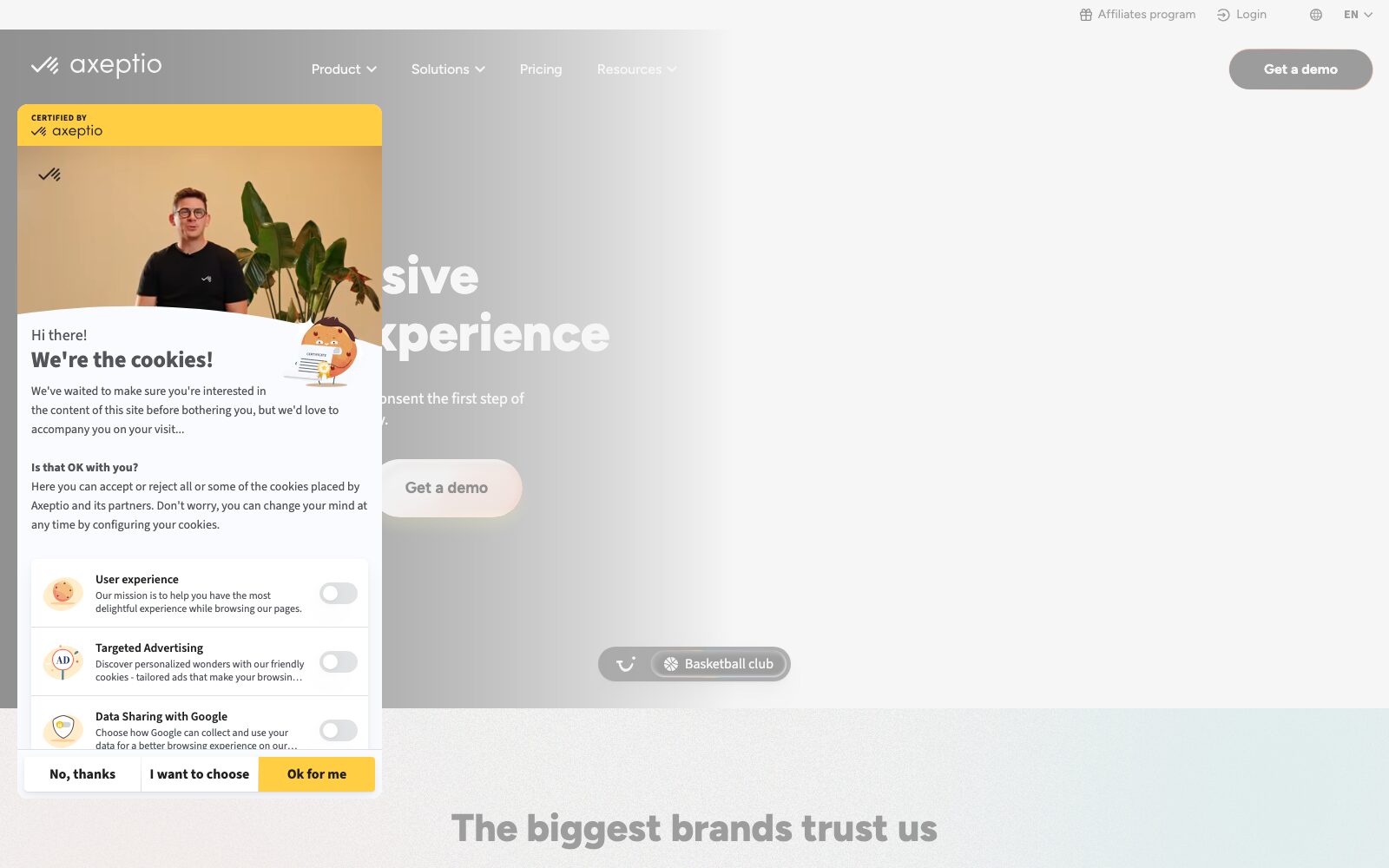
Axeptio is a French consent management platform for websites and mobile apps, built in Montpellier. It treats the cookie banner as part of the brand experience rather than a legal pop-up, and it is a Gold member of Google's CMP Partner Program. It is also the CMP Trackingplan uses on trackingplan.com.
Core features
Axeptio provides fully customizable banners, including video-led consent journeys, with Google Consent Mode v2 on every plan and IAB TCF v2.3 (Europe and Canada) from the Small plan up. Its Shake scanner detects and monitors the trackers on a site, and every consent is stored in a consent registry. It also covers Microsoft UET Consent Mode, a mobile SDK with Apple ATT, consent to terms and conditions, and A/B testing of the banner. Native integrations include WordPress, Shopify, PrestaShop, Webflow, Drupal and Wix.
Pros
- Banner as a brand touchpoint: Copy, visuals and video can match the site's voice, which helps marketing teams treat consent as part of the journey.
- Google and IAB coverage: Consent Mode v2 on all plans, Google CMP Partner Gold status, and TCF v2.3 for publishers and ad-tech vendors.
- No-code setup: Business teams configure the banner and its texts without a developer for each change.
- Opt-in measurement: Built-in analytics and, on Enterprise, A/B testing show how a banner change affects consent rates.
- Broad regulation coverage: GDPR, CCPA, Quebec's Law 25, PIPEDA and Global Privacy Control.
Cons
- The cheapest plan has no IAB TCF, no multilingual banner and no cookie scanner; those start on the Small plan.
- Each plan covers one domain, so multi-domain setups need the Enterprise or Agency plan.
- API access, A/B testing and the mobile SDK are reserved for Enterprise.
Who it’s for
Axeptio suits brands, ecommerce sites and agencies in Europe and Canada that want a compliant banner that still looks like their own site. It fits marketing teams that measure opt-in rates as closely as conversion rates.
Unique value proposition
Axeptio turns the moment of consent into a designed experience instead of a grey box. A banner people actually read and accept keeps more of the analytics and advertising data that depends on consent.
Real-world use case
An ecommerce brand replaces a generic banner with an Axeptio banner in its own tone of voice, turns on Consent Mode v2 for Google Ads and GA4, and compares opt-in rates before and after the change.
Pricing
Axeptio prices by pageviews and domain. Plans start at $7 per month billed annually for one small domain, with Small at $29, Medium at $69 and Large at $129 per month on monthly billing. Enterprise and Agency plans are quoted.
Website: https://www.axept.io
Didomi
At a glance
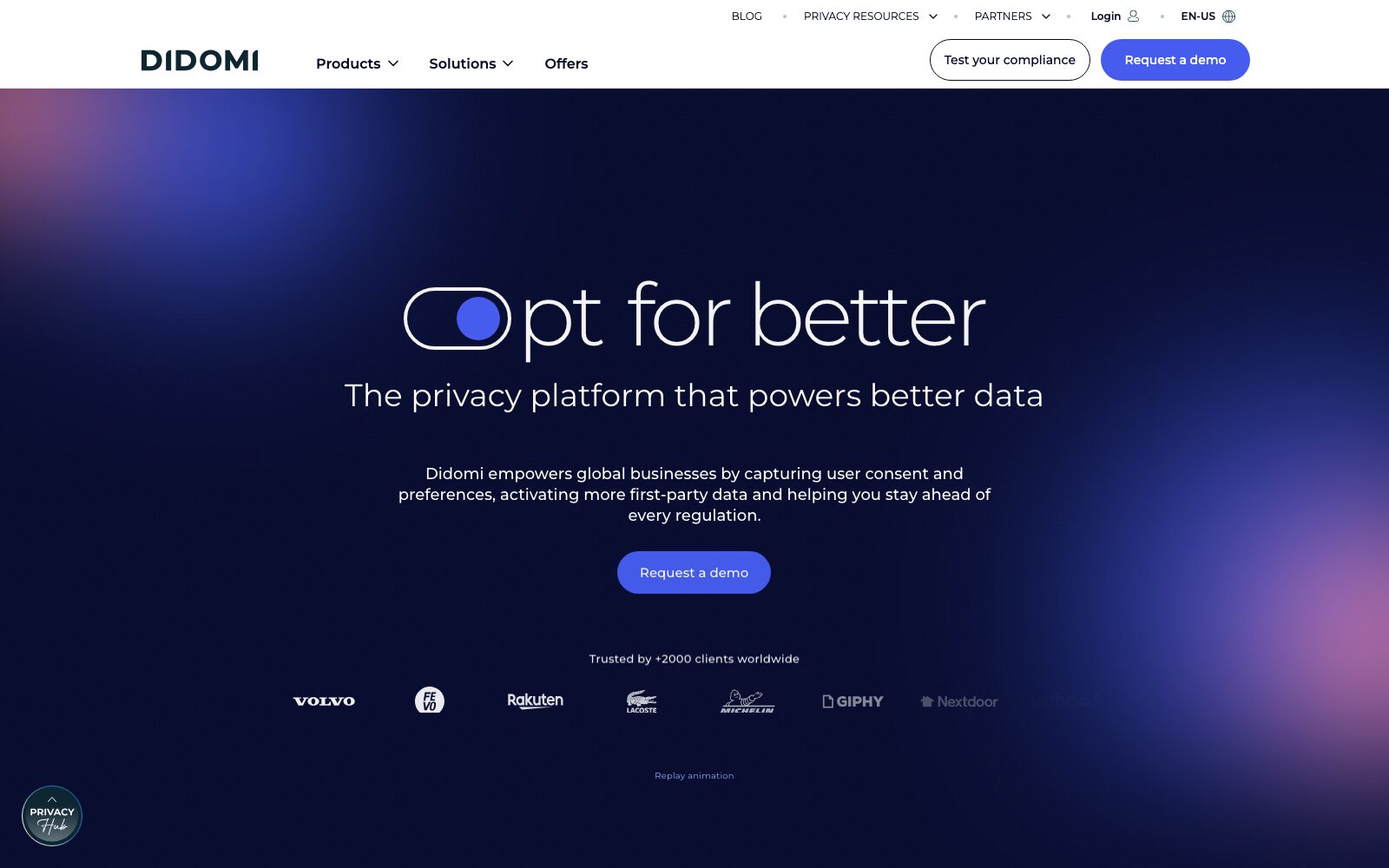
Didomi is a privacy platform for large organizations that need consent and preferences managed across websites, mobile apps and connected TV. Its CMP is Google-certified, and it says it is trusted by more than 2,000 clients worldwide.
Core features
Didomi's multi-regulation CMP supports IAB TCF v2.3, GPP, Google Consent Mode v2, Amazon Consent Signal and Microsoft UET Consent Mode. Around it sit Preference Management (including email and in-store touchpoints), Advanced Compliance Monitoring that scans trackers and scripts, Privacy Requests for data subject requests, and server-side tagging through Addingwell by Didomi.
Pros
- Every surface: One platform covers web, mobile apps and connected TV, which media and multi-app companies need.
- Preferences, not just cookies: Preference Management goes beyond the banner to newsletters, channels and topics.
- Monitoring included: Compliance monitoring scans sites for trackers and scripts that load outside the consent rules.
- Publisher-ready: TCF v2.3 and GPP support for sites that sell advertising.
- Server-side option: Addingwell gives a path to server-side tagging from the same vendor.
Cons
- Didomi does not publish prices or offer a free plan; every plan goes through sales.
- The module set is more than a small site with a single banner needs.
- Rolling out across web, apps and CTV takes planning and technical work.
Who it’s for
Didomi fits enterprises, publishers and media groups with many brands, apps or regions, where legal, marketing and data teams share one consent and preference layer.
Unique value proposition
Didomi connects consent, preferences and compliance monitoring in one platform, so the choice a person makes on a website, in an app or on a TV follows them across channels.
Real-world use case
A media group runs Didomi on its websites, apps and connected-TV app, uses TCF v2.3 for its advertising partners, and lets readers manage newsletter topics in the same preference center.
Pricing
Didomi does not publish prices. Plans are quoted by sales, based on traffic and the modules you choose.
Website: https://www.didomi.io
CookieYes
At a glance
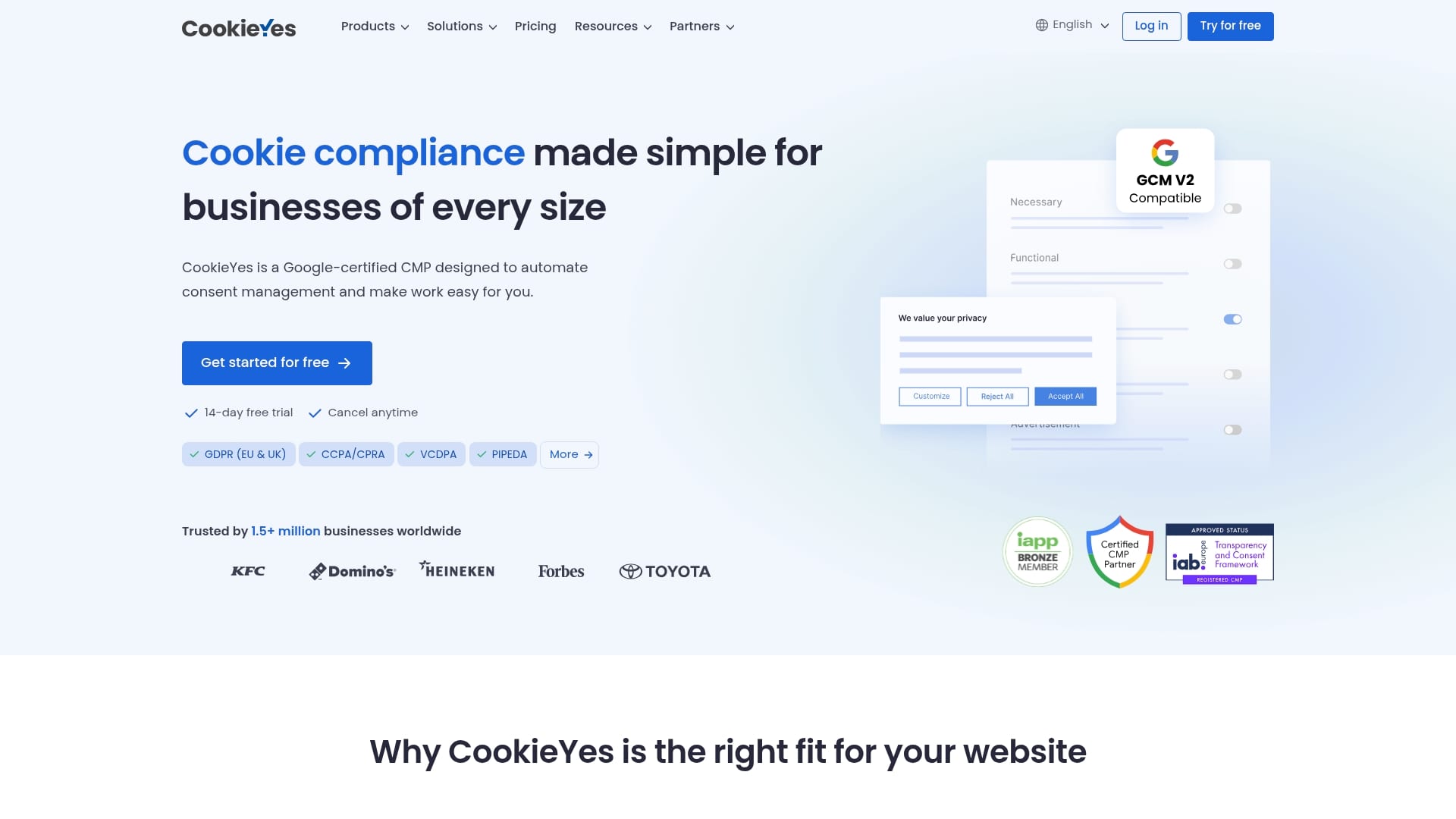
CookieYes is a Google-certified consent management platform that automates cookie blocking, scanning, and consent logging for websites of all sizes. It combines straightforward deployment with multilingual banners to help marketing and compliance teams manage GDPR and CCPA requirements efficiently.
Core features
CookieYes provides customizable cookie banner templates and automated consent flows that include auto-blocking cookies before consent. The platform scans sites for cookies, delivers compliance risk reports, and integrates with Google Tag Manager and Google Consent Mode v2 on every plan, with IAB TCF v2.3 on the Pro and Ultimate plans.
Pros
- Easy setup: Implementation requires a single code snippet, letting teams deploy consent controls quickly without heavy developer time.
- Broad platform support: CookieYes supports WordPress, Shopify, Wix, and other platforms so ecommerce and CMS sites can adopt it without custom engineering.
- Automated compliance tasks: The product automates cookie blocking, scanning, and consent logging which reduces manual auditing work for compliance officers.
- Customizable banners: The library of templates and multilingual support allows marketing teams to match brand voice and local language needs.
- Law coverage: CookieYes supports major privacy laws like GDPR and CCPA so legal teams can maintain consistent controls across regions.
Cons
- Pricing is per domain, so the cost grows quickly for teams with many sites.
- The free plan stops at 5,000 pageviews per month and 100 pages per scan, which only fits small sites.
- IAB TCF v2.3 is only available on the Pro and Ultimate plans.
Who it’s for
CookieYes suits web teams, compliance officers, and digital marketing managers who need a deployable consent solution across multiple CMS and ecommerce platforms. It also fits agencies and developers managing compliance for client portfolios with multiple domains.
Unique value proposition
CookieYes combines automated site scanning, consent logging, and platform integrations into a single package that reduces manual tracking errors. For teams juggling multiple domains and languages, the package delivers fast deployment and centralized consent controls.
Real-world use case
A retail company installs CookieYes across its ecommerce domains to automate consent collection, block tracking scripts until permission, and produce compliance reports by country. Marketing keeps brand banners in local languages while legal receives consolidated logs for audits.
Pricing
CookieYes offers a free plan up to 5,000 pageviews per month, then Basic at $10, Pro at $25 and Ultimate at $55 per month per domain. Enterprise is quoted, and paid plans include a 14-day free trial.
Website: https://www.cookieyes.com
Cookiebot
At a glance
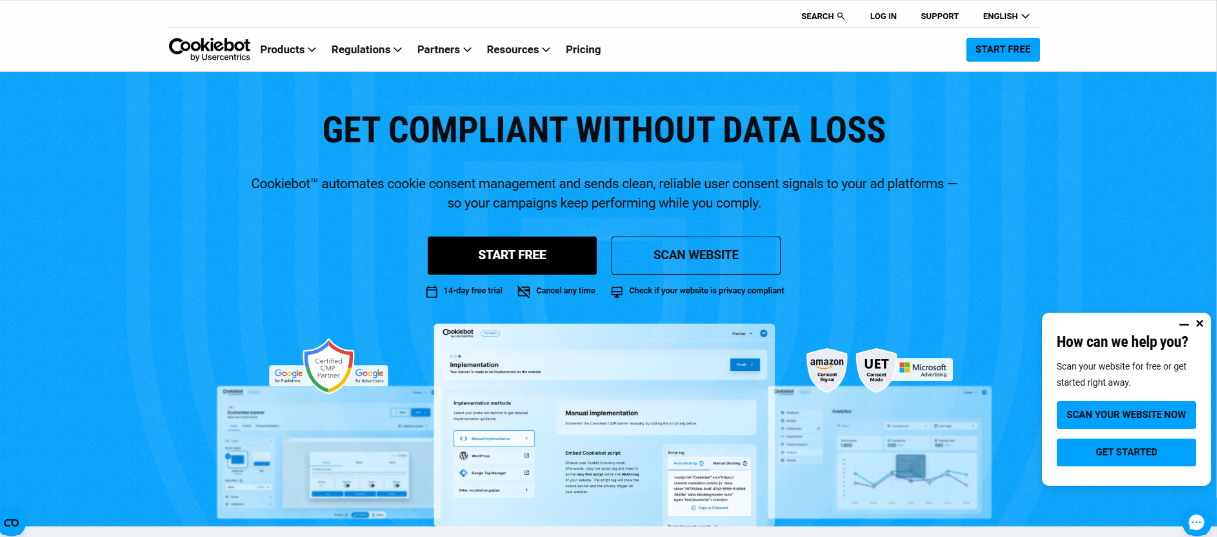
Cookiebot is a Google-certified consent management platform by Usercentrics that automates cookie scanning, consent collection, and script blocking. It helps businesses comply with privacy regulations while preserving valuable analytics data through integrations with Google Consent Mode V2 and leading tag management platforms.
Core features
Cookiebot automatically scans websites to detect cookies and trackers, categorizes them, and updates cookie declarations. It offers customizable consent banners, automatic script blocking before consent, multilingual support, Google Consent Mode V2 integration, IAB TCF compatibility, consent logging, and support for multiple privacy regulations including GDPR, ePrivacy Directive, CCPA/CPRA, LGPD, and more.
Pros
- Automatic cookie scanning: Cookiebot continuously scans websites to detect new cookies and trackers, reducing the need for manual audits.
- Strong Google integrations: Native support for Google Consent Mode V2 and Google Tag Manager helps businesses maintain measurement while respecting user consent.
- Highly customizable banners: Businesses can tailor consent banners to match their branding, languages, and regional compliance requirements.
- Broad regulatory support: The platform supports GDPR, CCPA/CPRA, LGPD, and other major privacy frameworks, making it suitable for international websites.
- Easy implementation: Deployment requires only a small script and integrates with popular CMS platforms such as WordPress, Shopify, Wix, and Drupal.
Cons
- Advanced customization and enterprise-level implementations may require technical expertise or developer involvement.
- Pricing increases with website traffic, which may become expensive for high-traffic publishers or businesses managing multiple large domains.
- Some advanced compliance and reporting capabilities are only available on higher-tier plans.
Who it’s for
Cookiebot is ideal for businesses, ecommerce stores, publishers, agencies, and enterprises that need an automated consent management platform with strong Google ecosystem integration. It is particularly well suited for organizations relying on Google Analytics, Google Ads, and Tag Manager while maintaining privacy compliance.
Unique value proposition
Cookiebot combines automated cookie discovery, intelligent consent management, and deep Google integrations into a single platform. Its automatic scanning and real-time cookie declaration updates reduce ongoing maintenance while ensuring consent choices are reflected across marketing and analytics technologies.
Real-world use case
An online retailer uses Cookiebot across multiple regional websites to automatically scan for new tracking technologies, display localized consent banners, and activate Google Consent Mode V2. Marketing teams continue measuring campaign performance while ensuring tracking only begins after visitors provide consent, helping maintain both compliance and analytics quality.
Pricing
Cookiebot offers a free plan for one domain with up to 50 subpages. Paid plans are priced per domain by number of subpages, from 7€ per month (Premium Lite) to 90€ per month (Premium XLarge). Usercentrics, its parent company, quotes larger setups.
Website: https://www.cookiebot.com
Termly
At a glance
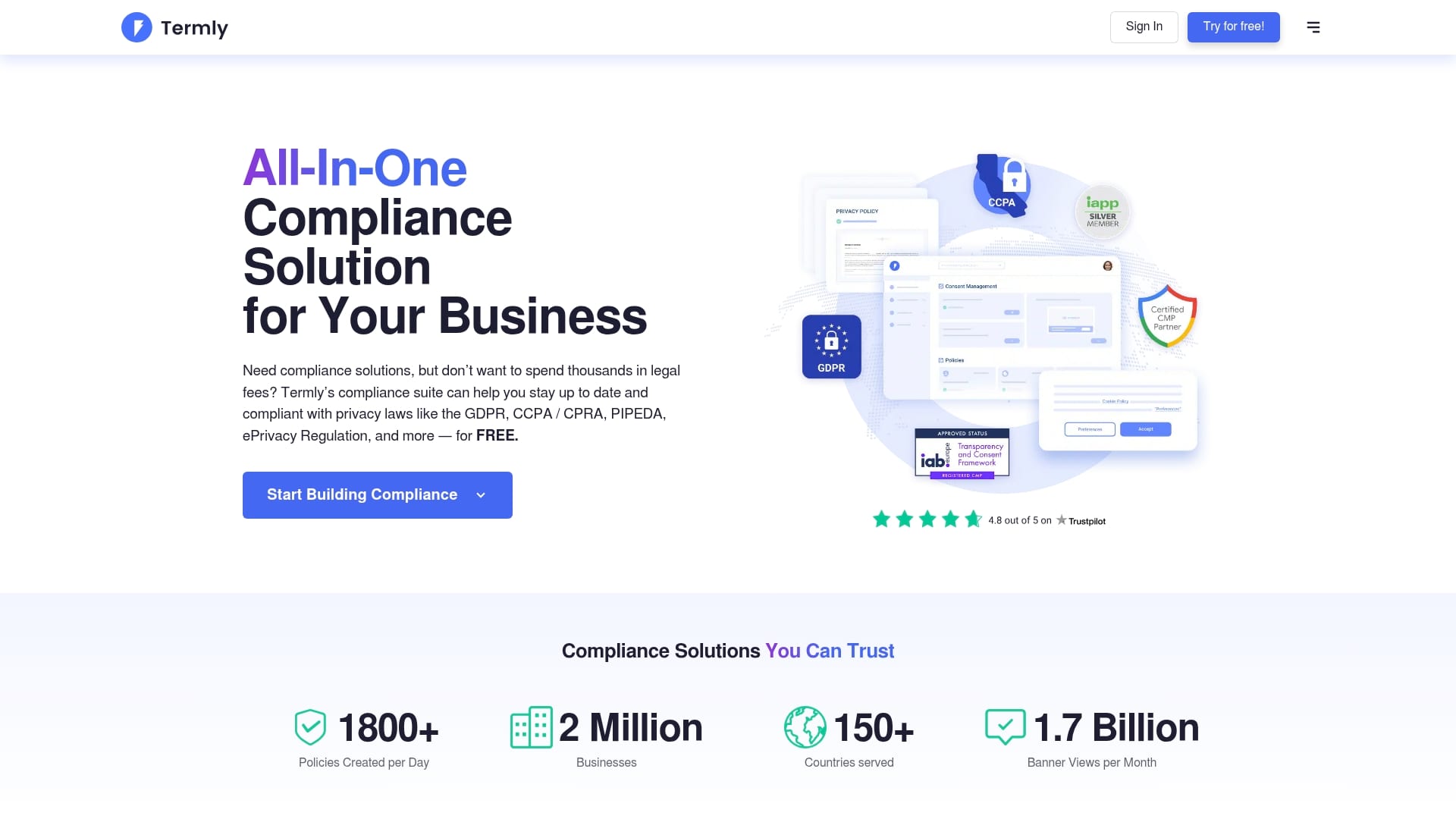
Termly provides an all-in-one compliance toolkit that helps teams generate policies and manage user consent without hiring outside counsel. It pairs user friendly interfaces with automated updates to reduce manual oversight for privacy teams and marketing managers.
Core features
Termly includes attorney crafted policies, a consent management platform, and cookie scanners that surface deployed trackers. The platform covers global laws such as GDPR, CCPA, and PIPEDA and automatically updates policy text when laws change. The combined toolset supports policy generation, consent banners, preference centers, and cookie scanning across websites and apps.
Pros
- Comprehensive toolset: Termly bundles policy generators, consent banners, and cookie scanning in a single platform so teams avoid stitching multiple vendors together.
- Automated policy updates: The platform automatically updates documents in response to legal changes which reduces manual review work for compliance teams.
- User friendly implementation: The product offers straightforward setup and clear interfaces that lower the onboarding time for marketing and web teams.
- Legal support included: Documents and templates are attorney crafted which raises the baseline quality of generated policies for internal reviewers.
- International coverage: Support for GDPR, CCPA, and PIPEDA gives multinational teams consistent controls across markets.
Cons
- Pricing may feel steep for very small startups or individual users when advanced plans are needed for full feature access.
- Some capabilities require technical setup to achieve optimal results which increases reliance on engineering resources for complex sites.
- Relying on a third party for compliance content still leaves highly sensitive legal questions that require direct consultation with legal counsel.
Who it’s for
Termly fits business owners, website managers, and compliance professionals at small to medium sized companies that need an affordable way to centralize privacy documents and consent flows. It also suits digital marketing managers who need a ready made consent layer without building a custom solution.
Unique value proposition
Termly combines policy generation and consent management in one product backed by attorney authored content and automated updates. That combination reduces the number of vendors you manage and shortens the time from legal requirement to live implementation.
Real-world use case
A small ecommerce team uses Termly to generate a privacy policy, deploy a cookie consent banner, and run periodic scans to identify new trackers. When regulators change guidance, the policy updates automatically and marketing can focus on campaigns rather than manual policy edits.
Pricing
Termly offers a free plan with one basic policy and 10,000 banner views per month. Paid plans start at $10 per website per month billed annually ($14 billed monthly), and Agency plans are quoted.
Website: https://www.termly.io
Osano
At a glance
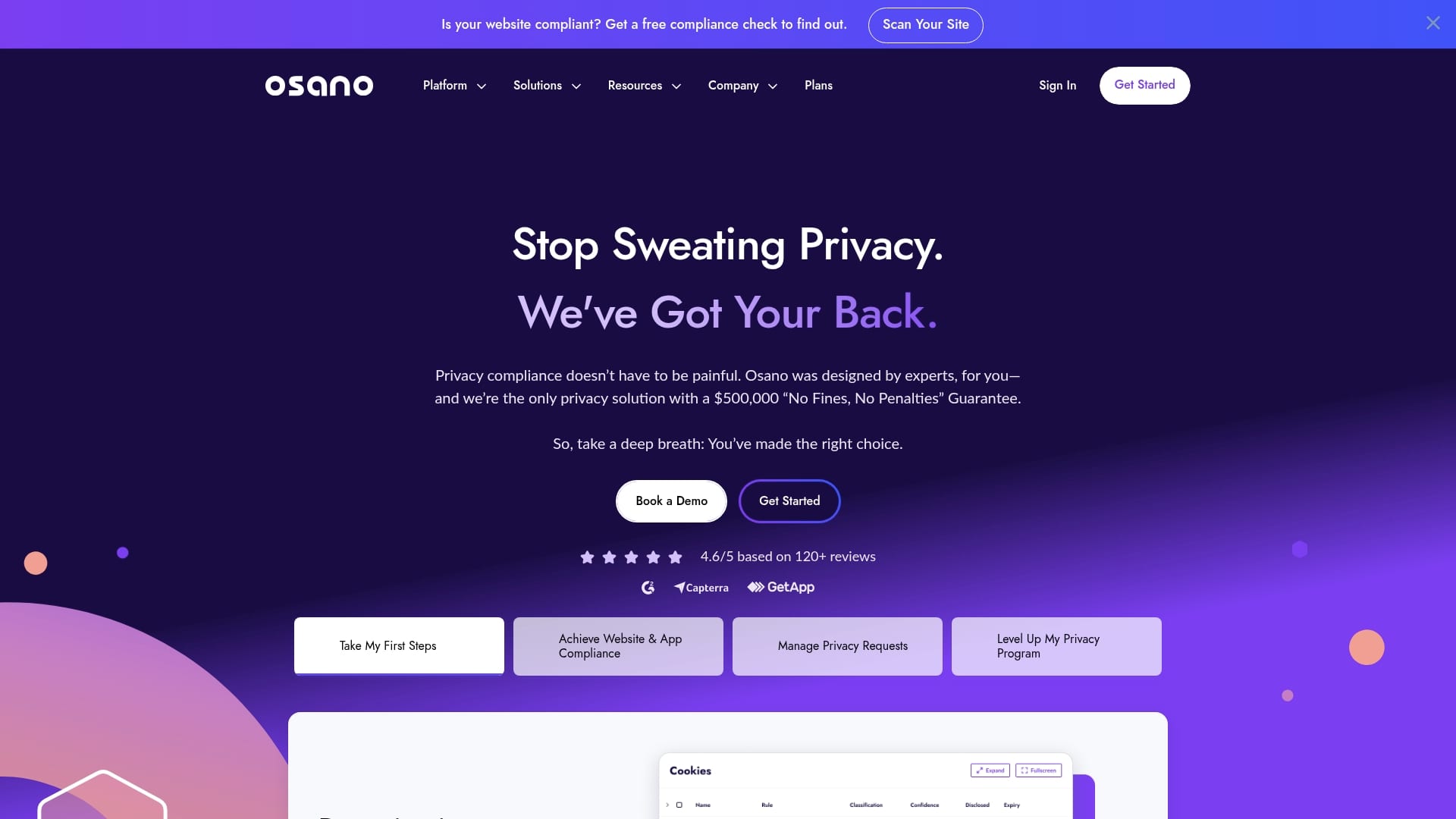
Osano is a data privacy management platform that centralizes consent, subject rights, and vendor risk across regions. Its all in one approach reduces manual work and helps medium to large teams maintain consistent privacy controls across websites and apps.
Core features
Osano combines Cookie Consent Management, Subject Rights Management, and a Unified Consent & Preference Hub with Data Mapping and Visualization and Vendor Privacy Risk Management to cover end to end privacy operations. The platform also includes assessments, regulatory guidance, and integrations with major marketing and data tools.
Pros
- All-in-one platform simplifies privacy compliance by bringing consent, DSAR workflows, and vendor management into a single dashboard so teams stop chasing scattered tools.
- Broad regulatory coverage ships pre-built rule sets for 95+ regulations in 50+ countries which reduces manual policy updates for global operations.
- Workflow automation automates complex tasks like DSARs and data mapping to save legal and compliance teams measurable time on repetitive work.
- Vendor risk tooling provides detailed assessments and score monitoring so you can prioritize remediation with data driven signals rather than guesswork.
- No Fines, No Penalties Guarantee offers a visible assurance that can reduce stakeholder anxiety about regulatory exposure.
Cons
- Onboarding complexity may require dedicated training because the feature set is broad and configuration spans multiple modules.
- The extensive feature set may be more than small teams need if they only require basic cookie banners and simple consent capture.
- Prices are not published, which makes initial budgeting harder without a sales conversation.
Who it’s for
Legal and compliance teams, privacy officers, and data protection officers at medium to large organizations will get the most value from Osano. Teams operating across multiple countries and managing many vendors benefit from centralized policy enforcement and automated subject rights workflows.
Unique value proposition
Osano’s strength lies in consolidating privacy tasks that usually live in separate systems. By coupling consent management, automated DSAR handling, and vendor risk scoring, Osano turns fragmented privacy work into coordinated programs that scale across brands and regions.
Real-world use case
A multinational company uses Osano to manage cookie consent on dozens of sites, route subject access requests to its legal teams, and monitor the privacy posture of its vendors.
Pricing
Osano does not list prices on its pricing page; it offers a 30-day free trial and quotes plans through a demo, based on the modules and the size of the organization.
Website: https://www.osano.com
Consent management platforms compared
All six collect and store consent; they differ in who they are built for and how they charge. Prices were checked on each vendor’s site in October 2026.
| Tool | Best for | Covers | Google Consent Mode v2 | IAB TCF | Starting price |
|---|---|---|---|---|---|
| Axeptio | Brands that want a banner in their own voice | Web, mobile apps | All plans | v2.3, from Small | $7/month billed annually, 1 domain |
| Didomi | Enterprises and publishers across many surfaces | Web, mobile apps, connected TV | Yes | v2.3 | Quote only |
| CookieYes | Small and mid-size sites on popular CMSs | Web | All plans | v2.3, Pro and Ultimate | Free; paid from $10/month per domain |
| Cookiebot | Stacks built around Google Analytics and Ads | Web | Yes | Yes | Free for 1 domain; paid from 7€/month |
| Termly | Policies and consent from one vendor | Websites and apps | Yes | Not stated | Free; paid from $10/month per website, billed annually |
| Osano | Privacy programs with DSARs and vendor risk | Websites and apps | Yes | Not stated | Quote only; 30-day free trial |
Check that your CMP’s choices reach every tag
Choosing the right Consent Management Platform (CMP) is only part of the privacy compliance equation. Once a CMP is implemented, organizations still need to verify that consent choices are correctly reflected across their analytics, advertising, and marketing technology stack.
Trackingplan provides continuous monitoring for your tracking implementation, helping ensure that consent-related events, tags, and integrations behave exactly as expected. Rather than replacing your CMP, it works alongside the most popular consent management platforms by validating that tracking remains both privacy-compliant and reliable.
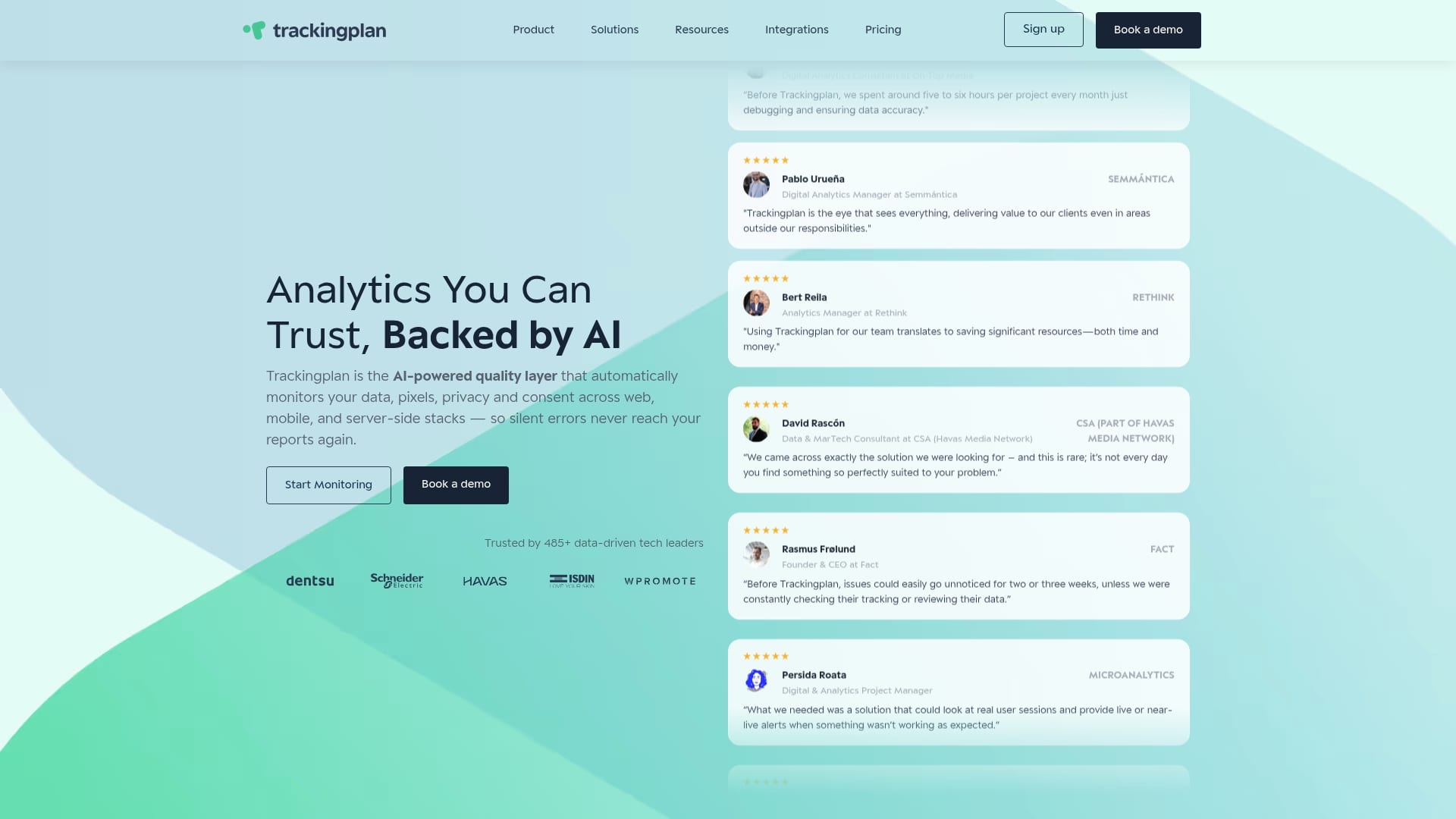
Whether you use Axeptio, Didomi, Cookiebot, CookieYes, OneTrust, Usercentrics or another supported CMP, Trackingplan reads the consent state on every hit and flags vendors that fire before the banner is answered.
What Trackingplan monitors
Trackingplan helps teams verify that:
- Consent events are firing correctly.
- Analytics and marketing tags only execute according to users' consent choices.
- Google Analytics, Google Ads, Meta Pixel, and other MarTech integrations receive the expected consent signals.
- New releases don't accidentally break consent-aware tracking.
- Changes to your CMP configuration don't silently affect data collection.
By continuously validating your tracking implementation, Trackingplan helps prevent data loss, unexpected consent violations, and measurement inconsistencies that are often difficult to detect manually.
Why use Trackingplan alongside your CMP?
While a CMP manages user consent, Trackingplan verifies that the entire tracking ecosystem respects those consent decisions.
This additional layer of monitoring helps marketing, analytics, and engineering teams maintain high-quality data without sacrificing privacy compliance. Instead of discovering broken consent implementations weeks later through inaccurate reports, teams receive automated alerts as soon as unexpected changes occur.
For organizations that rely on accurate analytics, advertising attribution, and privacy compliance, combining a CMP with continuous tracking validation creates a much more reliable measurement foundation. The privacy and compliance page shows what that monitoring covers, and PII leak detection in analytics explains how personal data slips into tags even when the banner is answered correctly.
Frequently asked questions
What features should I look for in a consent management platform in 2026?
Look for features like automated consent collection, customizable cookie banners, and comprehensive policy generation. These functionalities will help ensure compliance while streamlining your privacy management processes.
How can a consent management platform improve my website’s compliance?
A consent management platform can centralize your user consent processes and ensure that you are meeting regulatory requirements by providing automated updates and comprehensive reporting. Implementing one can enhance your compliance efforts by reducing the risk of costly fines.
How do I assess the pricing of consent management platforms?
To assess pricing, compare the features offered against your business needs, and look for platforms that provide transparent pricing structures. Consider starting with a platform that offers a free tier or a trial to evaluate its effectiveness before committing to a paid plan.
Can consent management platforms integrate with my existing tools?
Most consent management platforms offer integrations with popular marketing and analytics tools, so the consent choice reaches your analytics and advertising tags. Review potential platforms for integration capabilities to maximize your current tech stack benefits.
How often do I need to update my consent policies?
You should update your consent policies regularly, especially when there are changes in laws affecting user privacy. Set a schedule for reviewing your policies at least quarterly to ensure they remain compliant and aligned with current regulations.
What is the typical onboarding process for a consent management platform?
Onboarding typically involves creating an account, configuring your compliance preferences, and implementing consent banners on your website. This can usually be completed within a few days to a few weeks, depending on the complexity of your site.