
Consent management is the system your business uses to ask users for permission before collecting or using their personal data. Think of it as a digital handshake—it's how you transparently tell visitors what data you want, why you want it, and get their explicit 'okay' before moving forward. This process is absolutely fundamental to building trust and meeting legal requirements in today's privacy-focused world.
The Digital Gatekeeper Your Website Needs
At its core, consent management is pretty straightforward. Imagine your website is a private club, and every visitor’s personal data is a guest. Before a guest can enter, they have to check in at the front door, where a friendly gatekeeper explains the club's rules and asks for permission to let them in. Consent management is that digital gatekeeper.

This system isn't just a single pop-up you set and forget. It’s an entire process designed to respect user privacy while still enabling your business to operate effectively. It involves several key components working together to ensure every piece of data is handled correctly and ethically, from the first click to the last.
Key Components of Consent Management
A solid consent management strategy relies on a few essential tools working in tandem. Each one plays a specific role in informing users and, more importantly, honoring their choices.
- Consent Banners: These are the initial pop-ups or banners that greet users. They’re your first opportunity to explain your data collection practices and ask for permission.
- Consent Management Platforms (CMPs): This is the central technology that powers the whole system. A CMP presents the banner, records user preferences, and then broadcasts those choices to your other marketing and analytics tools.
- Preference Centers: This is a dedicated portal where users can review and change their consent choices at any time. It gives them continuous control over their data, which is a huge part of building trust.
These pieces work together to create a transparent, user-centric experience. A user's interaction with a consent banner generates a signal that is stored and respected across all your digital properties, ensuring their preferences are consistently applied no matter where they go on your site.
A well-implemented consent management system does more than just keep you compliant; it builds a foundation of trust. When users feel they have control over their data, they are far more likely to engage with your brand in a meaningful way.
That initial handshake is critical. Getting it wrong can lead to serious legal penalties and a permanent loss of customer confidence. But getting it right transforms a legal obligation into a real competitive advantage.
The table below breaks down the essential functions that make up an effective, trustworthy consent strategy.
The Four Pillars of Effective Consent Management
A breakdown of the essential functions required for a robust consent management system.
These four pillars are non-negotiable. Without them, your consent management is just a box-ticking exercise that fails to respect your users or protect your business.
Not too long ago, "consent management" was a term you'd mostly hear in legal departments or among privacy wonks. Today, it’s front and center in marketing, analytics, and customer relations—a non-negotiable part of doing business online. This wasn't some slow, academic shift. It was a rapid change driven by tough new laws, eye-watering financial risks, and a massive swing in what people expect from the brands they deal with.
Think back to the digital gold rush of the early 2000s. Businesses were scooping up user data with hardly any rules in place. That free-for-all eventually triggered a global privacy backlash. People started asking hard questions: What are companies collecting on me? What are they doing with it? And crucially, what say do I have in any of this?
The Global Wave of Privacy Regulation
Lawmakers worldwide heard the public outcry and responded with sweeping new regulations. These laws weren't just about punishing companies; they were about rebalancing the power dynamic, giving people real, enforceable rights over their personal information. The old way of doing things was officially over.
- The General Data Protection Regulation (GDPR): When the EU rolled out GDPR in 2018, it set a new global benchmark. It forced businesses to get explicit, unambiguous consent before touching the personal data of anyone in the EU. Gone were the days of sneaky, pre-ticked boxes. Clear, affirmative choice was now the law of the land.
- The California Consumer Privacy Act (CCPA): California followed suit with the CCPA in 2020. This gave Californians the right to see exactly what data was being collected on them and, just as importantly, the right to tell companies to stop selling it.
These two regulations were just the first big dominoes to fall, inspiring similar laws everywhere from Brazil to Japan. The message was unmistakable: the era of collecting data by default is dead. You have to ask permission first. This new reality created an urgent need for systems that could handle these permissions efficiently and at scale—and just like that, consent management was born.
More Than Just Fines The High Cost of Non-Compliance
Let's be clear: ignoring these rules carries a massive price tag. The penalties aren't just a slap on the wrist; they’re designed to hurt. Under GDPR, for example, fines can soar as high as €20 million or 4% of a company’s annual global turnover—whichever is greater. And these aren’t idle threats. Regulators are actively enforcing them.
Customer trust is the new currency. A consent violation isn't just a legal misstep; it's a breach of that trust that can take years to repair. Losing customer confidence is often far more damaging to a business than any single fine.
But the financial hit is only part of the story. The damage to a company's reputation can be far worse and last much longer. When news breaks that a company has been fined for mishandling data, trust evaporates. In a world with endless choices, a reputation for respecting privacy is a huge competitive advantage. One consent-related scandal can send customers running to your competitors and stain your brand for years. This is why knowing what is consent management and getting it right is fundamental to your business's health.
The market has reacted accordingly. The consent management industry is booming, projected to jump from USD 1.07 billion in 2026 to USD 2.34 billion by 2031, according to Mordor Intelligence. This explosive growth tells a simple story: businesses are investing serious money to get this right because the risk of getting it wrong is just too high. It's not just about dodging fines anymore; it's about adapting to a world where privacy and trust are the foundation of business. Explore detailed market growth projections on Mordor Intelligence.
How Consent Management Technology Actually Works
To really get what consent management is, you have to look under the hood. It’s not just a pop-up banner; it's a sophisticated system built to capture, store, and act on a user's choices across your entire digital ecosystem. Think of it as the central nervous system for user privacy preferences.
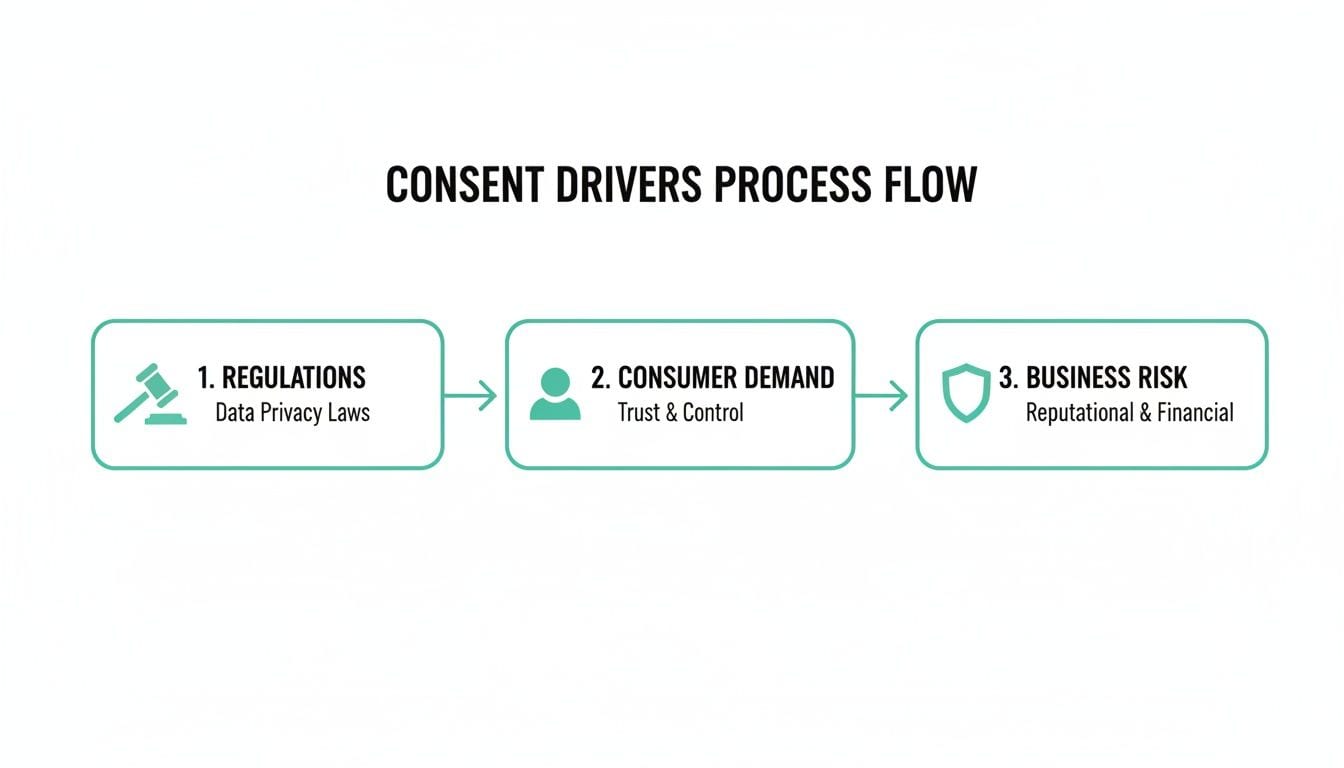
This whole setup exists because of a few key pressures working together. As you can see below, a perfect storm of regulations, rising consumer expectations, and plain old business risk is what makes these systems a necessity.
This technology is all about handling user preferences for tracking, the kind of stuff you see detailed in various company cookie policies.
At its core, the action starts the second a visitor lands on your site. The Consent Management Platform (CMP), which is the command center for all this, kicks into gear immediately.
The Role of the Consent Management Platform
The CMP is the engine that makes your entire consent strategy run. Its most visible job is presenting the consent banner. This is your first interaction with the user on this topic—it's where you have to clearly explain what data you want to collect and why, whether it's for analytics or targeted ads.
But what happens after the user clicks a button? The CMP's real work begins. It doesn't just make the banner go away; it performs a few critical tasks behind the scenes:
- Capturing the Choice: The CMP logs the user's exact preferences. This isn't just a simple "yes" or "no." It can be incredibly granular, like noting consent for "analytics" but rejecting "marketing."
- Creating a Consent Signal: It then translates that choice into a machine-readable format, often called a consent string. This string acts like a digital passport, holding all the permissions the user granted.
- Storing the Proof: Finally, the CMP creates a timestamped log of this consent. This gives you a verifiable record, which is absolutely crucial if you ever face a compliance audit.
The consent string is the lifeblood of this whole system. It’s a standardized, often encrypted, piece of data that tells every other tool on your site—from Google Analytics to your Meta pixel—exactly what it can and can’t do with that user's data.
This entire sequence has to happen flawlessly and in the blink of an eye. The CMP’s ability to correctly capture and communicate user choices is what stands between you and a major compliance headache. You can use tools like a consent and cookie checker to make sure everything is working as it should.
Communicating Consent Across Your Tech Stack
Once the consent string is created, the CMP's next job is to broadcast that signal to every other piece of technology on your site. This is where frameworks like the IAB’s Transparency and Consent Framework (TCF v2.2) become so important. TCF provides a universal language that allows CMPs and advertising vendors to understand each other perfectly.
Think of it like an airport. The TCF is the common language spoken by air traffic control (the CMP) and all the different airlines (your marketing vendors). It ensures every pilot gets the right instructions, preventing any confusion or mistakes.
Using this framework, the CMP passes the consent signal along. If a user opted out of advertising cookies, the CMP tells your ad tags not to fire or collect any personal data. This stops data leakage in its tracks and makes sure the user’s choices are respected instantly, across your entire marketing and analytics stack. Without this technology, trying to honor user preferences at scale would be a chaotic, and likely impossible, task.
The Real Impact of Consent on Your Analytics and Marketing

A user’s simple click on a "Reject All" button is a lot more than just a preference. It kicks off a chain reaction that can directly hit your company's bottom line. When consent is denied, it's not just a single data point that vanishes—entire segments of your analytics and marketing pipelines go dark.
Think of it like trying to navigate a city with half the map missing. That’s what your analytics look like when users opt out. Your reports are skewed by huge blind spots, user journey maps are broken, and your conversion data becomes fundamentally unreliable. You might see a dip in traffic and assume a campaign failed, when in reality, a large chunk of users simply became invisible to your tracking.
When Marketing Pixels Go Blind
This data blackout hits your marketing tools especially hard. Pixels from platforms like Google and Meta are the engines of modern advertising, responsible for tracking conversions, building audiences, and optimizing every dollar of ad spend. The catch? They can only fire with user consent.
When a user rejects tracking cookies, these pixels are effectively switched off. The consequences are immediate:
- Ad attribution is broken: You can no longer reliably connect ad clicks to conversions, making it impossible to calculate your true return on ad spend (ROAS).
- Retargeting audiences shrink: Your ability to re-engage interested users is crippled as your audience pools get smaller and smaller.
- Automated bidding algorithms suffer: AI-driven ad platforms depend on a steady stream of conversion data to optimize campaigns. With incomplete data, their performance degrades, leading to wasted ad spend.
Without a solid consent management strategy, you're essentially flying blind, pouring money into campaigns without knowing what's actually working. For a deeper look into this, check out our guide on cookies and their role in marketing.
Navigating Data Gaps with Consent Mode
So, what happens to your GA4 data when consent is denied? In a basic setup, you get a black hole. Nothing. To address this, Google introduced Consent Mode, a clever mechanism that allows Google tags to adjust their behavior based on a user's choices.
When a user says no, Consent Mode uses cookieless, anonymized signals called "pings" to model conversion data and user behavior. This helps fill in some of the analytics gaps, giving you a more complete picture without crossing any privacy lines.
But don't be mistaken—Google Consent Mode isn't a silver bullet. It's a sophisticated tool that is completely dependent on being implemented correctly. A misconfigured CMP that fails to properly signal consent choices to your Google tags will render the modeling useless, leaving you to make decisions based on flawed data.
This is precisely why ongoing validation is non-negotiable. An analytics observability platform like Trackingplan acts as a safety net, continuously monitoring your consent implementation to ensure your CMP and Google tags are always communicating correctly. It catches the misconfigurations that could otherwise silently cripple your data accuracy and marketing efforts.
The demand for these kinds of robust solutions is growing fast. In the U.S. alone, the consent management market reached USD 169 million in 2024 and is projected to hit USD 970.52 million by 2033, growing at a staggering 19.1% CAGR. Platforms offering banners, preference centers, and reporting already hold an 80% market share, helping marketers personalize experiences without privacy headaches. For analysts and developers using Trackingplan, this means catching consent errors in real-time before they can skew attribution or corrupt data integrity. Discover more insights on the US consent management market on Straits Research.
Avoiding the Most Common Consent Implementation Mistakes
Getting the theory of consent management right is one thing, but making it work in the real world is what separates compliant, data-driven companies from those walking a tightrope. It's surprisingly easy to fall into common traps during implementation—mistakes that can shatter user trust, break your data pipelines, and open you up to some serious legal heat.
These aren't just minor technical glitches. They're fundamental flaws that can poison your entire consent strategy from the root. The good news? They are almost always preventable if you know what to look for. Let's walk through the most frequent blunders and, more importantly, how to steer clear of them.
Pitfall 1: Firing Tags Before Consent Is Given
This is the big one—the most critical and widespread mistake we see. It’s what happens when your marketing or analytics tags, like a Google Analytics script or a Meta pixel, load and start collecting data before a user even has a chance to see the consent banner. This is a direct violation of privacy laws like GDPR.
Often, the culprit is a simple misconfiguration in your tag manager or scripts loading in the wrong order. It completely defeats the purpose of asking for consent, because you’ve already grabbed the data regardless of what the user chooses.
- How to spot it: Data is being collected from users who haven't yet clicked "accept" or "reject."
- The fix: Configure your tag manager or CMP to block all non-essential scripts by default. The starting position for every tracking tag should be "off" until you get an explicit green light from the user.
Pitfall 2: Using Confusing and Misleading Banner Designs
Another common misstep is using "dark patterns" in consent banners. These are intentionally confusing UIs designed to nudge or trick users into giving away more consent than they actually want to.
You've probably seen them: a hidden "reject all" button, pre-ticked boxes for non-essential cookies, or confusing language that makes it hard to say no. While this might temporarily pump up your consent rates, it corrodes user trust and is explicitly forbidden under GDPR, which demands that consent be freely given and unambiguous.
A consent banner should be a tool for transparency, not a hurdle for users to overcome. If you have to trick someone into saying yes, you don't have real consent. It's a compliance failure waiting to happen.
Pitfall 3: Failing to Honor Consent Across All Systems
Getting consent is only half the battle; you also have to enforce that choice everywhere. A huge mistake occurs when a user's preference is logged by the CMP but isn't properly passed along to every downstream tool. For instance, a user opts out of marketing cookies, but your ad-tech vendor’s tag fires anyway.
This usually stems from broken integrations between your CMP and other platforms. It also happens when new marketing tools are added to the site without being hooked into the consent framework. The result is a data leak where user preferences are ignored, creating a serious compliance breach.
To help you visualize these common issues and how to solve them, here's a quick comparison of what not to do versus the best-practice approach.
Common Consent Misconfigurations vs. Best Practices
Following these best practices isn't just about avoiding fines; it's about building a trustworthy relationship with your users and ensuring the data you collect is both ethical and accurate.
The Automated Safety Net: Analytics Observability
Trying to manually audit for these mistakes is a losing game. Your tech stack is always in flux, new tags are constantly being added, and a simple website update can break your CMP configuration without anyone noticing. This is where an analytics observability platform like Trackingplan becomes your essential safety net.
Instead of relying on spot-checks, Trackingplan provides continuous, automated validation of your entire consent implementation. Think of it as a 24/7 security guard for your data privacy, instantly flagging issues like:
- Rogue Tags Firing: It immediately detects marketing or analytics tags that fire without the necessary consent.
- Broken CMP Integrations: It spots when your CMP stops talking to other tools, preventing consent signals from getting lost.
- Data Mismatches: It verifies that the data being collected perfectly matches the level of consent the user actually gave.
By automatically monitoring your entire setup, Trackingplan helps you shift from a reactive, "hope-for-the-best" stance to a proactive one. It provides the assurance that your consent framework isn't just compliant on paper but is actually working as intended, protecting both your users and your business.
The Future of Data Privacy and Consent
The world of data privacy is anything but static. What we think of as consent management today is just a snapshot in time, with the forces that will reshape it tomorrow already in motion. This isn't just about keeping up with new rules; it's about getting ahead of the curve and building a strategy based on user trust. As the tech evolves, so must our approach to managing consent.
This shift is really being pushed by two big trends. First, the move toward a cookieless web is quickly making third-party data obsolete. As a result, businesses are pivoting hard to first-party data strategies, where the information they collect comes straight from their audience. This puts consent front and center, transforming it from a legal checkbox into the very foundation of a lasting customer relationship.
Automation and AI in Consent
As data ecosystems get more complicated, we need smarter solutions to manage them. This is where automation and AI are starting to make a real difference. Think about systems that can tailor a user's consent experience in real-time, or use machine learning to spot potential privacy risks before they turn into full-blown breaches. These technologies will be key to maintaining high privacy standards without sacrificing the personalized experiences customers have come to expect.
At the same time, there’s a growing push for more unified privacy laws across the globe. While we’re currently juggling regional regulations like GDPR and CCPA, the long-term trend points toward a more harmonized legal framework. Businesses that build agile, observable consent systems now will be in the best position to adapt to these changes without having to tear everything down and start over.
The future of consent management isn't about finding clever workarounds to collect more data. It's about building transparent, automated systems that prove to users their privacy is a priority, earning you the right to engage with them.
A Market Reshaped by Technology and Trust
Looking ahead, consent management is on track to fundamentally reshape digital analytics. The market is projected to skyrocket to USD 13.06 billion by 2035—a massive jump from its 2024 valuation of USD 3.529 billion, according to Market Research Future. This explosive growth is being driven by the unstoppable rise of e-commerce, growing consumer awareness, and the urgent need for tools that can navigate a post-cookie, AI-driven world.
For QA teams and agencies, this means investing in CMPs with unified dashboards and real-time monitoring to catch PII leaks or banner misfires is no longer a "nice-to-have." It’s a matter of survival. You can learn more about the future of the consent management market in this detailed report.
Ultimately, as technology barrels forward, having a flexible and continuously validated consent framework becomes absolutely critical. An observability platform gives you the oversight needed to future-proof your data strategy, ensuring your consent mechanisms stay robust, compliant, and effective—no matter what comes next.
Frequently Asked Questions About Consent Management
To help you get a handle on the practical side of all this, let’s clear up a few of the most common questions that pop up when teams start digging into consent management.
What Is the Difference Between a CMP and a CDP?
It’s easy to mix these two up, but they have fundamentally different jobs. A Consent Management Platform (CMP) is a specialized tool built specifically to request, record, and manage user consent for data processing. Its entire purpose is to handle the legal basis for your data collection, keeping you compliant with privacy laws like GDPR.
A Customer Data Platform (CDP), on the other hand, is all about collecting, unifying, and activating customer data from many different sources. The goal of a CDP is to build a single, persistent customer profile that you can use for analytics and marketing.
The simplest way to think about it is this: the CMP provides the "permission slip" (the consent signal), and the CDP uses that permission to decide what data to ingest and what campaigns to run.
How Does Consent Management Affect SEO?
Consent management can throw a wrench in your SEO efforts in a couple of key ways. First, a poorly implemented consent banner can tank your Core Web Vitals, especially Cumulative Layout Shift (CLS). If the banner pops up and causes page elements to jump around, Google notices, and it can hurt your rankings.
Second, if a large number of your visitors deny consent for analytics cookies, you’re suddenly flying blind. You lose a huge amount of visibility into user behavior in tools like Google Analytics. This makes it incredibly difficult to understand how people are interacting with your content, which is the lifeblood of good SEO. While solutions like Google Consent Mode can help model some of this lost data, it has to be implemented perfectly to work.
Can I Build My Own Consent Management Solution?
Technically, yes. But you probably shouldn't. Building a homegrown consent solution is a massive, high-risk project that rarely pays off. The global legal landscape is a moving target, with constant updates to regulations like GDPR, CCPA, and the TCF v2.2 framework.
Keeping a custom-built tool compliant requires continuous legal and technical maintenance—it's a full-time job. Commercial CMPs invest millions in staying ahead of these changes and offer pre-built, battle-tested integrations with thousands of marketing and advertising vendors. For almost every company out there, the cost, risk, and sheer effort of building and maintaining a custom solution just isn't worth it compared to using a specialized, third-party CMP.
Trackingplan provides a fully automated observability platform that acts as your safety net. It continuously monitors your consent implementation to detect issues like rogue tags, broken CMP configurations, and data leaks in real time, ensuring your consent strategy works flawlessly.
Learn how Trackingplan can help you maintain data integrity and compliance.