
The EU AI Act (Regulation (EU) 2024/1689) is the world’s first comprehensive legal framework governing artificial intelligence, and it applies to you even if your organization never sets foot in Europe. Entered into force on August 1, 2024, with full application starting August 2, 2026, this regulation sets binding rules for any provider or deployer whose AI systems are used in the EU, regardless of where the company is based. The core goal is trustworthy, human-centric AI that protects fundamental rights, safety, and health across the EU single market.
Key entities governing the Act:
- European Commission: Proposed the legislation and oversees the broader EU digital strategy
- European AI Office: Coordinates coherent enforcement across member states and regulates general-purpose AI (GPAI) models
- AI Board: Composed of member state representatives; steers governance and advises on implementation
- Scientific Panel of Independent Experts: Provides technical guidance, particularly on GPAI model risks
- Advisory Forum: Brings in stakeholder perspectives from industry, civil society, and academia
How does the EU AI Act work? Scope and risk classification
The regulation’s reach is deliberately broad. It applies to providers placing AI systems on the EU market, deployers operating within the EU, and, critically, providers and deployers in third countries whose AI output is used in the EU. A US company selling an AI-powered hiring tool to a German employer is squarely within scope.
Who is excluded?
- Natural persons using AI for purely personal, non-commercial purposes
- Scientific research and development activities before market placement
- AI systems developed exclusively for military, defense, or national security purposes
- Open-source AI models, unless they fall under high-risk or prohibited categories
One nuance worth flagging: testing under real-world conditions is not covered by the research exclusion. The moment your AI system interacts with real users in the EU, compliance obligations kick in.
The four risk tiers
The Act’s risk-based approach is its defining architectural choice. Higher potential for harm means stricter rules.
-
Unacceptable risk (prohibited): Eight specific practices are banned outright, effective from early 2025. These include social scoring by public authorities, real-time remote biometric identification in public spaces (with narrow exceptions), AI that exploits psychological vulnerabilities, and systems that manipulate behavior subliminally. The AI omnibus amendment added new prohibitions on certain AI-generated content violating consent.
-
High risk: AI use cases that can pose serious risks to health, safety, or fundamental rights. Examples include biometric identification systems, AI in critical infrastructure, educational assessment tools, employment screening, credit scoring, and AI used in migration or border control. These systems face the most demanding compliance requirements.
-
Transparency risk: Systems like chatbots must disclose that users are interacting with AI. Deepfakes require labeling. These disclosure obligations take effect in August 2026.
-
Minimal or no risk: The vast majority of AI systems currently deployed in the EU fall here. Spam filters, AI-enabled video games, and basic recommendation engines face no additional obligations under the Act.
What compliance obligations apply to high-risk AI systems?
Providers of high-risk AI systems bear the heaviest burden. Compliance is not a one-time checkpoint; it runs across the entire AI lifecycle, from design through decommissioning.
Core obligations for providers:
- Conformity assessment: Conduct and document a conformity assessment before placing the system on the market. For certain categories, this requires a notified body.
- Risk management system: Maintain an ongoing risk management process that identifies, analyzes, and mitigates foreseeable risks throughout the system’s lifecycle.
- Data governance: Training, validation, and testing datasets must meet quality standards. Bias and gaps must be identified and addressed.
- Technical documentation: Detailed records covering system design, capabilities, limitations, and performance metrics must be maintained and available to authorities.
- Logging and record-keeping: High-risk systems must automatically log events to enable post-market monitoring and incident investigation.
- Transparency to deployers: Providers must supply clear instructions for use, including the system’s intended purpose, performance characteristics, and known risks.
- Human oversight: Systems must be designed to allow human intervention, monitoring, and the ability to override or shut down the system.
- Accuracy, robustness, and cybersecurity: Systems must perform consistently and resist attempts to exploit or manipulate their outputs.
Deployers (users of AI systems) carry distinct obligations too. They must use systems according to the provider’s instructions, implement human oversight measures, monitor system performance in their specific context, and report serious incidents to the relevant national authority.
Interaction with GDPR: The Act explicitly states it does not affect Regulation (EU) 2016/679 (GDPR). In practice, high-risk AI systems that process personal data must satisfy both frameworks simultaneously. Data minimization, purpose limitation, and data subject rights under GDPR apply alongside the Act’s data governance requirements. Organizations should treat these as complementary, not competing, obligations. Sound data governance practices are the foundation for meeting both.
Who enforces the EU AI Act, and what are the penalties?
Governance under the Act is layered. The European AI Office sits within the European Commission and serves as the primary regulator for GPAI models. It also coordinates enforcement across member states to prevent fragmentation. National competent authorities handle oversight and enforcement for AI systems deployed within their borders.
The AI Board, Scientific Panel, and Advisory Forum each play advisory and steering roles, ensuring that enforcement stays technically informed and responsive to how AI actually evolves.
Penalties for non-compliance can include fines, restrictions on market access, and coordinated enforcement actions. The Act sets penalty tiers based on the severity of the violation, with the highest fines reserved for prohibited practices.
Support mechanisms built into the framework:
- AI Pact: A voluntary initiative launched by the European Commission inviting providers and deployers to comply with key obligations ahead of the mandatory deadlines. Joining signals good faith and provides early access to implementation guidance.
- Regulatory sandboxes: Controlled environments where organizations can test AI systems under real-world conditions with regulatory oversight, without triggering full compliance obligations. The AI omnibus expanded sandbox access, including an EU-level sandbox, to reach more innovators.
- AI Act Service Desk: An official information and support platform for organizations navigating implementation questions.
The AI omnibus also centralized oversight of AI systems built on GPAI models under the AI Office, reducing the governance fragmentation that had been a concern for organizations operating across multiple member states.
EU AI Act timeline and what it means for startups and SMEs
The phased rollout is one of the Act’s most practically important features, and many organizations have already missed early deadlines.
| Milestone | Date |
|---|---|
| Entry into force | mid 2024 |
| Prohibited practices and AI literacy obligations | early 2025 |
| Governance rules and GPAI model obligations | mid 2025 |
| Full application (most provisions) | mid 2026 |
| High-risk AI in certain areas (biometrics, education, employment, migration) | August 2, 2026 |
| High-risk AI embedded in regulated products (lifts, toys, etc.) | — |
The GPAI rules, covering transparency and copyright obligations for foundation model providers, became effective in August 2025. Organizations that assumed they had until 2026 to act on GPAI compliance are already behind.
For startups and SMEs, the Act includes meaningful concessions. Simplified requirements, extended transition periods, and broader access to regulatory sandboxes reduce the compliance burden for smaller organizations. The AI omnibus extended simplified requirements, previously available to small and medium-sized enterprises, to cover a wider range of innovators. The AI Innovation Package and AI Factories program provide additional support for early-stage companies building AI products.
The practical implication for a startup: if your AI product touches a high-risk use case, you have more time and more support than the headline 2026 date suggests. But you need to start the risk classification and documentation process now, not when the deadline arrives.
How compliance monitoring tools support EU AI Act adherence
Regulatory compliance at the scale the Act demands is not a spreadsheet exercise. AI-powered monitoring platforms that provide automated discovery, anomaly detection, and real-time alerts are becoming a practical necessity for organizations managing complex AI deployments.

The compliance challenge is ongoing. High-risk AI systems require continuous logging, performance monitoring, and incident detection. A system that passed conformity assessment at launch can drift, degrade, or produce unexpected outputs over time. Catching that drift before it becomes a regulatory incident is exactly what automated monitoring addresses.
Key capabilities to look for in a compliance monitoring platform:
- Automated audit trails: Continuous logging of system inputs, outputs, and decision points to satisfy the Act’s record-keeping requirements
- Anomaly detection: Real-time identification of unexpected model behavior, data quality issues, or schema mismatches
- Incident alerting: Immediate notifications via email, Slack, or Teams when thresholds are breached or errors detected
- Root-cause analysis: Tools that trace an anomaly back to its source, whether a data pipeline failure, a tracking misconfiguration, or a model performance shift
- Privacy compliance checks: Automated scanning for data handling issues that could trigger GDPR obligations alongside AI Act requirements
Trackingplan’s platform covers this ground for digital analytics and marketing AI implementations. It monitors tracking implementations across websites, apps, and server-side environments, flags broken pixels, schema mismatches, and campaign misconfigurations in real time, and delivers the kind of audit-ready documentation that regulators expect. For organizations whose AI systems touch attribution, personalization, or behavioral analytics, that combination of data quality monitoring and privacy compliance checking directly supports EU AI Act obligations.
Pro Tip: Integrate compliance monitoring into your AI development pipeline from day one, not as a post-deployment add-on. Catching a data governance issue during testing costs a fraction of what it costs after a regulator flags it.
Understanding how AI agents operate in marketing contexts also helps teams identify which deployments cross into regulated territory before they go live.
Cross-border data transfers and what the AI Act adds to GDPR
The AI Act does not replace GDPR’s cross-border data transfer rules, but it adds a layer of complexity that organizations often underestimate. When a US company processes EU personal data through an AI system, GDPR’s transfer mechanisms (Standard Contractual Clauses, adequacy decisions, Binding Corporate Rules) still apply. The AI Act then adds its own requirements on top: data governance standards for training datasets, logging obligations, and transparency requirements that must be satisfied regardless of where the data is processed.
The practical tension arises when AI systems are trained on EU personal data in the US. The data transfer itself is a GDPR question. But if the trained model is then deployed to make decisions about EU individuals, the AI Act’s high-risk obligations apply to that deployment. Both frameworks must be satisfied simultaneously, and neither creates an exemption from the other.
Organizations should map their AI data flows explicitly: where data originates, where it is processed, where the model runs, and where outputs are consumed. That map is the foundation for identifying which obligations apply at each stage. Data privacy practices built around GDPR compliance provide a strong starting point for this analysis.
Steps US organizations should take to prepare now
The extraterritorial reach of the AI Act means US firms cannot treat this as a European problem. If your AI system’s output is used in the EU, you are in scope. Here is a practical sequence for getting ready.

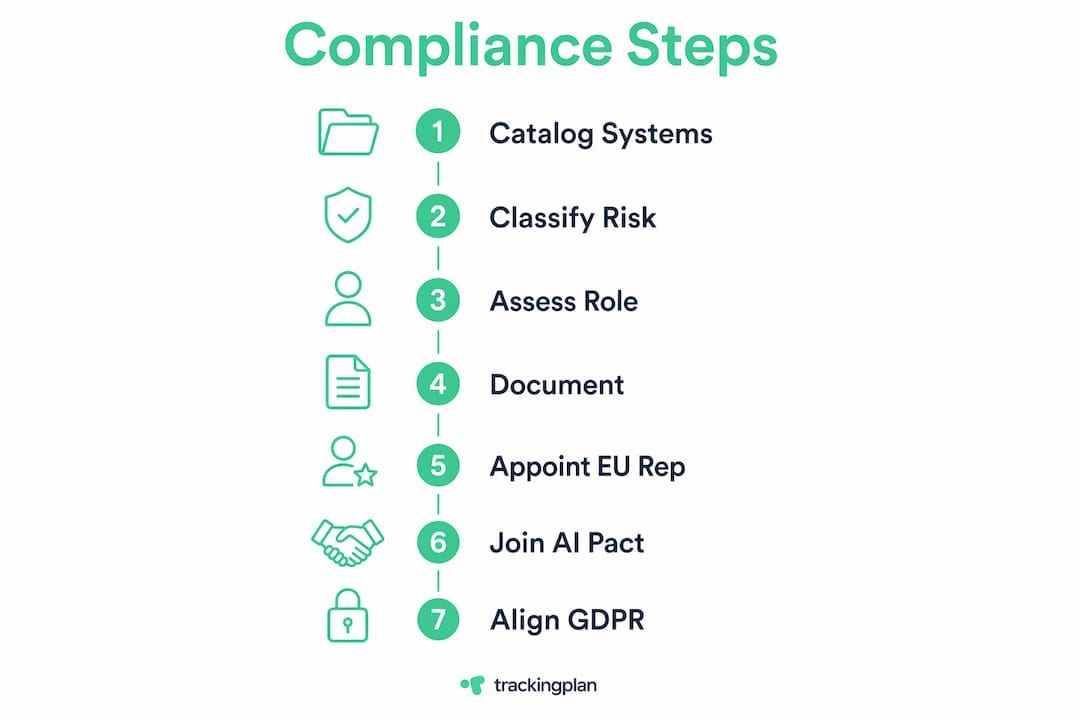
1. Conduct an AI inventory. Catalog every AI system your organization develops, deploys, or procures. Include third-party AI tools embedded in your products or workflows.
2. Classify each system by risk tier. Apply the Act’s four-tier framework to each system. Most will land in the minimal-risk category. Any that touch biometrics, employment decisions, credit, or critical infrastructure need immediate attention.
3. Assess your role. Are you a provider (placing AI on the market), a deployer (using AI in your operations), or both? Your obligations differ significantly depending on the answer.
4. Prioritize GPAI compliance. If you develop or use foundation models, the August 2025 GPAI obligations are already in effect. Transparency documentation and copyright compliance are not optional.
5. Build documentation infrastructure. High-risk systems require technical documentation, risk management records, and audit logs. Start building these systems now rather than retrofitting them before a deadline.
6. Appoint an EU representative if needed. Providers established outside the EU that place AI systems on the EU market must designate an authorized representative within the EU.
7. Join the AI Pact. Voluntary early compliance signals good faith to regulators and gives your team access to implementation guidance before the mandatory deadlines hit.
8. Align with GDPR obligations. Treat AI Act data governance requirements and GDPR as a unified compliance program, not separate workstreams.
Where to find compliance support and conformity assessment resources
The compliance ecosystem around the AI Act is still maturing, but several resources are already operational.
Official EU resources:
- AI Act Service Desk (ai-act-service-desk.ec.europa.eu): The European Commission’s official support platform for implementation questions. Covers Article-by-Article guidance and practical FAQs.
- European AI Office (digital-strategy.ec.europa.eu): Publishes guidance documents, coordinates enforcement, and manages the AI Pact registration process.
- EUR-Lex (eur-lex.europa.eu): The full text of Regulation (EU) 2024/1689, including all annexes listing high-risk use cases and prohibited practices.
Conformity assessment bodies:
For high-risk AI systems that require third-party conformity assessment, notified bodies designated under existing EU product safety frameworks (such as the Machinery Regulation or medical device regulations) are the primary route. The AI omnibus clarified the interplay between the AI Act and EU product safety laws to reduce duplication between sectoral and AI-specific rules. Organizations should identify the relevant notified body for their product category early, as capacity is limited and lead times are growing.
Regulatory sandboxes:
National competent authorities in EU member states are establishing regulatory sandboxes for AI testing. The AI omnibus created an EU-level sandbox as well. These are particularly valuable for US organizations that want to test EU market readiness before full commercial deployment.
Legal and advisory support:
Law firms with EU regulatory practices, such as Baker McKenzie, have published detailed guidance on the Act’s extraterritorial provisions. Industry associations in sectors like fintech, health tech, and HR technology are also developing sector-specific compliance frameworks that translate the Act’s general requirements into practical checklists.
Staying current matters here. The AI omnibus, with a political agreement reached in May 2026, introduced amendments that affect timelines, sandbox access, and GPAI oversight. Any compliance program built on pre-omnibus guidance needs to be updated.
Key Takeaways
The EU AI Act is the world’s first binding AI law, and its extraterritorial scope means US organizations deploying AI systems used in the EU must comply regardless of where they are based.
| Point | Details |
|---|---|
| Full application date | Most provisions apply from August 2, 2026; GPAI rules have been in effect since August 2025. |
| Extraterritorial reach | US firms are in scope if their AI output is consumed in the EU, per Regulation (EU) 2024/1689. |
| Risk classification | Four tiers determine obligations: prohibited, high-risk, transparency, and minimal or no risk. |
| Provider vs. deployer | Providers bear lifecycle compliance responsibility; deployers must implement oversight and report incidents. |
| Compliance monitoring | Automated audit trails, anomaly detection, and real-time alerts support ongoing high-risk AI obligations. |
FAQ
What is the EU AI Act?
The EU AI Act (Regulation (EU) 2024/1689) is the world’s first comprehensive legal framework for artificial intelligence, establishing harmonized rules across the EU to ensure trustworthy, human-centric AI while protecting fundamental rights, safety, and health.
Has the EU AI Act been passed?
Yes. The Act entered into force on August 1, 2024, with prohibited practices applying from february 2, 2025, GPAI rules from August 2025, and full application from August 2, 2026.
Does the EU AI Act apply to US companies?
Yes. The Act applies extraterritorially: any US provider or deployer whose AI system’s output is used in the EU falls within scope, regardless of where the company is established.
What is the point of the EU AI Act?
The Act’s purpose is to foster trustworthy AI that supports innovation while protecting EU citizens from the risks posed by high-impact AI systems, using a risk-based approach where stricter rules apply to higher-risk applications.
What are the penalties for non-compliance?
Penalties include fines, market access restrictions, and enforcement actions coordinated by national competent authorities and the European AI Office, with the highest fines reserved for violations involving prohibited AI practices.