
Why does value-based bidding produce a strong return in one account and a slow bleed in another running the same Target ROAS target? The bid strategy is rarely the difference. The values are.
Every bidding system that accepts a value signal does the same thing with it: it learns what a conversion like that tends to be worth, then pays accordingly. It doesn't check whether the number is right. A purchase counted twice, a sale that never fired, or a flat figure applied to every lead all become the lesson, and the lesson gets applied to the next auction.
Once the setup is live, value-based bidding runs a loop that starts at the conversion hit and ends with a bid adjustment in a future auction. That loop is where budget is won or lost, and it's why the value data deserves more attention than the bid mechanics.
What value-based bidding optimizes for
Value-based bidding tells the bidding system to chase the total economic value of conversions, not the number of conversions. That's the short answer, and it changes which auctions get your budget.
A sales team paid a flat bonus per signed contract behaves differently from a team paid a percentage of deal size. The first team chases signatures, and it will work a $400 contract as hard as a $40,000 one. The second team still wants signatures, but it spends its week on the enterprise deal and lets the small one go. Value-based bidding moves your ads from the first pay plan to the second.
Google describes value-based bidding as a subset of Smart Bidding, with two core strategies under it: Maximize conversion value and Target ROAS (Google Ads Help). Maximize conversion value pushes for as much recorded conversion value as possible inside the campaign's daily budget. Target ROAS adds an efficiency constraint, bidding toward the highest expected value while trying to hold the conversion-value-to-cost ratio near your target.
The model reads your numbers, not your intentions. Every value you send through conversion tracking becomes a training example. The system uses those values to estimate which auction opportunities are likely to produce valuable outcomes, then adjusts bids auction by auction.
The contrast that matters is with Maximize Conversions, which seeks conversion volume and may use Target CPA. A count-based strategy treats a $1,000 purchase and a low-value form submission as equal events, so the system is indifferent between them. Value-based bidding isn't, provided the values reflect the business: transaction revenue, profit margin, or assigned weights for each lead type.
Run one check today. Open the campaign's conversion goals and read whether the primary action is a count or a monetary value. If the goal is a form submission with no value attached, you're running a volume strategy with a value strategy's branding, and the bids will reflect volume no matter what the reporting tab says.
How the bidding loop works step by step
How does value-based bidding work once it's live? It runs a loop that passes data from stage to stage, and a break at any stage poisons everything after it.
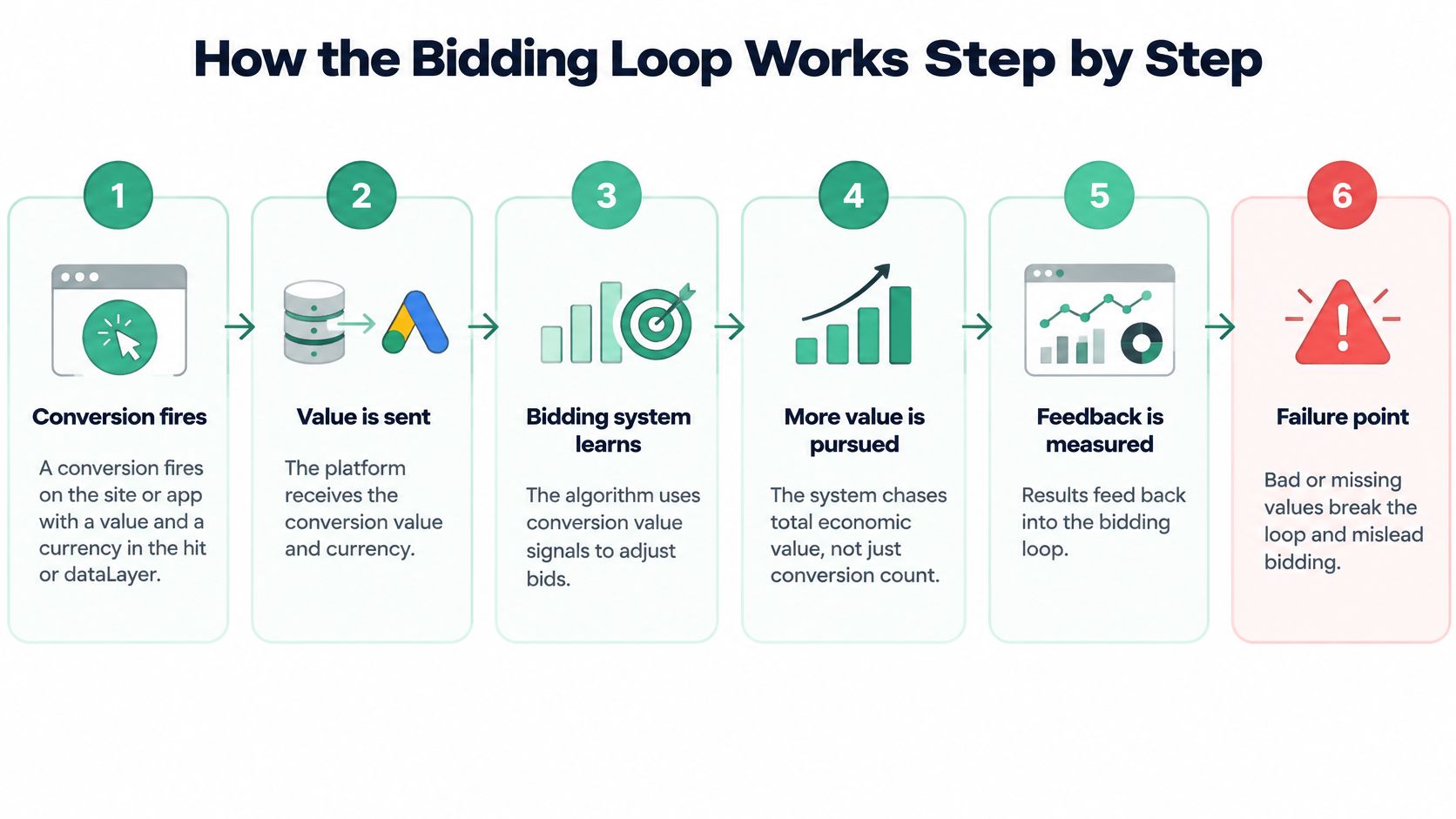
- A conversion fires with a value and a currency. The purchase hit or the dataLayer push carries a monetary amount and a currency code next to the event. If the value field is hardcoded to zero, or the currency defaults to the wrong code, the model receives a number that means nothing.
- The value reaches the ad platform. For an on-site purchase the tag does the work. For a lead that closes in a CRM three weeks later, an imported offline conversion carries it. Failure point: the upload is late, partial, or sent twice.
- The platform ties the conversion back to the original click. Device, location, time of day, query and audience all come from that click. Google's guidance is to store each GCLID with the related prospect record so an offline sale can be attributed to the original campaign, and it warns that configuration errors can stop Smart Bidding from using those signals (Google Ads Help). A form that drops the click ID severs the link.
- The model estimates expected value for similar auctions. It groups the patterns it has already seen and predicts what a comparable impression is likely to be worth.
- Bids move, one auction at a time. Higher where the signals resemble past valuable outcomes, lower everywhere else. No human sets those increments.
- Reported value and cost return as new training data. This is the step that makes errors expensive. The loop feeds on its own output, so a wrong value gets confirmed rather than corrected.
The loop corrects slowly. A week of inflated values doesn't wash out in the next week of clean data, because the model is still weighting what it learned while the data was wrong.
That lag is the practical reason to treat the value feed as production infrastructure rather than a marketing setting. Check it weekly, on the same day, so a break shows up as a change against last week rather than as an unexplained dip in ROAS six weeks later.
Each week, pull the conversion value column in the ad platform and the revenue figure from the backend for the same period. Note any gap that exceeds the tolerance you agreed with finance. A gap that small and stable is measurement noise from attribution timing. A gap that moves is a data problem, and it's already in the bids.
Maximize conversion value compared with Target ROAS
Four strategies can share one budget, and the differences sit in what each optimizes and what stops it.
| Strategy | Goal | Constraint | Best when |
|---|---|---|---|
| Maximize conversion value | Highest total recorded value within the daily budget | Daily budget only | Values are trusted and efficiency isn't yet a limit |
| Target ROAS | Highest expected value while holding value-to-cost near the target | Target ratio, for example 400% | A margin floor or efficiency target matters most |
| Target CPA | Most conversions at a set cost per conversion | Target cost per conversion | Conversions are roughly equal in worth |
| Maximize conversions | Most conversions within the daily budget | Daily budget only | Values aren't tracked yet |
What the target actually constrains
Say a campaign spends $10,000 and carries a 400% target. The intended outcome is about $40,000 in reported conversion value, though actual performance can vary. The target doesn't promise that revenue. It tells the system how aggressively to bid for value it thinks it can win, and it will decline auctions that don't clear the bar.
That's the trade. Target ROAS gives up volume for efficiency. Set the number high enough and the campaign bids conservatively enough that impression volume collapses, which starves the model of new data as well as the business of new customers. Set it low and you fund orders that lose money on delivery.
Maximize conversion value carries no efficiency ceiling. It spends the daily budget chasing the highest total recorded value it can find. That's the right tool when you trust the values but don't yet know what an acceptable return looks like, and it's the usual starting point before a target goes on.
The decision rule is short. Choose Maximize conversion value when the value data is trusted and efficiency isn't the binding limit. Choose Target ROAS when a margin floor decides which orders are worth having. Keep Target CPA or Maximize conversions when conversions are roughly equal in worth, or when no values exist yet.
If the ratio itself is still fuzzy, this explainer on return on advertising spend covers how it behaves when a budget limit, not the target, is setting your volume.
You pick the strategy in the campaign's bidding settings. Enter a target only after the preconditions hold, not on the day you flip the switch. For your own campaign, name the figure the choice depends on: a margin floor, a cost per conversion, or the absence of values altogether. If you can't name it, the strategy choice is guesswork dressed as analysis.
Preconditions and pre-switch checks
Value-based bidding rewards preparation. The measurement work is the method. Google publishes thresholds for it, and they read as a description of how much history the model needs rather than a formality (Google Ads Help).
| Requirement | Google guidance | Why it matters |
|---|---|---|
| Conversion value history | Upload values for at least 3 weeks or 1–2 conversion cycles, whichever is longer, before activating value-based bidding | The model needs accumulated value patterns |
| Distinct values | At least 2 unique, non-zero values before testing Maximize conversion value or Target ROAS | One repeated value gives no signal to separate outcomes |
| Learning window for Target ROAS | When adopting Target ROAS, include the new values in the Conversions column and wait 6 weeks | The campaign needs time to receive values at a similar rate |
| Offline upload cadence | Upload at least daily; if not possible, use a steady schedule such as every two days or weekly | Missed uploads change the signals used for bidding |
| Click identifier | Store the GCLID with the related prospect record | Links an offline outcome to the original click |
What the waiting periods are for
The model learns from accumulated value patterns, not from today's data alone. A purchase event that breaks on a Tuesday costs more than a day of reporting. It teaches the system something false about which auctions produce revenue, and that lesson sits in the estimates for weeks.
History is the first constraint. Three weeks or one to two conversion cycles, whichever is longer, is the floor Google sets before activating value-based bidding, and an account below it should be building value data rather than arguing about targets.
Distinct values are the second. Google's bar for experiments is at least 2 unique, non-zero values, and it recommends transaction-specific values when the order system can supply them, because real order revenue or profit carries more information than one average applied to every conversion. A flat $50 on every form fill produces the same behavior as count-based bidding with extra steps.
The third is patience after a change. When you adopt Target ROAS, Google recommends including the new values in the Conversions column and waiting six weeks for the campaign to receive values at a similar rate. Prices, close rates and refund rates move. A value set two years ago doesn't.
A pre-switch check that takes an afternoon. Pull 30 days of conversion value from the ad platform and 30 days of orders from the backend. If they don't reconcile inside the tolerance you agreed, the problem is upstream of the bid strategy and no target change will fix it.
Offline uploads and the Conversions column
Offline outcomes have their own schedule. Google recommends uploading imported offline conversions at least daily, and if that isn't possible, on a consistent rhythm such as every two days or every week. (Google Ads Help).
Smart Bidding uses the actions in the Conversions column, so a half-tested import can move bids before anyone has confirmed it works. Watch the uploads run steadily, and the value they deliver, before you let the target depend on them.
The pre-switch checklist
- Each conversion fires once. Deduplicate at the source with an order ID or a server-side rule, not in the report afterward.
- Each conversion carries the right value and currency. Check a real transaction end to end, not the tag template.
- Click identifiers survive the form or checkout path. Submit a test lead from a live ad click and confirm the identifier lands in the CRM record.
- Offline uploads run on the agreed schedule. A feed that stops without alert is the failure nobody notices for a month.
- Predicted value tracks realized value within tolerance. Compare last month's estimates against what finance closed.
- Every tag has a named owner. Shared ownership is how a broken purchase event survives an entire quarter.
Switching strategies resets learning, so sequence matters. Automate the daily or weekly check where you can, because the Google Ads automation work that pays off is the routine comparison, not a one-off audit. Then gate the switch: move to a value strategy only when every row in the table and every step in the checklist passes. Book the review date six weeks after the change before you touch the setting.
How bad conversion values mislead automated bidding
Bidding that looks wrong is usually data that is wrong. When Target ROAS overpays for cheap traffic, or a campaign that used to convert stops spending, the strategy is doing what it was told with the numbers it was handed.
The pressure isn't easing. In 2024, 55% of advertising and data professionals expected conversion tracking to become harder, and 55% also expected campaign and channel attribution to become harder, according to the IAB State of Data report.
Six errors and what each one teaches the model
| Error | What the model learns | Check |
|---|---|---|
| Duplicate purchase counted twice | Inflated value for the same demand, so bids overpay | Compare order IDs with backend orders; check Meta Pixel and CAPI deduplication |
| Missing conversions | High-quality traffic looks weak, so bids fall | Compare daily event counts with backend orders |
| Zero-value events | Valuable and empty outcomes look the same | Confirm every event carries a value and currency |
| Gross revenue where margin matters | Low-margin orders are favored | Switch the value field to profit or margin |
| Late offline outcomes | The signal arrives weeks late and the model lags | Measure upload delay against the close date |
| Attribution date mismatch | Totals in GA4 and Google Ads differ, so teams change settings on noise | Use the All conv. (by conv. time) column for comparison |
Why GA4 and Google Ads totals disagree
Google Ads attributes a conversion to the date of the ad click. GA4 and most backend systems attribute it to the date the conversion happened, so the two reports can disagree while both are correct. Imported Analytics conversions can also take up to 24 hours to reach Google Ads, while Google Ads conversion tracking usually appears within about three hours (Google Ads Help). Use the All conv. (by conv. time) column when the other system reports by conversion date.
Teams that don't know this spend Fridays changing settings in response to a timing difference. Nothing in the bidding changes and the totals shift again next week. When an event is missing altogether rather than merely late, work through this guide to checking whether your Google Ads conversions are accurate before you touch a bid target.
Deduplication is a value control
The same purchase can arrive three ways: through the Meta Pixel, through the Conversions API, and through GA4. Google's enhanced-conversions checklist asks for an order ID or transaction ID when conversion data is sent through the API or server-side Google Tag Manager, specifically so a repeat can be dropped instead of counted twice (Google Ads Help). It also asks for a GCLID when one is available, and for customer-provided data when the enhanced-conversion method is used.
This is the layer Trackingplan works on. For paid media teams, it monitors every conversion, UTM and consent signal across ad platforms, spotting lost match rate, missing value and CAPI double-counting on websites and server-side, so campaigns are optimized on conversion data the team can trust.
Open the last 30 days of data and look for each of the six errors in turn. Write down what each one did to bids. That exercise is more useful than another target adjustment.
Building a value model the bidding can trust
The bid strategy takes whatever value you hand it and spends against it. It never asks whether the figure is unique, complete, or comparable across campaigns. Google's documentation explains what Maximize conversion value and Target ROAS each optimize; whether the number you supplied means what you think it means is a question the platform leaves to you (Google Ads Help).
That gap is where the value model lives: the set of rules that decides which conversions carry which numbers. Google accepts both real economic values, such as revenue or profit margin, and proxy values, such as lead scores. For an e-commerce account, the model is mostly the order total and what happens when a return comes back. For lead gen, it is an estimate, and the hard part is deciding what to send when the money arrives weeks after the click.
Pricing a lead you haven't closed yet
Start with expected value. The formula is:
Expected value = close rate × average margin × (1 - refund rate)
Say a lead closes at 10%, carries $600 in average margin, and 10% of orders come back as refunds. Expected value is 0.10 × $600 × 0.90, or about $54 per lead.
Send that number. The $600 deal size would tell the auction every lead is worth a closed order, and a flat $100 applied to every lead would erase the difference between a strong campaign and a weak one.
Proxy values hold up when they track real outcomes. A lead score that reliably separates a 20% close rate from a 5% close rate is a valid input, because the model only needs the relative ordering to be right. Directionally correct values applied consistently beat precise values nobody maintains.
Five steps that keep the model honest
- Define the value field and its unit. Revenue, gross margin, or a weighted score, named explicitly and used everywhere the event fires.
- Document the delay and the attribution window. Write down the typical days from click to revenue, and the window in which a conversion still counts.
- Validate the event count against backend records. Match the platform's total to your order system or CRM weekly; a quarterly check can leave a broken release inflating values for months.
- Import offline outcomes with the same identifiers. Use the click ID stored at lead creation so the sale returns to the campaign that earned it.
- Compare predicted value with realized value every month. When the gap grows, recalibrate the formula rather than raising the target.
Step five is the one that gets skipped. A platform can optimize with real efficiency toward a signal that is systematically wrong: duplicate purchases inflate value, missing conversions make strong traffic look weak, and gross revenue favors low-margin orders. Efficient bidding toward the wrong number is worse than inefficient bidding toward the right one, because the error scales with every dollar.
One question tells you how much of this work you need: what share of value comes from revenue that arrives after the attribution window closes? If the answer is most of it, the value model is your bidding strategy, and the bid settings are just the last step.