Compare the best marketing observability tools of 2026 to see how Trackingplan stacks up against ObservePoint, Segment, and more.
You're staring at a dashboard that should be reassuring, but one metric looks off and nobody can explain why. ROAS is slipping, a conversion path feels noisy, and the first question is never simple, is the campaign weak, or did tracking break two days ago and poison every report after it? That's why marketing observability tools have become a serious category, not a niche QA add-on. Market forecasts point to sustained double-digit growth, with observability platforms projected from USD 2.4 billion in 2023 to USD 4.1 billion by 2028 in one estimate, and from USD 2.7 billion in 2023 to USD 5.4 billion by 2030 in another, which tells buyers this is now a mainstream enterprise software decision, not a side project (MarketsandMarkets forecast). For teams that need a practical buying guide, the right question is less “Which tool has the longest feature list?” and more “Which platform catches the exact failures that break our marketing data?” KPIs that prove your value
1. Trackingplan
Trackingplan fits teams that need continuous marketing data QA rather than periodic tag audits. It automatically discovers the tracking surface from dataLayer to destinations, then monitors events, pixels, UTMs, consent flows, SDK calls, and backend activity in real traffic. That matters because many teams do not need another static checklist. They need an always-on layer that catches drift before dashboards, ad spend, or attribution reports start to break.
The platform differentiates itself with a combination of AI-powered anomaly detection and a campaign QA focus. When something breaks, it sends alerts through email, Slack, or Microsoft Teams and uses an AI debugger to summarize the likely root cause, remediation steps, and probable business impact. Installation stays lightweight, with a 10KB tag or iOS and Android SDK that loads asynchronously, so teams can move fast without turning implementation into a quarter-long project.
A practical strength is cross-functional coverage. Marketing can watch UTMs and pixels, analytics can validate event schemas and properties, engineering can inspect SDK behavior, and agencies can standardize QA across multiple accounts. The platform also adds privacy guardrails, including consent checks, cookie checks, automated PII leak alerts, and GDPR-first security practices, which helps when server-side tracking and consent handling get messy.
You can review the product directly on the Trackingplan website, and the company says it serves 485+ customers. For teams that want a representative screenshot, the platform view shows the monitoring workflow in practice: 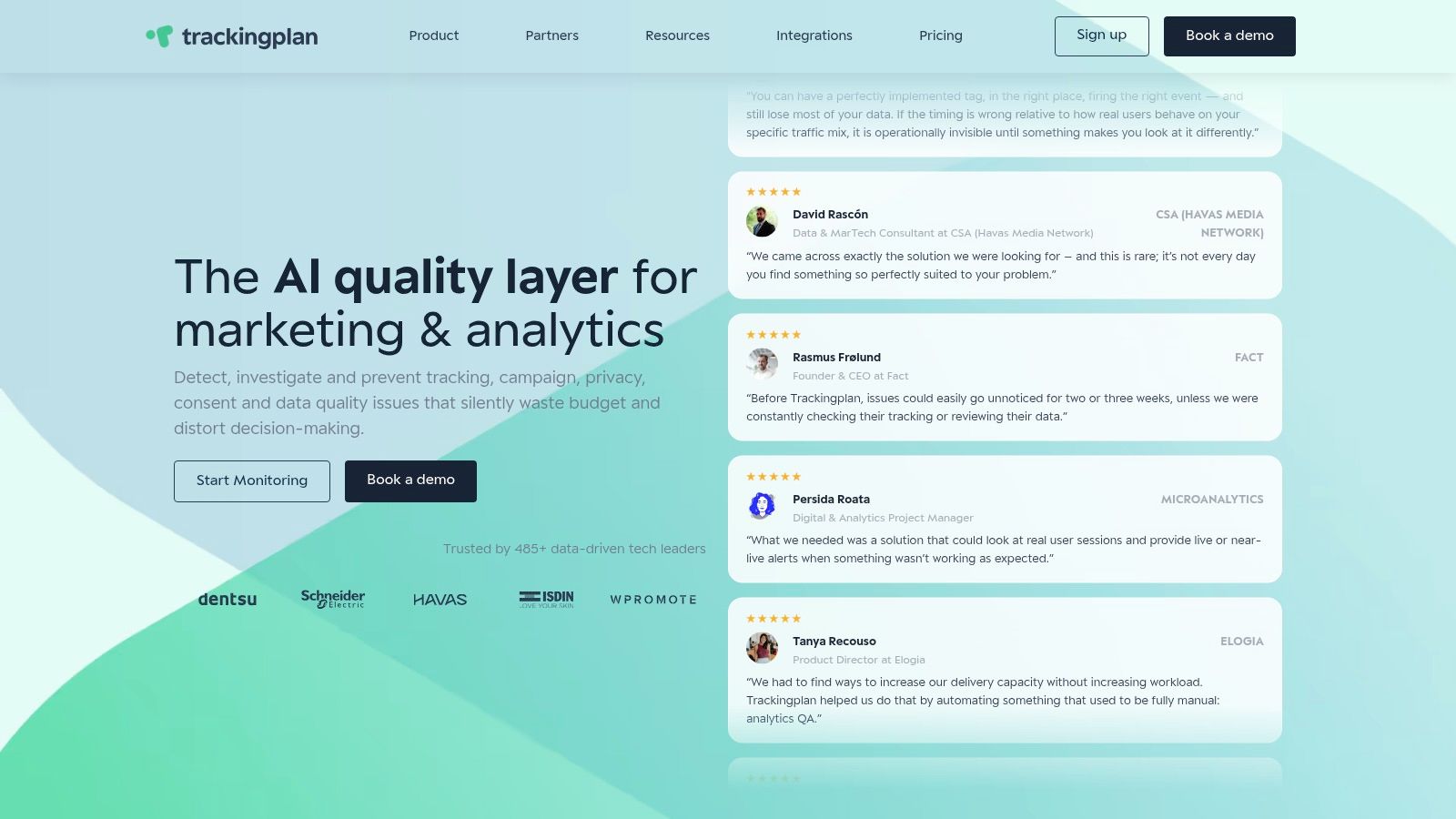
Practical rule: use Trackingplan when you care about live traffic behavior, not just whether tags exist on a page.
Pricing is easier to test than to guess. Trackingplan offers a Growth plan with a 14-day free trial and Enterprise options with a free proof-of-concept evaluation, which gives teams a sensible way to prove ROI before standardizing on a new monitoring layer.
Trackingplan's video library is useful if your team wants to see the product workflow before a trial.
2. ObservePoint
ObservePoint is a strong choice for teams that need deep web governance and repeated audits across large site footprints. It's especially useful when the core job is scanning pages, validating tags, and checking journeys on a schedule, rather than watching every real-user event as it happens. For enterprise marketing ops teams, that distinction matters because a scanning tool and a live observability layer solve different problems.
The platform focuses on automated site audits, journey validation, tag discovery, and governance checks. In practice, that means you can verify analytics beacons, data-layer values, and the presence of unexpected tags across many pages and flows, then route the results into ongoing alerting. That's a useful fit for organizations that have accumulated a lot of legacy tags, vendor scripts, and compliance obligations.
ObservePoint's web-first orientation is also its main trade-off. It's well suited to browser-based governance, but it's less centered on server-side pipelines and real-user traffic than Trackingplan. If your pain point is a broken conversion event that only appears in production traffic after a campaign launch, a scanning approach alone can miss the timing and context of the failure.
For buyers comparing options, the official site is the place to start: ObservePoint. The company's product image makes the scanning model obvious at a glance: 
ObservePoint makes the most sense when governance teams own the audit calendar and want broad web coverage, not when marketers need instant diagnosis on live campaigns.
Pricing is custom, and that usually means it's better aligned to enterprise budgets than smaller teams. That's not a weakness by itself, but it does mean smaller organizations should be clear about how much of the platform they'll operationalize before they commit. For a direct comparison with Trackingplan, see the Trackingplan alternative to ObservePoint.
3. Tag Inspector by InfoTrust
Tag Inspector is the right kind of tool when compliance and PII detection sit near the top of the priority list. It scans pages, catalogues tags, validates firing behavior, and looks for clear-text data exposure in places where marketing stacks often leak information, especially URLs and tag payloads. That makes it useful for privacy-conscious organizations that want visibility into what is being collected and transmitted.
What stands out here is the compliance angle. Many teams buy tag QA tools and later realize they still need a way to watch for privacy policy drift, misconfigured consent behavior, or accidental PII exposure. Tag Inspector is closer to that need than general analytics tooling, which is why it can be a strong fit for privacy programs that support marketing, not just legal review.
Its limit is scope. The product is primarily web tag-centric, so it's not the first choice if your tracking stack includes a lot of server-side orchestration, app-level event validation, or live anomaly detection across many delivery paths. In other words, it helps keep the website side clean, but it doesn't try to replace a broader observability layer.
The product page is here: Tag Inspector by InfoTrust. The interface image reflects the compliance-led positioning clearly: 
If your hardest problems are consent, leakage, and tag sprawl, Tag Inspector gives governance teams a clearer lens than generic analytics dashboards.
Pricing isn't public, so buyers should expect a scoped sales conversation. That isn't unusual in this category, but it does mean you'll want to define the exact compliance checks you need before evaluating fit. For a deeper governance framing, the company's related guidance on a tag management audit tool is worth reading once the audit requirements are clear.
4. DataTrue
DataTrue is a sensible pick for teams that need web and mobile analytics validation in one place. It monitors important pages and user flows, checks events and properties, and extends that validation to iOS and Android SDKs, which is useful when campaign quality issues don't stop at the browser. Many organizations still separate web QA from app QA, and that split is where broken measurement often survives longer than it should.
The product's strength is breadth across channels. Automated tests for conversion paths help marketing teams catch missing events before reports get polluted, while privacy and PII checks add a governance layer that many teams now need whether they planned for it or not. It's also positioned to reduce manual QA overhead, which matters when a team ships often and can't afford to hand-test every launch.
Where DataTrue will feel less mature to some buyers is market visibility. Its public presence is smaller than some incumbent vendors, so teams that want a very well-known enterprise logo list may lean elsewhere. That said, brand visibility doesn't fix tracking drift, and many practitioners care more about whether the platform watches the right flows.
The website is here: DataTrue. Its product image shows the data-assurance positioning well:
Teams that ship both app and web campaigns often need one validation layer, not separate spreadsheets for each surface.
Pricing isn't published, so this is another tool where the buyer should ask how monitoring volume, mobile coverage, and alerting are packaged before moving too far. For brands that need app-level and web-level QA but don't want to manage a manual test matrix, DataTrue can be a pragmatic middle ground.
5. Segment Protocols
Segment Protocols is best understood as governance inside the data plane. If Segment already sits at the center of your marketing and product data flows, Protocols lets you define tracking plans, validate events in pipeline, and block off-spec data before it reaches downstream tools. That's a powerful model when the main problem is not discovery, but control.
The major advantage is ecosystem fit. Teams using Segment can enforce schema rules, review changes, and keep taxonomy consistent across websites, apps, and server events without bolting on a separate governance stack. Segment also brings a broad destination ecosystem, which is important when marketing teams push data into multiple tools and need the upstream schema to stay stable.
The trade-off is commitment. Protocols is a Business-tier add-on with custom pricing, and it works best when you're already committed to the Segment way of operating. If your stack is more fragmented, or if you need always-on anomaly detection around live campaign behavior, a governance add-on won't replace a dedicated observability layer.
The main platform page is here: Segment. For teams already standardizing on tracking-plan governance, the related data governance best practices piece is a useful complement.
Segment Protocols protects the pipes. It doesn't try to be the whole monitoring system.
The strongest use case is a mature data team that wants enforcement, approvals, and destination control within an existing Segment-first architecture. If you're comparing it with Trackingplan, the key question is whether you need source-of-truth governance or real-user observability plus campaign QA. In many stacks, the answer is both.
6. Avo
Avo is built for teams that want a developer-friendly governance workflow. It combines tracking plans, code generation, and live inspection so product, engineering, and analytics teams can coordinate around event quality without relying on tribal knowledge. That's especially useful when instrumentation changes often and schema drift starts coming from many directions at once.
The best thing about Avo is how naturally it fits engineering workflows. Typed SDK generation and linting reduce implementation errors before they ship, while Inspector helps teams observe live event streams and catch off-spec behavior after release. That combination is valuable when teams want both proactive governance and a feedback loop from real usage.
The main trade-off is that Avo is not trying to replace a CDP. It complements analytics and data infrastructure, which is the right design choice for many teams, but buyers should be clear that it's a governance layer, not a destination hub. Pricing also scales with observed events and seats, so the financial model may feel more natural to larger teams than to lean startups.
The product site is here: Avo. The screenshot reflects the governance-and-codegen model well: 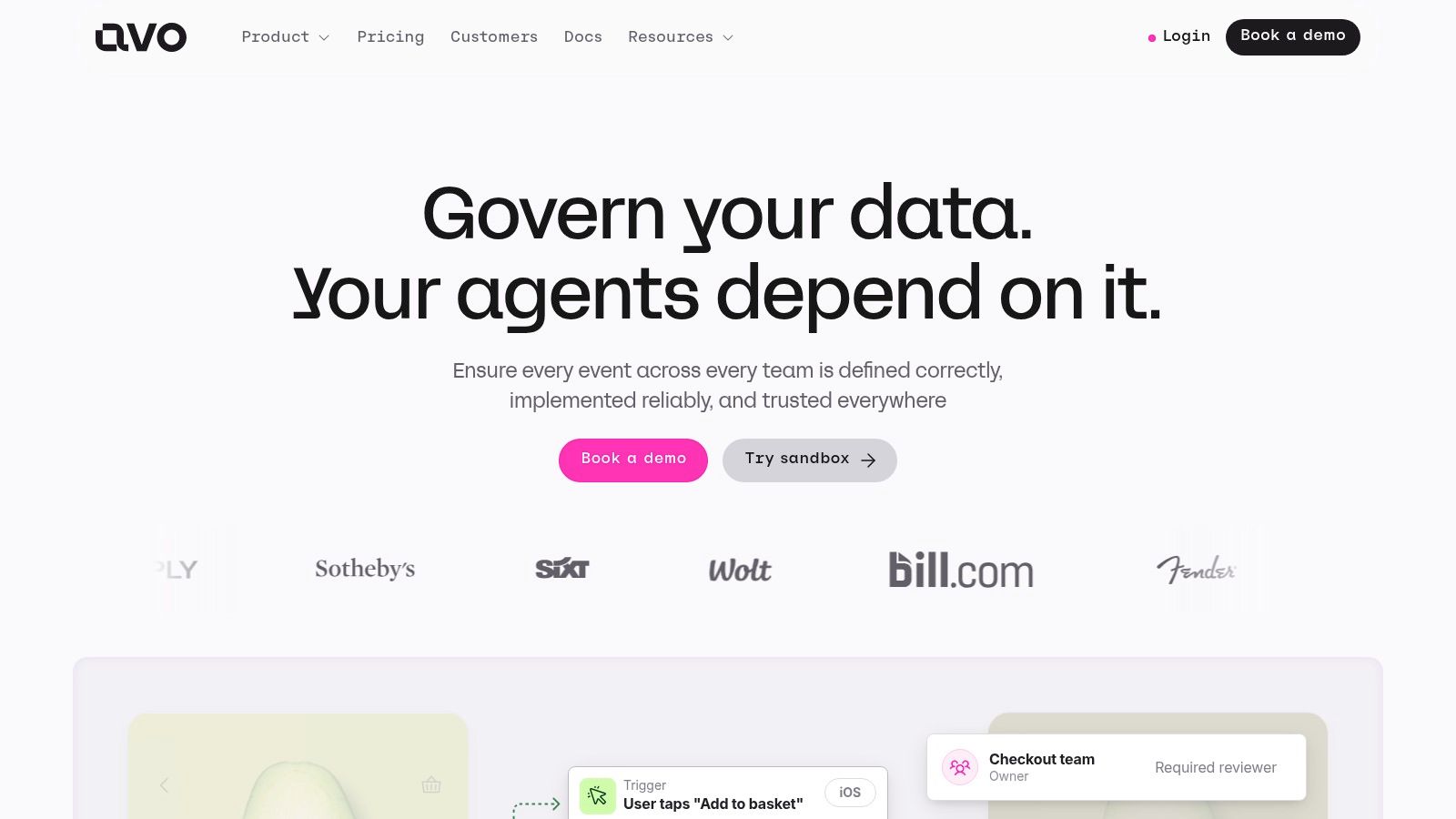
Avo works best when engineers are willing to treat tracking plans like first-class code artifacts.
This platform is strongest for cross-team governance where the code path matters as much as the data path. If your biggest source of pain is malformed events caused by release velocity, Avo will feel especially relevant. If your bigger pain is silent campaign breakage in live traffic, you'll likely want a more automated monitoring layer alongside it.
7. mParticle Data Plans
mParticle Data Plans make the most sense when mParticle is already your central CDP or data hub. The product lets teams define schemas, enforce validation at runtime, and prevent non-compliant events from being stored or forwarded, which is exactly what governance should do when the collection layer is already standardized. For mature consumer-data teams, that can be a clean way to protect downstream marketing and analytics tools.
The advantage is enforcement at the point of collection. Teams can define plans through the UI, Google Sheets, or API, then apply runtime checks that stop off-spec data from spreading downstream. That works well for organizations with many destinations, because the cost of dirty inputs multiplies quickly once data is activated across a broad stack.
The limit is adoption dependency. If you're not already using mParticle, the migration and operating model become the decision, not just the feature list. Pricing is also contractual and credit-based, which can complicate early-stage evaluation when a team is still trying to estimate monitoring volume and governance needs.
The platform page is here: mParticle. The product image shows the CDP orientation clearly:
Data Plans are strongest when the CDP is the control point, not when the business still needs external monitoring to catch what the CDP can't see.
For enterprise teams already invested in mParticle, this can be a strong governance anchor. For everyone else, the question is whether you need a schema enforcement engine or a broader marketing observability layer that watches live traffic, campaign tags, consent behavior, and PII leaks across the stack.
8. Amplitude Data
Amplitude Data is a natural fit for teams that already treat Amplitude as a core analytics source of truth. The product gives teams a governance workspace for tracking plans, validation rules, SDK generation, and data reshaping on ingest, which makes it easier to keep event quality aligned with the analytics stack people use every day. That native integration lowers friction in a way standalone governance tools sometimes can't.
The practical benefit is workflow consolidation. Planning, approvals, and validation happen close to analysis, so the people who care about the data can see what's breaking without bouncing between too many systems. That can be especially useful for marketing and product teams that share instrumentation and need a single place to coordinate changes.
The trade-off is focus. Amplitude Data is centered on Amplitude itself, so it is strongest when analytics governance is the main objective. If your biggest pain is broad monitoring across pixels, consent signals, and server-side marketing events, a native governance feature may not be enough on its own.
The documentation page is here: Amplitude Data. The screenshot shows the documentation-led governance model:
Native governance helps adoption, but it also narrows the center of gravity to one analytics stack.
Amplitude offers multiple plan tiers, including Free, Plus, Growth, and Enterprise, so it can fit different maturity levels. For teams already living inside Amplitude, that pricing and integration path can make sense. For teams that need always-on monitoring outside the analytics vendor boundary, Trackingplan often fills the gap more completely.
9. RudderStack Data Governance
RudderStack Data Governance is a strong option for warehouse-native and engineering-friendly teams. It lets organizations define schemas and rules, apply transformations, and mask or remove PII before activation, which is useful when the marketing stack is driven by modern data infrastructure rather than a classic tag-management model. That makes it appealing for teams that want control without giving up flexibility.
The big advantage is fit with modern stacks. RudderStack aligns with reverse ETL, destination control, and data-pipeline thinking, so it can serve teams that want governance where the data moves, not just where the browser fires. Published pricing tiers and free trials also help buyers get a feel for the platform without starting from a blank sales cycle.
The constraint is that the best governance features tend to live in higher plans, and the platform makes the most sense when RudderStack is a core data plane. If the team is still trying to discover where data breaks in live campaign traffic, a governance-only approach may be too late in the chain.
The product page is here: RudderStack Data Governance. The screenshot shows the governance layer in a modern stack:
RudderStack is a better fit for teams that think in pipelines and destinations than for teams that think in pixels and campaigns.
For buyers who want an engineering-led data plane with governance controls, RudderStack deserves a close look. For buyers who need campaign-level QA, consent monitoring, and live anomaly detection, it works best as part of a broader stack rather than the only layer.
10. Snowplow
Snowplow is the most rigorous option in this set for teams that want a schema-first behavioral data platform. It validates event structures, quarantines bad rows, and provides data-quality monitoring through its managed offering, which is ideal when event hygiene is a core engineering concern rather than a side responsibility. If you want strong discipline around how event data enters the warehouse, Snowplow is very credible.
The open-source and managed split is important. Teams can self-host if they have the DevOps maturity to support it, or they can use Snowplow BDP Cloud for a more managed path. That flexibility is a major strength, but it comes with a real operational choice, and self-hosting is not a trivial decision for most marketing teams.
What Snowplow does not try to be is a WYSIWYG tag-auditing product. It's oriented toward governed event pipelines, not browser-scanning workflows, so marketers who want direct campaign QA often need another layer to complement it. That's where an automated observability tool can sit on top of the structured pipeline and catch issues sooner.
The website is here: Snowplow. The product image reflects the pipeline orientation:
Snowplow is a strong foundation when you need schema discipline, but it doesn't replace live marketing QA.
For more on pipeline-side monitoring, the related guide to data pipeline monitoring tools for 2026 is worth pairing with this evaluation. Snowplow's best fit is a mature data organization that wants control and extensibility, especially when event quality has downstream reporting consequences.
Top 10 Marketing Observability Tools, Feature & Governance Comparison
| Product | Coverage & Core features | Unique selling points | Target audience | Pricing & setup |
|---|---|---|---|---|
| Trackingplan (Recommended) | Web, mobile, server-side; auto-discovery; continuous monitoring of events, pixels, UTMs, consent, PII | AI root-cause debugger; real-user mapping; broad integrations (GA, Amplitude, Mixpanel, Snowplow); privacy-first | Marketers, analysts, engineers, QA teams, agencies, enterprises | Growth plan + 14‑day trial; Enterprise PoC; lightweight 10KB tag / SDK, minutes to install |
| ObservePoint | Automated site scans, journey audits, tag & data-layer validation (web-focused) | Deep enterprise-grade auditing and governance; strong site-wide validation | Enterprise web governance, analytics ops, tag QA teams | Custom enterprise pricing; crawl-based setup |
| Tag Inspector (InfoTrust) | Full-site spidering, tag cataloging, PII and consent checks, regression alerts | Strong compliance / PII detection backed by InfoTrust expertise | Privacy/compliance teams, analytics/marketing ops | Custom pricing; page-scanning setup |
| DataTrue | 24/7 monitoring for web & mobile; SDK validation; automated conversion-path tests | Combined web + native mobile validation; reduces manual QA | Product, QA, analytics teams with mobile apps | Contact sales; setup for pages, flows, SDKs |
| Segment Protocols | Central tracking plans, schema enforcement, in-pipeline validation & blocking | Real-time blocking/transformations tightly integrated with Segment pipelines | Teams using Segment as CDP/data plane | Business-tier add-on with custom pricing; requires Segment adoption |
| Avo (Inspector + Governance) | Tracking plan design, codegen for typed SDKs, live schema drift detection | Developer-first code generation, linting, collaboration workflows | Engineering, product, analytics teams focused on typed instrumentation | Usage/seat pricing; integrates with dev CICD workflows |
| mParticle Data Plans | Schema definition, compile/runtime checks, runtime enforcement & logging | Point-of-collection enforcement within mParticle; mature CDP integrations | Teams using mParticle as central CDP | Credit-metered / contractual pricing; best with mParticle deployment |
| Amplitude Data (formerly Iteratively) | Tracking plan workspace, validation, codegen, in-ingest reshaping | Native to Amplitude; can reshape incoming data without redeploy | Amplitude-centric product & analytics teams | Free/Plus/Growth/Enterprise tiers; advanced governance on higher tiers |
| RudderStack Data Governance | Schema controls, transformations, PII masking, warehouse-native flows | Published tiers, engineering-friendly, good for modern data stacks | Engineering teams, warehouse-native stacks, reverse ETL users | Free/Growth/Enterprise tiers; trial available |
| Snowplow | Schema-first collection (Iglu), bad-row quarantine, data-quality monitoring | Rigorous, engineering-focused governance; self-host or managed cloud | Data engineering teams needing warehouse-grade pipelines | Open-source self-host or BDP Cloud (managed); managed plans are enterprise-oriented |
Choosing Your Stack From Finding Errors to Building Trust
Choosing the right marketing observability tools stack isn't about finding one platform that does everything well. It's about matching the tool to the job, then layering the rest only where the job demands it. A fast-growing e-commerce brand might use Trackingplan to catch live campaign anomalies and pair it with Amplitude Data for schema enforcement. An enterprise agency might keep ObservePoint for deep audit coverage while using Trackingplan to monitor multiple client accounts continuously.
The cleanest way to evaluate the category is by work model, not vendor category. Real-time monitoring belongs to tools like Trackingplan, where live traffic exposes breakage as it happens. Periodic auditing suits platforms like ObservePoint and Tag Inspector, where governance teams need scheduled scans and compliance checks. Schema enforcement belongs to Segment Protocols, Avo, mParticle, RudderStack, Amplitude Data, and Snowplow, where the goal is to stop bad data from entering the system in the first place.
Two product examples make the distinction clear. A SaaS team launching paid acquisition campaigns may care most about broken UTMs, missing pixels, and consent misfires, which means an always-on observability layer is the first buy. A privacy-heavy enterprise may care more about who can approve events, what gets blocked, and how PII is masked before activation, which puts governance tooling closer to the center. The strongest stacks often combine both.
I'd evaluate any platform on four practical questions. Implementation matters, because a lightweight tag or SDK reduces time-to-value. Coverage matters, because web-only visibility leaves mobile and server-side gaps. Alerting matters, because context-rich messages in Slack or Teams are easier to act on than vague dashboard noise. Privacy matters, because consent and PII failures can corrupt both compliance and measurement at the same time.
If your main job is to protect campaign performance, preserve attribution quality, and stop silent tracking decay, Trackingplan is the most directly aligned option in this list. It's built to watch the traffic that marketers depend on, not just the tags they hope are firing.
If you want to replace reactive dashboard debugging with continuous data trust, start a trial with Trackingplan. It gives marketing, analytics, engineering, and agency teams an automated observability layer for web, app, and server-side tracking, plus AI-assisted diagnosis when something breaks. Visit the product site, see how it fits your stack, and decide whether it's the monitoring layer your team has been missing.