
You can have a clean dashboard on Monday, a big campaign launches on Tuesday, and by Friday the numbers still look “fine.” Then the post-launch review starts, and the problem shows up. The conversion event never fired on half the journeys, the UTM convention broke in one channel, consent blocked a key payload in another, and the team is now making decisions on data that looked trustworthy until it wasn't.
That's where a quality audit earns its keep. In analytics, it's not a ceremonial review, it's the difference between catching silent tracking failures early and letting them distort spend, attribution, and trust for weeks or months. The economics are brutal, too. Quality issues account for a large share of manufacturing cost in broader industry reporting, recall events are expensive, and even in digital stacks the same pattern repeats, broken data creates bad decisions fast, then the cleanup takes longer than the original launch cycle. A disciplined audit turns that risk into something visible, documented, and fixable.
Why Your Analytics Stack Needs a Quality Audit
The most common failure I see is also the most expensive. A team ships a campaign, the stakeholder report looks normal at first glance, and only later does someone notice that a critical event was never firing, or that consent settings suppressed the measurement layer in specific browsers. By the time the issue is found, ad spend has already gone out, the reporting story has hardened, and the team is explaining why numbers that looked confident were never complete. For a practical framing of why this matters in digital analytics, Trackingplan's note on quality assurance in digital analytics lines up with what I've seen in production systems.
Broken tracking doesn't fail loudly
Analytics failures usually don't announce themselves. They accumulate through small gaps, a malformed UTM, a renamed property, a schema change after a release, a rogue tag injected by a vendor, or a consent rule that blocks collection on one path but not another. None of those creates a neat outage page, so the business keeps moving while the data degrades underneath it.
That's why quality audit work in analytics has shifted from an occasional hygiene task into risk management. ISO 9001, first published in 1987, gave quality systems a shared global language, and by 2022 the ISO Survey reported about 1.1 million ISO 9001 certificates worldwide (source). That scale matters because it shows how organizations learned to treat process verification as a management discipline, not just an inspection. The same logic applies to analytics stacks that span web, app, server-side, and third-party destinations.
The hidden cost is decision drift
Bad tracking rarely creates one dramatic failure. It creates a slow drift in decisions, because teams optimize around metrics that are incomplete, biased, or wrong. That's why the financial case for audit discipline is so strong in quality management more broadly, with industry compilations estimating the global quality management market at about $25 billion, and reporting that 55% of total manufacturing costs are related to quality issues (source). The exact numbers belong to manufacturing and quality management more than marketing analytics, but the pattern holds, poor quality is expensive because it multiplies downstream work.
Practical rule: if a tracking issue can survive one release cycle without someone noticing, your audit process is too manual, too shallow, or both.
The operational takeaway is simple. A strong audit program verifies that documented tracking matches what's running in production, and it does that before the dashboard becomes the source of truth for finance, growth, and leadership. In modern stacks, that means coverage across implementation, consent, attribution, and every destination that depends on clean events.
Understanding the Three Types of Quality Audits
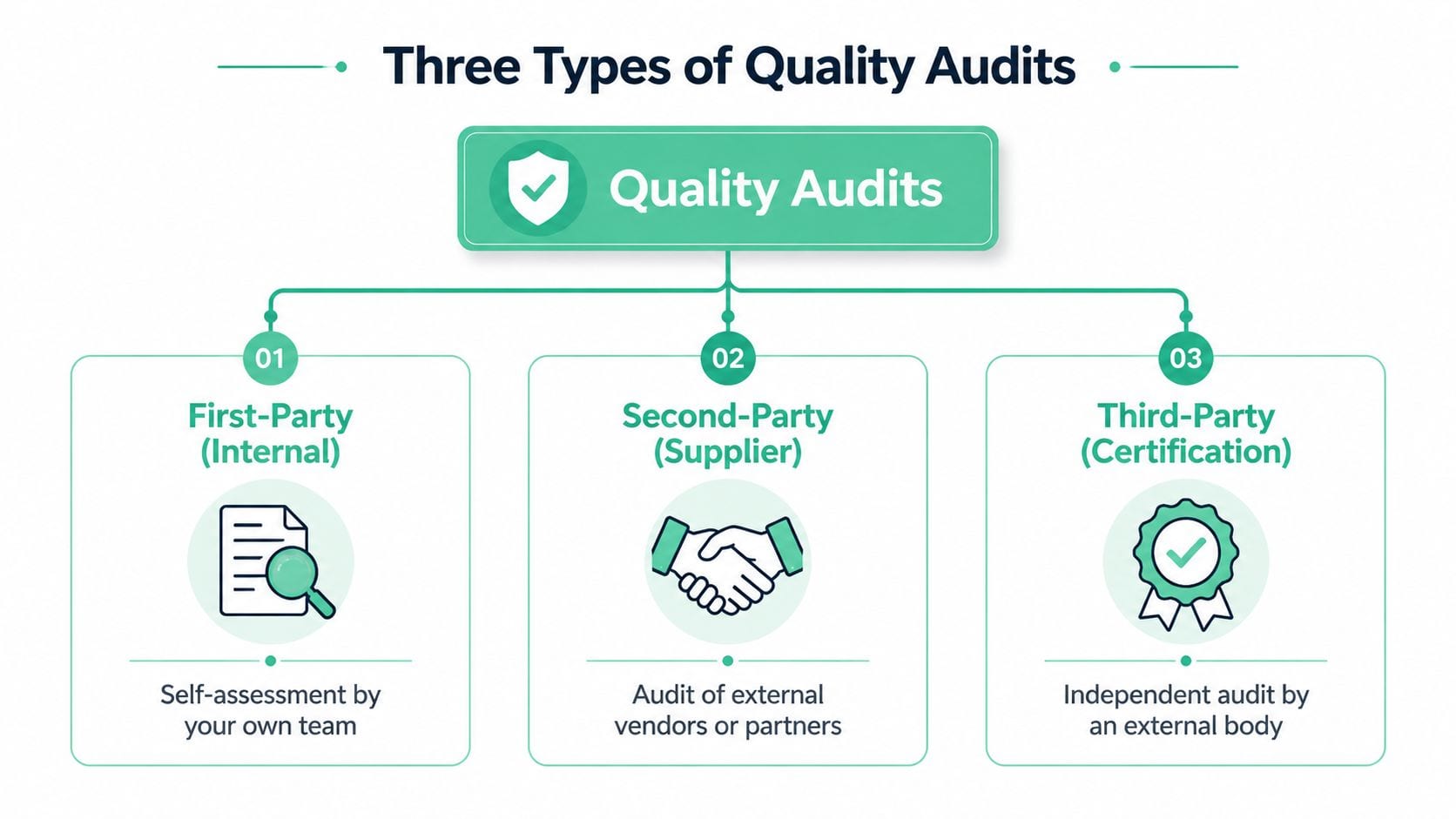
The word audit gets used loosely, but the mechanics are different depending on who is doing the checking and why. In analytics, that difference matters because the risk profile changes when you move from your own tracking implementation to a vendor's behavior, or from internal governance to external certification. The simplest way to keep it straight is to map the audit type to the accountability chain.
First-party audits are your own control system
A first-party audit is your internal review of your own work. In analytics terms, that means inspecting your dataLayer, tag manager rules, consent logic, event schemas, and destination mappings against the tracking plan you say you follow. This is where organizations start, and it's also where many teams stay stuck if they rely on ad hoc checking instead of documented criteria.
The advantage is control. You can review implementation details, trace root causes, and see where handoffs break between product, marketing, and engineering. The downside is bias and blind spots, especially when the same people who built the setup are also judging it. That's why internal audit scope has to be explicit, and why it helps to separate implementation ownership from audit ownership whenever the team is large enough to do so.
Second-party audits are vendor and partner checks
A second-party audit is what you do when someone else's system affects your data quality. In digital analytics, that usually means a tag vendor, a media partner, a consent platform, a data processor, or a managed service that touches events before they reach your reporting layer. If a vendor injects a tag with inconsistent firing logic, or a partner sends malformed parameters, your stack inherits the failure even though the code didn't originate inside your repo.
That's where supplier audits become practical, not theoretical. The audit doesn't need to be a formal ceremony. It needs evidence that the external system follows the rules your reporting depends on, and that the data handoff is traceable. For a broader comparison of approaches, Trackingplan's overview of tracking audits and monitoring is useful because it separates one-time reviews from ongoing monitoring.
Third-party audits matter when independent proof is required
A third-party audit comes from an external body. In regulated environments, that's the route you take when independent verification is part of the requirement, not just a comfort blanket. For analytics teams, the most common trigger is compliance work, especially when privacy, security, or formal management systems are in scope.
The important trade-off is depth versus independence. Third-party audits bring credibility, but they won't know your stack as well as the people who live in it. So the best use of third-party review is to confirm that your internal controls and vendor controls are real, documented, and repeatable, not to replace them.
The Seven-Phase Analytics Quality Audit Framework
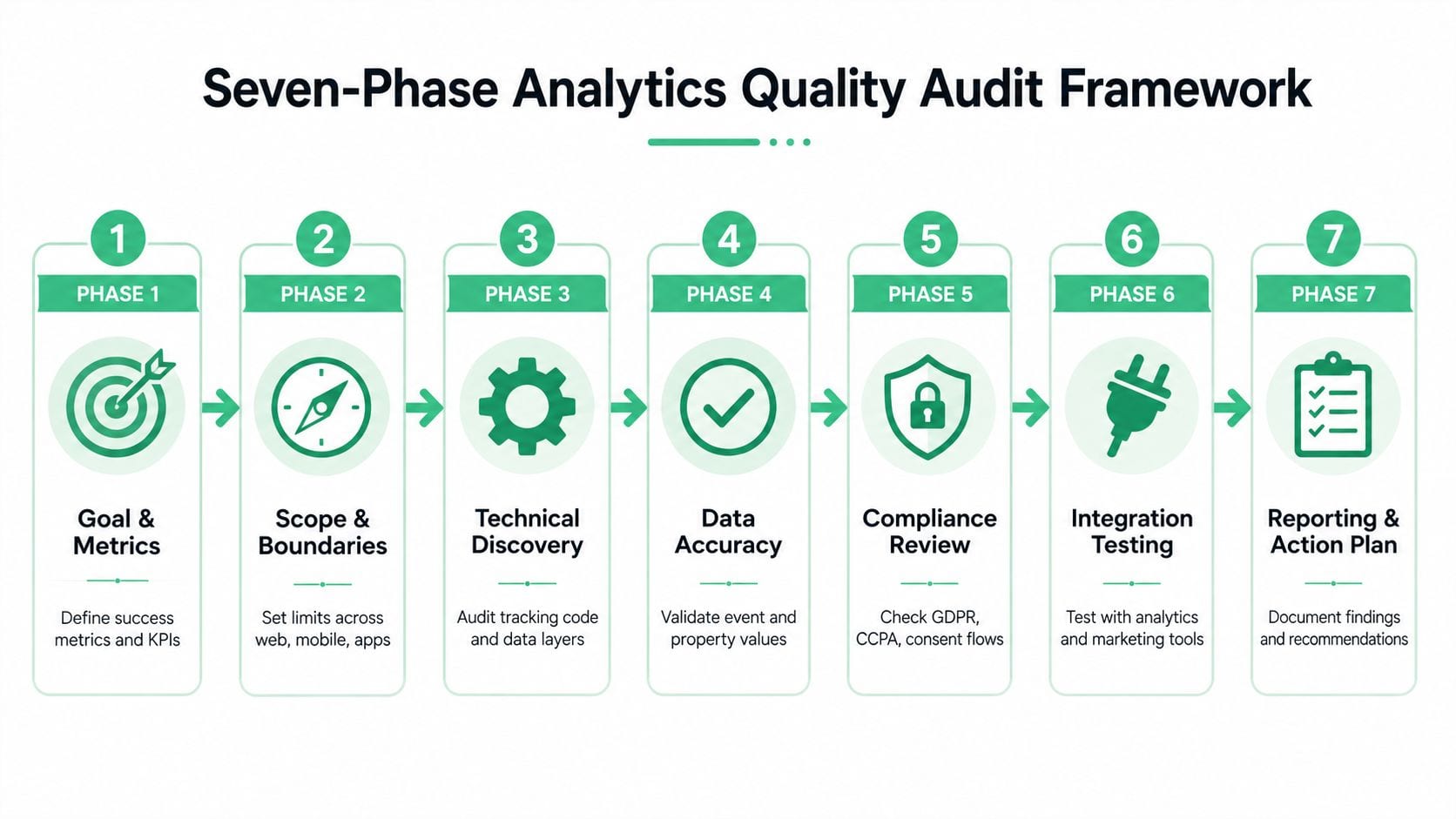
A useful audit framework has to reflect how analytics systems break. It can't stop at a checklist of “did we look at the tag?” because modern stacks fail across discovery, validation, consent, and downstream delivery. The seven phases below work because they move from intent to evidence, then from evidence to ongoing control.
Phase 1 through Phase 3 establish what exists
Start with goal and metric definition. If nobody can say which events, properties, destinations, or consent states matter most, the audit becomes a scavenger hunt. The output should be a short list of business-critical signals, the systems that produce them, and the people who own them.
Next, lock the scope and boundaries. Web, app, and server-side implementations don't behave the same way, and they shouldn't be audited as if they do. One team's “complete coverage” is another team's blind spot if it ignores SDK events or server-side forwarding.
Then move into technical discovery. This is the phase that is often underinvested in, because it's tedious and easy to skip once a dashboard seems healthy. Map the full martech path, from dataLayer or SDK to tag manager, analytics platform, advertising pixels, and any downstream warehouse or CDP. If the mapping is weak, the rest of the audit rests on guesswork.
Phase 4 through Phase 7 turn discovery into control
Data accuracy testing comes next. Validate event names, required properties, data types, schema consistency, consent behavior, and destination firing. Mismatches surface, and manual sampling fails hardest because a few clean examples can hide a lot of broken paths.
Then run the compliance review. For privacy-sensitive stacks, that means checking how consent states change collection behavior and whether sensitive fields are being suppressed or leaked. The test has to reflect actual user journeys, not just ideal paths.
Practical rule: if a tracking plan exists only in a spreadsheet, it isn't governable yet. It's just documentation with no operational teeth.
After that comes integration testing. Confirm that analytics, marketing, and attribution tools all receive the same event logic, or at least the right transformations when they don't. Finally, close with reporting and an action plan. A good audit output names the issue, the owner, the remediation path, and the review date. Health Canada's guidance on audit reports is relevant here because it insists on sufficient detail, audit criteria, and findings that support the conclusion, not just a pass/fail label (source).
Manual Audits Versus Automated Observability
Manual audits still matter. They're useful when you need a strategic review, a governance checkpoint, or documentation for stakeholders who want human sign-off. They also force people to read the stack end to end, which surfaces ownership problems that dashboards alone won't show.
The problem is coverage. Manual review is periodic, and analytics failures are not. A broken pixel after a release, a schema drift after a deployment, or a consent misconfiguration during a traffic spike can happen long before the next scheduled audit. Traditional audit guidance frames quality checks as systematic and documented, but it doesn't solve real-time detection in digital stacks, which is why observability exists as a separate discipline.
| Dimension | Manual Audit | Automated Observability |
|---|---|---|
| Coverage | Point-in-time sampling | Continuous monitoring |
| Detection speed | Depends on the next review | Real-time or near real-time |
| Best use | Governance, documentation, deep reviews | Ongoing control, anomaly detection |
| Weak spot | Misses issues between audits | Requires setup and tuning |
| Team load | Heavy on analyst and engineer time | Lower repetitive effort after setup |
Use both, but for different jobs
The right question isn't whether manual audits are obsolete. It's where they're still the best tool. A quarterly review can validate governance, ownership, and risk prioritization. Automated observability can watch the stack every day, catch regressions as they land, and alert the right people before a reporting cycle gets contaminated.
That trade-off is why manual audit work often becomes expensive fast. The price isn't just the engagement cost. It's the labor of chasing screenshots, sampling events, reconciling contradictory reports, and rebuilding context every time the review starts again. If the same stack changes frequently, the manual model becomes a treadmill.
Continuous checks change the economics
Automated observability is stronger when the stack is active, fragmented, or high stakes. It works best when it monitors event naming, schema changes, destination status, pixel health, UTM conventions, and consent flows without waiting for someone to ask. That doesn't eliminate human review. It changes human work from repetitive checking to exception handling.
The architecture note matters too. Trackingplan's marketing observability overview aligns with the operational model here, continuous coverage instead of periodic inspection. In practice, the teams that combine both approaches spend less time rediscovering the same mistakes and more time fixing the ones that affect revenue or compliance.
Tooling and Platforms for Analytics Quality Assurance
Tool choice should follow the failure mode, not the feature list. A browser debugger can help you inspect one page load. A tag assistant can tell you whether a hit fired. Neither one will give you broad coverage across multiple releases, vendors, or consent states. That's the gap enterprise observability platforms fill, especially when the tracking surface is larger than one analyst can inspect by hand.
Match the tool to the audit phase
Discovery tools are strongest when you need to map what's deployed. Validation platforms are strongest when you need to check whether events conform to a plan. Monitoring tools are strongest when you need alerts, anomaly detection, and regression tracking after release. A common mistake is buying only one class of tool and expecting it to solve every phase of the audit lifecycle.
For smaller teams, lightweight debugging extensions and focused tag checks can be enough at first, especially if the stack is simple and change volume is low. For larger enterprises, governance features matter more, because audit evidence, ownership, and retention all become part of the job. Agencies sit in the middle, they need repeatability across many client properties, and they need enough abstraction to avoid rebuilding the same validation logic from scratch every week.
Integrations matter more than dashboards
A tool is only useful if it understands the systems you already run. Google Analytics, Adobe Analytics, Segment, Snowplow, app SDKs, server-side endpoints, and ad pixels all produce different failure patterns. A validation layer that only sees one destination can miss the mismatch that matters downstream, especially when the same event is transformed differently for different platforms.
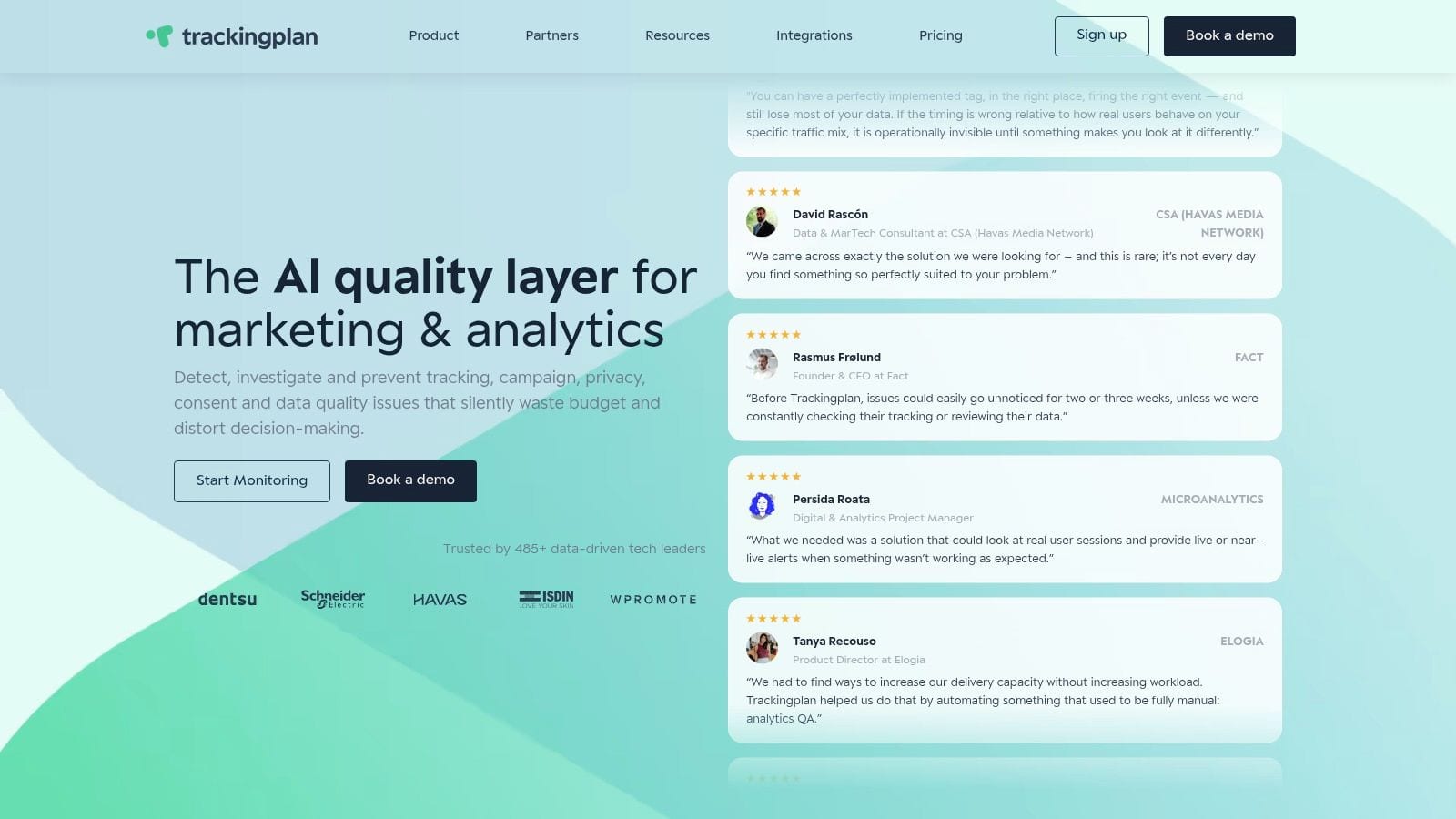
Trackingplan is one option in this category. It continuously discovers implementations, monitors events and pixels, and flags issues such as schema mismatches, broken or missing pixels, campaign tagging errors, and consent-related misconfigurations. That kind of coverage is useful because it closes the gap between one-time audits and always-on control without forcing teams to rely on brittle test suites alone.
Don't buy a tool for its alert count. Buy it for whether it reduces the time between a broken deployment and a human action.
The selection criteria are boring but decisive. Can the tool explain what changed, not just that something changed? Can it surface the owning team? Can it keep up with a stack that changes every sprint? If the answer is no, the platform will create more review work than it removes.
Real-World Audit Outcomes and Lessons Learned
One team I've seen had a classic post-launch problem. The product launch had gone live cleanly on the surface, but the audit that followed found missing conversion events, broken attribution paths, and consent misconfigurations that had persisted for months. The discovery wasn't dramatic. It was worse, it was routine, which meant no one had enough urgency to stop the leak until the damage had already spread across reporting and planning.
The remediation was painful because every fix had to be traced backward through releases, tag changes, and vendor settings. Teams had to answer basic questions like when the failure started, which journeys were affected, and which dashboards had been used to brief leadership during the gap. The lesson was clear. A periodic review can tell you what's broken now, but it can't protect you from the time between reviews.
Faster detection changes the business outcome
A second organization took the opposite path and used continuous monitoring to catch issues within hours of deployment. A schema mismatch surfaced after a release, the right owner got the alert, and the team fixed it before the bad data spread into reporting and weekly stakeholder packs. That kind of response changes the tenor of the whole analytics function, because teams spend less time defending numbers and more time using them.
The common failure patterns were familiar. GTM updates introduced schema mismatches. Campaign teams used inconsistent UTM conventions. A dataLayer change exposed fields that should've been suppressed. None of those problems needed a heroic rescue, they needed quick detection and a clear ownership path.
The real lesson is operational, not philosophical
A quality audit only pays off when it shortens the distance between issue and fix. If the finding sits in a spreadsheet for three weeks, the audit has become theater. If the finding triggers a controlled workflow, the audit becomes a quality system.
That distinction is why the best teams treat audit outcomes as feedback loops. They don't ask whether the review found everything. They ask whether the system learned fast enough to prevent the next avoidable failure. On a live stack, that's the difference between clean measurement and expensive guesswork.
Building a Sustainable Quality Governance Program
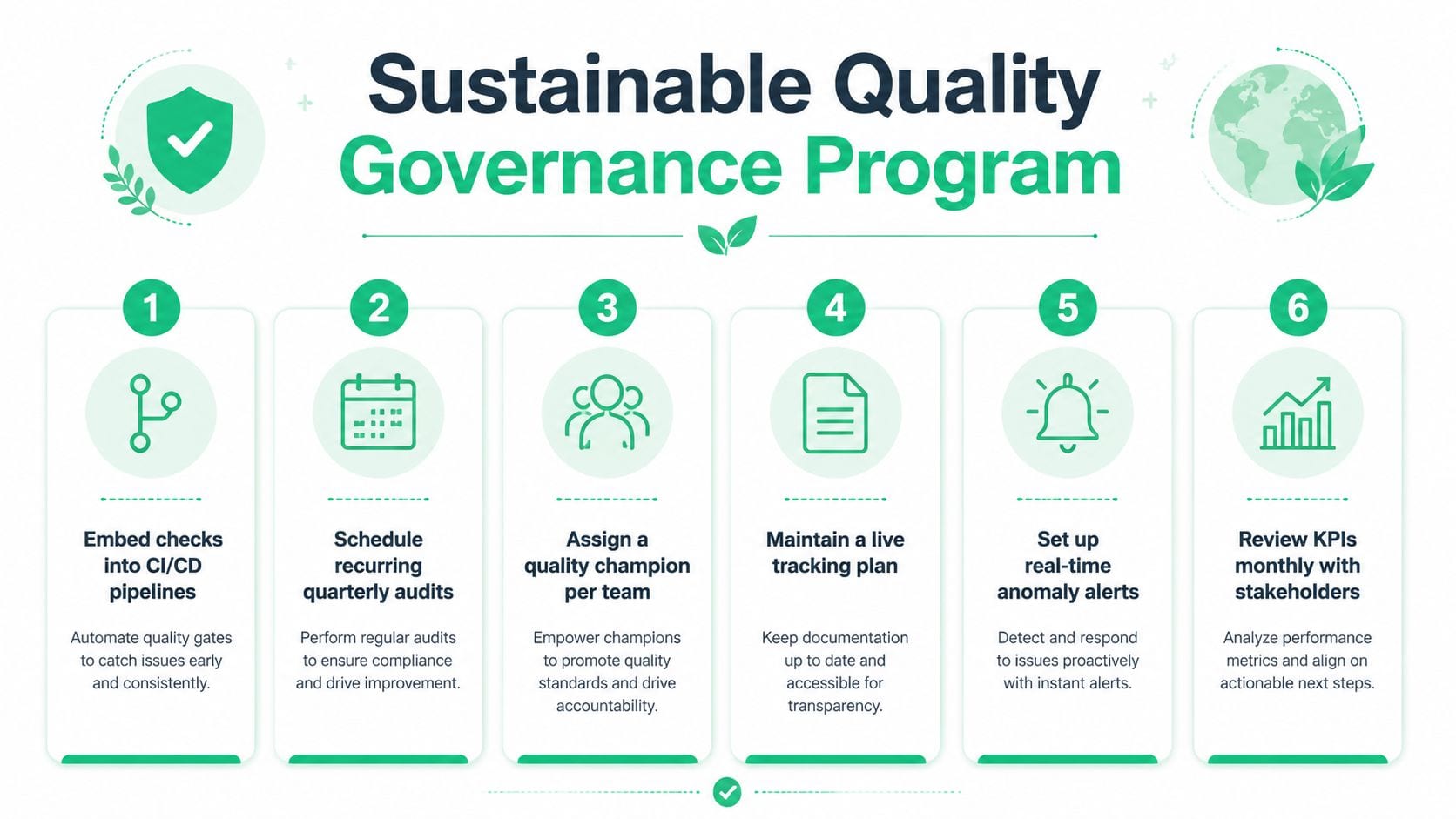
A sustainable program doesn't live in a single audit report. It lives in the workflow. The teams that make progress fastest are the ones that embed checks into release processes, assign ownership clearly, and keep the tracking plan current enough that people use it. Without that operating model, even a strong audit becomes a snapshot that ages too fast.
Governance has to touch people and process
Ownership is the first fix. Marketing owns campaign intent, analytics owns measurement logic, engineering owns implementation quality, and privacy or legal owns consent constraints. If those responsibilities aren't explicit, issues bounce between teams until someone decides the problem belongs to someone else.
A live tracking plan keeps that from happening. Content-audit guidance from Nielsen Norman Group says criteria should reflect both content quality and business goals, and it recommends recording the final disposition for each item as keep, update, or remove (source). The same idea applies to analytics governance. The plan should tell teams what matters, what changed, and what still needs review.
Use scoring, not vibes
Quality work gets better when it's measurable. Content Strategy Inc. recommends ranking items from 1 to 5 and averaging the scores to create an overall quality score for each page and each area of the site (source). That method translates well to analytics governance because it forces reviewers to compare issues against the same standard every time.
A practical scorecard can include whether the event exists, whether it fires consistently, whether properties are populated correctly, whether consent logic is respected, and whether the destination receives the payload intact. The point isn't to create bureaucracy. It's to make priorities visible so remediation work lands where the business risk is highest.
Continuous observability is the durable model
The strongest governance programs combine scheduled audits with real-time monitoring. Scheduled reviews still matter for documentation, process design, and executive visibility. But continuous observability is what keeps the stack honest between those reviews, and that's where the competitive advantage comes from.
A useful benchmark is whether your team can answer three questions without scrambling. What changed? Who owns it? How fast can we prove the fix? If your current process can't answer those cleanly, the governance model is still too manual.
For teams formalizing that discipline, Trackingplan's data quality governance overview fits the operational need because it treats governance as an ongoing system rather than a once-a-quarter event.
If your analytics stack keeps surprising you after launches, Trackingplan gives you a way to monitor events, pixels, consent flows, and schema changes continuously instead of waiting for the next manual review. If you want a practical layer for analytics quality audit work across web, app, and server-side setups, visit Trackingplan and see how it fits into your current tracking workflow.