
Most advice on running Facebook ads starts in the wrong place. It obsesses over audiences, buttons, and creative formats, then acts surprised when performance stalls, even though failure happened earlier, in measurement, naming, and event integrity.
Meta's ad engine is still massive, with $160.38 billion in advertising business generated in 2024, and that scale is why the channel remains worth serious attention (The Social Shepherd). But scale doesn't save weak infrastructure. If your pixel is broken, your UTMs are sloppy, or your conversion events don't line up with what your team thinks is happening, you're not optimizing ads, you're optimizing noise.
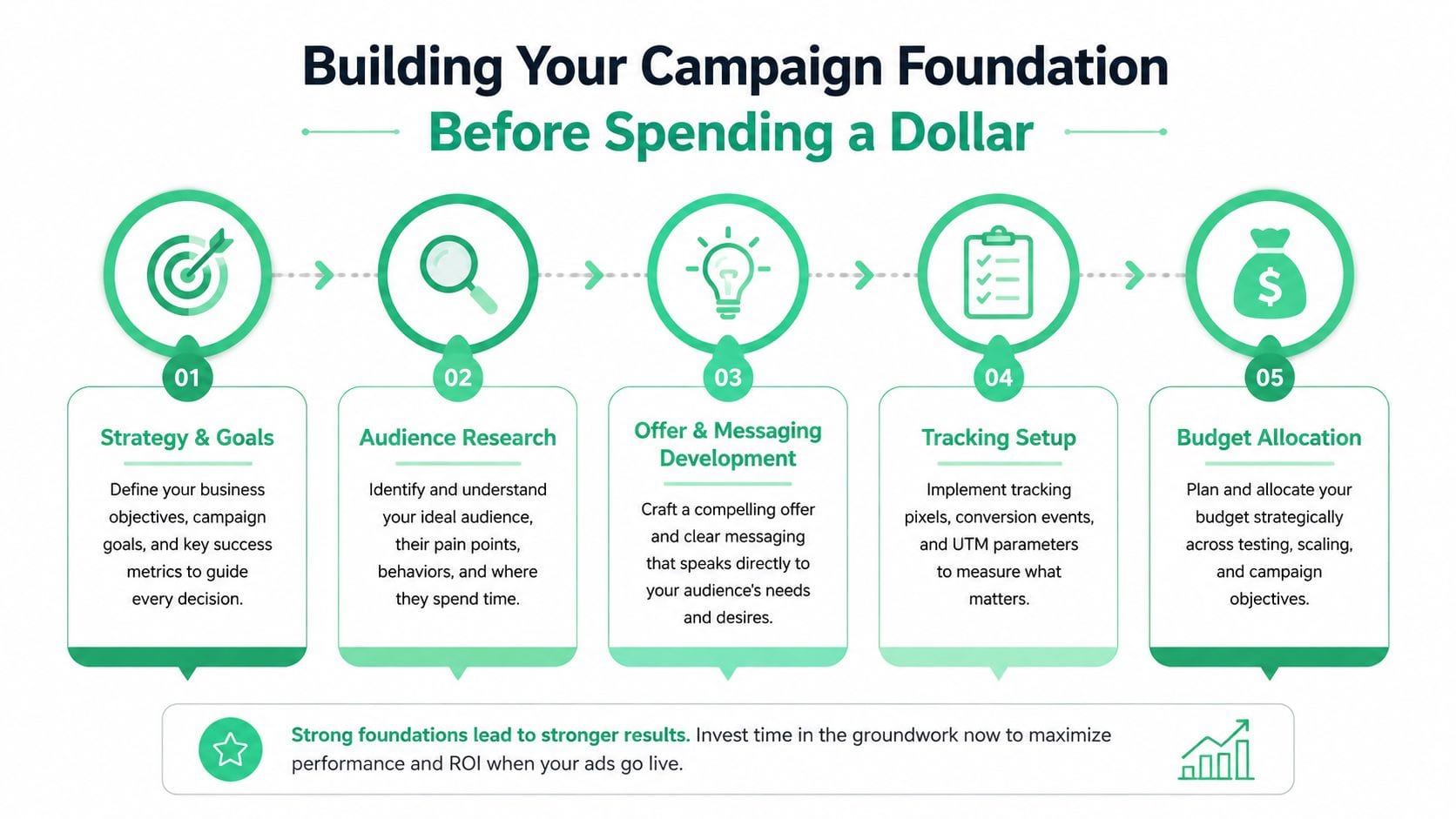
Building Your Campaign Foundation Before Spending a Dollar
The hardest part of running Facebook ads isn't clicking through Ads Manager. It's deciding what success means, then building a measurement stack that can prove it without guesswork.
Start with business goals, not platform defaults
Meta will happily let you pick an objective, but your objective should come from the business model, not the menu. A lead gen team, an ecommerce brand, and a webinar funnel all need different success definitions, even if they all use the same platform.
That's where a lot of accounts drift. Marketers choose traffic because it feels safer, then complain that the campaign didn't produce sales. If the ultimate goal is qualified leads or purchases, the campaign has to be built to measure those outcomes, not just clicks.
A good planning pass also forces you to map the funnel before launch. Awareness campaigns need different proof points than retargeting campaigns, and educational content often belongs upstream of conversion asks. If you're pairing social activity with paid media, a broader social media marketing strategy can help keep the messaging and offers consistent across the journey, which is useful context before you open Ads Manager (boost results with social media).
Audit tracking before launch
A launch-ready setup starts with clean event logic. Check that the pixel fires on the right pages, that the conversion event matches the actual business action, and that the landing page doesn't create a mismatch between ad promise and on-site experience. Meta's policy framework also matters here, because ads must accurately represent the product or service and avoid misleading omission (Meta Advertising Policy Basics).
Practical rule: if you can't explain where each lead, purchase, or booked call is attributed from impression to conversion, you're not ready to scale spend.
A useful internal reference is Tracking Facebook Ads, because pixel QA is easier when you treat it as an observability problem instead of a one-time setup task. That mindset matters even more when pixel data is incomplete, because customer lists, exclusion logic, and staged funnels can still give Meta enough signal to optimize without pretending the data is perfect.
For teams dealing with weaker conversion signals, a staged funnel usually works better than a blunt ask. Educational content warms the audience, exclusion lists keep existing buyers out of prospecting, and custom audiences let you control who sees what. The point isn't to remove uncertainty, it's to keep the uncertainty from contaminating every downstream decision.
Structuring Campaigns and Ad Sets for Clarity and Scale
A messy account structure makes clean data look unreliable. When campaign names, ad sets, and creative variations blur together, you lose the ability to tell whether performance changed because of the audience, the offer, the placement, or the ad itself.
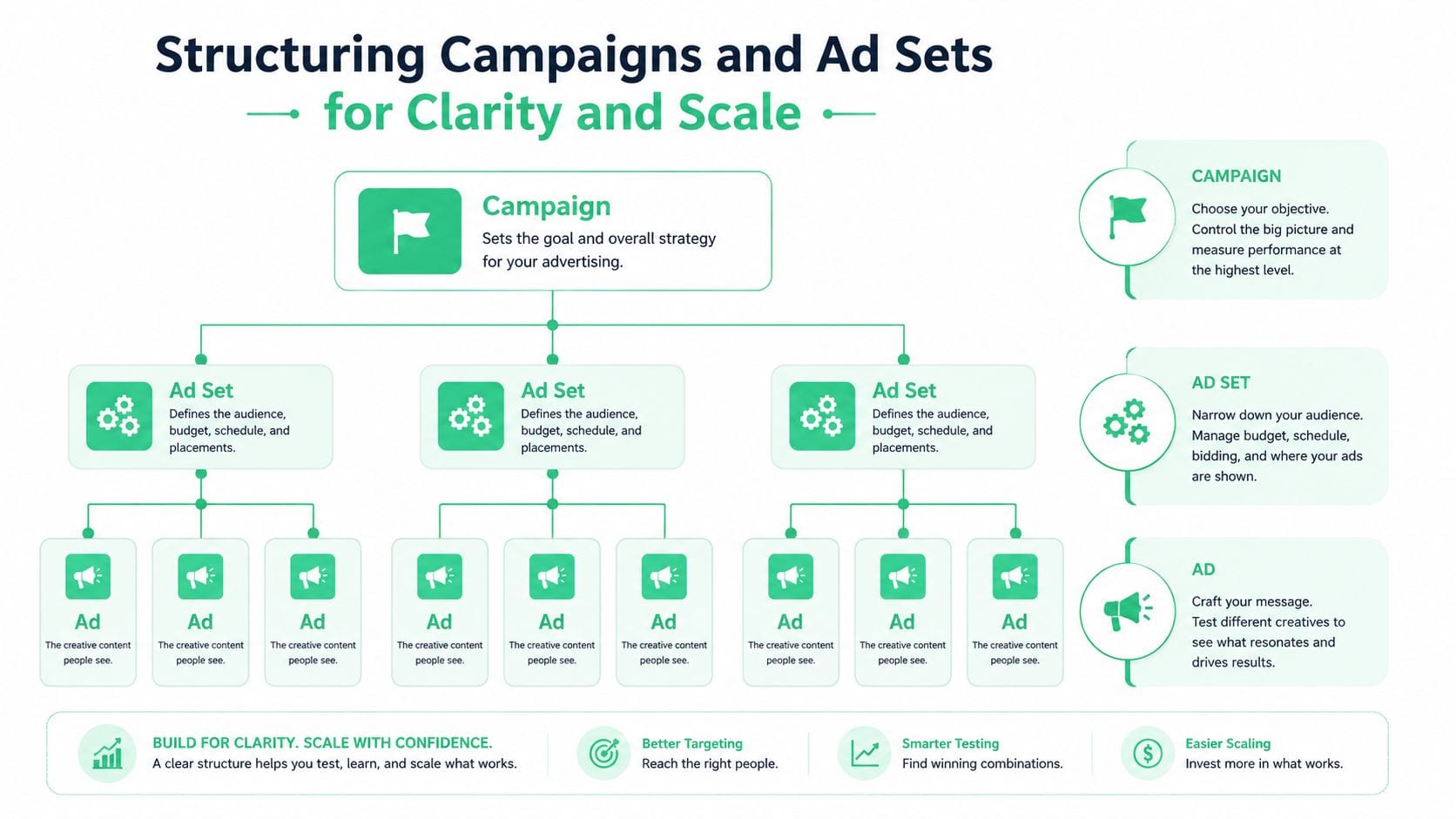
Keep the hierarchy simple enough to learn from
At the top level, the campaign should represent the business outcome, such as leads or purchases. The ad set should represent the main segmentation logic, usually audience type, geography, or retargeting stage. The ad should hold the creative variable you want to evaluate.
That structure matters because Meta learns at each layer differently. Split too aggressively, and you starve delivery and make every result noisier than it needs to be. Consolidate too hard, and you lose the ability to isolate what is driving performance.
Overbuilding ad sets is the most common mistake. Teams create too many segments for too little budget, then wonder why nothing stabilizes. Fewer ad sets with clearer intent usually work better, especially when the budget cannot support enough delivery for each segment to generate useful signal.
A campaign structure should answer one question per layer. If one layer is trying to do three jobs, the account is already harder to manage than it needs to be.
Budget for signal, not just spend
Current practitioner guidance often suggests allowing roughly 3,000 to 5,000 impressions per ad set before making major decisions, then holding tests for at least 7 days so you do not react to daily swings (Demand Curve). Another testing framework recommends 3 to 5 variants per round, about 100 conversions per variant before naming a winner, and refreshing winners every 7 to 21 days to reduce fatigue (Demand Curve).
Those numbers are not magic. They are a reminder that small datasets are easy to misread, especially when the tracking stack is shaky. If your pixel fires late, your UTMs are inconsistent, or your CRM and ads manager disagree on conversions, the account can look broken even when the structure is fine. A good reference for tightening the measurement layer is Facebook Advertising Optimization, because structure only helps if the underlying tracking can be trusted.
For a B2B lead account, that often means one campaign for prospecting and one for retargeting, with a small number of ad sets tied to high-intent segments. For ecommerce, it usually means consolidating around catalog or purchase intent instead of splitting every audience into its own tiny bucket. The cleaner the structure, the easier it is to scale winners without creating internal competition.
If you are tightening naming conventions and campaign hygiene, the payoff is cleaner readouts in reporting, fewer false conclusions, and faster decisions when performance changes.
Creative Testing That Actually Produces Winners
Creative testing fails when teams test everything at once. If you change the audience, the angle, the format, and the placement in the same round, you don't learn what moved performance, you just collect opinions disguised as data.
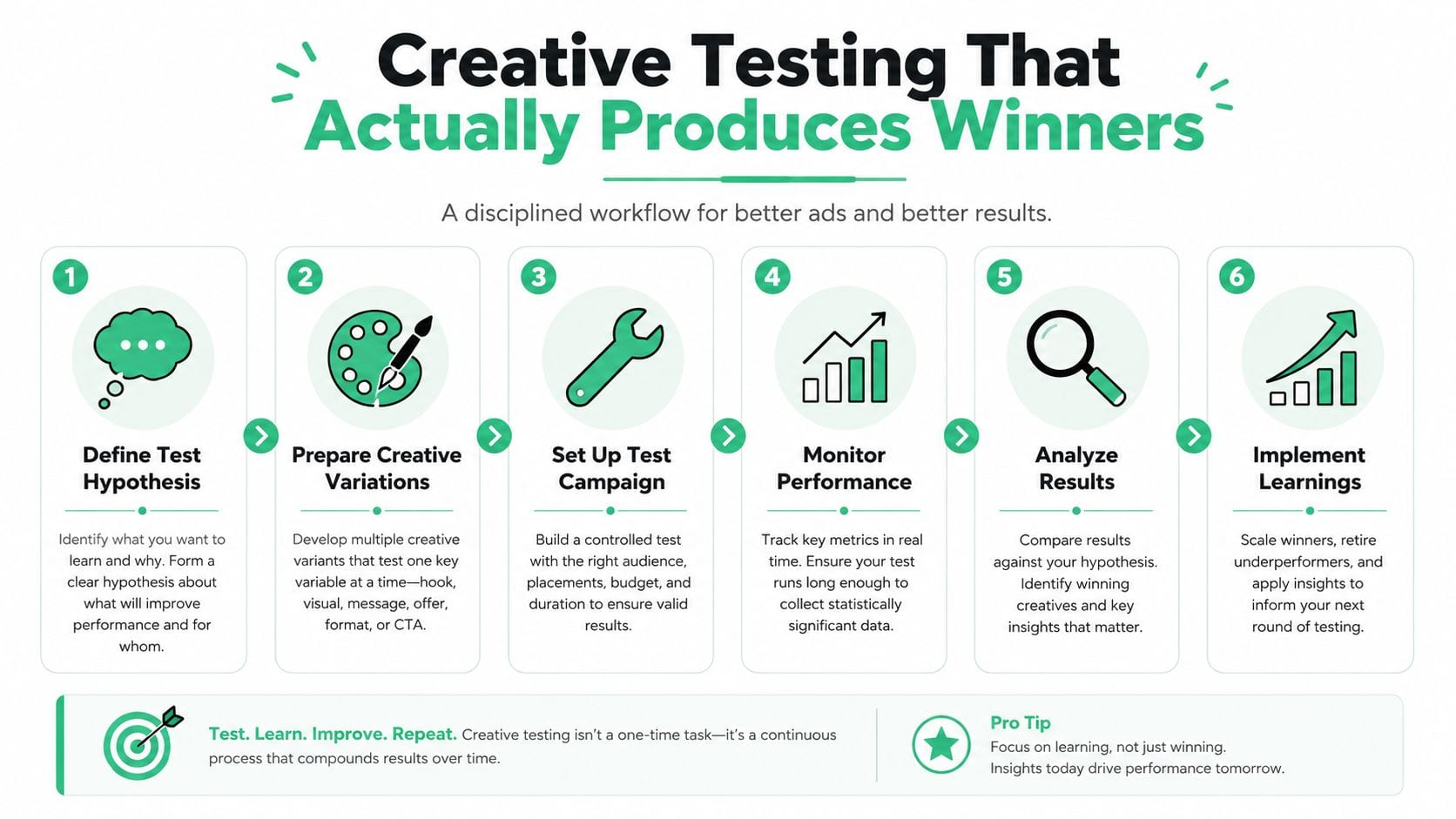
Test the message before the polish
The strongest testing setups start with the angle, not the production finish. Newer practitioner guidance is right to push advertisers toward message framing first, because a pretty ad that says the wrong thing still loses money (AdEspresso).
That doesn't mean format doesn't matter. It means format should be tested after you know which promise, pain point, or benefit is pulling response. If the framing is weak, better editing won't fix it.
A practical matrix usually starts with a few personas, then a small set of ad-set segments per persona, then two variations of headline, copy, and visual per segment. The goal is to isolate one variable at a time so the winner tells you something you can repeat.
Use decision rules, not mood
Many advertisers wait too long to kill an obvious loser, then too short to judge a slow starter. That's why a written rule set matters more than a gut feeling on Monday morning. If an ad is getting expensive attention without lifting link clicks or qualified downstream actions, it's probably not a sleeper, it's just weak.
Meta's creative guidance still favors cleaner visuals over cluttered text-heavy assets, and the old 20% text convention remains a useful readability benchmark (Meta Ads Guide Update). Separate versions for different placements also matter, because a feed asset and a stories asset don't behave the same way.
Simple truth: the ad people notice isn't always the ad that converts. The ad that converts is the one that matches the audience's moment and the landing page's promise.
If you need a workflow example outside paid media, an ai fashion photoshoot can show how quickly creative variations multiply when the source message is stable but the presentation changes, which is exactly why controlled testing beats random iteration (WearView).
Use the timing discipline too. A winning creative should be refreshed before fatigue flattens performance, not after spend has already been wasted. That's the difference between a testing program and an expensive content habit.
Validating Your Pixel and Conversion Tracking Before Launch
Launching with unverified tracking is the fastest way to fool yourself. The campaign may still spend, but every report you open afterward will be less trustworthy than it looks.
Check the pixel and event logic first
Before budget goes live, validate the pixel in the browser, confirm the right event fires on the right page, and make sure duplicate fires are not inflating your numbers. A purchase event that fires twice is worse than no event at all, because it pushes optimization toward the wrong behavior.
UTM discipline matters just as much. If naming conventions drift from campaign to campaign, your analytics stack will split one traffic source into several misleading fragments, and the attribution story gets messy fast. A tracking QA layer pays for itself here, because it can flag missing or rogue events, schema mismatches, and UTM errors before the dashboard becomes a guessing game.
For teams that want a deeper implementation reference, Facebook Pixel and Conversions API guidance is worth keeping handy. It becomes especially relevant when browser-side signal is thin and server-side validation has to carry more of the measurement load.
Build a monitoring habit, not a one-time check
Trackingplan continuously monitors analytics, marketing, and attribution pixels to detect issues in real time, including traffic anomalies, missing or rogue events, schema and property mismatches, campaign tagging and UTM convention errors, broken or missing pixels, and potential PII leaks or consent misconfigurations (Trackingplan). That kind of ongoing detection matters because tracking rarely fails loudly.
If the ad platform says conversions are rising but your CRM says leads are flat, do not assume the CRM is wrong. Check the event path, the UTM logic, and the consent layer before changing bids.
Consent misconfigurations are especially dangerous because they can suppress data without obvious visible errors. Broken pixels and blocked scripts cause the same problem, which is why automated observability beats occasional manual audits once campaigns are live.
A platform like Trackingplan fits naturally into that workflow, but the bigger lesson is broader. Whether you use one tool or a stack of them, tracking needs to be monitored with the same discipline you apply to spend, because measurement failures hurt performance long before creative ever gets blamed.
Optimizing for Conversions Instead of Vanity Metrics
A lot of Facebook advertisers still chase the wrong scorecard. They celebrate click-through rate, watch impressions climb, and never ask whether those clicks became qualified leads or profitable customers.
A better read starts with the economics behind the click. If the pixel is broken, UTMs are inconsistent, or the CRM and ad platform do not agree on what a conversion is, the numbers can look good while the campaign loses money.
Read the benchmarks in context
Current benchmark data shows that Facebook can still perform as a response channel. For lead campaigns, Search Engine Land reported a 2.53% CTR, $1.88 CPC, 8.78% conversion rate, and $21.98 cost per lead in 2024 (Search Engine Land). For traffic campaigns, the same report cited a 1.71% CTR and a 70¢ average CPC, while Sprout Social reported a 1.71% CTR in 2026, up from 1.57% the year before (Search Engine Land).
Those numbers are useful only if you read them as benchmarks, not promises. A campaign with a lower CTR can still outperform if it drives more qualified downstream actions at a lower blended cost. A clean measurement setup matters more than a flattering top-line metric because weak tracking can make a strong campaign look weak, or the reverse.
| Metric | Lead Campaigns | Traffic Campaigns |
|---|---|---|
| CTR | 2.53% | 1.71% |
| CPC | $1.88 | 70¢ |
| Conversion rate | 8.78% | Not provided |
| Cost per lead | $21.98 | Not provided |
Optimize for the economic outcome
Meta's policy system also constrains how aggressively you can write or infer claims. Ads can't assert or imply knowledge of a person's personal characteristics, and false, fraudulent, or misleading claims are prohibited; claims need to be adequately substantiated (Meta Advertising Standards Best Practices). That matters because strong optimization depends on honest offers, not copy that overpromises and underdelivers.
The question is whether the campaign improves the economics of the business. That means watching qualified leads, revenue, and actual post-click behavior, not just surface engagement.
CTR still has a place, but only as a diagnostic. If an ad gets attention and never converts, the traffic is not the win, the conversion is.
Automating Monitoring to Protect Your Campaign Investment
Manual checks hold up until the first quiet failure slips through. By then, you have already paid for the mistake, and the question is how long it stayed invisible.
Build alerts around the failures that happen
A useful monitoring system watches for missing conversion events, traffic spikes or drops, broken pixels, and tagging drift. That beats a weekly dashboard review, because bad data can be caught while the campaign is still salvageable.
Trackingplan's ad pixel monitoring approach fits that model because it treats analytics QA as ongoing infrastructure, not a launch checklist. The same logic applies whether your stack includes Google Analytics, Adobe Analytics, Segment, or the ad platforms themselves. If your team needs a practical way to keep pixel and event setup from drifting after launch, this kind of ad pixel monitoring workflow is the right place to start.
If your team also tracks email engagement, track email opens and clicks is a useful reminder that performance reporting only works when the upstream signals are trustworthy. Paid media and lifecycle channels fail in similar ways, bad tagging, missing events, and mismatched attribution assumptions.
Review performance with the stack, not against it
The right operating rhythm combines automated alerts with weekly performance review. Alerts catch breakage fast, while the weekly pass checks whether campaign economics still make sense across ad platform data, analytics, and CRM outcomes.
That combination matters because no single dashboard tells the full story. A clean ad account with broken measurement is still a broken system, and an account with noisy creative data still needs a trusted event flow before anyone makes scaling decisions.
For a practical view of how observability and marketing QA work together, the product pages and examples at Trackingplan show how real-time detection can surface data issues before they turn into budget waste. That is the guardrail serious Facebook advertisers need once spend starts to scale.
If you are serious about running Facebook ads without wasting budget on bad data, build the measurement layer first and the creative layer second. Continuous tracking QA, pixel monitoring, and UTM validation help teams protect spend, catch broken events early, and trust the numbers behind every optimization decision.