
Your team has probably seen this before. A vendor promises “reliable service,” a dashboard misses data during a launch, and everyone argues about whether the failure was real, out of scope, or just “not our problem.” That's exactly where service level agreements earn their keep, because they turn a fuzzy promise into something measurable, enforceable, and reviewable.
A good SLA isn't paperwork for legal alone. It's the operating contract that keeps engineering, support, analytics, and procurement aligned when a service breaks, a campaign spikes traffic, or a customer asks why the numbers disappeared. It gives the team a shared definition of success, and it gives the business a way to enforce that definition without guessing.
Why Service Level Agreements Matter in Modern Operations
A service can look healthy in a dashboard and still fail the people relying on it. The difference usually comes down to whether the agreement names the service, the measurement method, and the remedy before anything breaks. That is why service level agreements matter, they turn promises into measurable contractual targets around availability, response time, and resolution time.
A missed target has real operational and financial consequences. Benchmarking from Termscout notes that downtime can reach roughly $500,000 to $1.1 million per hour for e-commerce platforms, $100,000 to $540,000 per hour for B2B SaaS, and $1 million to $5 million per hour for financial services. The same benchmarking also reports that 73% of organizations had an outage costing more than $100,000 in the prior year, which is why SLAs now sit at the intersection of procurement, engineering, analytics, and customer operations.
What an SLA Does
A strong SLA names the service scope, the performance target, and the consequence if the target is missed. In legal and industry terms, it is a contract or contract section that defines the service level, the measurable indicators, and what happens when the provider falls short (Flexential overview of service level agreements). Once those pieces are written down, “fast response” no longer floats around as a vague promise. It becomes a specific obligation that both sides can check against the same record.
Practical rule: if the promise cannot be measured, it cannot be enforced.
That is why SLA design matters in cloud, SaaS, analytics, and support. Teams need commitments that hold up during an outage review, a customer escalation, or a vendor dispute. They also need observability tooling that turns the agreement from a document into an operating control, because logs, traces, metrics, and event timestamps are what make the target testable instead of aspirational.
SLAs, SLOs, and SLIs Explained Clearly
The fastest way to confuse a team is to use SLA, SLO, and SLI like they're interchangeable. They're related, but they're not the same thing. One is the contract, one is the internal target, and one is the measurement.
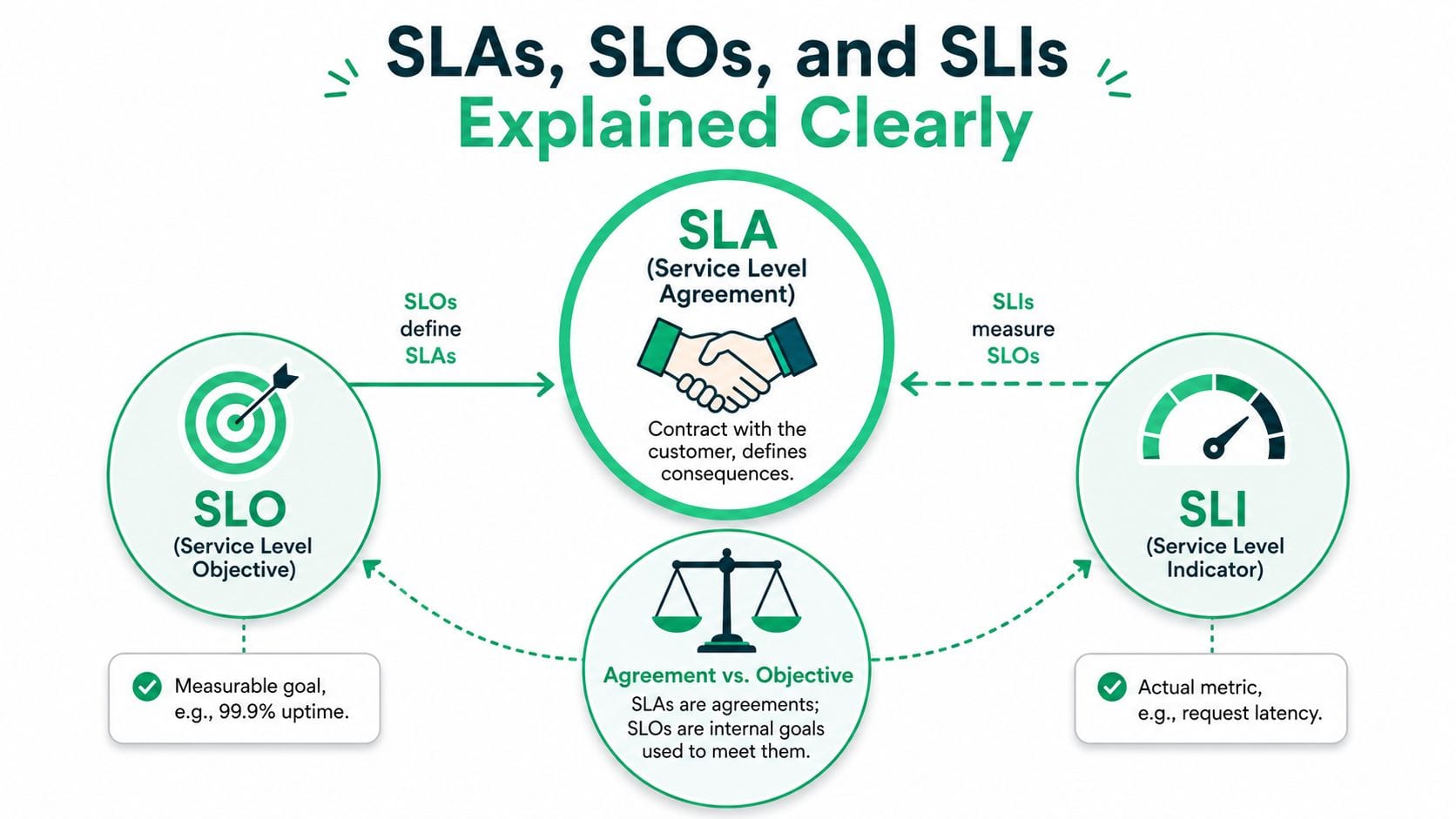
At the center sits the SLA, the agreement with the customer. The SLO is the internal reliability goal that makes the agreement achievable, and the SLI is the actual metric you measure to see whether the target was hit. For a restaurant analogy, the customer-facing promise is “delivery in 30 minutes,” the internal goal is 25 minutes, and the observed delivery time is the SLI. That structure maps cleanly to support, cloud uptime, and analytics delivery.
The simple mental model
An SLA is external. It's what the provider commits to in writing. An SLO is internal. It's the target your team uses to stay ahead of the promise. An SLI is factual. It's the timestamp, latency, uptime check, or event count that tells you what really happened.
Objective SLIs are easier to automate than subjective ones. “Was the event delivered to the destination?” is much cleaner than “Did the dashboard feel okay?” That's why observability tooling matters. When the measurement is machine-readable, the agreement stops being aspirational and starts becoming enforceable.
For a deeper look at how data visibility supports that measurement layer, this internal guide on what data observability is fits neatly with the SLI part of the stack.
An SLA without an SLI is just a promise. An SLI without an SLO is just a number. An SLO without an SLA is just internal wishful thinking.
There's one more useful distinction. The SLA is the customer's contract, the SLO is the engineering target, and the SLI is the observation. If your team gets those roles right, you can set realistic targets, prove compliance, and know exactly where a failure happened.
The Essential Components of a Strong SLA
A weak SLA can look complete on paper and still fail the moment operations get messy. The gaps usually surface in three places, scope, measurement, and remedies. A defensible agreement has a simple backbone, but every part needs enough precision that another team, or an auditor, can follow it without guessing.
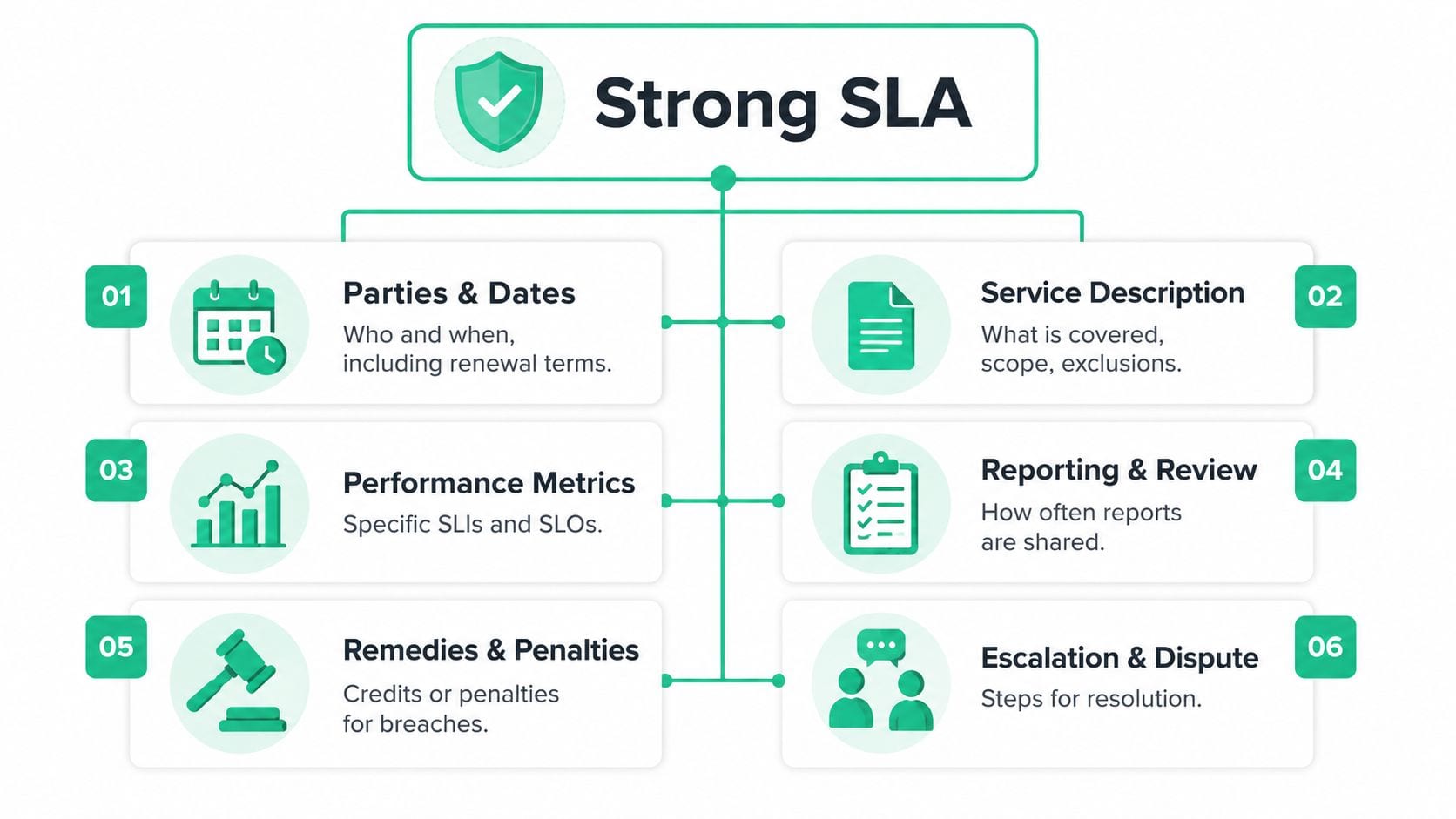
The parts that keep a contract enforceable
The first requirement is measurable standards. A legal practice guide says a properly drafted SLA should include measurable standards, a defined way to measure them over a specified period, explicit measuring and reporting responsibilities, and remedies for failure to meet the standard (Day Pitney SLA drafting guide). That is the difference between “we'll respond quickly” and “we'll acknowledge critical incidents within a defined window.”
The second requirement is a clean split between service and management elements. Service terms define what is covered, what is excluded, and how escalations work. Management terms define how the work gets measured, how often reports are issued, and how disputes are resolved (CIO on outsourcing SLA definitions). Without that governance layer, even a solid uptime clause can become hard to audit.
A checklist that holds up in real life
- Parties and dates. Name who is bound by the agreement and when it starts, renews, or ends.
- Service description. Describe the covered service, the hours of coverage, and the exclusions.
- Performance metrics. Tie the promise to a concrete metric, like availability, response time, or resolution time.
- Reporting cadence. State how often reports are shared and who receives them.
- Remedies and penalties. Write down the consequence of failure, not just the goal.
- Escalation and dispute. Define the steps for resolution before people start improvising.
A useful SLA also needs clear monitoring, exclusions, escalation paths, and privacy or security controls when the service touches sensitive data. That broader scope matters because many teams focus only on uptime, then discover that privacy, indemnification, or incident handling is the part that decides whether the agreement works in production.
The strongest agreements are boring in the best way. They leave little room for interpretation, which is exactly what you want when a breach has to be measured and resolved.
Common SLA Metrics Worth Measuring
A common mistake is choosing a metric because it sounds important, then finding out later that it does not describe the failure mode that hurts the service. Uptime matters, but so do how quickly a ticket is acknowledged, how long a broken flow stays broken, and whether the data feeding a dashboard is still complete. The right SLA metric depends on what the service is meant to do.
Choosing the right metric for the job
For infrastructure, availability is often the starting point. The common commitments in practice are 99.5%, 99.9%, and 99.99%, and those numbers allow very different amounts of downtime. At 99.9%, the budget is about 43.8 minutes per month, while 99.99% leaves only 4.38 minutes per month. That is why “three nines” and “four nines” are not interchangeable in planning, and why teams should treat those labels as different operating targets rather than loose marketing shorthand.
For support teams, response time and resolution time are often better indicators than raw uptime. Atlassian notes that SLA terms can specify how quickly tickets are acknowledged, updated, and resolved, and that SLAs can define delivery, response, and resolution expectations along with what happens when targets are missed (Atlassian on SLAs). If the problem is user frustration, fast acknowledgement may matter more than service uptime.
Operational insight: if users are waiting on a fix, uptime alone can hide the true impact of the failure.
SLA Metrics by Use Case
| Metric | Best For | Example Target |
|---|---|---|
| Availability | Infrastructure, hosting, APIs | 99.9% uptime |
| Response time | Support, incident handling | Acknowledge critical issues within a defined window |
| Resolution time | Support, engineering escalation | Close priority incidents within a defined window |
| Delivery time | Cloud services, content pipelines | Deliver output within the agreed window |
| Error rate | APIs, data pipelines | Keep failed transactions within an agreed threshold |
| Event freshness | Analytics, observability | Confirm data arrives before reporting windows close |
| Coverage | Tracking and instrumentation | Ensure key events are captured across critical paths |
| Tracking-plan compliance | Analytics QA, data governance | Keep implemented events aligned with the approved plan |
For analytics and observability, the important metric is often not uptime at all. It is whether the event arrived, whether the schema matched, and whether the data stayed usable for reporting. If the service is the measurement stack, then coverage, event freshness, and tracking-plan compliance belong in the SLA as first-class targets.
For resolution mechanics, the guide on mean time to resolution helps connect resolution targets to the way teams work.
Drafting an SLA for Analytics and Observability
A draft SLA becomes useful only when it names the exact flow you are trying to protect. For an analytics stack, that usually means data collection, event delivery, validation, alerting, and remediation. If one step breaks, the dashboard can still load while the business data underneath goes stale or incomplete.
Start with the scope. Define the covered channels, such as web events, server-side events, destination delivery, and alerting for schema or property mismatches. Then define the measurable targets. In analytics and observability, that often means event delivery rate, tracking-plan adherence, and alert response time, because those are the points where data quality failures show up in practice.
Ownership comes next. One person or team has to own measurement, another has to own remediation, and a third has to receive the reports. If nobody owns the evidence trail, every dispute turns into a debate about opinions instead of records. The healthcare-oriented SLA review linked earlier makes the broader point clearly, because SLAs can cover monitoring, security and privacy, failure handling, and cost structure, not just performance targets.
A helpful internal model is to separate the customer promise from the operational control plane. Teams that also run security or infrastructure often use models like MSSP vs co-managed SIEM models, where responsibilities are divided between provider and internal staff. The same split works for analytics governance, because ownership needs to be explicit before an incident happens.
A short draft can include:
- Scope. Web and server-side analytics events, destination delivery, and alert handling.
- Targets. Defined thresholds for delivery, validation, and response.
- Ownership. Who measures, who reports, who fixes.
- Remedies. Credits, escalations, or service review if the agreement is breached.
- Review rhythm. A regular meeting to inspect failures and adjust the contract.
A detailed governance perspective is also covered in the internal guide on data governance for analytics, which fits naturally with an SLA because governance and enforceability have to point in the same direction. If the contract says data quality matters, the measurement system has to prove it.
The best draft is short enough to read in one sitting and strict enough to survive a dispute. It should make it obvious who owns the broken event, who gets the alert, and what happens if the fix does not land on time.
Monitoring, Enforcement, and Dispute Resolution
An SLA that never gets measured is marketing copy. The operational job is to instrument the metric, collect evidence, compare the result to the target, and escalate in time for someone to act. If the data trail is missing, the breach is hard to prove and even harder to resolve.
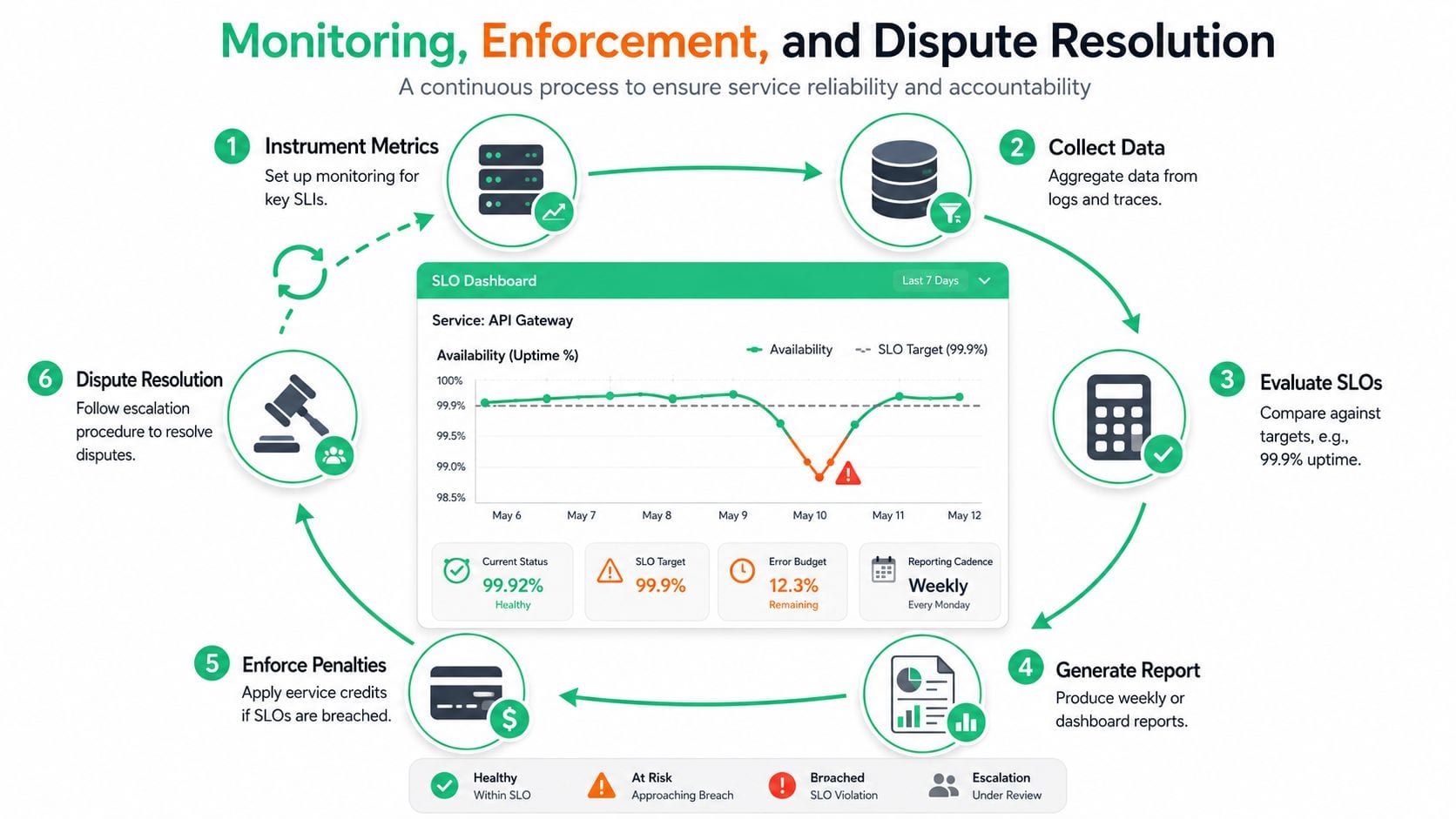
Proving the claim, not just making it
Microsoft's SLA guidance is useful because it's operational instead of theoretical. It advises customers to retain timestamps, error details, and other incident evidence that match the SLA definitions, then calculate availability using the same units and subtract documented exclusions such as planned maintenance or excluded event types before comparing the result to the committed percentage (Microsoft Azure SLA guidance). That's the standard you want for your own agreements, too.
Observability tooling earns its place here. Dashboards, logs, traces, and alerts need to line up with the SLA definition so the data can answer one question cleanly, did the service meet the target or not? For ecommerce and high-volume digital services, that often means selecting monitoring tools that surface failure patterns early, not after a customer complaint. A practical roundup of monitoring tools for ecommerce platforms can help teams think about that evidence layer without turning it into a manual audit.
A workable enforcement loop
- Instrument the metric. Capture the SLI in a form the team can trust.
- Collect evidence. Store timestamps, logs, and incident details.
- Evaluate against the SLA. Compare the observed result to the agreed formula.
- Generate the report. Share the result on the agreed cadence.
- Apply the remedy. Credits, escalations, or review actions follow the breach.
- Resolve the dispute. Use the written process, not hallway debate.
The cleanest dispute is the one you can settle from shared evidence before legal gets involved.
The cultural shift matters as much as the tooling. Both sides have to treat the measured data as the source of truth, because otherwise every outage becomes a negotiation. When the evidence trail is complete, the SLA stops being a document and starts behaving like a control system.
For a more hands-on setup view, the internal guide on real-time tracking, monitoring, and alerts with Trackingplan fits naturally with this enforcement loop.
Common SLA Mistakes and How to Avoid Them
Most SLA failures come from structure, not malice. Teams set ambitious targets without baselines, define incidents too loosely, or write remedies so weak that nobody cares. A good SLA prevents these mistakes by forcing the hard conversations up front.
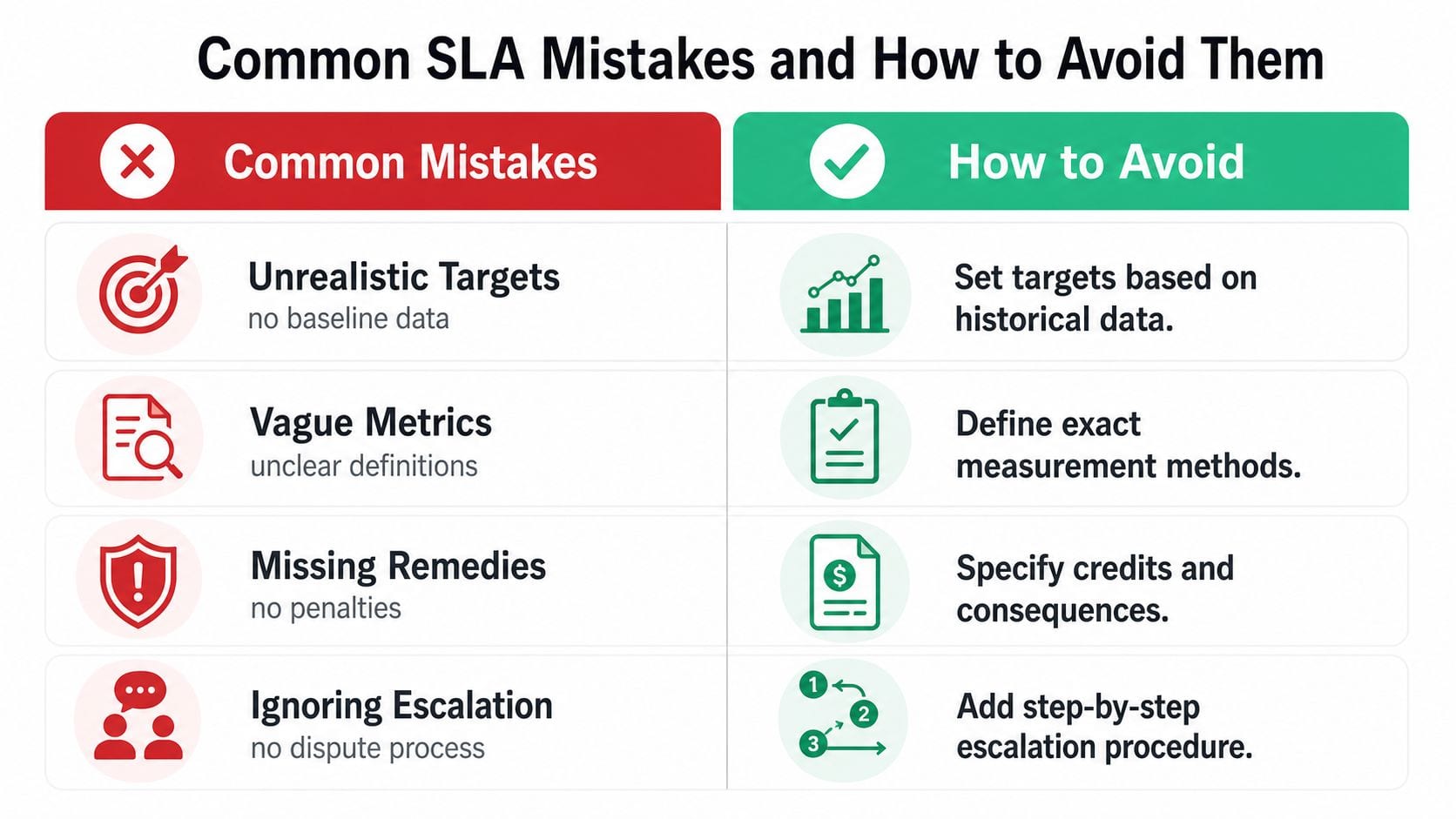
Four failure modes that show up again and again
Unrealistic targets usually come from leadership setting goals without baseline data. The fix is to anchor the target in historical performance and staffing reality, then tighten it over time.
Vague metrics create disputes because nobody agrees on what was measured. The fix is to define the exact units, the measurement method, and the exclusions before the agreement is signed.
Missing remedies make the contract toothless. The fix is to state the credit, penalty, or escalation path clearly so both sides know the consequence of a breach.
Ignoring escalation leaves the team scrambling when a timer is about to expire. The fix is a step-by-step escalation procedure that triggers before the breach, not after it.
A separate mistake is using penalties so harshly that teams game the metric instead of improving the service. That's where shared SLOs help, because they give the internal team a cleaner target than the external contract alone. The best SLAs reward clarity and improvement, not compliance theater.
Bottom line: if your SLA can be gamed by the measurement, it's not ready.
Putting It All Together and Frequently Asked Questions
The simplest checklist is also the one teams skip. Define scope, pick measurable metrics, set targets you can hit, assign owners, automate measurement, and write down remedies. If any one of those is missing, the agreement won't hold up when the service gets stressed.
How often should SLAs be reviewed? On a regular cadence, and again whenever the service, staffing, or customer expectations shift.
Who should own them internally? Usually support, engineering, and the business owner together, because enforcement touches all three.
Should SLAs be customer-facing or internal-only? External SLAs set the promise, internal SLOs and operational agreements make that promise achievable.
Trackingplan helps teams make those commitments real by continuously validating analytics, marketing, and attribution data across web, app, and server-side stacks. If you want SLAs that reach beyond the contract and into live operational enforcement, visit Trackingplan and see how observability makes targets measurable instead of aspirational.