
Federated learning is a decentralized approach where multiple clients jointly train a shared model while keeping raw data local and only exchanging model updates like gradients or weights. It was formally introduced in 2016, with the first arXiv submission posted on 17 February 2016.
You may already be facing the problem it addresses. Your marketing team wants better propensity models, your analysts need broader behavioral signals, and your privacy team won't approve a central repository containing every customer interaction. A hospital network faces a similar constraint with patient records, while a manufacturer may not want to expose operational data across plants. The useful data exists, but moving it into one training environment creates legal, security, operational, or commercial friction.
Federated learning changes the direction of travel. Instead of sending raw records to the model, the system sends the model to the data. That sounds like a straightforward privacy solution, but it isn't a complete privacy guarantee. Model updates can still reveal information, and distributed training introduces difficult questions about quality, communication, governance, and accountability.
This guide explains what federated learning is, how its communication rounds work, where secure aggregation and differential privacy fit, and when a data team should choose a simpler centralized approach instead. For teams working on privacy-first measurement, the principles also connect naturally with privacy by design, where protection is built into the system rather than added after collection.
Introduction to Federated Learning for Modern Data Teams
A product analyst wants to predict which users are likely to return. The strongest signals sit across several apps, regions, or business units, but each group controls its own data. Centralizing everything would make modeling easier, yet it could also create a new repository of sensitive behavioral information and trigger lengthy governance reviews.
Federated learning offers another arrangement. A coordinating server distributes a model to participating clients, such as devices, hospitals, banks, or organizational data silos. Each client trains that model using its own local records, then sends back an update rather than the underlying data. The server combines those updates to produce a shared model.
The distinction matters:
- Centralized learning: Raw data moves into one repository, where the model is trained.
- Federated learning: The model moves to each data environment, while clients return updates such as gradients or weights.
- Privacy-preserving federated learning: The system adds controls that limit what the coordinator can learn from those updates.
For an analyst or marketer, a simple example is collaborative audience modeling. Several retailers might want a model that recognizes likely repeat purchasers, but they may not want to exchange customer-level browsing or purchase records. Each retailer can train locally, contribute mathematical updates, and receive an improved shared model, subject to the governance and security controls agreed by the participants.
The approach can support privacy-conscious analytics, but it also changes the operating model. Teams must coordinate participants, align labels and schemas, monitor update quality, manage intermittent connectivity, and decide who can use the resulting model. The technical architecture is only one part of the project.
A Trackingplan channel video may be useful alongside this introduction if you're looking for a visual explanation of analytics governance and privacy-aware data practices: Trackingplan's video channel. Use it as supplementary context, not as a substitute for reviewing the threat model and deployment requirements.
Understanding the Core Concept Behind Federated Learning
Start with a group-study analogy. In centralized learning, every student sends their notes to one classroom, and one instructor studies the complete collection. In federated learning, the instructor sends the same exercise to each student. Students work with their own notes, report what they learned in a structured form, and the instructor combines those reports without collecting the notebooks.
The analogy has limits, but it captures the central idea: computation happens close to the data. The data holders keep control of their records, while a coordinator uses the returned updates to improve a common model.
Why the model moves instead of the records
Traditional machine learning often assumes that engineers can collect, clean, and label data in one environment. That assumption breaks down when records are subject to privacy restrictions, data residency rules, institutional boundaries, or commercial confidentiality.
Federated learning emerged from this distributed reality. It was formally introduced in a landmark 2016 paper, whose first arXiv submission appeared on 17 February 2016 and was authored by Hugh Brendan McMahan and coauthors, as documented in this history of federated learning. The original research baseline framed the approach around training across many devices without moving raw data to a central server, with mobile environments providing an important motivating use case.
For someone explaining it to a stakeholder, this sentence is usually enough:
Federated learning lets separate data owners improve one shared model without handing their raw records to a central trainer.
That explanation becomes more useful when paired with a grounding in machine learning fundamentals guide, especially for readers who need to distinguish training data, model parameters, gradients, and predictions.
The phrase “data stays local” should be treated as an architectural description, not a blanket security promise. The server still receives information derived from local training. That distinction becomes central when evaluating secure aggregation, differential privacy, and defenses against malicious participants.
How Federated Learning Works Step by Step
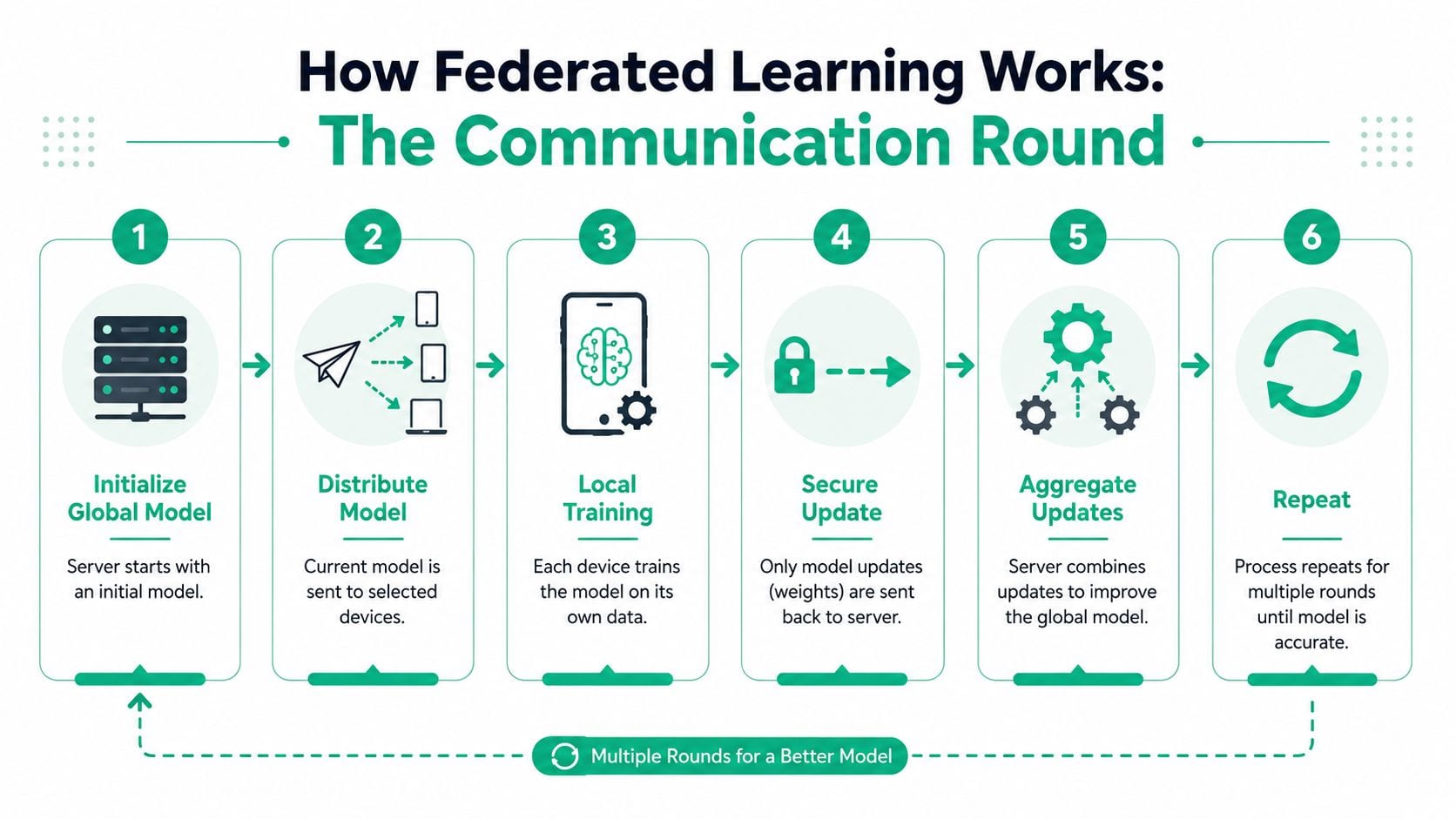
A federated system usually operates through repeated communication rounds. Each round updates a shared model, but the coordinator doesn't receive the raw examples used by participating clients.
Step one, initialize the global model
The coordinating server starts with an initial model. It may be untrained, partially trained, or based on an existing model that the participants have agreed to improve. The server also defines the training configuration, including the task, model version, permitted participants, and validation rules.
Step two, select participating clients
The server chooses a subset of available clients for the round. A client might be a mobile device, hospital, business unit, or plant. Selection matters because clients can differ in data volume, connectivity, hardware, geography, and user population.
Step three, distribute the model
The selected clients receive the common model initialization. They also need the code, parameters, and policies required to train locally. In a regulated environment, the deployment should make clear which model version was sent, when it was sent, and which participant executed it.
Step four, train locally
Each client runs training against its private local data. A hospital uses its own clinical records, a retailer uses its own customer interactions, and a device uses locally available behavioral signals. The training process produces an update to the model, such as revised weights or gradients.
Step five, protect and return the update
The client sends the update to the coordinator instead of sending its raw records. Secure aggregation can be added so the server learns only the combined update from a group, rather than inspecting each participant's contribution individually.
Step six, aggregate and repeat
The server combines the returned updates, often using a federated averaging approach, to create a new master model. It then distributes that model in a later round. The cycle continues while the team evaluates convergence, fairness, and the cost of communication.
The important engineering tradeoff is that distributed training replaces one large data movement problem with many smaller coordination problems. Clients must remain compatible with the global model, updates need validation, and the system must handle participants that are slow, unavailable, or unreliable.
Communication efficiency deserves particular attention. The dominant cost is often repeated exchange of model updates rather than local computation, so teams use aggregation protocols and optimization techniques that reduce what the server sees while still supporting global optimization. A system can protect raw records and still become impractical if it requires excessive communication or poorly synchronized rounds.
Privacy and Security Realities Every Team Should Know
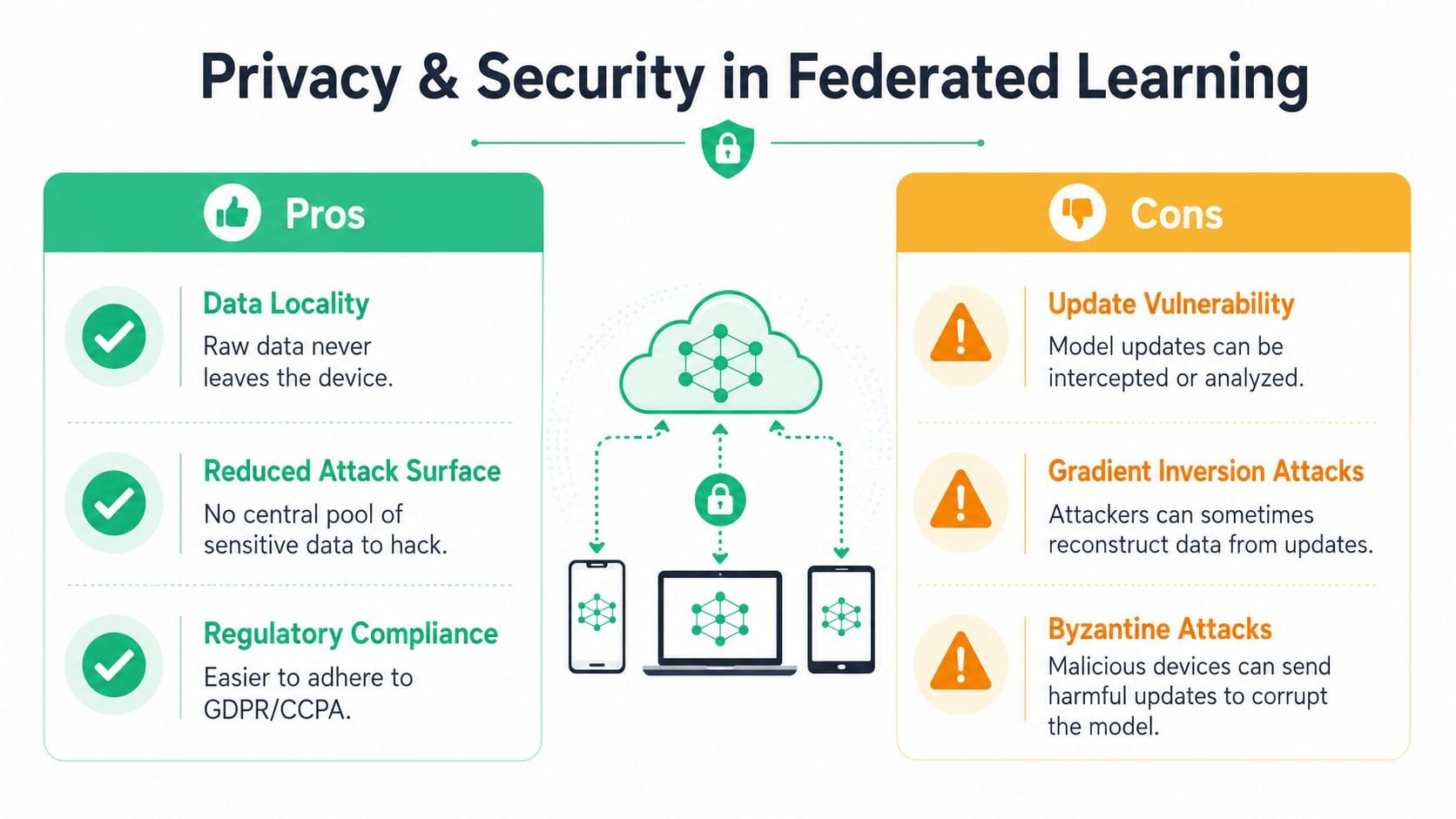
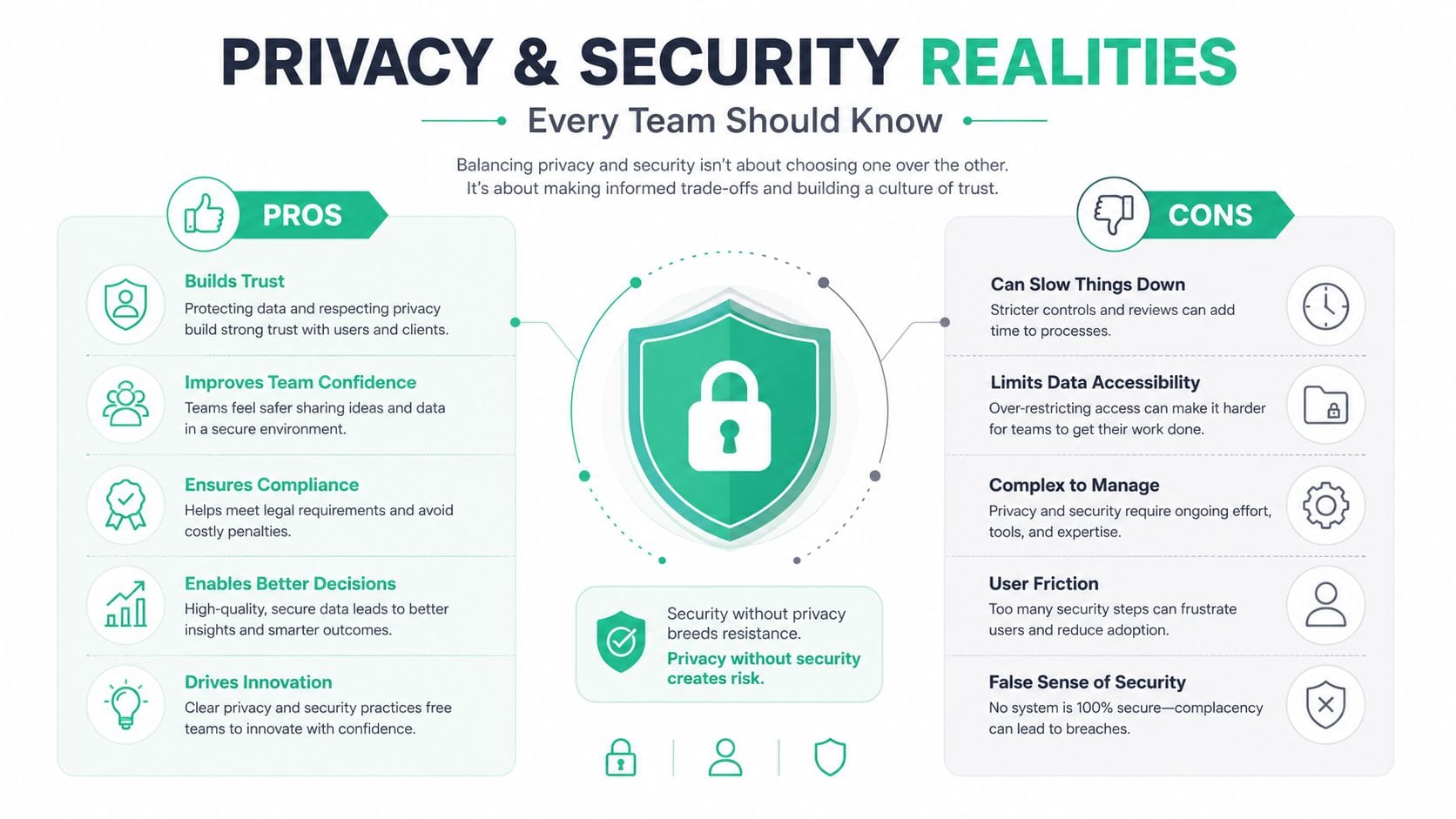
The most common misunderstanding is simple: raw data staying local doesn't automatically make federated learning private. The server may not receive a customer record or patient file, but it does receive model updates derived from local training. Those updates can contain information about the underlying examples.
Researchers and practitioners discuss inference and reconstruction attacks because an attacker may analyze updates to learn sensitive properties or attempt to recover aspects of the training data. The risk depends on the model, update size, participant configuration, attacker access, and other design choices. It shouldn't be reduced to a slogan about data never leaving the device.
Controls that strengthen the design
Secure aggregation prevents the coordinator from viewing each individual update in isolation. The server can recover the aggregate needed for training, but not the separate contribution from every client. This reduces exposure, although it doesn't eliminate every threat.
Differential privacy adds carefully designed noise to updates or outputs. The aim is to make it harder to infer whether a particular record influenced the result. The tradeoff is that added noise can affect model utility, so teams need to evaluate privacy protection and predictive performance together.
Update validation helps identify malformed, extreme, or suspicious contributions before they influence the global model. A participant can attack the training process by sending harmful updates, even when the raw data remains hidden.
Access control and auditability establish who can join, which model they can receive, what code runs locally, and which outputs leave the system. Privacy is a system property that depends on these operational details, not only on the training algorithm.
The NDSS discussion of federated learning privacy describes the distinction clearly: a central server can coordinate clients without accessing raw data, but local updates can still leak sensitive information unless protections such as secure aggregation or differential privacy are added.
For a broader perspective on privacy risks in AI systems, LocalChat's 2026 AI privacy overview offers useful context. Teams should also separate model privacy from analytics governance. Good data anonymization practices can reduce risk before training begins, but anonymization alone doesn't address every update-level attack.
Practical rule: Treat every model update as sensitive data until your threat model proves otherwise.
The European data-protection perspective is similarly cautious. Federated learning can reduce the need to centralize raw data, but it still relies on gradients or weights that may carry privacy and security risks. A responsible design documents what leaves each client, who can inspect it, how aggregation works, and what happens when a participant withdraws.
Federated Learning Versus Centralized Learning Compared
Federated learning isn't automatically the better architecture. It solves a specific problem, namely how to train across data that shouldn't or can't be pooled. If your organization can legally and safely centralize the relevant records, centralized learning may be easier to debug, label, monitor, and iterate.
The choice also affects analytics quality. A central environment gives one team direct visibility into schemas, missing values, event definitions, and data lineage. Federated systems distribute those responsibilities across participants, so every local pipeline needs compatible definitions and reliable observability.
| Criteria | Federated Learning | Centralized Learning |
|---|---|---|
| Data movement | Raw data remains with each client, while model updates are exchanged | Raw data moves into a shared training repository |
| Privacy posture | Reduces raw-data centralization, but updates still need protection | Concentrates sensitive data and requires strong repository controls |
| Communication cost | Requires repeated model-update exchanges across communication rounds | Usually relies on centralized data access and training infrastructure |
| Data quality management | Each participant must maintain compatible local data and labels | One team can inspect and standardize data in one environment |
| Governance | Requires distributed participation rules, update controls, and model ownership decisions | Requires clear access, retention, and use policies for the central store |
| Best fit | Cross-organization or cross-device learning where raw data can't be pooled | Situations where centralization is permitted and faster experimentation matters |
Communication is a major design consideration. Research on secure aggregation and efficient federated learning emphasizes that repeated update exchanges can dominate system cost, even when local training is manageable. Compression, client selection, and aggregation design can help, but they add engineering complexity.
A data clean room can be another option when the requirement is controlled collaboration or measurement rather than distributed model training. This data clean room guide helps frame that alternative in analytics terms.
Choose federated learning when centralization is blocked and participants can support local computation, compatible pipelines, and ongoing coordination. Choose centralized learning when the data is available, governance is straightforward, and the distributed architecture would add more operational burden than business value.
Limitations Challenges and How to Evaluate Success
Federated learning often fails for practical reasons rather than because the learning algorithm is incorrect. Participants may hold different populations, schemas, labels, devices, or network conditions. A model that performs well for one client can behave poorly for another, especially when local data doesn't resemble the combined training distribution.
The operational obstacles
Heterogeneous data makes convergence harder. One hospital may code diagnoses differently from another, or one retailer may define a conversion event differently from its partner. Federated learning can train across silos, but it doesn't magically reconcile incompatible definitions.
Communication overhead grows when the system depends on frequent exchanges. Slow or unreliable participants can delay rounds, while limited bandwidth can make large model updates expensive to transmit.
Client selection and synchronization affect representativeness. If the same easy-to-reach clients participate repeatedly, the global model may underrepresent harder-to-reach populations or environments.
Robustness matters because malicious or compromised participants can submit harmful updates. The coordinator needs screening, validation, and recovery procedures rather than assuming every client is trustworthy.
A successful pilot measures the distributed system, not just the final accuracy score.
What to measure
Track model quality across clients, not only in an overall average. A global score can conceal poor performance for a particular hospital, region, device class, or customer segment.
Track convergence behavior across communication rounds. If the model improves slowly, oscillates, or stops improving when certain clients join, the team needs to inspect data skew, synchronization, and update weighting.
Track fairness and coverage. Ask which participants contribute, which populations receive useful predictions, and whether the model's errors are concentrated in specific groups.
Track communication and reliability. Record round completion, client availability, update size, failed deployments, and time spent waiting for participants. These operational measures determine whether the system can run consistently.
Track security outcomes. Test secure aggregation, update validation, access controls, incident response, and the ability to audit model versions and participant activity.
Recent surveys identify heterogeneity, communication overhead, client selection, synchronization, and robustness as core unresolved issues. A 2026 Fraunhofer summary also says that larger convincing real-world use cases remain limited even though the frameworks work technically, as noted by the European data-protection authority's federated learning overview.
Governance should be part of the evaluation from the beginning. Teams working with European AI requirements can use an EU AI Act overview as background, then obtain specific legal advice for their use case, roles, and data categories.
Real World Applications Tooling and Best Practices to Get Started
Federated learning works best where data is distributed by nature and centralization creates a genuine obstacle. Mobile personalization is a familiar example, because local devices can contribute to model improvement without sending all personal activity to a central repository. Healthcare networks can train across siloed hospitals, while financial institutions may collaborate on fraud detection without pooling transaction records.
Marketing and analytics teams should be more selective. Federated learning may support audience, retention, or measurement models across brands, retailers, agencies, and publishers, but only when event definitions, labels, incentives, and governance are aligned. If one partner calls an engaged user “active” and another uses a different rule, the shared model inherits that inconsistency.
A practical starting checklist
- Confirm the constraint: Document why raw data can't be centralized and whether a clean room, secure enclave, or another privacy-preserving method would solve the problem.
- Assess local readiness: Check whether each participant can run approved training code, maintain compatible data pipelines, and support monitoring.
- Align definitions: Agree on labels, features, outcome windows, model ownership, and permitted uses before the first round.
- Protect updates: Design secure aggregation, differential privacy, access control, and update validation into the pilot.
- Start narrowly: Choose one measurable use case with a clear baseline and a limited participant group.
- Monitor the whole system: Evaluate client coverage, convergence, fairness, communication, failures, and privacy incidents alongside model quality.
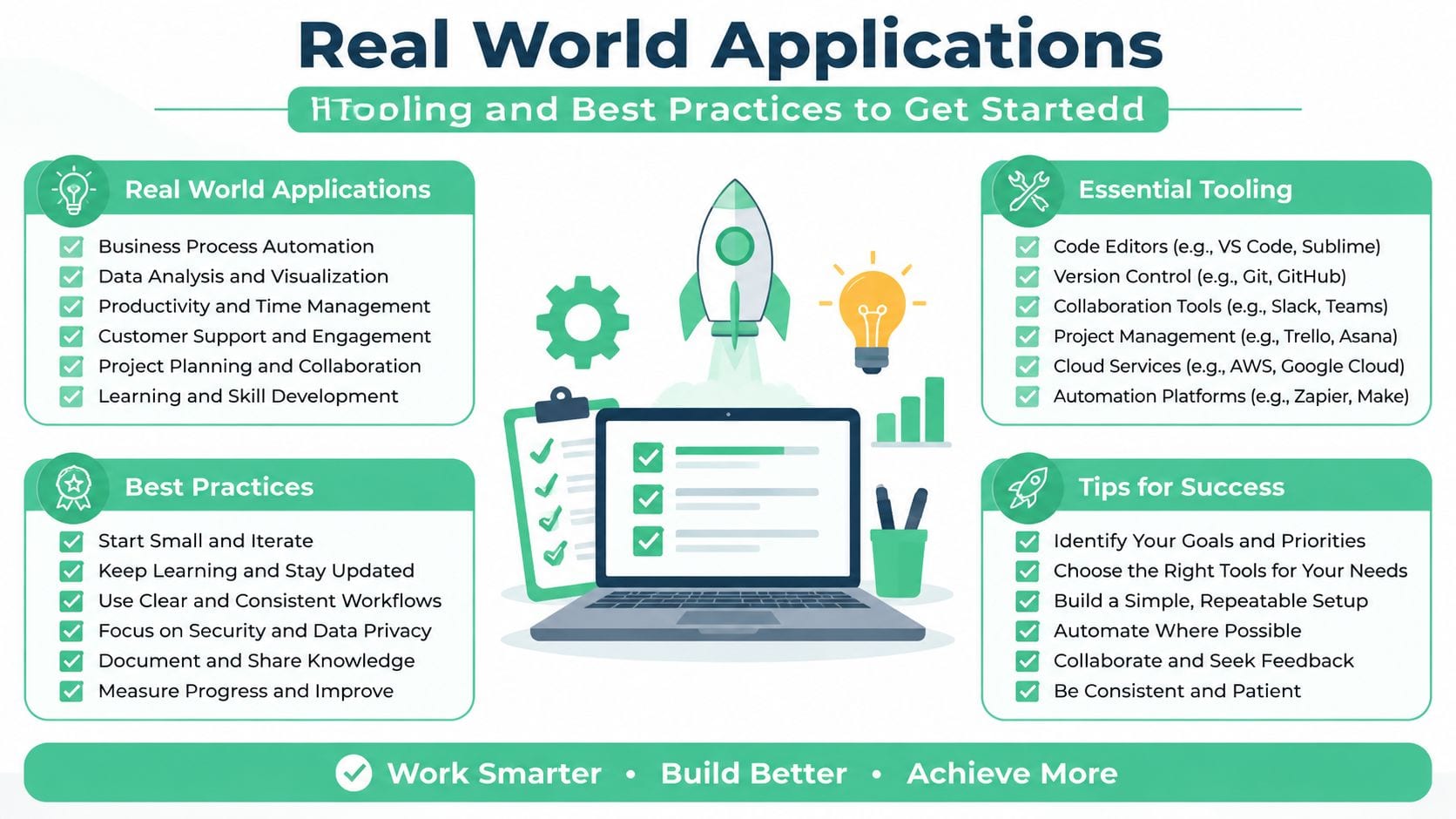
Tooling should cover orchestration, local training, secure aggregation, model registry, participant authentication, monitoring, and audit logs. A pilot isn't ready for production until the team can explain what happened in each round and investigate a bad update without accessing the raw data.
Federated learning is a strong option when data must remain distributed and participants are technically prepared. It isn't the default answer for every privacy-sensitive analytics problem. Start with the constraint, compare realistic alternatives, and treat data quality and observability as first-class requirements.
Trackingplan helps data teams monitor analytics quality across web, apps, and server-side stacks while detecting broken events, schema mismatches, campaign-tagging errors, consent problems, and potential PII leaks. Visit Trackingplan to keep distributed analytics implementations observable and trustworthy as you evaluate privacy-preserving machine learning.