
The End of Easy Data and the Rise of Clean Rooms
For years, marketers got used to easy joins between platforms, loose identity stitching, and a lot of behind-the-scenes data movement they rarely had to think about. That convenience is gone. Today, teams often have first-party data in one place, media exposure in another, and conversion signals spread across websites, apps, retail systems, and ad platforms.
That shift is why data clean rooms matter. The U.S. Federal Trade Commission describes them as cloud data processing services that let companies exchange and analyze data under rules that limit use, typically when two companies want to exchange limited information about their customers. In that model, parties don't hand over full records. They run queries and export only constrained outputs or derivative analysis, often using hashed or pseudonymized identifiers like email addresses, phone numbers, or user IDs to match records safely. You can read more in the FTC's explanation of data clean rooms and the limits built into them.
A simple analogy helps. If a shared spreadsheet is like giving someone your filing cabinet, a clean room is like meeting in a secure conference room with a clerk who only allows approved questions and only hands back summary notes.
Practical rule: A clean room is about controlled collaboration, not cleaner data.
That distinction matters because teams often confuse “clean room” with data cleansing or data hygiene. Those are separate problems. If your tracking is broken, a clean room won't fix that. What it does do is create a privacy-safe way to collaborate when your analytics and measurement depend on combining data across organizational boundaries.
The pressure behind that shift is the same pressure driving renewed interest in first-party strategy. Trackingplan's take on the death of third-party cookies and why first-party data matters is useful background for understanding why clean rooms have become part of the modern stack.
Why Old Data Sharing Models Are Broken
The old model was straightforward. One company exported rows of user-level data, another imported them, and everyone hoped contracts, access controls, and good intentions would be enough. In a privacy-first environment, that approach creates too much risk and too little trust.
The first problem is signal loss. Marketers still need to answer familiar questions: Which partner reached our buyers? Which campaign influenced a sale? Where do our best customers overlap with a publisher or retailer audience? But the straightforward path to those answers, broad tracking and direct record exchange, has narrowed.
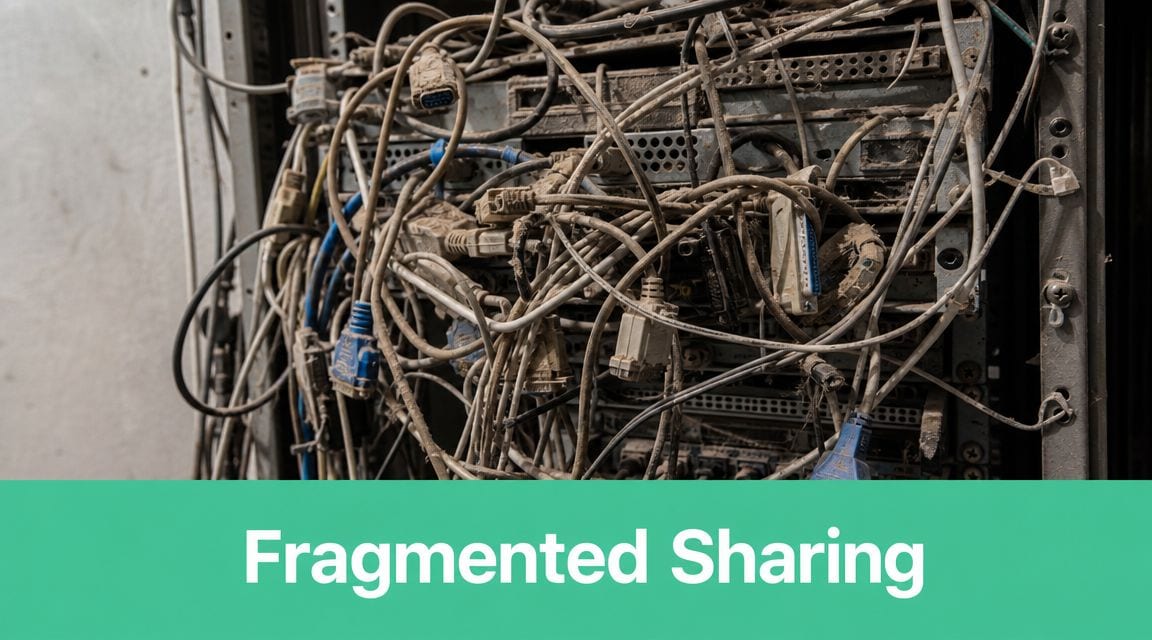
Why direct sharing no longer holds up
When teams move raw customer records between companies, several issues appear at once:
- Privacy exposure increases: Each transfer creates another place where sensitive data can be viewed, copied, or mishandled.
- Governance gets fuzzy: Analysts may not know which fields were approved for which purpose, or whether a downstream use still matches the original agreement.
- Partner trust weakens: Many companies are willing to collaborate on insights, but not willing to expose the underlying records that created those insights.
- Measurement quality declines: Once teams start stripping fields, masking details, or limiting data movement manually, reporting often becomes inconsistent and difficult to reproduce.
This is why clean rooms didn't emerge as a nice-to-have feature. They emerged because the old operating model became harder to defend.
Signal loss is a business problem, not just a technical one
Signal loss sounds abstract, but the consequences are immediate. Paid media teams lose confidence in attribution. CRM teams can't easily connect media exposure to downstream outcomes. Analysts spend more time reconciling partial datasets than answering business questions.
That ripple effect reaches operations too. As companies adopt more privacy-conscious infrastructure, they also need better control over the software and systems that shape their data flows. If you're thinking more broadly about operational complexity, this overview of insights on SaaS for growing businesses is a useful companion read.
Old data-sharing workflows were optimized for convenience. Modern ones have to be optimized for privacy, control, and auditability.
The clean room fits that new environment because it changes the unit of exchange. Instead of sharing raw records, parties share access to approved computation.
How a Data Clean Room Protects Privacy
The easiest way to understand the mechanics is to picture two companies arriving with locked briefcases.
One briefcase contains a brand's first-party customer data. The other contains a publisher's or retailer's data. They enter a secure room with rules about what can be opened, what can be compared, who can ask questions, and what can leave. Neither party walks out with the other's files. They walk out with approved findings.
A technical description says the same thing in more precise language. Modern clean rooms commonly rely on pseudonymization, differential privacy, secure multiparty computation (SMPC), trusted execution environments (TEEs), encryption-in-use, and strict query/output controls. Those mechanisms are what let the system return matched or aggregated results without exposing raw records, especially in advertiser-publisher collaboration, audience analysis, and attribution workflows, as described in Avenga's explanation of privacy-preserving technologies used in data clean rooms.
Here's the process in a simple visual.
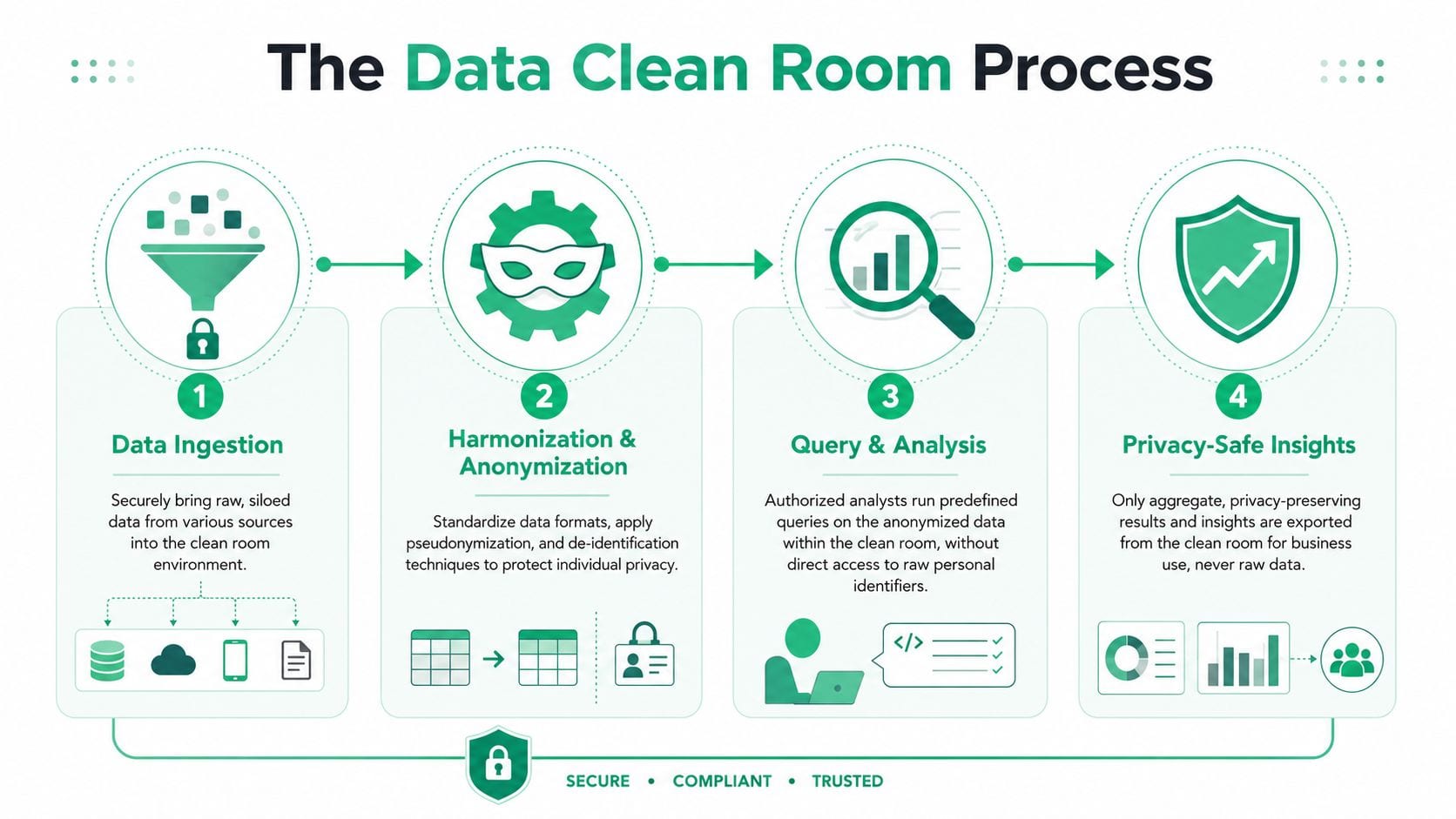
What happens inside the clean room
A typical workflow looks like this:
- Data enters under controlled conditions
Each party contributes its own dataset to the clean room environment. The data remains governed by agreed rules. - Identifiers are protected
Matching usually relies on hashed or pseudonymized identifiers rather than directly exposing names or raw personal details. - Queries happen inside the environment
Analysts do not browse raw tables freely. They run approved analyses under permissions and output restrictions. - Only constrained results leave
The export is usually aggregated, filtered, or otherwise controlled so one party can't reconstruct the other party's underlying records.
The privacy tools in plain English
The names can sound intimidating, so it helps to translate them:
- Pseudonymization: Replaces direct identifiers with protected substitutes.
- Differential privacy: Adds protections that reduce the chance of tracing an output back to one person.
- SMPC: Lets multiple parties compute a result together without exposing each party's inputs.
- TEEs: Use protected computing environments so sensitive analysis can happen in isolation.
- Encryption-in-use: Protects data while it is actively being processed, not just when stored or transmitted.
- Query and output controls: Limit what users can ask and what they're allowed to export.
A lot of confusion comes from the idea that privacy in a clean room is one feature. It isn't. It's a stack of controls.
The compliance side matters too. Even a well-designed clean room needs clear policy, access rules, and oversight. Trackingplan's guide to privacy and compliance in digital data collection is a useful complement if your team is trying to align technical safeguards with governance expectations.
Later in the workflow, it helps to see these principles in motion.
A clean room protects privacy by limiting visibility, limiting computation, and limiting output at the same time.
Practical Use Cases for Marketers and Analysts
The concept becomes much easier once you attach it to work real teams already do.
Clean rooms first gained traction in AdTech as advertisers and publishers needed a way to measure campaign performance without directly sharing customer identities. That use case later expanded into broader measurement and audience workflows. A commonly cited business example is a newspaper and a grocery store using a clean room to evaluate ad effectiveness by linking subscriber data with sales data under controlled conditions, as discussed in Duality's overview of how data clean rooms emerged from advertising and measurement needs.
Closed-loop measurement
A retailer runs media with a publisher. The publisher knows who saw the campaign within its environment. The retailer knows who bought. Neither side wants to hand over raw customer files.
A clean room gives them a way to ask a narrower question: did exposure and purchase overlap in meaningful ways under approved rules? That's far more useful than broad impressions data alone, and far safer than unrestricted file exchange.
Audience overlap and partner planning
A brand often wants to know whether a publisher, retailer, or media network reaches the same people it already knows from CRM or loyalty data. Not individual names. Just overlap patterns.
That makes clean rooms useful for questions like:
- Which partner reaches our known customers well
- Where do we have duplication across media relationships
- Which partner seems better suited for prospecting versus retention
- How does overlap vary by approved segment definitions
Journey and attribution work
Customer journeys no longer sit neatly in one platform. A person may interact with a publisher, a brand site, an app, and an offline purchase environment. A clean room can help combine those fragments under privacy controls so analysts can evaluate contribution, timing, and sequence more confidently.
Working rule: Use a clean room when the answer depends on joined data, but the parties involved can't or shouldn't exchange raw records.
Audience understanding without identity exposure
Marketers also use clean rooms for safer audience analysis. A media partner may know content consumption patterns. A brand may know purchase history. Together, they can evaluate broad traits of shared segments without either side exposing the underlying user-level records to the other.
That's the practical value. The clean room doesn't replace strategy. It creates a governed place to ask sharper questions with less privacy risk.
DCR vs Warehouse vs CDP vs DMP
A lot of confusion comes from putting every data tool in the same mental bucket. They're not interchangeable.
A data warehouse stores and organizes data for one company. A CDP unifies customer data for one company and often supports segmentation and activation. A DMP traditionally focused on audience management, often using third-party data patterns that are far less central than they once were. A data clean room has a different job. It exists for controlled collaboration across parties.
Data Platform Comparison
The simplest way to separate them
Think about ownership and purpose.
- Warehouse: “What do we know internally?”
- CDP: “How do we unify and activate our customer data?”
- DMP: “How do we manage audience segments for advertising in older ad-tech patterns?”
- DCR: “How do we collaborate with another party's data without exposing raw records?”
That means a clean room usually complements the rest of your stack rather than replacing it.
Where teams often misjudge the fit
The mistake I see most often is assuming a clean room is just a warehouse feature. It isn't. Warehouses are about storing and transforming your data. Clean rooms are about governed collaboration between datasets that don't belong to the same organization.
Another common mistake is assuming a CDP already solves the problem. It solves a different one. A CDP helps unify your customer view. It doesn't automatically create a neutral collaboration space for you and a publisher, retailer, or platform partner.
If your team is already sorting through adjacent tooling, Trackingplan's explanation of what Tealium is and where it fits in the stack helps clarify the role of data collection and orchestration tools versus collaboration environments.
Don't ask whether a clean room replaces your warehouse or CDP. Ask whether you need a privacy-controlled place to work with someone else's data.
Key Considerations for Implementation
Adopting a clean room starts with business design, not vendor demos. If the team can't define the collaboration goal, the data needed, and the rules of engagement, the technology won't save the project.
Start with the use case, not the platform
A strong first question is simple: what decision will this clean room help us make?
Examples include evaluating campaign effectiveness with a media partner, understanding audience overlap with a retailer, or improving attribution in a privacy-conscious workflow. If the use case is vague, teams often over-collect data, overcomplicate permissions, and under-deliver value.
A practical checklist:
- Define the outcome: Measurement, overlap analysis, audience insight, or attribution all require different query logic and governance.
- Name the partner: A clean room is collaborative by nature. The partner relationship shapes the technical and legal design.
- Limit the fields: Bring only what the approved use case requires.
- Set success criteria early: Know what a useful output looks like before anyone starts mapping data.
Assess your data readiness
Most implementation pain isn't caused by the privacy layer. It's caused by inconsistent schemas, unclear identity strategy, and event data that means different things across teams.
You need alignment on basics such as customer identifiers, event naming, campaign metadata, consent handling, and data freshness. If one partner tracks “purchase” at checkout completion and the other defines it at order confirmation, the collaboration starts with ambiguity.
Decide what kind of environment fits
Not all clean room setups work the same way. Some are tied closely to large platform ecosystems. Others are positioned as more neutral collaboration environments.
When evaluating options, ask:
- Who controls the environment
- How are permissions set and enforced
- What query flexibility do analysts have
- What outputs are allowed to leave
- How easily can new partners be onboarded
- What auditability exists for access and usage
Involve more than marketing
Successful clean room projects usually involve marketing, analytics, privacy, engineering, and legal teams. That can feel slower at first, but it prevents the much slower outcome of rebuilding the project after governance concerns appear late.
Implementation works best when everyone agrees on one principle: the point isn't just to make collaboration possible. It's to make collaboration trustworthy.
Governance and the Garbage In Garbage Out Problem
A clean room can protect privacy beautifully and still produce misleading analysis.
If the incoming data is incomplete, mislabeled, duplicated, delayed, or inconsistently structured, the output won't become trustworthy just because it emerged from a secure environment. Privacy controls solve one class of problem. They do not solve data quality.
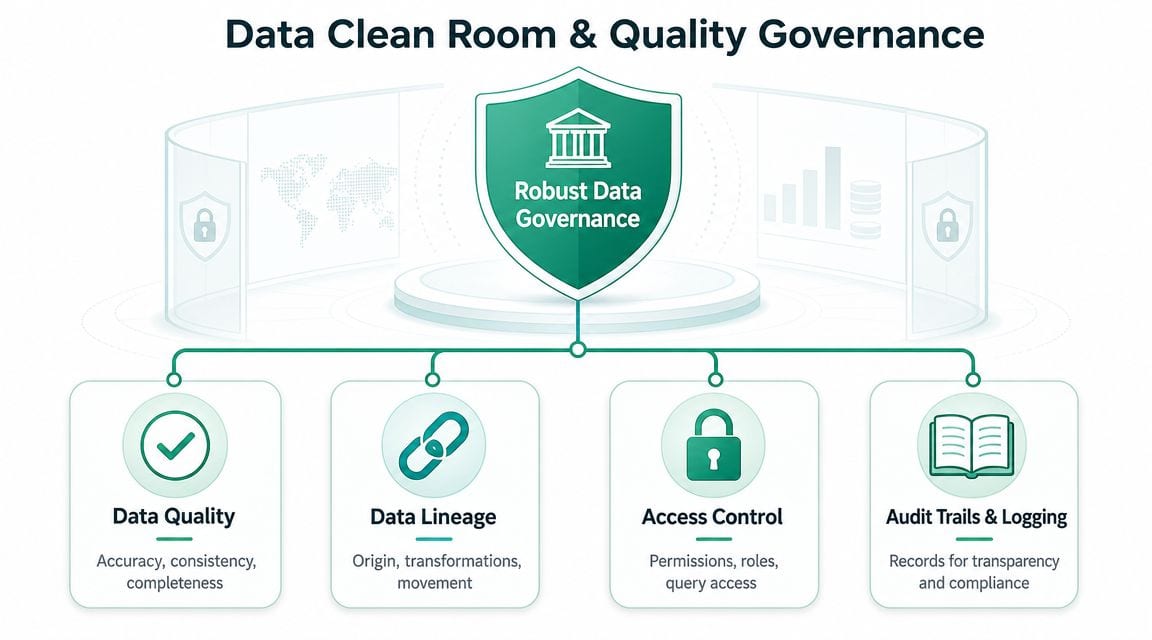
Why governance matters more in clean rooms
In a normal internal analytics workflow, bad tracking often reveals itself through broken dashboards, impossible totals, or confused stakeholders. In a clean room workflow, errors can be harder to spot because access is more restricted and outputs are more constrained.
That means weak governance creates two risks at once:
- Bad inputs distort analysis
- Restricted visibility makes those distortions harder to diagnose
If campaign tags drift, events fire incorrectly, identity fields are hashed inconsistently, or consent logic changes without notice, your clean room analysis may still run. It just won't tell the truth.
The pillars that keep outputs trustworthy
Strong clean room governance usually depends on a few habits:
- Data quality discipline: Event names, properties, and business definitions need to be stable and documented.
- Lineage visibility: Teams need to know where a dataset came from and what transformations it went through.
- Access control: Query permissions should reflect role, purpose, and partner agreement.
- Audit trails: Someone should be able to review who ran what and when.
A data clean room is not a magic box. It amplifies the quality of your governance just as much as it amplifies the quality of your data.
Many teams underestimate the operational side of privacy-first collaboration. They focus on legal approval and partner onboarding, but not on tracking integrity. Then they discover that a missing event, broken pixel, or schema mismatch undermines the whole exercise.
A durable approach starts earlier, with clear analytics standards, monitoring, ownership, and change management. Trackingplan's guide to data governance best practices is a strong reference if your team needs to tighten the foundation before adding more advanced collaboration layers.
The clean room is valuable because it gives teams a controlled way to answer hard questions in a privacy-first world. But if you want those answers to be reliable, governance can't be an afterthought. It has to be part of the design from day one.
If your team is preparing for clean room workflows, the quality of your tracking becomes a strategic issue, not just a QA task. Trackingplan helps marketing, analytics, and engineering teams monitor analytics quality across web, app, and server-side implementations so the data entering privacy-first collaboration environments is accurate, governed, and ready for serious measurement.