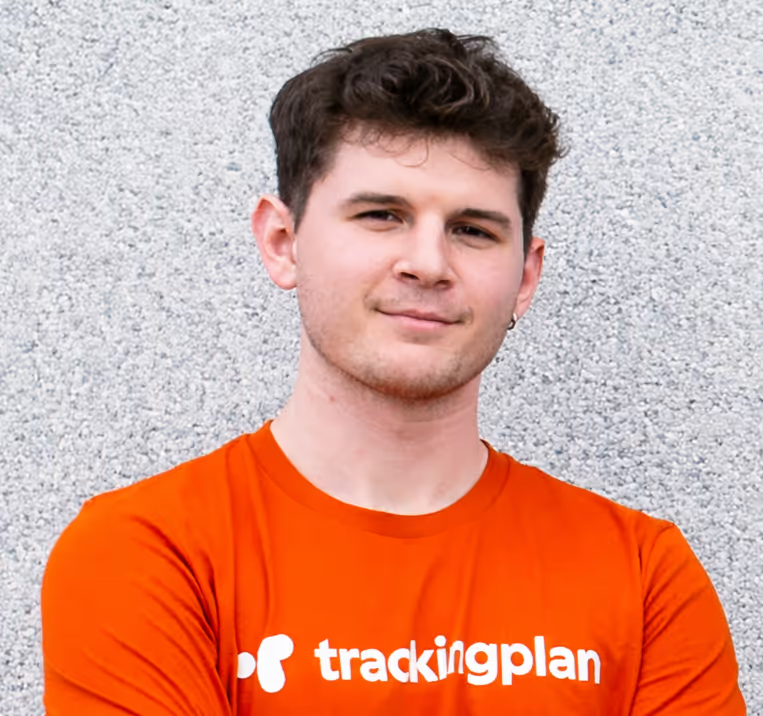
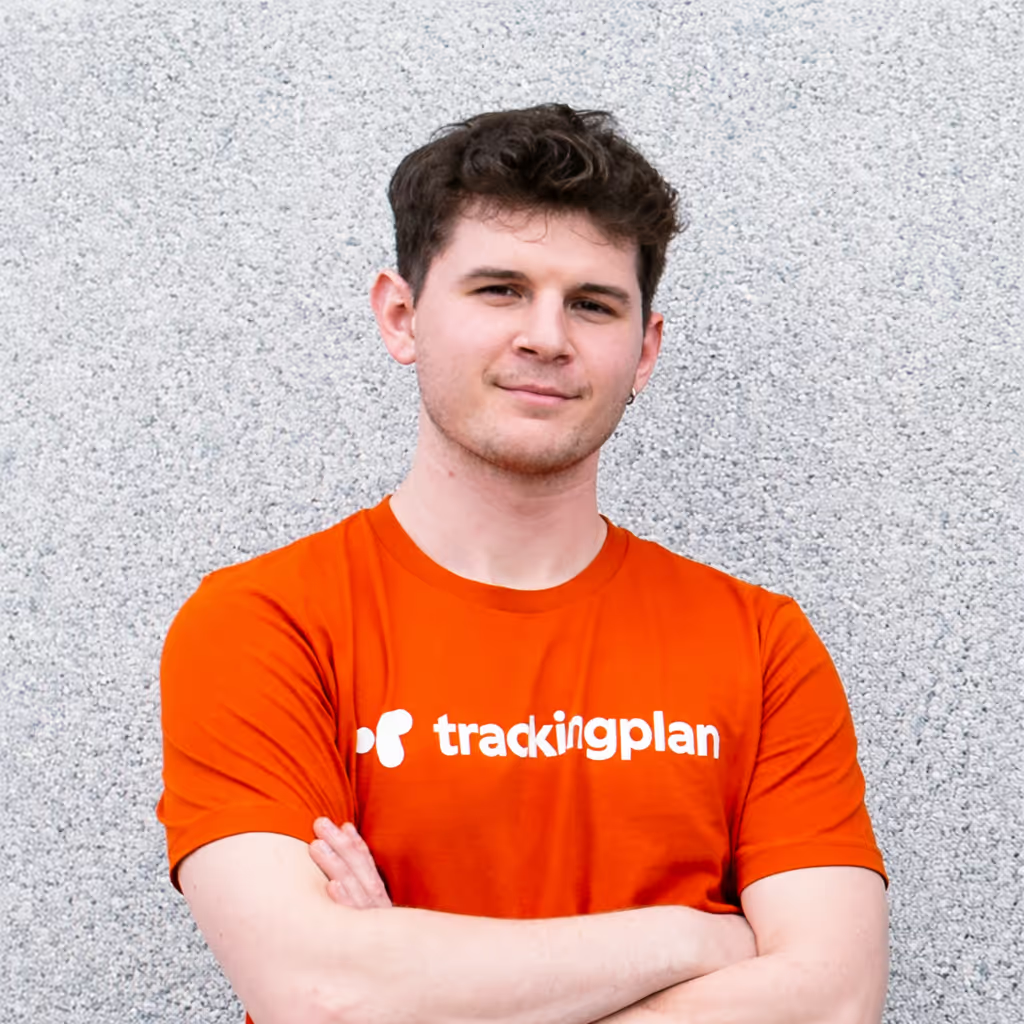
So first of all, what do you do at Trackingplan?
I work in Sales Development. My role is to identify agencies and analytics teams that might benefit from improving their tracking QA and monitoring processes. I focus on understanding their current setup, their challenges around data quality, and whether Trackingplan can help.
One of my main goals is to generate meetings and qualify opportunities properly, making sure the conversations we start are relevant and valuable.
What’s a day in the life of Agus like?
Most of my day is centered around conversations. I spend part of my day on the phone speaking with prospects, trying to understand how they manage their analytics and whether there’s a real opportunity to work together.
Follow-ups are also a big part of the routine, keeping conversations moving forward and maintaining momentum in ongoing opportunities.
I also dedicate time to exploring new accounts and identifying potential fits. At the same time, I rely heavily on AI to generate and refine campaigns, personalize outreach at scale, and analyze performance metrics. Reviewing what works, adjusting messaging, and continuously optimizing outreach is an ongoing process.
What do you think sparked your passion for marketing and sales, and what keeps you excited about it today?
What attracted me initially was the strategic aspect. Sales is often misunderstood as persuasion, but at its core it’s about problem discovery and alignment. It’s about understanding what really matters to someone and determining whether there’s a fit.
What keeps me motivated today is the intellectual challenge. Every company is different, every stakeholder has distinct incentives, and every buying process has its own internal dynamics. Learning how to navigate those variables in a structured way makes the role consistently engaging.
I also believe selling is a fundamental life skill. Professionally, knowing how to sell is valuable in almost any role. It’s equally critical if you ever want to build something on your own. Sales is demanding and often unpredictable, with clear highs and lows, but that intensity forces you to develop resilience, discipline, and clarity of thought. Over time, those lessons extend far beyond the job itself.
Have you ever had a moment with a prospect that totally changed the way you think about your work? What’s one insight or lesson from talking to prospects that really surprised you?
It wasn’t one specific lead, but more a realization over time. One thing that genuinely surprised me is how much fear we build around cold calling in our own heads. There’s this idea that you’re interrupting someone, that you’re being annoying, that they’re doing you a favor by even picking up the phone.
In reality, that’s mostly imaginary. If you call respectfully, demonstrate that you’ve done your research, and clearly explain why you think you might help, very few people react negatively. The worst-case scenario is usually neutral — they don’t pick up, they say they’re not interested, or they ask you to follow up later.
The percentage of people who react aggressively is extremely small, almost negligible. Yet that tiny possibility is what many people focus on. It’s like stopping your progress because of a small stone on the road and imagining it’s a massive obstacle. Once I understood that, cold calling became much more rational and much less emotional.
How do you approach prospecting, and what have you learned about connecting with potential clients?
My approach to prospecting has evolved significantly. In the beginning, it was very manual - a lot of time spent filtering companies, qualifying contacts, and trying to determine whether someone was relevant. It was inefficient and difficult to scale.
Today, most of that process is automated. We systematically identify companies that match our ICP, detect relevant roles, and even surface professionals who actively engage with analytics-related topics. That allows me to focus less on filtering and more on actual conversations.
What I’ve learned from connecting with prospects is that if you reach the right audience, patterns emerge quickly. Most of them share similar structural pains. The context changes, but the underlying problems are often the same.
When you consistently speak to the right people, you can standardize your approach. You begin to recognize recurring objections, recurring decision paths, and recurring friction points. The step-by-step process to generate opportunities becomes more predictable, because the core pains tend to repeat. The key is targeting correctly; once that’s in place, the rest becomes much more structured.
Do you have any funny, unexpected, or memorable moments while doing outreach that you could share with us?
One of the most memorable moments wasn’t funny, but deeply satisfying. It was the first time I felt that cold calling was actually working for me. Cold outreach is uncomfortable by nature, and you rarely feel fully at ease doing it.
But there’s a point where you start gaining rhythm. You become more confident, conversations flow more naturally, and meetings start getting booked consistently. The first time I experienced that shift — when I saw that the skill was real and repeatable — it was very rewarding.
It’s a unique feeling. You realize that something difficult and uncomfortable can turn into a structured process that generates real results. That moment builds a lot of confidence.
How are AI tools and automation changing the way you manage leads and plan your outreach?
AI and automation have fundamentally changed how we operate. What used to require significant manual effort — identifying accounts, enriching data, structuring outreach - is now largely systematized. That allows us to focus more on strategy and conversation quality rather than operational tasks.
We also analyze conversations. This helps us classify what prospects are saying more accurately, identify recurring objections or patterns, and use that insight to refine our positioning. Beyond that, it allows us to extract learnings from advanced-stage opportunities and anticipate what earlier-stage prospects are likely to bring up. Instead of reacting in real time, we can prepare proactively.
We are also implementing AI-driven cold messaging. There is still room for refinement, but the level of personalization is already close to human-written outreach. The main advantage is scalability - we can test angles faster, iterate quickly, and reach a larger volume of relevant prospects without sacrificing too much quality.
What are the biggest lessons you’ve picked up while growing as an SDR?
The biggest lesson is that sales is extremely difficult, especially at the top of the funnel. As an SDR, you’re creating opportunities from zero. You’re often contacting people who have never heard of you, especially in a startup environment. That requires resilience.
Another key lesson is that follow-up is far more important than most people think. A lack of response doesn’t mean rejection. It can mean they’re busy, distracted, or simply forgot. If your targeting and positioning are correct, consistent follow-up is part of the process, not a nuisance.
I’ve also learned that sales is fundamentally a numbers game — but only after you’ve validated that you’re speaking to the right audience with the right message. Conversion rates are small. Pickup rates are low. Reply rates are often single-digit percentages. And from those replies, only a fraction turn into real opportunities.
However, a single positive response can turn into a significant deal. And that deal can lead to referrals, partnerships, or expansion. That’s why you can’t underestimate any lead. In sales, outcomes often look small in percentages, but large in impact.
Outside of work, what hobbies or routines help you stay energized and focused?
I value structure and routine a lot. I like waking up early, taking a cold shower to clear my head, and starting the day by taking my dogs out. Living in Andorra helps - I usually walk them through forest areas near my home, which gives me mental clarity before work. When it’s snowing, I sometimes go out a bit earlier just to spend some time playing with them in the snow.
I also care about my workspace. I keep my home office extremely clean, quiet, and organized. Having a controlled environment reduces distractions and helps me concentrate for long periods.
I try to train after work. Lately I’ve had less time than I’d like, but staying physically active has always been important to me. It helps release stress and maintain discipline.
I’m also very structured with time. I prefer having my calendar clearly defined — allocating specific hours to specific tasks, meals, and personal time. That level of organization helps me stay efficient and reduces mental noise.
In the evenings, I try to disconnect. Working remotely means you’re never fully disconnected, especially if you genuinely enjoy what you do. I don’t necessarily see that as negative - it usually means you’re engaged and motivated. Still, I make a conscious effort to switch gears, whether that’s cooking with my partner, going for a walk, meeting friends, or simply stepping away from the screen.
In summer, I enjoy hiking peaks around Andorra with my dogs, my partner, and friends. And whenever possible, I like taking short trips - France and Spain are close enough to drive to for a weekend.
If someone is just starting out as an SDR today, especially with AI and automation changing the game, what’s one piece of advice you’d give them?
I would tell them to treat AI as leverage, not as an autonomous replacement.
In prospecting and outbound work - which is still 90% follow-ups and calls - automation can make things more scalable, but it’s far from perfect. There are still many elements that require refinement.
The mindset that helps is to treat AI as if it were part of your team. Imagine you are an SDR manager and the AI agents handling prospecting or messaging are junior team members. You wouldn’t expect a new SDR to perform well without training. The same applies here.
You need to train it on your company, your ICP, your positioning, your technical context, and your step-by-step outbound process. You provide the structure, the frameworks, and the guardrails. Then the AI executes on top of that base and can even help you iterate and propose improvements. But it only performs well if the foundations are clear.
 Josele Pérez
 Alexandros Andre Chaaraoui
 Jose Padilla
 David Pombar
 Mariona Martí
 Ángel Vega
 Javi Vázquez