
TL;DR:
- Organizations must enforce pre-consent blocking of tracking scripts and ensure vendor agreements restrict data use to achieve CIPA compliance.
- They should audit all scripts regularly, properly integrate consent management tools, and maintain accurate privacy disclosures to prevent legal and financial risks.
CIPA compliance is defined as the process by which organizations enforce pre-consent blocking of tracking technologies and maintain governance structures to protect minor users’ online privacy under the Children’s Internet Protection Act. Any business whose website is accessed by California residents faces direct exposure under CIPA regulations, regardless of where the company is headquartered. The law imposes statutory damages of $5,000 per violation with no requirement to prove harm, meaning a single misconfigured tracking tag can generate massive liability fast. Achieving compliance requires three interlocking layers: technical pre-consent blocking, vendor contract restrictions, and accurate privacy disclosures that match your actual tracking practices.

What are the key technical requirements for CIPA compliance?
Pre-consent blocking is the foundation of any compliant tracking setup. A cookie banner alone does not satisfy CIPA compliance requirements. The most common compliance failure is a Consent Management Platform (CMP) that records user preferences but does not actually block scripts at the execution level before consent is given. That gap means tracking fires before the user agrees to anything, which is exactly what CIPA prohibits.
True compliance requires your CMP to integrate directly with a Tag Management System (TMS) at the script execution level. The CMP must emit structured consent signals that prevent tags from loading until a user provides explicit consent. Without that TMS integration, your banner is cosmetic. It records a preference but does nothing to stop the underlying data collection.
Global Privacy Control (GPC) signals add another layer. Organizations must configure their systems to honor GPC browser signals automatically. A user who has set GPC in their browser has already expressed a preference, and your site must respect it without requiring them to interact with a banner.
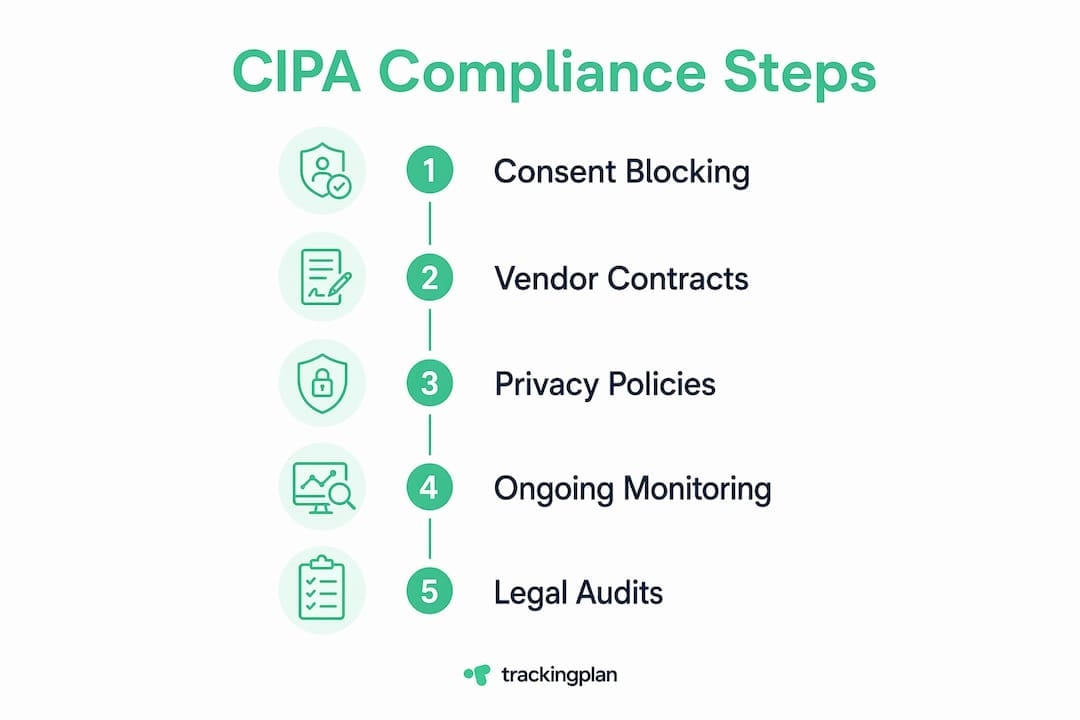
Key technical steps for maintaining compliant tracking infrastructure:
- Audit all third-party scripts on your site, including marketing pixels, analytics tags, and chat widgets. Courts treat even non-sensitive metadata like IP addresses and device identifiers as potentially unlawful pen registers.
- Verify TMS and CMP integration by confirming that tags are categorized correctly and that blocking rules fire before any script loads.
- Honor GPC signals at the server and client level, not just through front-end UI logic.
- Run quarterly tag audits to catch new scripts added by marketing or development teams without privacy review.
Pro Tip: Test consent blocking by opening your site in a fresh browser with no cookies, then observing network requests before clicking any consent option. Network-level testing reveals whether scripts fire pre-consent in ways that front-end UI checks will never catch.
A comprehensive compliance checklist covers 60 discrete items across six organizational workstreams. That scope reflects how technical this work actually is. Treating it as a one-afternoon task is the fastest path to a demand letter.
How do vendor contracts and policies support CIPA compliance?
Vendor agreements are where many organizations have the most hidden risk. A Data Processing Agreement (DPA) must explicitly prohibit the vendor from using collected data for its own independent purposes. Broad carve-outs, such as clauses that allow vendors to use data for “product improvement” or “fraud prevention,” can undermine the processor classification that CIPA compliance depends on.
The distinction between a vendor acting as a data processor versus a data controller matters legally. A processor handles data only on your instructions. A controller uses data for its own purposes. If your analytics or advertising vendor operates as a controller, you cannot rely on a DPA to limit their data use, and consent becomes your only viable defense.
Common vendor contract risks to address:
- Missing or vague DPAs with marketing pixel providers, including social media advertising platforms and retargeting networks.
- Broad independent use clauses that allow vendors to process data beyond the scope of your instructions.
- No processor classification in the agreement, leaving the vendor’s data use legally ambiguous.
- Outdated contracts that predate current privacy requirements and have not been reviewed since the vendor updated its own terms.
Some marketing pixels and analytics tools inherently lack vendor agreements that classify them as processors. For those tools, consent blocking is the only available defense. Annual contract reviews are not optional. Vendors update their terms regularly, and a clause that was compliant last year may not be compliant today.
What privacy disclosures and governance practices are essential?
Your privacy policy must accurately describe every tracking tool your site uses, what data each tool collects, which third parties receive that data, and how long you retain it. A policy that says “we do not track users” while your TMS fires advertising pixels before consent creates double liability through misrepresentation. Courts treat that gap as a separate legal claim on top of the underlying CIPA violation.
For K-12 schools and libraries subject to CIPA standards for schools, documentation requirements go further. These institutions must retain records of public notice, filtering proofs, and internet safety policies for 10 years to remain compliant with E-rate program requirements. That retention obligation applies even after a policy is updated or a vendor relationship ends.
Governance is where compliance either holds or falls apart. Cross-functional ownership across marketing, legal, IT, and engineering is not a nice-to-have. Organizations without clear ownership and quarterly reviews experience technical drift, where new tags get added, vendor contracts lapse, and privacy policies fall out of sync with actual practices.
Governance practices that prevent compliance drift:
- Assign a named compliance owner with authority to approve new tracking implementations before they go live.
- Conduct quarterly cross-team reviews covering technical audits, vendor contract status, and privacy policy accuracy.
- Train marketing and IT teams on what constitutes a tracking technology under CIPA’s broad interpretation.
- Document all changes to your tracking setup with timestamps and approvals.
Pro Tip: Run a side-by-side comparison of your privacy policy language against your actual tag inventory at least twice a year. Any tag not disclosed in your policy is a misrepresentation waiting to be discovered by a plaintiff’s attorney.
What legal risks do organizations face without proper CIPA compliance?
The financial exposure from CIPA non-compliance is not theoretical. Each visit by a California resident can count as a separate $5,000 violation. A site with moderate traffic can accumulate millions of dollars in potential liability from a single misconfigured tag firing over weeks or months.
Businesses outside California are not protected by geography. CIPA applies based on visitor location, not business location or stated audience intent. Adding a disclaimer that your site is not intended for California residents has no legal effect if California residents can access it and your tracking fires before consent.
“The CIPA legal landscape remains unsettled. Pending appellate rulings and stalled legislation mean courts vary widely in how they interpret tracking technologies under the statute. Without clear appellate authority, organizations must apply conservative compliance standards to protect themselves.”
Common litigation triggers that organizations should address immediately:
- Pre-consent tracking where scripts fire before a user interacts with any consent mechanism.
- Broken or misconfigured banners that display correctly but fail to block tags at the network level.
- Misrepresentations in privacy policies that contradict actual tracking behavior.
- Ignored demand letters that allow claims to escalate without a documented response and technical review.
If your organization receives a CIPA demand letter, immediate preservation of technical records and a network-level audit of your tracking setup are the critical first steps. Ignoring the letter is the worst available option. It signals no compliance program exists and removes your ability to demonstrate good-faith remediation.
Understanding tracking pixels and their legal risks under CIPA’s broad interpretation is a starting point for any marketing team that has not yet reviewed its tag inventory.
Key Takeaways
CIPA compliance requires pre-consent technical blocking, enforceable vendor contracts, and privacy policies that accurately reflect your actual tracking practices, all maintained through ongoing governance.
| Point | Details |
|---|---|
| Pre-consent blocking is mandatory | A CMP must block scripts at the TMS execution level, not just record consent preferences. |
| Visitor location triggers CIPA | Any site accessible to California residents falls under CIPA, regardless of business location. |
| Vendor DPAs must restrict data use | Agreements must explicitly prohibit independent vendor data use without broad carve-outs. |
| Governance prevents compliance drift | Quarterly cross-team reviews and named ownership keep technical and policy practices aligned. |
| Documentation protects against claims | Schools and libraries must retain compliance records for 10 years; all organizations should document tag changes. |
Why CIPA compliance is harder than it looks
Most organizations I have seen approach CIPA compliance as a setup task. They implement a banner, sign a DPA with their main analytics vendor, and update their privacy policy. Then they move on. That is exactly how you end up with a demand letter 18 months later.
The technical layer is where I see the most overconfidence. Marketing teams add new pixels for a campaign. A developer installs a chat widget. A retargeting network updates its tag. None of these go through a privacy review because no one owns that process. The banner still shows up correctly in the browser, but the network requests tell a completely different story.
Vendor management is equally underestimated. I have reviewed DPAs that look compliant on the surface but contain a single clause allowing the vendor to use data for “service improvement.” That clause can flip a processor into a controller and void your entire contractual defense. Annual reviews are not bureaucratic overhead. They are the only way to catch those changes before a plaintiff’s attorney does.
The organizations that handle this well treat compliance as an infrastructure problem, not a legal checkbox. They build tag auditing into their regular workflow, assign ownership across teams, and test consent blocking at the network level on a schedule. That cadence is what separates organizations that can demonstrate good-faith compliance from those that cannot.
— David
How Trackingplan supports ongoing CIPA compliance operations
Maintaining CIPA compliance across a live website is an operational challenge, not a one-time project. Trackingplan’s web tracking monitoring platform continuously audits your tag inventory, detects new or changed scripts, and alerts your team in real time when tracking behavior deviates from your consent configuration.

Trackingplan integrates with your CMP and TMS to verify that pre-consent blocking is functioning at the script execution level, not just at the UI layer. Its automated vendor tag detection identifies third-party scripts that lack compliant DPAs, giving your legal and marketing teams a clear picture of where contract gaps exist. For teams managing digital analytics tools across multiple properties, Trackingplan provides the continuous visibility that quarterly manual audits alone cannot deliver.
FAQ
What is CIPA compliance for websites?
CIPA compliance for websites means implementing pre-consent blocking of tracking technologies, maintaining vendor contracts that restrict independent data use, and keeping privacy policies accurate to actual tracking practices. Any site accessible to California residents must meet these requirements.
Does CIPA apply to businesses outside California?
Yes. CIPA applies based on the location of the website visitor, not the business. A company headquartered outside California still faces CIPA exposure if California residents can access its site and tracking fires before consent.
What is the penalty for a CIPA violation?
CIPA imposes statutory damages of $5,000 per violation with no requirement to prove actual harm. Each visit by a California resident can count as a separate violation, which means liability can accumulate rapidly from a single misconfigured tag.
What does a CIPA compliance checklist cover?
A thorough CIPA compliance checklist covers tag auditing, CMP and TMS integration verification, GPC signal enforcement, vendor DPA review, privacy policy accuracy, and governance documentation. A full audit spans 60 discrete items across six organizational workstreams.
How do schools achieve CIPA compliance?
Schools must implement internet safety policies, use certified content filtering technology, and retain documentation including public notices and filtering proofs for 10 years to satisfy both CIPA standards for schools and E-rate program requirements.