
TL;DR:
- Privacy compliance involves strictly following laws like GDPR and CCPA to protect personal data and individual rights. Organizations must embed operational controls such as inventories, consent management, and audit trails into their systems and continuously monitor them to ensure compliance. Failure occurs when policies are not enforced practically, especially in areas like consent propagation and system verification.
Privacy compliance is defined as the process of following applicable laws and operational controls to collect, use, and share personal data in ways that protect individual rights and reduce legal exposure. For business leaders, this means far more than drafting a privacy policy and filing it away. Regulations like the GDPR and CCPA impose specific obligations around consent, transparency, and data subject rights, and regulators assess whether your systems actually enforce those obligations. Understanding what is privacy compliance means understanding both the legal requirements and the operational machinery required to meet them every day.
What is privacy compliance and why does it matter?
Privacy compliance is the organizational practice of following privacy rules involving transparency, security, and respecting individual rights across every system that touches personal data. The term “data privacy compliance” is the recognized industry standard, and it covers everything from how you collect an email address to how long you retain a customer’s purchase history. Failing to meet these obligations exposes organizations to regulatory fines, reputational damage, and loss of customer trust.

The importance of privacy compliance extends beyond legal risk. Customers increasingly make purchasing decisions based on how companies handle their data. Organizations that treat compliance as a genuine operational commitment, rather than a checkbox exercise, build stronger relationships with customers and partners alike.
Consent, transparency, and honoring individual rights form the foundational pillars that enable organizations to design effective compliance programs beyond mere legal notification. This distinction matters because regulators do not just read your policies. They examine your systems, your audit logs, and your evidence of actual enforcement.
What are the main laws and regulations that define privacy compliance requirements?
Several major regulations shape data privacy compliance obligations globally, and each carries distinct scope, rights, and enforcement mechanisms.
The General Data Protection Regulation (GDPR) is the European Union’s primary privacy law and the most influential regulation worldwide. GDPR defines personal data broadly, covering any information that directly or indirectly identifies a natural person, including names, IP addresses, location data, and behavioral identifiers. Processing under GDPR includes collection, storage, disclosure, erasure, and virtually every other operation performed on personal data. Organizations outside the EU must comply if they offer goods or services to EU residents or monitor their behavior.
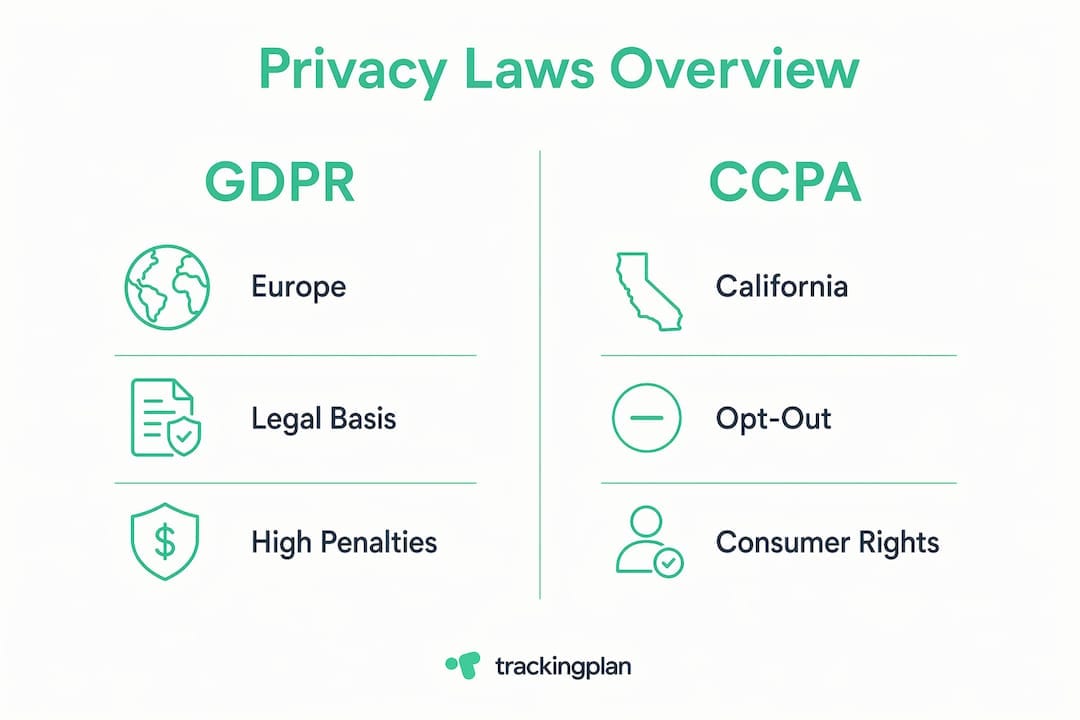
The California Consumer Privacy Act (CCPA) and its successor, the California Privacy Rights Act (CPRA), grant California residents rights to know, delete, and opt out of the sale of their personal information. The CCPA applies to for-profit businesses meeting specific revenue or data volume thresholds. Unlike GDPR, CCPA does not require a legal basis for every processing activity, but it does require clear disclosure and a functional opt-out mechanism.
Other regulations worth knowing:
- HIPAA governs protected health information in the United States and applies to healthcare providers, insurers, and their business associates.
- LGPD is Brazil’s General Data Protection Law, closely modeled on GDPR, covering personal data processed in Brazil or about Brazilian residents.
- CPRA strengthens CCPA by creating a dedicated enforcement agency and adding new rights around sensitive personal information.
Each regulation defines different rights, different consent standards, and different penalties. An organization operating across multiple jurisdictions must map which laws apply to which data flows and build compliance controls accordingly.
How do organizations operationalize privacy compliance effectively?
Documented policies alone do not constitute compliance. Compliance gaps arise when documented rules are not enforced by systems like access controls and retention enforcement. Operationalizing privacy compliance means embedding controls directly into the systems and workflows that handle personal data.
The core tools organizations use include:
- Records of Processing Activities (ROPA): ROPA serves as an operational inventory mapping all personal data processing activities for compliance and audit readiness. A well-maintained ROPA connects product, security, legal, and operations teams with live data maps and evidence for regulators and customers.
- Data Protection Impact Assessments (DPIAs): DPIAs identify and mitigate privacy risks before launching new products, features, or data processing activities. GDPR requires DPIAs for high-risk processing operations.
- Consent Management Platforms (CMPs): CMPs help businesses manage user preferences and maintain consent records to stay compliant. Under GDPR, placing cookies without valid consent is a direct violation, making CMPs a technical necessity rather than an optional tool.
- Access controls and retention enforcement: Systems must restrict who can access personal data and automatically delete or anonymize data when retention periods expire.
- Audit trails: Logs of who accessed, modified, or shared personal data provide the evidence regulators and auditors require.
What does privacy compliance monitoring mean in practice? It means continuously verifying that these controls are working as intended, not just that they exist on paper.
Pro Tip: Connect your ROPA directly to your technical systems. A ROPA that lives in a spreadsheet and is updated once a year will not reflect your actual data flows. Link it to your data catalog or tracking inventory so it updates as your systems change.
For organizations running digital analytics, privacy compliance for analytics requires specific attention to tracking implementations, pixel behavior, and consent signal propagation across web and app environments.
What are the best privacy compliance practices for businesses in 2026?
Building a mature compliance program requires sustained effort across multiple functions. The following practices define what effective programs look like in practice.
-
Maintain a live data processing inventory. Continuously updated inventories, risk assessments, and evidence generation are the foundation for responding to audits and data subject requests effectively. A static inventory is a liability, not an asset.
-
Align policies with technical enforcement. Aligning privacy policies with system enforcement through access controls, retention rules, and audit trails is the difference between documented compliance and operational compliance. Regulators assess actual operations, not just documentation.
-
Implement consent management with verification. Consent is not a one-time collection event. You need systems that record consent, honor withdrawals, and propagate preferences across every downstream tool. Detailed guidance on consent enforcement verification is critical for marketing and analytics teams specifically.
-
Run regular privacy audits focused on high-risk areas. Privacy monitoring programs require coordinated oversight across departments with regular audits focusing on highest-risk areas. Prioritize processes involving sensitive data, third-party sharing, or cross-border transfers.
-
Train employees and assign clear accountability. Privacy compliance fails when employees do not understand their obligations. Assign a designated privacy lead or Data Protection Officer (DPO) and run annual training that covers real scenarios, not just policy summaries.
-
Track regulatory changes proactively. New laws and amendments appear regularly. Subscribe to updates from the International Association of Privacy Professionals (IAPP) and build a process for assessing how changes affect your current controls.
Pro Tip: Do not wait for an audit to test your data subject request process. Run a dry run quarterly. Request your own data, submit a deletion request, and time how long it takes your team to respond. The gaps you find will be the same ones a regulator finds.
Digital marketing teams face specific challenges at the intersection of tracking and compliance. The top data privacy tips for digital marketers cover how to balance measurement needs with consent obligations in 2026.
What are the common pitfalls in achieving privacy compliance?
The most dangerous compliance gap is the distance between what your policy says and what your systems actually do. Many organizations have documented compliance but lack operational compliance, and this gap becomes visible during audits or data incidents.
Common pitfalls include:
- Treating compliance as a project, not a program. A one-time compliance effort becomes outdated the moment your data flows change or a new regulation takes effect. Privacy compliance is an ongoing lifecycle, not a deliverable.
- Siloed ownership. When legal owns the policies, IT owns the systems, and marketing owns the data, no single team sees the full picture. Cross-functional ownership with clear accountability is the only structure that works.
- Consent without verification. Organizations collect consent at the point of entry but fail to verify that the consent signal actually reaches every downstream tool. A user who opts out of tracking may still be tracked if the consent management platform is not properly integrated with your analytics and advertising stack.
- Outdated inventories. A ROPA or data map that does not reflect current systems is worse than no map at all. It creates false confidence and produces incorrect responses to data subject requests.
- No monitoring after implementation. Effective privacy compliance demands ongoing monitoring to verify that operational controls work as intended and adapt to regulatory changes. Deploying controls without monitoring them is a structural failure.
The solution to most of these pitfalls is the same: treat privacy compliance as a continuous program with defined owners, live documentation, and regular verification cycles. Organizations that use documentation, training, and dashboards to maintain compliance awareness and report to leadership are the ones that pass audits and avoid incidents.
Key Takeaways
Privacy compliance requires live operational controls, not just documented policies, and must be treated as a continuous program spanning legal, technical, and organizational functions.
| Point | Details |
|---|---|
| Core definition | Privacy compliance means following applicable laws and controls to protect personal data and individual rights. |
| Key regulations | GDPR, CCPA, HIPAA, LGPD, and CPRA each impose distinct obligations depending on your data flows and geography. |
| Operational tools | ROPA inventories, DPIAs, CMPs, access controls, and audit trails are the technical backbone of compliance. |
| Biggest pitfall | Documented compliance without operational enforcement fails audits and leaves organizations exposed to incidents. |
| Ongoing monitoring | Regular audits, regulatory tracking, and cross-functional accountability are required to sustain compliance over time. |
The gap nobody talks about until it’s too late
After working with dozens of organizations on their analytics and data governance setups, the pattern I see most often is not a lack of awareness. Leaders know GDPR exists. They have a privacy policy. They have a cookie banner. What they do not have is any reliable way to verify that the consent signal collected at the front door actually travels through to every pixel, every analytics tag, and every third-party integration running on their site.
That gap is where real compliance risk lives. A user clicks “reject all” and your CMP records it faithfully. But your tag manager fires the Facebook pixel anyway because the integration was misconfigured six months ago and nobody noticed. That is not a policy failure. It is an operational failure, and it is exactly the kind of failure that shows up in regulatory investigations.
The organizations that handle this well treat their tracking stack as a compliance surface, not just a measurement tool. They monitor it continuously, they verify consent propagation, and they audit it the same way they audit their financial controls. Privacy compliance monitoring is not a separate discipline from analytics governance. They are the same discipline, and the sooner business leaders recognize that, the better their programs will be.
— David
How Trackingplan supports your privacy compliance program
Trackingplan’s Privacy Hub gives organizations a centralized platform for monitoring consent enforcement, detecting tracking errors, and verifying that privacy controls are working across web and app environments. When a pixel fires outside consent boundaries or a tracking schema changes unexpectedly, Trackingplan surfaces the issue in real time via Slack, Teams, or email, so your team can act before it becomes a compliance incident.
For teams managing complex analytics stacks, Trackingplan’s web tracking monitoring provides continuous visibility into whether your implementations match your compliance requirements. It connects the operational reality of your tracking layer to the compliance standards your legal and privacy teams have defined.
FAQ
What does privacy compliance mean for a business?
Privacy compliance means a business collects, uses, and shares personal data according to applicable laws and its own stated policies. It requires both documented rules and technical systems that enforce those rules in daily operations.
What is the difference between GDPR and CCPA compliance?
GDPR applies to organizations processing data of EU residents and requires a legal basis for every processing activity. CCPA applies to qualifying businesses handling California residents’ data and focuses on disclosure rights and opt-out mechanisms rather than requiring prior consent for most processing.
What is privacy compliance monitoring?
Privacy compliance monitoring is the ongoing practice of verifying that privacy controls, consent mechanisms, and data handling practices are working as intended. It includes regular audits, automated alerts, and tracking of regulatory changes that may affect current controls.
How do you achieve privacy compliance in a digital analytics environment?
Achieving privacy compliance in digital analytics requires integrating consent management with your tracking stack, verifying that consent signals reach every downstream tool, and continuously monitoring your implementations for schema changes or unauthorized data collection.
Why do organizations fail privacy compliance audits?
Organizations most often fail audits because their documented policies do not match their operational systems. Access controls, retention rules, and consent enforcement may exist on paper but are not technically implemented or regularly verified.