
Key Takeaways
What Is Analytics in Decision Making
Analytics in decision making is the process of collecting, analyzing, and interpreting data to inform business choices. It transforms raw information into actionable insights that guide strategy, reduce guesswork, and improve outcomes. For ecommerce teams, this means turning clickstream data, conversion patterns, and customer behavior into decisions that directly impact revenue.
At its core, analytics enables data-driven decision-making by reducing information gaps and shifting authority from gut instinct to evidence. Rather than relying on assumptions about your customers or campaigns, you work with facts grounded in actual behavior and performance metrics. This fundamentally changes how organizations operate and prioritize.
The Foundation: Data-Informed Culture
Implementing analytics in decision-making requires more than tools or dashboards. Analytical decision-making culture develops through consistent top management support and perceived data quality, which influence how decisions get made across your organization. When your leadership team trusts the data, teams follow suit.
Key components that build this foundation include:
- Accessible data quality so teams trust what they’re looking at
- Leadership commitment to using analytics over opinion in meetings
- Clear data ownership so someone’s accountable for accuracy
- Training and literacy so your team understands what the numbers mean
When data quality is high and leadership champions analytical thinking, organizations see measurable improvements in decision speed and accuracy.
Without this cultural foundation, even the best analytics platform becomes shelf-ware.
Why It Matters for Ecommerce
Ecommerce operates in a hyper-competitive space where a 1-2% improvement in conversion rate compounds into significant revenue gains. Your competitors are using data to optimize pricing, personalization, inventory, and ad spend. Falling behind on analytics means losing market share.
Analytics enables you to answer critical questions rapidly:
- Which traffic sources deliver the highest-value customers?
- Where are customers dropping off in checkout?
- Which product attributes drive repeat purchases?
- How does seasonal demand affect inventory decisions?
- Which customer segments justify premium support investment?
These answers drive every decision from campaign budgets to warehouse automation.
The Decision-Making Process in Practice
Analytical decision-making follows a structured flow. You collect data from your site, apps, and server infrastructure. Then you analyze patterns, identify trends, and test hypotheses. Finally, you communicate findings to stakeholders and implement decisions. Systematic data analysis processes ensure consistency and reduce bias in how insights get translated into action.
This isn’t a one-time event. Analytics is continuous. Your site changes, customer behavior evolves, and markets shift. Regular monitoring and iteration keep decisions relevant.
The Real Challenge: Data Accuracy
All of this breaks down if your tracking data is broken. Misfiring pixels, schema errors, campaign misconfiguration, and missing events create blind spots. You make decisions based on incomplete or incorrect data, which feels good until results disappoint.
Mid-sized ecommerce teams often discover tracking issues months after they occur, by which point bad decisions have already cost money and opportunity. This is where continuous monitoring of your analytics implementation becomes critical—catching issues before they skew your decisions.
Pro tip: Set up real-time alerts on key metrics like traffic drops or sudden conversion rate changes. The faster you detect anomalies, the sooner you can investigate whether it’s a business issue or a tracking problem.
Types of Analytics for Ecommerce Teams
Ecommerce teams work with three primary types of analytics, each serving different strategic purposes. Descriptive analytics answers what happened. Predictive analytics forecasts what will happen. Prescriptive analytics recommends what you should do. Together, they form a complete decision-making toolkit.
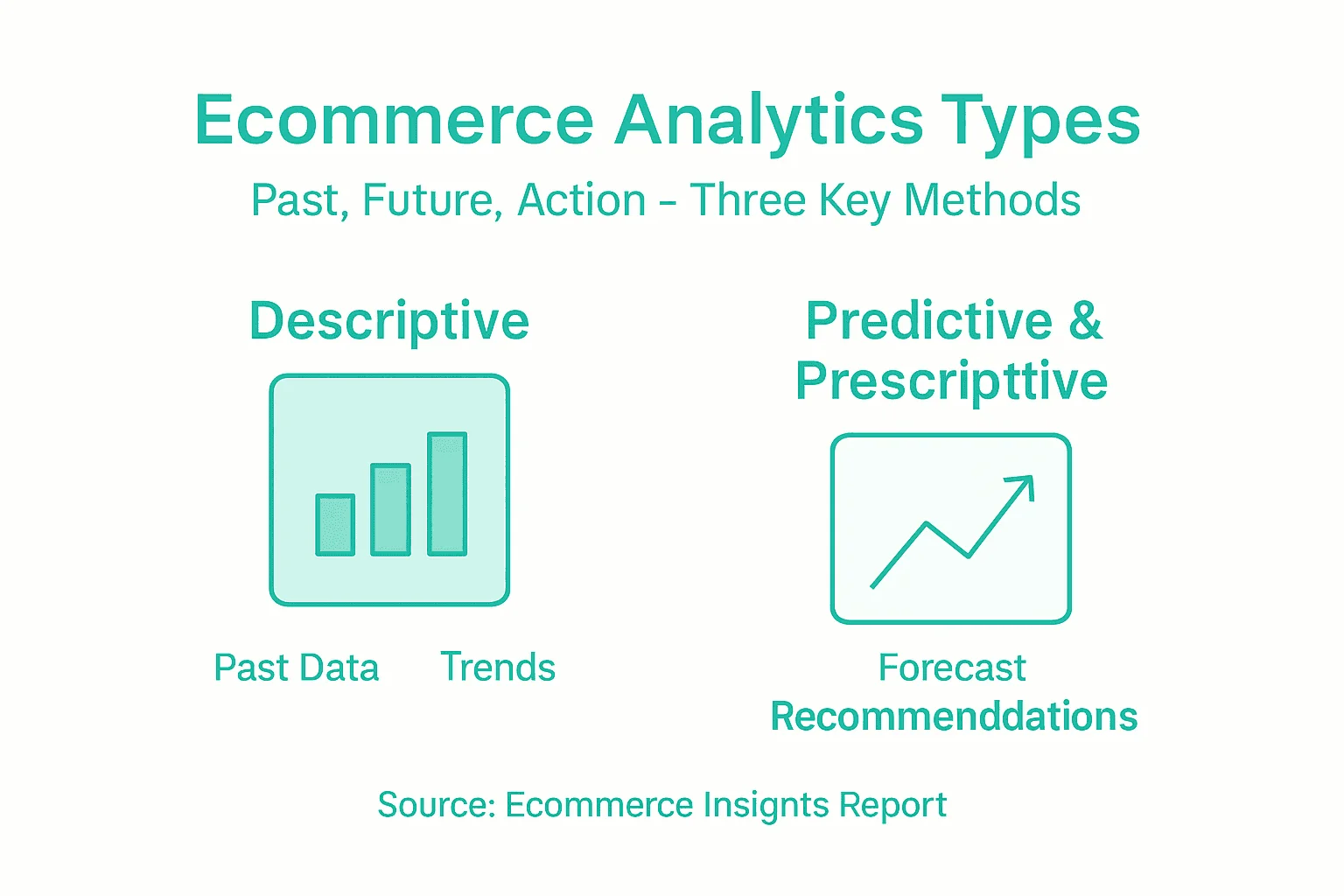
Understanding how big data analytics shapes ecommerce strategy helps you build the right analytics foundation for your team’s needs.
Here is a comparison of the main types of ecommerce analytics and how they support decision-making:
Descriptive Analytics: Understanding Your Past
Descriptive analytics examines historical data to understand what occurred in your business. It answers straightforward questions about traffic, conversions, revenue, and customer behavior patterns.
Your team likely uses descriptive analytics daily through:
- Traffic volume by channel, device, and geography
- Conversion rates and abandonment points in checkout
- Average order value, product popularity, and seasonal trends
- Customer acquisition cost and lifetime value segments
- Return rates and inventory turnover by category
This is your baseline. Without understanding historical performance, you can’t predict or optimize anything else.

Predictive Analytics: Forecasting Future Behavior
Predictive analytics uses patterns from past data to estimate future outcomes. Instead of looking backward, you project forward to answer “what might happen?”
Common predictive applications in ecommerce include:
- Forecasting demand for inventory planning
- Estimating customer churn risk before it happens
- Predicting which prospects convert to buyers
- Projecting seasonal revenue fluctuations
- Identifying at-risk orders likely to return
Predictive models take historical patterns and apply them to new scenarios. If customers with specific behaviors historically churned, you flag similar customers today for retention campaigns. If certain product combinations typically drive repeat purchases, you recommend them to similar prospects.
Predictive analytics shifts you from reacting to customer behavior to proactively influencing it before decisions are made.
Prescriptive Analytics: Recommending Actions
Prescriptive analytics goes beyond prediction to recommend specific actions. It answers “what should we do?”
This is the most advanced type and combines prediction with optimization rules. Examples include:
- Recommending optimal pricing for each product based on demand elasticity
- Suggesting personalized product offers to maximize each customer’s lifetime value
- Allocating marketing budget across channels to maximize ROI
- Determining ideal inventory levels by location and season
- Recommending which customer segments warrant direct sales outreach
Prescriptive analytics requires clean, accurate data flowing through your entire tech stack. One broken pixel or missing event undermines the entire decision chain.
Building Your Analytics Stack
Most mid-sized ecommerce teams start with descriptive analytics, layer in predictive capabilities, then move toward prescriptive optimization. You don’t need all three immediately, but understanding the progression helps you prioritize what to build next.
Each type depends on accurate, complete tracking data. Misfiring pixels, schema mismatches, or campaign misconfiguration create gaps that compound through all three types. A broken data source creates wrong descriptions, bad predictions, and harmful prescriptions.
Pro tip: Audit your analytics implementation before investing in advanced predictive or prescriptive tools. Fixing foundational tracking issues delivers more immediate value than adding complexity on top of broken data.
How Analytics Powers Smarter Choices
Analytics transforms decision-making by replacing hunches with evidence. When your team has access to reliable data, they make faster, more confident choices across pricing, inventory, marketing spend, and customer experience initiatives. The difference between guessing and knowing is measurable in revenue.
From Uncertainty to Clarity
Decisions made without data carry hidden costs. You optimize a checkout flow based on assumption, only to discover months later it actually hurt conversion. You allocate budget to a channel thinking it’s performing, then realize tracking was broken. You stock inventory for predicted demand, then get stuck with excess.
Analytics reduces uncertainty by providing concrete evidence at every decision point. Instead of debating what customers want, you observe what they actually do. Instead of guessing which campaigns work, you measure their precise impact.
This shift changes team dynamics. Disagreements shift from opinion-based arguments to data-driven discussions.
Speed and Confidence
Analytics enables faster decisions because the information is already there. You don’t wait for reports or spend weeks gathering data from multiple systems. Real-time dashboards show what’s happening right now, so you can react immediately to opportunities or problems.
This speed compounds advantages:
- Spot a traffic spike and capitalize on it within hours
- Detect a checkout bug and fix it before losing customers
- Identify underperforming campaigns and reallocate budget the same day
- Notice inventory shortages and adjust sourcing immediately
When decisions are evidence-based and timely, competitive advantage shifts from strategy to execution speed.
Building Team Alignment
Analytics creates shared truth across departments. Marketing, product, operations, and finance all see the same metrics. When everyone references the same data, conflicts dissolve because there’s nothing to debate.
Team alignment improves through:
- Clear visibility into what metrics matter most
- Transparent performance against targets
- Accountability tied to measurable outcomes
- Credit distributed based on actual impact
Without shared analytics, departments operate in silos with conflicting narratives about performance.
The Quality Requirement
Here’s the hard truth: reliable, timely, accessible analytics only works if the underlying data is accurate. One broken pixel or misconfigured tracking corrupts everything downstream.
Teams confidently making decisions based on corrupted data are actually making worse decisions than those relying on instinct, because they have false confidence.
This is where implementation monitoring becomes critical. Your analytics platform is only as good as your tracking infrastructure supporting it.
Moving From Reactive to Proactive
Analytics empowers you to stop reacting and start planning. Instead of discovering problems after they damage metrics, you predict and prevent them. Instead of wondering why performance changed, you understand causation and adjust accordingly.
Proactive decision-making requires three things:
- Historical data to understand patterns and baselines
- Real-time monitoring to catch anomalies immediately
- Predictive models to forecast outcomes before decisions
Mid-sized ecommerce teams rarely have all three. But building toward this maturity increases decision quality exponentially.
Pro tip: Start by establishing one shared metric your entire leadership team owns. Track it daily. Build decisions around that single number before adding complexity. Once the team trusts one metric, expand to others.
Preventing Tracking Errors and Data Gaps
Tracking errors silently undermine decision-making. A broken pixel here, a misconfigured event there, and suddenly your metrics diverge from reality. By the time you notice, you’ve already made bad decisions based on incomplete data.
Preventing these errors requires systematic attention, not just hoping your implementation stays intact.
The Hidden Cost of Tracking Issues
Broken pixels and misfired events create data gaps that compound over time. You lose visibility into customer journeys, campaign attribution becomes unreliable, and ROI calculations are wrong. Teams then make decisions based on corrupted signals.
Common tracking failures include:
- Pixels not firing due to third-party script conflicts
- Event data missing required parameters or schema mismatches
- Campaign UTM parameters inconsistently applied
- Server-side tracking not syncing with client-side data
- Privacy tools blocking tracking without fallback methods
Each represents a blind spot in your decision-making.
Proactive Monitoring vs. Reactive Discovery
Most teams discover tracking issues months after they occur. You notice conversion attribution looks off, or revenue doesn’t match expectations, then spend weeks tracing the root cause. By then, you’ve optimized campaigns based on wrong data.
Proactive monitoring catches issues immediately. Real-time alerts on traffic anomalies, conversion drops, or missing events trigger investigation within hours, not months. This dramatically reduces the damage window.
The difference between catching a tracking issue in hour one versus month one is millions in wasted marketing spend and bad strategic decisions.
Building a Quality Framework
Data integrity requires cross-functional ownership. Preventing ecommerce tracking errors means implementing automated validation, standardized naming conventions, and regular audits. Your marketing, analytics, and development teams must collaborate on implementation standards.
Essential practices include:
- Automated data validation that flags incomplete or malformed events
- Standardized product tagging across categories and attributes
- Regular implementation audits to catch configuration drift
- Documentation that defines what each event should contain
- Testing protocols before deploying tracking changes
The table below summarizes essential practices for ensuring analytics data quality in ecommerce:
Server-Side Tracking as Insurance
Client-side tracking (pixels in the browser) is vulnerable to ad blockers, privacy tools, and script conflicts. Server-side tracking provides a backup layer that captures conversion data regardless of what the browser allows.
Combining both approaches improves data completeness. When a pixel fails silently, server-side tracking still captures the conversion. You lose some data, but not all of it.
Creating Accountability
Tracking quality improves when someone owns it. Assign a single person or small team responsibility for implementation monitoring. Give them authority to halt campaigns when data quality drops, and metrics to prove their impact.
Without clear ownership, tracking issues get deprioritized. Everyone assumes someone else is monitoring.
Pro tip: Start a daily standup where your analytics person reviews key metrics for anomalies. A 5-minute daily check catches 80% of tracking issues before they cascade into bad decisions. Document what you find to build a pattern library of known issues.
Avoiding Common Pitfalls and Misinterpretations
Accurate data means nothing if you misinterpret it. Teams regularly draw wrong conclusions from correct numbers, leading to decisions that feel data-driven but are actually based on flawed reasoning. The mistakes are subtle but costly.
Correlation Versus Causation
The most dangerous pitfall in analytics is confusing correlation with causation. Two metrics move together, so you assume one causes the other. You change something based on this assumption, results disappoint, and you’ve wasted time and budget.
Example: You notice that email subscribers have higher average order value than non-subscribers. You assume email drives spending, so you aggressively grow the email list. In reality, customers who already spend more tend to subscribe to email. Email didn’t cause the higher value. Growing the list with inactive customers won’t improve AOV.
Distinguishing correlation from causation requires proper statistical testing and control groups. You can’t just observe patterns and act on them.
Biased or Insufficient Data Samples
Decisions based on incomplete data lead you astray. If you’re only looking at mobile traffic, or only analyzing a two-week window, your conclusions don’t apply to the full picture.
Common sampling mistakes include:
- Analyzing only peak traffic periods and missing off-peak behavior
- Looking at one product category instead of your full catalog
- Using only last-click attribution instead of multi-touch models
- Testing with a subset of traffic too small for statistical confidence
Each creates a distorted view that feels real because the numbers are accurate for that specific slice.
Small data samples create false patterns that disappear at scale. Always verify findings against your full dataset before acting.
Confirmation Bias in Analysis
You form a hypothesis, then look for data that confirms it. You ignore contradicting signals because they don’t fit your narrative. This happens unconsciously, even to experienced analysts.
Combat this by:
- Defining your analysis questions before collecting data
- Explicitly listing what would prove your hypothesis wrong
- Having someone else review your conclusions independently
- Testing alternate explanations before settling on one
Missing Context and Baseline Comparisons
Metrics in isolation are meaningless. A 2% conversion rate tells you nothing without knowing your historical baseline, competitor benchmarks, or what changed. You might celebrate an improvement that’s actually seasonal or attribute growth to the wrong source.
Always provide context:
- Historical trends showing where metrics came from
- Baseline comparisons to known good periods
- Control groups measuring impact of specific changes
- Seasonality adjustments for fair period-to-period comparison
Acting Too Fast on Early Signals
A campaign shows promise after three days, so you scale it aggressively. One week later, performance normalizes and you’ve wasted budget. Early signals are volatile and unreliable.
Set minimum sample sizes before making optimization decisions. Don’t act on partial data. Wait for statistical significance, especially for conversion-rate decisions affecting revenue.
Pro tip: Before presenting any insight to leadership, write down what would prove you wrong. If you can’t articulate that, you haven’t thought critically about your conclusion yet. This simple exercise catches confirmation bias before it costs money.
Ensure Flawless Ecommerce Analytics for Data-Driven Decisions
Making smart, evidence-based decisions in ecommerce hinges on accurate and complete tracking data. This article highlights the critical role of analytics and the costly risks of broken pixels, misconfigured events, and data blind spots. If you want to move from guessing to knowing, your team needs real-time visibility into tracking health to prevent errors that undermine your most important metrics.
Trackingplan offers a powerful SaaS platform designed to tackle these exact challenges. With automated discovery, continuous monitoring, and AI-powered alerting, you will detect tracking issues before they impact your decision-making. Learn how to protect your investment in data quality and analytics by exploring insights in our Blog specialized in Data Quality | Trackingplan and deepen your understanding through the Blog specialized in Digital Analytics | Trackingplan.
Take control over your analytics implementation today. Visit Trackingplan to start monitoring your ecommerce tracking effectively and empower your team to make faster, more confident, and data-driven decisions. Don’t wait until invisible errors cost you revenue—act now and safeguard your ecommerce success.
Frequently Asked Questions
What is the significance of analytics in ecommerce decision making?
Analytics plays a crucial role in ecommerce by transforming raw data into actionable insights. It helps businesses understand customer behavior, optimize campaigns, and improve conversion rates, leading to better revenue outcomes.
What are the main types of analytics used in ecommerce?
Ecommerce teams primarily utilize three types of analytics: descriptive analytics, which looks at past performance; predictive analytics, which forecasts future trends; and prescriptive analytics, which recommends optimal actions based on the analysis.
How can I ensure data accuracy for my ecommerce analytics?
To ensure data accuracy, regularly audit your tracking setup, implement automated validation processes, and establish standardized naming conventions for data events. This helps avoid common tracking issues that can skew decision-making.
Why is a data-informed culture important for analytics?
A data-informed culture, supported by leadership and quality data, is essential for effective analytics implementation. It encourages teams to trust and rely on data insights rather than gut feelings, improving the speed and accuracy of decision-making.