
Marketing teams often treat marketing mix modeling and multi-touch attribution as separate systems, creating fragmented measurement and slowing strategic decisions. Adobe Mix Modeler eliminates this divide by unifying both approaches using AI, delivering faster, more accurate insights into incremental marketing impact. This guide explains how Mix Modeler’s architecture, data workflows, AI capabilities, and optimization tools work together to improve ROI and planning accuracy.
Table of Contents
- Understanding Adobe Mix Modeler: Architecture And Capabilities
- Data Harmonization & Integration For Accurate Measurement
- AI & Machine Learning Driven Marketing Mix Modeling
- Model Configuration & Customization: Best Practices
- Budget Optimization & Scenario Planning
- Common Misconceptions About Adobe Mix Modeler
- Bridging Theory And Practice: Optimizing Adobe Mix Modeler Integration
- Unlock Reliable Marketing Insights With Trackingplan
- Frequently Asked Questions
Key Takeaways
| Point | Details |
|---|---|
| Unified measurement | Adobe Mix Modeler combines MMM and MTA using AI to deliver unified, incremental marketing insights. |
| Data harmonization | Accurate data harmonization across event and aggregate sources is crucial for reliable measurement. |
| Customizable models | Customizable model configurations allow tailoring to unique business marketing goals. |
| Budget optimization | Scenario planning and budget optimization tools enable confident marketing investment decisions. |
| Ongoing quality | Ongoing data quality assurance and model tuning are necessary for optimal performance. |
Understanding Adobe Mix Modeler: Architecture and Capabilities
Mix Modeler integrates marketing mix modeling and multi-touch attribution in one AI platform. This unification addresses the fragmentation that forces marketing teams to reconcile conflicting reports from separate systems. Instead of maintaining distinct tools for aggregate channel analysis and individual touchpoint tracking, teams get a single source of truth.
The platform supports up to 30 independent marketing touchpoints per conversion across paid, owned, and earned channels. This breadth captures the full customer journey from awareness through conversion. It utilizes both event level and aggregate data for comprehensive measurement, giving teams flexibility in data sources while maintaining consistency.

Powered by Adobe Sensei, Mix Modeler applies advanced machine learning for incremental impact analysis. The AI identifies which marketing activities truly drive conversions versus those that reach customers already likely to convert. This distinction matters enormously for optimizing spend and avoiding wasted budget on ineffective tactics.
Key architectural components:
- Unified data layer harmonizing diverse marketing datasets
- AI engine applying transfer learning between MMM and MTA
- Self service configuration interface for model customization
- Scenario planning tools for budget optimization
- Integration hooks for Adobe Experience Platform schemas
The marketing attribution guide explains how traditional attribution struggles with data silos. Mix Modeler’s harmonized view reduces these silos, enabling consistent incremental measurement across all channels.
“Adobe Mix Modeler combines marketing mix modeling (MMM) and multi-touch attribution (MTA) using AI and machine learning to deliver unified, incremental marketing measurement and planning.” — Mix Modeler overview
This architecture represents a fundamental shift from fragmented measurement toward integrated marketing intelligence. Teams no longer waste time reconciling conflicting attribution stories or choosing between top down and bottom up approaches.
Data Harmonization & Integration for Accurate Measurement
Data quality determines whether Mix Modeler delivers reliable insights or misleading recommendations. The platform ingests event level and aggregate data via Adobe Experience Platform schemas, requiring consistent schema compliance and privacy aware ingestion. Without this foundation, models produce garbage out regardless of AI sophistication.
Consistent schema compliance means every data source follows standardized field definitions and data types. When one channel tracks conversions as “purchases” and another as “transactions,” harmonization breaks down. The result is incomplete conversion attribution and skewed ROI calculations that mislead budget decisions.
Quality assurance includes pixel tracking accuracy and real time monitoring to prevent silent errors. Silent errors are particularly dangerous because they corrupt datasets without triggering obvious failures. A misconfigured tracking pixel might fire on every page view instead of just conversions, inflating conversion counts and artificially boosting calculated ROI for associated channels.
Data integration workflow:
- Validate source data conforms to Adobe Experience Platform schemas before ingestion
- Implement automated quality checks detecting anomalies like sudden traffic spikes or schema violations
- Harmonize naming conventions and field mappings across all marketing data sources
- Establish continuous monitoring with real time alerts for tracking failures or data gaps
- Document data lineage to enable rapid troubleshooting when issues emerge
Automated tools like Trackingplan help detect data anomalies pre integration. These tools catch problems before corrupted data enters Mix Modeler, preventing the costly process of model retraining after discovering data quality issues. Prevention beats remediation for maintaining measurement continuity.
Harmonized data enables accurate incremental and ROI measurement across channels. According to the Adobe Mix Modeler guide, data harmonization across diverse datasets is essential to create a consistent, reliable data view for accurate incremental measurement and actionable insights. Without it, you’re building sophisticated models on a shaky foundation.
Pro tip: Establish a data validation checklist that every marketing data source must pass before integration. Include schema compliance, privacy controls, tracking accuracy verification, and baseline data quality metrics. Run this checklist monthly to catch configuration drift before it impacts model performance. Refer to marketing data governance guide for comprehensive data stewardship practices.
AI & Machine Learning Driven Marketing Mix Modeling
Mix Modeler applies bi directional transfer learning to integrate top down MMM and bottom up MTA data. Traditional MMM analyzes aggregate channel performance over time but lacks touchpoint granularity. Traditional MTA tracks individual touchpoints but struggles with causality and upper funnel impact. Transfer learning bridges these limitations by allowing insights from each method to inform and refine the other.
Machine learning models refine incrementality measures and improve ROI calculations. Instead of static attribution rules, the AI continuously learns which touchpoints genuinely influence conversions in your specific market. This adaptive approach accounts for seasonality, competitive dynamics, and changing customer behavior without manual model updates.
Insight generation time shrinks from months to hours enabling agile marketing decisions. Legacy MMM required collecting months of data, building statistical models, validating results, and finally delivering insights often outdated by delivery time. Mix Modeler compresses this cycle dramatically, letting teams test and optimize campaigns while still active.
AI capabilities in action:
- Incrementality measurement isolating true marketing impact from baseline conversions
- Channel interaction modeling capturing synergies between marketing touchpoints
- Diminishing returns calculation identifying optimal spend levels per channel
- Trend analysis detecting performance shifts requiring strategic adjustments
- Predictive forecasting estimating future impact of budget scenarios
Models are customizable to align with business specific factors and channels. You define conversion goals, select relevant touchpoints, and set constraints matching your market reality. This customization ensures insights reflect your actual business rather than generic marketing patterns.
Unification prevents inconsistent or conflicting attribution across marketing efforts. When MMM says paid search drives 20% of conversions but MTA credits it with 35%, which number guides budget decisions? Mix Modeler eliminates this confusion by producing a single, coherent view grounded in both aggregate trends and individual customer journeys.
“Adobe Mix Modeler combines marketing mix modeling (MMM) and multi-touch attribution (MTA) using AI and machine learning to deliver unified, incremental marketing measurement and planning.” — Mix Modeler overview
The recent martech advances show how AI integration is reshaping marketing measurement. Mix Modeler represents this evolution, applying sophisticated machine learning while maintaining user accessibility through intuitive interfaces.
Model Configuration & Customization: Best Practices
Effective model configuration starts with defining clear conversion goals aligned with business objectives. Are you optimizing for revenue, lead volume, customer acquisition cost, or lifetime value? Different goals require different model structures and touchpoint weighting. Misaligned goals produce technically correct but strategically useless insights.
Select up to 30 marketing touchpoints spanning paid, owned, and earned channels for comprehensive coverage. This limit forces prioritization, ensuring you include the most impactful touchpoints while avoiding model complexity that obscures insights. Include channels across the full funnel from awareness through retention.
Configuration process:
- Define primary and secondary conversion goals matching strategic priorities
- Inventory all marketing touchpoints and select the 30 most significant for modeling
- Apply filters segmenting data populations by region, device type, or customer segment
- Identify overlapping touchpoints where customers encounter multiple channels simultaneously
- Set spend constraints and channel boundaries reflecting budget realities and operational limits
Segment data populations with filters to isolate marketing effects by region, device, or customer type. Regional performance often varies dramatically due to competitive intensity, customer preferences, or market maturity. Modeling these segments separately reveals optimization opportunities invisible in aggregated data.
Identify and manage overlapping touchpoints to avoid attribution errors. When customers see both a display ad and a social ad within the same session, naive attribution might double count the conversion impact. The Mix Modeler configuration documentation explains how the platform detects and adjusts for these overlaps, but you must configure touchpoint definitions correctly.
The self service UI streamlines these steps enabling faster model development and iteration. You don’t need data science expertise to configure effective models, though collaboration between marketing and analytics teams produces better results. According to Adobe’s guide, Mix Modeler offers a self service UI allowing customizable model configuration including defining conversion goals, selecting marketing touchpoints, and applying filters to segment eligible data populations.
Pro tip: Start with a baseline model using default settings and your top 15 channels. Validate results against known performance benchmarks before adding complexity. This iterative approach helps you understand how configuration choices impact results while building confidence in the platform. Review the Adobe marketing attribution guide and avoid last touch attribution pitfalls when selecting touchpoint weighting. Apply marketing data analysis tips to interpret initial results critically.
Budget Optimization & Scenario Planning
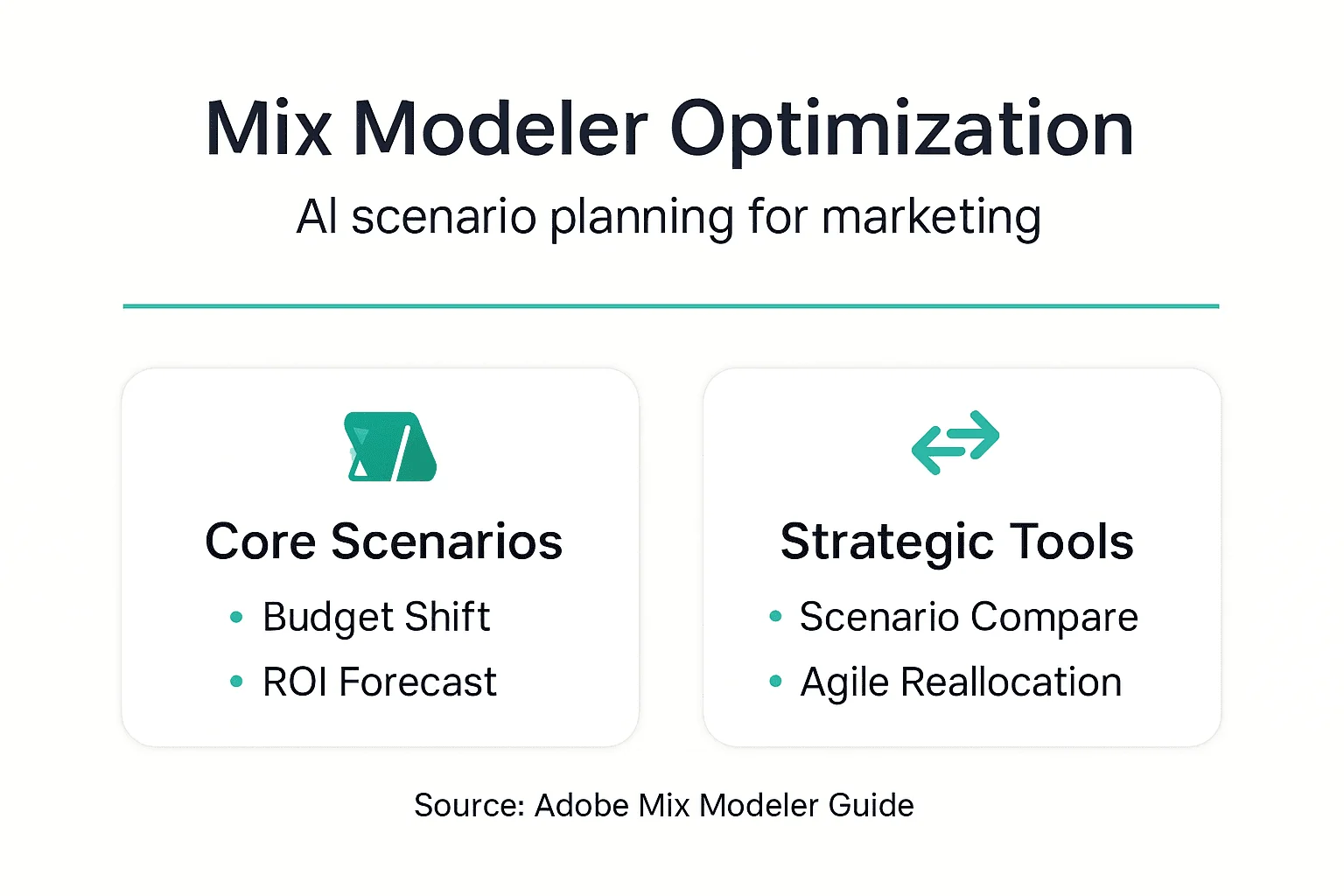
Scenario planning transforms Mix Modeler from a measurement tool into a strategic decision engine. Create and compare multiple budget scenarios adjusting channel spend and constraints to forecast outcomes before committing resources. This capability answers critical questions like “What happens to ROI if we shift $50K from paid search to video?”
Forecast incremental impact and ROI for each scenario over defined time windows. The AI models predict conversion volume, revenue, and efficiency metrics for each budget allocation. These forecasts incorporate diminishing returns, channel interactions, and seasonal patterns learned from historical data.
Align marketing budgets with broader business goals and constraints confidently. Maybe finance caps total marketing spend at $2M quarterly or requires minimum 3:1 ROI. Scenario planning lets you optimize within these guardrails, identifying the highest performing allocation that satisfies business constraints.
Scenario planning workflow:
- Define baseline scenario reflecting current budget allocation across channels
- Create alternative scenarios testing strategic shifts or tactical adjustments
- Set planning horizon matching business planning cycles
- Apply constraints like minimum spend per channel or maximum budget flexibility
- Compare forecasted performance across scenarios using consistent metrics
| Scenario | Total Spend | Forecasted ROI | Incremental Conversions | Strategic Focus |
|---|---|---|---|---|
| Baseline | $500K | 4.2:1 | 2,100 | Current allocation |
| Video Shift | $500K | 4.6:1 | 2,415 | +$75K video, reduce display |
| Search Focus | $500K | 4.4:1 | 2,310 | +$50K paid search, reduce social |
| Aggressive | $650K | 3.8:1 | 2,925 | Increase spend, accept lower efficiency |
Scenario planning enables agile reallocation responding to changing business conditions. When competitive pressure increases in paid search, quickly model the impact of budget shifts. When a product launch demands awareness building, forecast the incremental reach from increased video spend.
According to the Mix Modeler workflow guide, budget optimization and scenario planning features empower marketing teams to create multiple budget scenarios and determine optimal channel spend based on incremental impact forecasts. This capability closes the loop from measurement to action.
Leverage digital marketing analytics best practices to interpret scenario outputs critically. Follow the marketing observability guide to maintain visibility into actual performance versus forecasts, enabling rapid adjustment when reality diverges from predictions.
Common Misconceptions About Adobe Mix Modeler
MMM and MTA are not separate systems within Mix Modeler. The platform unifies them via AI powered transfer learning that produces a single, coherent attribution story. Teams accustomed to reconciling conflicting reports from distinct tools must adjust their workflow to leverage this unified view rather than seeking confirmation across multiple systems.
AI models accelerate insights but require ongoing data quality assurance and iteration. Machine learning is not magic that compensates for bad data or eliminates the need for human judgment. You must continuously monitor data quality, validate model outputs against business reality, and refine configurations as market conditions evolve.
Data ingestion involves privacy compliance and complex validation beyond simple data transfer. GDPR, CCPA, and other regulations constrain what data you can collect and how you can use it. Schema mismatches between data sources require careful mapping. These challenges are not trivial or optional but foundational to reliable measurement.
Misconceptions to avoid:
- Believing AI eliminates the need for marketing expertise in interpreting results
- Assuming initial model configuration will remain optimal without ongoing refinement
- Thinking privacy compliance is solely a legal concern rather than a data quality imperative
- Expecting Mix Modeler to automatically fix underlying tracking implementation problems
- Treating model outputs as absolute truth rather than probabilistic estimates requiring validation
Misconfiguration of overlapping touchpoints can distort attribution results if not carefully managed. When multiple channels reach the same customer simultaneously, improper handling either double counts impact or arbitrarily assigns credit. This distortion compounds across thousands of customer journeys, significantly skewing channel performance assessments.
Understanding these realities fosters more effective Mix Modeler implementation and results. According to Adobe’s documentation, common misconceptions include that marketing mix modeling and multi-touch attribution results are separate, while Adobe Mix Modeler unifies them into one consistent framework using bi directional transfer learning. Review the marketing data governance guide for context on why data quality cannot be an afterthought.
Bridging Theory and Practice: Optimizing Adobe Mix Modeler Integration
Successful integration demands rigorous data quality practices before and during Mix Modeler deployment. Conduct automated data quality checks before integration using tools like Trackingplan that detect tracking errors, schema violations, and anomalies. Catching problems pre integration prevents the expensive cycle of discovering issues only after model training completes.
Maintain pixel tracking consistency and conform to Adobe Experience Platform schemas across all marketing properties. When website tracking uses different schemas than mobile app tracking, harmonization becomes exponentially harder. Standardization from the start saves countless hours of data wrangling and reduces ongoing maintenance burden.
Integration best practices:
- Establish baseline data quality metrics before integration and monitor continuously
- Implement automated validation checking schema compliance and tracking accuracy daily
- Set up anomaly detection alerts notifying teams immediately when data patterns shift unexpectedly
- Document all data sources, transformation logic, and harmonization rules for troubleshooting
- Schedule regular model validation comparing predictions against actual outcomes
Set up continuous validation with anomaly detection alerts to catch errors early. Silent failures corrupt datasets gradually, making root cause analysis difficult when you finally notice problems. Real time alerting enables rapid response while issues remain isolated and manageable.
Integrate Mix Modeler insights smoothly into broader analytics and marketing stacks. Insights trapped in a separate system don’t influence decisions. Build workflows that surface Mix Modeler recommendations directly in campaign planning tools, budget allocation processes, and performance dashboards where marketers make daily decisions.
| Best Practice | Common Pitfall |
|---|---|
| Automated pre integration data validation | Assuming source data is clean without verification |
| Continuous monitoring with real time alerts | Discovering data quality issues only during model review |
| Standardized schemas across all marketing properties | Inconsistent tracking implementations creating harmonization challenges |
| Regular model validation against actual outcomes | Treating model outputs as truth without empirical validation |
| Integrated workflows surfacing insights in decision tools | Insights siloed in separate reporting system |
According to the Adobe Mix Modeler guide, pre integration data quality checks using automated monitoring tools, best practices for pixel tracking and schema adherence, and continuous validation and anomaly alerts improve Mix Modeler reliability significantly.
Pro tip: Create a monthly integration health scorecard tracking data quality metrics, model prediction accuracy, and insight adoption rates. This scorecard provides early warning when integration quality degrades and demonstrates value to stakeholders. Leverage data quality solutions for analytics tools, review the website audit checklist, and learn from tracking data errors to avoid common mistakes.
Unlock Reliable Marketing Insights with Trackingplan
Even the most sophisticated AI models produce misleading insights when built on flawed data. Trackingplan provides automated monitoring to detect and prevent tracking errors before they corrupt your Mix Modeler datasets. Our platform integrates seamlessly with Adobe Mix Modeler data workflows to ensure data reliability from collection through analysis.

Marketing and analytics teams using Trackingplan maintain high quality datasets resulting in dependable insights that confidently guide million dollar budget decisions. Real time alerts catch configuration drift, schema violations, and tracking failures immediately, preventing the costly cycle of discovering data problems only after bad decisions. Explore our data quality solutions purpose built for analytics tools or learn how our platform accelerates digital marketing analytics maturity across your organization.
Frequently Asked Questions
How does Adobe Mix Modeler handle privacy and data compliance?
Mix Modeler operates within Adobe Experience Platform’s privacy framework, supporting GDPR, CCPA, and other regulations through consent management and data governance controls. The platform processes data according to configured privacy policies, excluding non consented data from analysis and maintaining audit trails for compliance verification.
What are the typical data quality issues impacting Mix Modeler results?
Common issues include inconsistent schema compliance across data sources, tracking pixel failures creating conversion data gaps, duplicate event logging inflating metrics, and improper field mappings during harmonization. These problems compound in AI models, amplifying small data errors into significant measurement distortions. Implementing marketing data governance practices prevents most issues.
Can Mix Modeler integrate with non Adobe marketing platforms?
Yes, Mix Modeler ingests data from any source that can deliver information to Adobe Experience Platform via supported schemas and APIs. This includes Google Ads, Facebook, third party ad servers, CRM systems, and custom marketing applications, though integration complexity varies by platform.
How often should models be retrained or updated?
Retrain models quarterly at minimum to incorporate recent data and market shifts, more frequently during periods of significant business change like product launches or market expansion. Monitor model prediction accuracy continuously and retrain immediately when accuracy degrades beyond acceptable thresholds.
What role do marketers play in configuration versus analysts?
Marketers define conversion goals, select relevant touchpoints, set budget constraints, and interpret strategic implications of insights. Analysts handle technical configuration, validate data quality, troubleshoot integration issues, and ensure statistical rigor. Collaboration between both roles produces the most effective implementations.
How does Mix Modeler account for external factors like seasonality?
The platform incorporates time series analysis detecting seasonal patterns, trend shifts, and cyclical effects in historical data. You can also manually specify known external factors like holidays, competitive actions, or economic conditions that models should account for when calculating incremental marketing impact.