What is server-side tracking and why does it need auditing?
Server-side tracking sends data directly from backend servers to analytics platforms, bypassing browsers. Auditing ensures that data is accurate, complete, and compliant, preventing costly downstream analytics errors.
Server-side tracking represents a fundamental shift in how organizations collect analytics data. Rather than relying on client-side JavaScript tags that execute in user browsers, server-side implementations transmit data directly from backend infrastructure to analytics platforms. This approach delivers meaningful advantages: better data accuracy, stronger privacy compliance, and reduced vulnerability to ad blockers and browser restrictions, and research shows these benefits in practice.
However, the added complexity of server-side implementations creates new audit challenges that client-side setups rarely face. Without active monitoring, tracking configurations can drift from their intended state, data mappings can silently become incorrect, and critical events may stop transmitting entirely.
Server-side tracking audits verify that your implementation matches documented business requirements, that data flows correctly through your infrastructure, and that all connected systems communicate as expected. The urgency of auditing grows with scale. A single error can affect many users, according to practitioners.
"As one analytics engineering lead put it, 'Server-side tracking improves reliability, but it also moves complexity into systems that need continuous validation.'"
How do you choose between automated and manual audit approaches?
Automated audits scale continuously and catch known-pattern issues in real time. Manual audits provide deeper contextual investigation. Most mature teams combine both in a hybrid model for complete coverage, according to practitioner surveys.
The choice between automated and manual server-side tracking audits depends on your organization's tracking volume, team capacity, and data criticality. Automated audit systems continuously compare actual data flow against expected configurations. They excel at detecting anomalies, validating data formats, flagging missing events, and identifying schema violations the moment they occur.
Crucially, automated systems scale across hundreds or thousands of tracking points without requiring proportional increases in team effort.
Manual audits involve dedicated team members systematically reviewing tracking documentation, walking through implementation flows, and investigating specific issues in depth. Manual approaches allow for contextual understanding of why problems occur, not just that they occurred. They are well suited to periodic comprehensive reviews, validation of complex business logic, and investigation of anomalies that automated systems surface but cannot fully explain.
Most mature organizations use a hybrid model: continuous automated monitoring handles the high-frequency, high-volume detection layer, while manual audit efforts are reserved for quarterly deep dives, post-deployment verification, and targeted investigation of flagged data quality concerns. This hybrid approach is widely adopted, according to industry practitioners.
"A data quality manager summarized it well: 'Automation finds the noise, humans find the root cause.'"
Automated vs. manual server-side tracking audits: key differences at a glance
| Aspect |
Automated Audits |
Manual Audits |
| Real-time detection |
Yes, continuous monitoring |
No, periodic only |
| Scalability |
Handles thousands of events |
Limited by team capacity |
| Investigation depth |
Rule-based, pattern-focused |
Contextual and comprehensive |
| Setup cost |
Higher initial investment |
Lower initial cost |
| Ongoing effort |
Low maintenance after setup |
Significant recurring time commitment |
| Anomaly detection |
Excellent for known patterns |
Better for novel or ambiguous issues |
| Skills required |
Analytics engineering, data ops |
Deep domain and business expertise |
Pro tip: Start with automated monitoring on your highest-value events, revenue, conversion, and user identification, before expanding coverage. This delivers the fastest return on audit investment and builds team confidence in the system.
What specific metrics and data points should your audit cover?
Audits must cover event completeness, parameter schema compliance, user identification consistency, revenue accuracy, timestamp validity, duplicate detection, and data transmission latency across all tracking touchpoints, according to data quality best practices.
Comprehensive server-side tracking audits span multiple dimensions of your data infrastructure.
- Event completeness is the first priority: confirm that every expected event is being captured and transmitted, that no critical user actions are silently dropped, and that events arrive at your analytics platform within expected timeframes.
- Data accuracy audits validate that the values inside events match authoritative source data. For ecommerce implementations, this means verifying that transaction amounts match your order management system, product identifiers are correct, and currency values are accurate. For SaaS products, it means confirming that user attributes, subscription status, and feature usage data align with your application database.
- Parameter validation checks ensure that event attributes conform to defined schemas. Required fields must be present, values must fall within expected ranges, and data types must match specifications. A timestamp field should contain a valid timestamp, not a freeform string. A user ID should match your internal identification system exactly.
- User identification audits are especially critical in server-side implementations, where identity resolution is handled programmatically rather than by browser cookies. Verify that user IDs are passed correctly, that anonymous and authenticated tracking flows are distinct.
"'If revenue data is off by even a percent, reports and decisions are unreliable.'"
- Event completeness: Verify all expected events are captured and transmitted without gaps.
- Data accuracy: Confirm event values match authoritative source system records.
- Schema compliance: Validate that parameters follow defined type and format specifications.
- User identification: Ensure consistent identity tracking across all implementation touchpoints.
- Revenue tracking: Audit transaction amounts, currency values, and conversion funnel progression.
- Timestamp validation: Check that timing data is accurate, correctly formatted, and consistent.
- Duplicate detection: Identify and quantify event duplication that inflates metric counts.
- Latency monitoring: Measure data transmission delays from server to analytics platform.
How should you structure your audit schedule and documentation process?
Use a three-tier schedule: continuous automated monitoring, quarterly comprehensive reviews, and post-deployment verification.
Pair each tier with living documentation that tracks specifications, changes, and resolved issues, according to governance best practices.
Effective server-side tracking audits require structured scheduling and comprehensive documentation to remain sustainable over time. A tiered approach works best for most organizations.
Continuous automated audits run daily or in real time, catching anomalies and data quality issues as they emerge. This tier prevents small problems from becoming systemic failures that corrupt weeks of historical data.
Quarterly comprehensive audits provide deeper investigation. During these reviews, teams examine all tracking implementations, verify compliance with current specifications, test major user flows end to end, and investigate any issues flagged by automated systems that were not fully resolved.
Quarterly timing balances thoroughness with resource efficiency. Post-deployment audits verify that new tracking implementations work correctly before they reach production audiences. These audits should occur before any new tracking code goes live, catching configuration errors and specification mismatches at the lowest possible cost.
Documentation forms the foundation of a sustainable audit program. Maintain a tracking specification document that defines which events should be captured, which parameters each event must include, and which values are valid. This specification serves as the single reference point for all audits and must be updated whenever business requirements change or new tracking is added.
Implementation documentation should record which systems are responsible for sending which events, what data transformations are applied, according to implementation documentation.
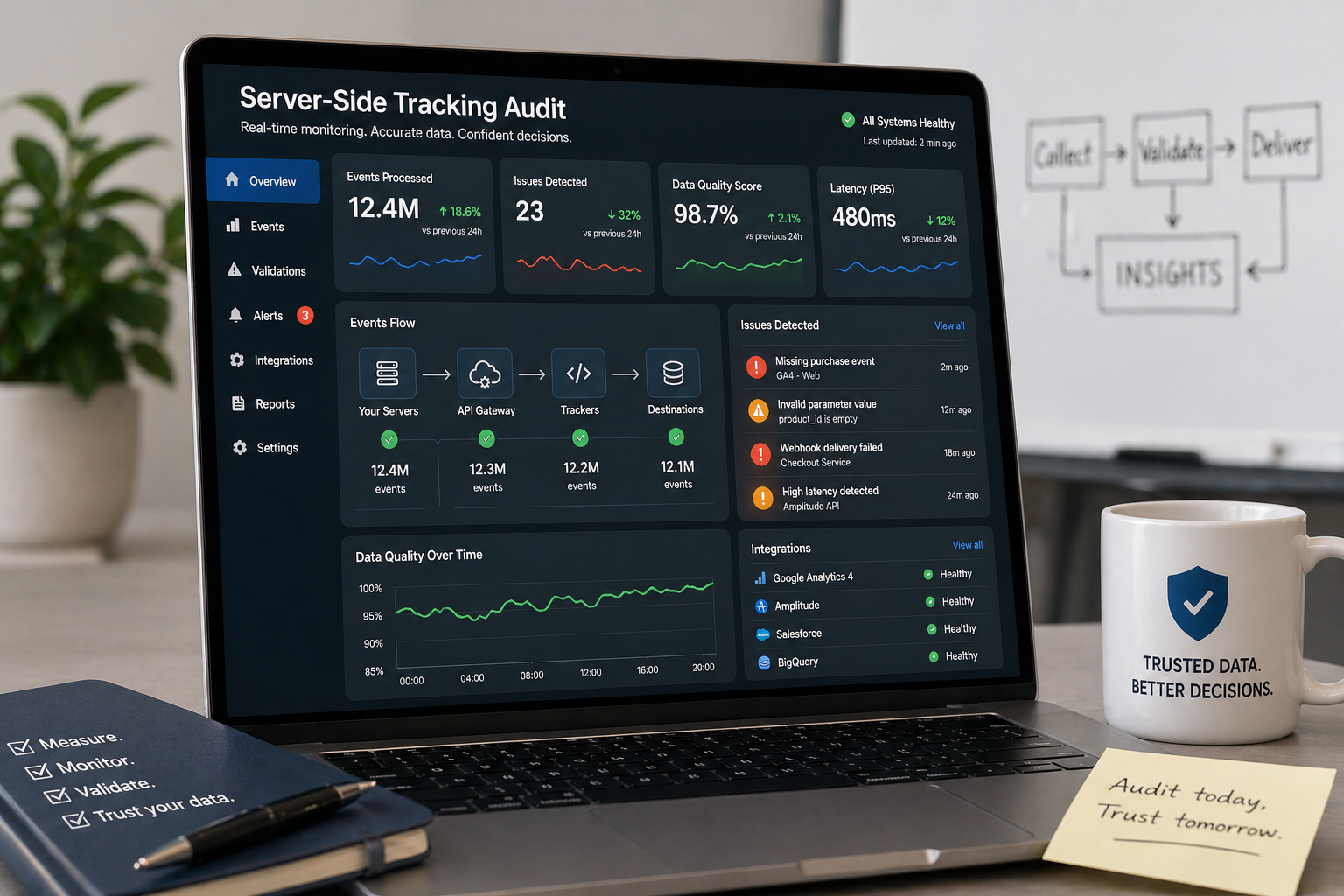
Build a tracking audit dashboard that surfaces key health metrics in one place: event delivery rates, schema validation pass rates, latency distributions, and open issue counts by severity. Share this dashboard with stakeholders across analytics, marketing, and engineering on a regular cadence.
What validation rules and testing frameworks work best for server-side tracking?
Schema validation, business logic tests, and end-to-end integration tests together provide the strongest coverage. Combine automated regression testing in staging environments with production monitoring to catch both new defects and configuration drift, according to testing best practices.
Validation rules form the technical foundation of effective server-side tracking audits. Schema validation checks that events conform to defined data structures, verifying that required fields are present, data types are correct, and string values do not exceed length limits. This layer prevents malformed data from reaching your analytics systems, according to schema validation guidance.
Consider implementing data quality scorecards that assign health ratings to individual tracking implementations based on metrics like event delivery rate, schema validation pass rate, and average latency. Update scorecards after each audit cycle to create a longitudinal record, according to data quality methodologies.
"Schema validation and scorecards are your first line of defense against silent data corruption.'"
Trackingplan automates schema validation, anomaly detection, and real-time alerting across server-side and client-side tracking implementations, reducing the manual effort required to maintain data quality at scale.