
TL;DR:
- Most marketing teams struggle with accurate attribution, relying on flawed models driven by incomplete data and cross-device gaps. Effective decision-making requires combining multiple attribution approaches, prioritizing data quality, and continuously auditing tracking systems to build trust. When implemented properly, attribution transforms organizational focus from opinion-based to evidence-driven, improving ROI and strategic clarity.
Most marketing teams know they should be doing attribution well. Far fewer actually are. The misconception that last-click attribution tells a complete story has persisted long enough to quietly drain budgets, end valuable partnerships, and reward the wrong channels. Understanding the true role of attribution in marketing goes well beyond tagging campaigns and pulling reports. It’s the connective tissue between what you spend and what you earn, and when it breaks down, every decision downstream breaks with it. This article covers attribution models, real-world challenges, and the practices that separate teams who guess from teams who know.
Table of Contents
- Key takeaways
- The role of attribution in marketing
- Understanding attribution models in marketing
- Challenges that undermine attribution accuracy
- Best practices for marketing attribution
- Attribution’s impact on marketing organization
- My honest take on attribution as strategic infrastructure
- How Trackingplan helps you trust your attribution data
- FAQ
Key takeaways
| Point | Details |
|---|---|
| Attribution connects spend to outcomes | It assigns credit to the right touchpoints, making budget decisions evidence-based rather than political. |
| No model is universally correct | Combining multiple attribution models improves decision accuracy far more than relying on any single approach. |
| Data quality is the real foundation | Even the best model produces unreliable results when the underlying tracking is broken or incomplete. |
| Privacy changes demand new methods | Signal loss from privacy restrictions requires supplementing attribution with incrementality testing and first-party data. |
| Attribution shapes organizational culture | Done well, it shifts marketing and sales teams from credit debates to shared, revenue-focused accountability. |
The role of attribution in marketing
Attribution is the practice of assigning credit to the marketing touchpoints that influenced a customer’s decision to convert. At its simplest, it answers the question: which channels, campaigns, and messages actually drove this result? At its most sophisticated, it maps the entire journey from first awareness to final purchase and assigns weighted credit at each stage.
But the role of attribution in marketing extends well past that definition. Attribution connects marketing activities to business outcomes like revenue, customer acquisition cost, and return on ad spend. Without it, marketing operates on assumption. With it, teams can make decisions grounded in real evidence about what’s working and what isn’t.
The decision-making value here is significant. Attribution doesn’t just tell you what happened. It tells you where to invest next. When a brand can see that paid search converts well at the bottom of the funnel while organic social generates the initial awareness that feeds that pipeline, it can allocate resources accordingly. That’s not reporting. That’s strategy.
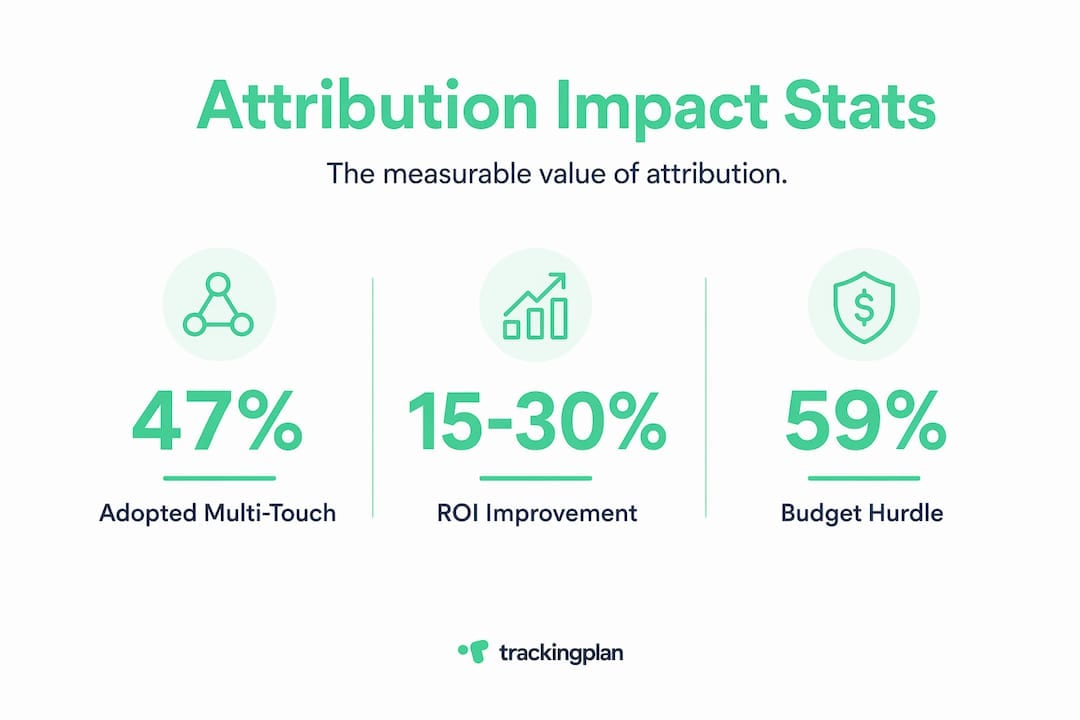
Attribution also surfaces the hidden costs of doing nothing. 59% of marketing leaders report insufficient budget, partly because they can’t demonstrate ROI clearly enough to justify more spend. Attribution solves exactly that problem when it’s implemented with discipline.
There are real challenges too. Customer journeys span multiple devices, channels, and time windows. A prospect might first see a YouTube ad, research via organic search three days later, click a retargeting ad on social, and finally convert through a branded keyword search. Standard tracking misses most of that journey. The result is fragmented data and false confidence in the wrong channels.
Pro Tip: Before choosing an attribution model, audit your tracking coverage first. A model applied to incomplete data doesn’t give you better answers. It gives you wrong answers faster.
These challenges don’t make attribution optional. They make getting it right more urgent.
Understanding attribution models in marketing
Attribution models determine how credit gets distributed across the touchpoints in a customer journey. Choosing the right model isn’t a technical detail. It directly shapes how budget gets allocated and how marketing strategy gets formed.
Single-touch models
Single-touch models assign 100% of the credit to one touchpoint. First-touch gives all credit to the channel that initiated the relationship. Last-touch gives it all to the final interaction before conversion. Both are easy to implement but carry significant blind spots.

Last-click attribution consistently undervalues awareness channels and inflates bottom-funnel performance. This leads teams to over-invest in retargeting and branded search while starving the channels that generate demand in the first place. First-touch has the opposite problem. It ignores everything that actually closed the deal.
Multi-touch models
Multi-touch attribution distributes credit across several touchpoints. The most common variants are:
- Linear: Divides credit equally across all touchpoints in the journey
- Time decay: Assigns more credit to touchpoints closer to the conversion
- Position-based (U-shaped): Gives 40% to the first touch, 40% to the last, and splits the remaining 20% among middle touchpoints
- W-shaped: Extends position-based logic by also weighting the lead creation touchpoint heavily
- Algorithmic or data-driven: Uses statistical modeling to assign credit based on actual conversion patterns across your data
Multi-touch attribution adoption nearly doubled to 47% in 2026, with users reporting ROI improvements of 15 to 30%. That growth reflects a real shift in how sophisticated marketing teams think about measurement.
Choosing based on data maturity
| Model | Best for | Data requirement | Key limitation |
|---|---|---|---|
| First-touch | Brand awareness focus | Low | Ignores close-stage influence |
| Last-touch | Direct response | Low | Undervalues upper funnel |
| Linear | Equal credit, simple audits | Medium | Doesn’t reflect true impact |
| Time decay | Short sales cycles | Medium | Deprioritizes awareness entirely |
| U-shaped | Lead gen focus | Medium-high | Ignores mid-funnel nuance |
| W-shaped | Complex B2B journeys | High | Requires reliable touchpoint data |
| Algorithmic | High-volume, mature analytics | Very high | Needs large datasets to be valid |
No single attribution model is perfect. Every model has biases. The most defensible approach is to run multiple models simultaneously and triangulate where they agree. Where they diverge, that divergence is itself useful information.
Pro Tip: Use algorithmic models as a directional signal, not gospel. If your dataset is under 10,000 conversions per month, the model won’t have enough variance to produce stable outputs. Combine it with a simpler model to cross-check the results.
Challenges that undermine attribution accuracy
Even well-resourced marketing teams struggle to get attribution right. The obstacles are structural, not just technical.
The biggest single issue is cross-device behavior. A customer who first encounters your brand on mobile, researches on desktop, and converts on a tablet is effectively invisible as a single person to most attribution systems. Privacy-driven tracking limitations compound this by reducing the observable signals available at each step, increasing gaps that no model can fill on its own.
Platform-specific attribution bias creates another layer of distortion. Every ad platform measures performance using its own attribution window and logic. Google reports on Google-attributed conversions. Meta reports on Meta-attributed conversions. When both platforms claim credit for the same sale, your aggregated numbers are inflated and your budget decisions are built on a fiction.
“Only 21% of B2B marketers feel confident in the accuracy of their attribution data.” — 4TM Marketing Attribution Report 2026
That figure should stop marketers in their tracks. It means the vast majority of B2B teams are making budget and strategy decisions with data they don’t trust. The downstream consequences show up everywhere: channels that look underperforming get defunded, audiences stop receiving relevant content, and revenue stalls without a clear explanation.
The creator marketing space illustrates the danger with unusual clarity. Standard tools risk misattributing YouTube creator conversions so badly that last-click bias threatens to drive brands to cut 40% of their top-performing creator partnerships. Those creators drive awareness and intent that never shows up in last-click reports. Teams who act on last-click data alone will cut their most effective awareness investments while believing they’re being rigorous.
Traditional attribution also fails to capture long-term retention and customer lifetime value. A channel that consistently brings in customers who churn after 60 days looks identical to one that brings in customers who stay for three years, unless you’re measuring lifecycle outcomes beyond conversion.
Best practices for marketing attribution
Knowing attribution is imperfect doesn’t mean you accept bad decisions. There are specific practices that meaningfully improve accuracy and confidence.
-
Build a multi-method measurement stack. No single tool or model covers the full picture. High-performing teams combine multi-touch attribution, incrementality testing, and marketing mix modeling. Each answers a different question. Attribution shows which touchpoints correlate with conversion. Incrementality testing measures causation rather than correlation, revealing whether a channel is actually driving additional conversions or just showing up on journeys that would have converted anyway. Marketing mix modeling provides a macro view of channel contribution without relying on user-level tracking.
-
Invest in first-party data and identity resolution. Strong data infrastructure and identity resolution are prerequisites for reliable attribution. Without the ability to connect touchpoints across devices and sessions to a single person, every model you run is working with Swiss cheese data. CRM integration, login-based tracking, and data clean rooms all help close that gap.
-
Audit your tracking before trusting your models. Broken pixels, misconfigured tags, and schema mismatches generate attribution errors that no model can correct for. Regular tracking coverage audits catch these failures before they compound into months of bad data.
-
Measure beyond initial conversion. Attribution models that stop at acquisition systematically miss the channels that drive retention and lifetime value. Segment your attribution analysis by customer quality metrics, not just conversion volume. A channel that drives high-LTV customers at higher CPA may still outperform a cheap-but-churny alternative.
-
Challenge platform-reported ROAS. Every platform reports the best possible version of its own performance. Run your own blended ROAS calculations using revenue data from your source of truth rather than platform dashboards. The gap between what platforms report and what actually happened is consistently larger than most teams expect.
Pro Tip: Run a holdout experiment before defunding any channel based on attribution data alone. Pause spend for a small segment, measure the revenue impact, and compare it against what your attribution model predicted. That comparison tells you more about your model’s accuracy than any report.
How attribution affects marketing strategy is ultimately determined by how much discipline teams apply to these practices. The mechanics are available to everyone. The execution gap is where competitive advantage is actually built.
Attribution’s impact on marketing organization
Attribution doesn’t just change how you measure campaigns. It changes how your entire organization thinks about marketing.
The most significant shift is cultural. Sales attribution is fundamentally a decision-making problem. When marketing and sales operate from different data sources and different attribution frameworks, the result is a recurring argument about who deserves credit for revenue. That argument is a waste of everyone’s time and almost always ends with political rather than analytical outcomes.
Teams that implement shared attribution frameworks see a different dynamic. Marketing can show which channels generated the leads that sales closed. Sales can see which content and campaigns are producing the most qualified pipeline. Shared accountability replaces the credit debate.
The organizational benefits extend further:
- Budget justification becomes data-driven. Marketing can defend spend increases with channel-level ROI evidence rather than anecdote.
- Campaign decisions happen faster. When attribution data is trustworthy and accessible, teams don’t need weeks of analysis to redirect spend.
- Personalization improves. Attribution data reveals where customers are in the journey, which allows for more relevant messaging at each stage.
- AI-driven workflows get better inputs. Attribution intelligence powers agentic AI workflows by supplying the contextual, identity-resolved data these systems need to make fast, confident optimization decisions.
The analytics and attribution impact on ROI is measurable and consistent when teams have the data infrastructure to support it. The organizations that see 15 to 30% ROI improvements from better attribution aren’t using different channels. They’re making better decisions about the same channels.
Consider a practical example. A B2B software company runs a mix of LinkedIn sponsored content, Google search, webinars, and email nurture. Under last-click attribution, search captures 60% of conversions because it’s the final click before demo requests. LinkedIn, which generates the initial awareness that fills search remarketing audiences, looks inefficient. A team acting on last-click data cuts LinkedIn. Awareness drops, search volume from warm prospects falls three months later, and pipeline dries up. The cause is invisible to last-click attribution, so the team assumes a market problem. The real problem was the measurement.
My honest take on attribution as strategic infrastructure
I’ve worked with enough marketing teams to know that the relationship with attribution tends to fall into one of two failure modes. Either teams ignore it and make decisions on instinct, or they over-index on it and treat a flawed model as ground truth.
The teams I’ve seen get real value from attribution share one trait: they treat it as infrastructure, not a report. The same way you wouldn’t accept broken code in your product, you shouldn’t accept broken tracking in your measurement stack. Every misfired pixel and every schema mismatch is a data quality failure that compounds quietly until the numbers stop making sense.
What I’ve learned is that the fixation on “perfect attribution” is the wrong goal entirely. Perfect attribution doesn’t exist. Cross-device behavior, offline touchpoints, and word-of-mouth will always create gaps. The actual goal is directionally confident attribution, which means triangulating across methods, being honest about the limits of each, and building the data infrastructure that makes all of them more reliable.
The hardest thing to convince teams to do is audit their own tracking. Nobody wants to find out their pixel has been misfiring for six months. But finding it late is still better than never finding it, and teams that monitor data quality continuously make faster, cleaner decisions than those who only investigate when something looks obviously wrong.
My practical advice: run your attribution model alongside an incrementality test at least once per quarter on your top two or three channels. If they agree, you can trust the direction of your attribution data. If they diverge significantly, you have a data quality or model bias problem to solve before acting on either.
— David
How Trackingplan helps you trust your attribution data

Reliable attribution starts with reliable tracking. When pixels misfire, tags break, or events get misconfigured, every attribution model downstream produces outputs that can’t be trusted. That’s the problem Trackingplan was built to solve.
Trackingplan automatically monitors your entire marketing analytics stack for tracking failures, schema mismatches, and campaign misconfigurations across web, app, and server-side environments. Real-time alerts via Slack, Teams, or email mean your team finds out about a broken pixel within minutes, not months. The platform’s automated audit and root-cause analysis also help you understand exactly where measurement errors originate, so you can fix the right thing.
Privacy compliance monitoring keeps attribution practice aligned with consent requirements, which matters more every year. If you’re serious about accurate campaign measurement and want to stop second-guessing whether your data is trustworthy, Trackingplan gives your team the foundation to act on attribution with confidence.
FAQ
What is the role of attribution in marketing?
Attribution assigns credit to the marketing touchpoints that influence a customer’s conversion, connecting marketing spend to business outcomes like revenue and ROI. It enables teams to make budget and strategy decisions based on evidence rather than assumption.
What are the most commonly used attribution models in marketing?
The most common models range from single-touch options like first-touch and last-touch to multi-touch approaches including linear, time decay, position-based (U-shaped and W-shaped), and algorithmic data-driven models. Each carries distinct trade-offs between simplicity and accuracy.
How does attribution affect marketing strategy?
Attribution directly shapes budget allocation, channel investment priorities, and campaign optimization. Teams using multi-touch attribution have reported ROI improvements of 15 to 30%, according to 2026 adoption data, compared to those relying on single-touch models.
What are the best practices for marketing attribution?
Best practices include combining multi-touch attribution with incrementality testing and marketing mix modeling, investing in first-party data and identity resolution, auditing tracking implementations regularly, and measuring customer lifetime value beyond initial conversion rather than stopping at the first sale.
Why do so many marketers struggle with attribution accuracy?
Only 21% of B2B marketers are confident in their attribution data, largely due to cross-device tracking gaps, privacy-driven signal loss, and platform-level attribution bias where multiple platforms claim credit for the same conversion.