
Marketing attribution is how you connect the dots between your marketing efforts and actual sales. It’s the process of figuring out which ads, emails, blog posts, and social media campaigns deserve credit for convincing a customer to buy.
Essentially, it answers the question every marketer asks: "What's actually working?"
Decoding The Customer Journey
Think of your customer's path to purchase like a detective story. They might see a social media ad (the first clue), then read a few of your blog posts (gathering evidence), get a reminder email (a key witness), and finally click a retargeting ad to make a purchase (cracking the case).
Marketing attribution is the investigation that pieces together all those clues. It shows you which touchpoints were critical in solving the mystery of the sale.
Without it, you're just guessing. You might only credit the final ad click—the "smoking gun"—while completely ignoring the blog posts and emails that built the entire case. This is a classic mistake that leads to terrible budget decisions.
Why Attribution Is Critical For Growth
Getting attribution right is the difference between spending money and investing it. It’s what moves your marketing strategy from guesswork to a data-backed science.
The main payoffs are huge:
- Optimized Marketing Spend: You can finally see which channels deliver the best return on investment (ROI) and double down on them.
- Improved Campaign Performance: When you know which messages and creative hit the mark, you can stop wasting time on what doesn't and refine your campaigns for better results.
- Deeper Customer Insights: Attribution maps out the real paths your customers take. You start to see how different people interact with your brand on their way to becoming a customer.
The biggest challenge in modern marketing is stitching together a fragmented customer journey that happens across multiple ads, devices, and platforms. If you can't see the whole picture, you're guaranteed to misread customer behavior and misallocate your budget. You can learn more about how to connect your marketing efforts to outcomes by exploring the world of analytics in advertising.
The High Stakes Of Getting It Wrong
Bad attribution isn’t just a reporting problem; it’s a financial one.
Imagine cutting the budget for your blog because it doesn't seem to drive direct sales. What you can't see is that your content is responsible for introducing 70% of your highest-value customers to your brand in the first place. You've just shut down your most important source of new business without even realizing it.
This is exactly why building an attribution system on a foundation of clean, reliable data is absolutely non-negotiable. Every decision you make—from the models you choose to the tools you buy—is only as good as the data feeding it.
Comparing Single-Touch And Multi-Touch Attribution Models
Deciding how to give credit for a conversion is one of the most critical choices you'll make in marketing. The methods we use, known as attribution models, can range from dead-simple, single-touch approaches to far more nuanced multi-touch systems. Each one gives you a different lens for looking at your customer's journey.
The whole point is to turn raw interaction data into strategic intelligence. Think of it as connecting the dots from a customer's first-ever visit to the moment they finally buy.
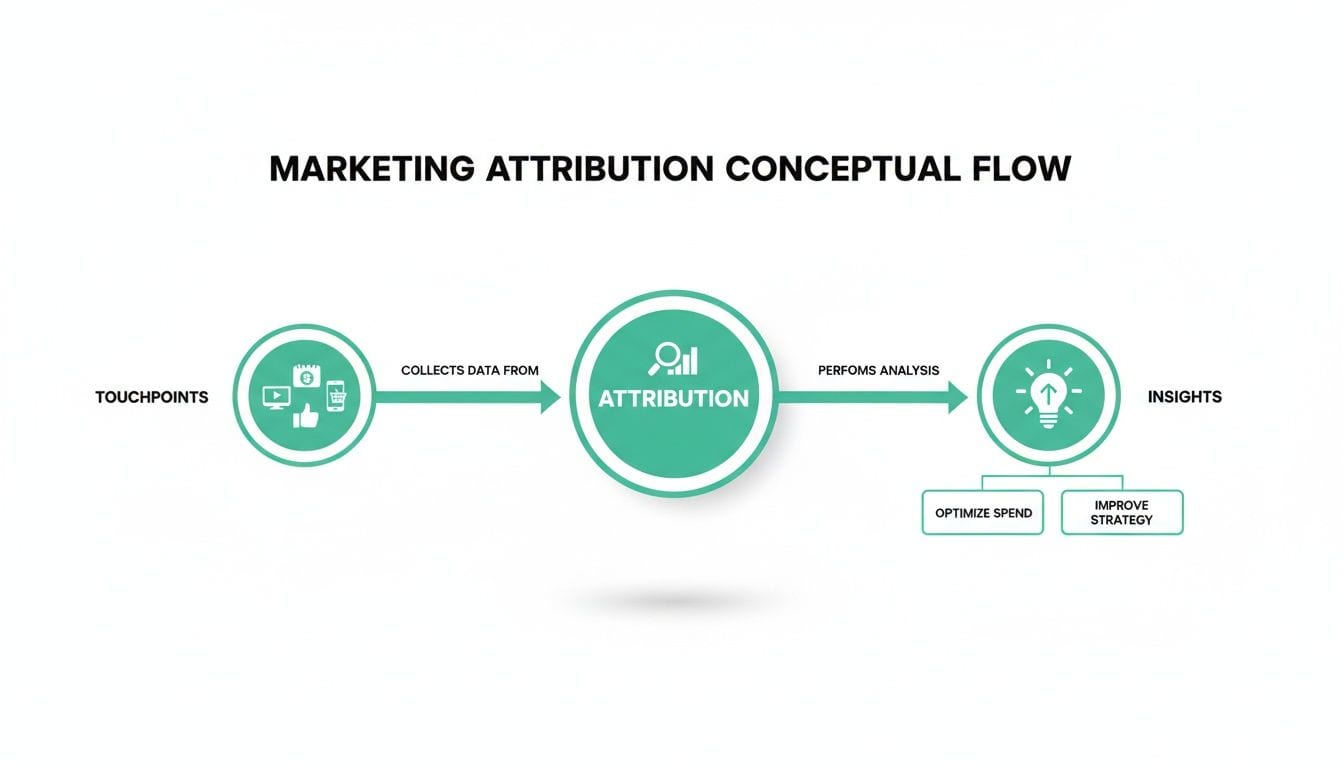
This flow is the backbone of attribution: collecting touchpoints, analyzing the path, and finding insights to make your next move smarter.
The Simplicity And Danger Of Single-Touch Models
Single-touch models are the old school, most direct way to assign credit. They work on a simple premise: give 100% of the credit for a sale to a single marketing interaction. The two most common flavors are First-Touch and Last-Touch.
-
First-Touch Attribution: This model gives all the credit to the very first interaction a customer had with your brand. If someone found you through a blog post and then converted a month later after seeing ads and getting emails, that first blog post gets all the glory. It’s a decent way to see what channels are good at kicking off the conversation.
-
Last-Touch Attribution: On the flip side, this model gives all the credit to the final touchpoint right before the conversion. A customer clicks a retargeting ad on Facebook and buys immediately? That ad gets 100% of the credit, totally ignoring everything that led them to that point.
While these models are a breeze to set up, they dangerously oversimplify the messy reality of how people buy things today. They create massive blind spots, often causing marketers to slash budgets for channels that build awareness and nurture leads—the stuff that happens in the middle.
Even as late as 2016, a surprising 12% of marketers were still clinging to the last-touch model, showing just how slow the industry can be to adapt. If you want to nerd out on the history, you can explore the evolution of marketing measurement practices.
A More Balanced View With Multi-Touch Models
As customer journeys got tangled across more channels, multi-touch attribution models stepped in to offer a more balanced and realistic picture. Instead of putting all their eggs in one basket, these models spread the credit across multiple touchpoints.
This approach actually respects the entire journey, from that first flicker of interest to the final decision to buy.
By spreading credit across various interactions, multi-touch attribution paints a far more accurate picture of how different channels work together. It helps you avoid the critical error of cutting budget from a channel that plays a vital "assist" role just because it doesn't score the final "goal."
There are a few popular ways to slice this pie, each with its own logic:
-
Linear Attribution: This is the fairest of them all. It splits the credit equally among every single touchpoint. If there were five interactions, each one gets 20% of the credit. Simple and democratic.
-
Time-Decay Attribution: This model assumes that the most recent interactions were the most persuasive. It gives more credit to the touchpoints that happened closer to the conversion, while earlier interactions get less.
-
U-Shaped (Position-Based) Attribution: The U-shaped model gives the most credit to the bookends of the journey: the first touch (for sparking awareness) and the last touch (for sealing the deal). A common split is 40% to the first touch, 40% to the last, and the remaining 20% gets sprinkled across everything in between.
These models are a huge leap forward from single-touch, giving you a much richer understanding of how your channels are really performing.
Choosing The Right Attribution Model
So, which model is "the one"? The truth is, there’s no single perfect model for every business. The right choice hinges on things like your typical sales cycle, your main business goals, and just how complicated your customer journey is.
To help you figure it out, here’s a breakdown of how the common models stack up.
Comparing Common Marketing Attribution Models
Ultimately, picking a model isn't just a technical decision—it's a strategic one. It defines what "success" looks like for your marketing channels and directly influences where you put your time, money, and effort.
Understanding Data-Driven Algorithmic Attribution
So far, we've looked at single and multi-touch models that give credit based on rules you set. They’re structured and predictable. But what if the model could tell you which touchpoints matter most, instead of the other way around?
That’s exactly what data-driven or algorithmic attribution does. It ditches the predefined rules and uses machine learning to sift through your unique customer data, figuring out the true impact of each interaction along the path to conversion.
Instead of you telling the model that the first touch is important, the model tells you.

Think of it like a super-powered analyst examining thousands of customer journeys—both the ones that converted and the ones that didn’t. The algorithm hunts for patterns a human would never spot, removing guesswork and assigning credit based on statistical probability.
How Algorithmic Models Uncover True Influence
At its core, an algorithmic model runs a massive, continuous experiment on your data. It compares the conversion rates of customers who saw a specific ad against those who didn't. If the group exposed to the ad converted at a much higher rate, the algorithm gives that ad a higher credit score. It's that simple in concept, but incredibly powerful in practice.
One of the common methods behind this is a concept called the Markov chain. Picture each marketing touchpoint as a stepping stone on a path. A Markov model calculates the odds of a customer "stepping" from one stone to the next, and eventually reaching the final "conversion" stone.
To measure a touchpoint's real value, the model digitally removes that single stone from the path and recalculates the overall conversion probability. If the probability drops significantly, it proves that stone was a critical part of the journey.
The real beauty of data-driven attribution is that it adapts to your business. It doesn't apply a one-size-fits-all template. It builds a custom model from your specific customer behavior, showing you which channels are actually driving results and which are just tagging along for the ride.
The Critical Need for High-Quality Data
For these advanced models to work their magic, they need fuel—and lots of it. We're talking about a large volume of clean, structured, and trustworthy data. Algorithmic attribution isn't magic; it's pure math. Feed it bad numbers, and it will give you confidently wrong answers.
This is a non-negotiable prerequisite. You absolutely need:
- Sufficient Conversion Volume: The algorithm needs enough data points to find statistically significant patterns. A handful of conversions per month just won’t cut it.
- Complete Journey Tracking: The model needs the full picture. Gaps from missing UTMs, broken pixels, or unmonitored channels will poison the entire dataset.
- Consistent Data Structure: All your events and properties must follow a rigid naming convention and schema. Inconsistent data is just noise to an algorithm.
The push for better measurement really took off in the late 2010s as companies drowned in siloed data. By 2018, 75% of enterprises admitted that fragmented data was causing them to waste 10-20% of their ad spend. This is precisely the waste algorithmic models are designed to eliminate—but only if they're built on a solid data foundation.
Without reliable data, even the smartest AI is just a powerful machine for making bad decisions faster. If you're ready to take the leap, our guide on developing data-driven attribution models in GA4 can walk you through the implementation details.
How Marketing Attribution Tracking Actually Works
To really get marketing attribution, you have to look under the hood. Think of it as the technical plumbing that makes all the tracking possible. Without this foundation, even the most sophisticated attribution model is just a nice idea on a whiteboard.
The whole game is about collecting signals from different places and stitching them together into a coherent customer journey. It’s a lot like assembling a puzzle where each piece is a touchpoint—a click on an ad, a page view, or a form submission.
Let's follow a fictional customer, Alex, to see how it works. Imagine Alex sees an ad for your product on social media, clicks it, browses your site, and then leaves. Later, a retargeting ad catches his eye, he comes back, and finally makes a purchase. Every single step in that journey needs to be logged.
The Building Blocks of Data Collection
Several key technologies work together to capture these interactions. Each plays a specific part in logging touchpoints and connecting them to a user and, eventually, a conversion. These are the tools that turn anonymous clicks into valuable data.
Here are the main components that power attribution tracking:
-
UTM Parameters: These are just snippets of text tacked onto the end of a URL to track the source, medium, and campaign of your traffic. When Alex clicks your social media ad, the UTMs in the link tell your analytics tool, "This person came from our Q2 Facebook campaign." They are the simplest and most fundamental tool for seeing what’s working.
-
Tracking Pixels (Tags): A pixel is a tiny piece of code on your website that fires when a user does something specific, like viewing a product page or adding an item to their cart. It sends that data back to platforms like Google or Meta. This is exactly how those retargeting ads seem to follow you across the internet.
-
Marketing APIs: Application Programming Interfaces (APIs) are the messengers that let different software systems talk to each other. For example, when a purchase is made, your e-commerce platform can use an API to send conversion data directly to an ad platform, confirming that a specific ad led to a sale.
The real goal here is to create a single, persistent identity for each user across all channels. This lets you connect a click on a LinkedIn ad from last Tuesday to the purchase they made from an email link today, piecing together the full story.
The Shift Toward Server-Side Reliability
Historically, most of this tracking happened in the user's browser—a method called client-side tracking. But this approach is getting shakier by the day. Privacy features in modern browsers, the explosion of ad blockers, and the slow death of third-party cookies mean client-side pixels often fail to fire. This leaves huge gaps in your data.
This has sparked a critical shift toward server-side tracking. Instead of data going straight from the user's browser to various marketing platforms, it's first sent to your own server. From there, your server securely relays that information to your analytics and ad tools.
This method is far more durable and accurate. It neatly bypasses ad blockers and browser restrictions, leading to much more complete data. For marketers who need precision, getting familiar with server-side solutions like the Meta Conversion API is becoming non-negotiable for maintaining a clear view of campaign performance in a privacy-first world. It’s a technical shift, but it highlights just how crucial reliable data is for any attribution strategy.
Common Pitfalls That Will Break Your Attribution
Even the most sophisticated attribution model is worthless if it's fed bad data. Think of it like a high-performance race car—if you fill the tank with dirty, contaminated fuel, it’s not going anywhere fast. In the same way, flawed data quietly sabotages your ROI calculations and leads to some seriously misguided budget decisions.
The hard truth is that perfect data collection is a myth. Over time, small, seemingly harmless errors start to compound, creating massive blind spots in your reports. This is the point where trust in your marketing data completely erodes, leaving you second-guessing every single insight.
The Problem With Inconsistent Tagging
One of the most common culprits behind broken attribution is inconsistent UTM tagging. UTM parameters are supposed to be the foundational building blocks of campaign tracking, but they are notoriously prone to human error. A single typo, a capitalization mistake, or a slightly different naming convention can shatter your data into disconnected pieces.
For example, your analytics platform might see traffic from three different sources that are actually one and the same:
utm_source=Facebookutm_source=facebookutm_source=FB
To your software, these are three totally separate channels. This simple mistake splinters your data, making it impossible to get a clear picture of how your Facebook campaigns are really performing. You might end up killing a campaign that you think is failing, when in reality its results are just scattered across a half-dozen incorrect tags.
Broken Pixels And Rogue Marketing Events
Another classic issue is broken or missing tracking pixels. A pixel is just a tiny snippet of code that fires to record user actions, but it’s incredibly important. If a critical pixel—like the one for "add to cart" or "purchase"—gets misconfigured or accidentally deleted during a website update, those conversions simply vanish.
Suddenly, your reports show a nosedive in sales. Your last-touch model might wrongly give all the credit to a recent email click instead of the paid ad that actually drove the purchase—all because that final tracking signal was lost in translation.
Just as damaging are rogue marketing events. These are unexpected or undefined events that pop up in your data, usually thanks to outdated code or unmonitored third-party tools. These phantom events just muddy the waters, creating a ton of noise that makes it hard to identify the real, meaningful touchpoints in a customer’s journey.
The struggle to maintain accurate attribution isn't new. In fact, it traces its roots back to the 1950s with marketing mix models (MMM), a statistical approach that first let businesses quantify marketing impact. Even back then, the core principle was the same: garbage in, garbage out. You can discover more insights about the historical importance of marketing attribution to see how these foundational ideas have evolved.
The Rise Of Dark Traffic
When your tracking starts to break down, you'll often see a surge in what’s known as "dark traffic"—visits and conversions that your analytics tool incorrectly labels as "Direct." This happens whenever the original source information gets lost along the way. A user might click a link from a mobile app that doesn’t pass referral data correctly, for example.
Instead of seeing the true source, your system just defaults to "Direct," making it look like thousands of people are meticulously typing your full URL into their browser. This completely obscures the value of your actual marketing channels, making it impossible to know where your best users are truly coming from. Manual spot-checks are nowhere near enough to catch these kinds of systemic, often invisible, data quality issues.
Building a Reliable Attribution System
After seeing how easily common issues can break your attribution, it's clear that a reactive approach is a losing strategy. Fixing problems only after they’ve corrupted your reports means you’re always a step behind. To build a system you can actually trust, you have to shift from constantly fighting fires to proactive data governance.
This means building a foundation so solid that your attribution models operate on clean, reliable data from day one.
The modern framework for this is called analytics observability. Think of it as having a complete, real-time view of your data's health—from the moment it’s collected to its final destination in your reports. Instead of manually spot-checking for errors, observability uses automation to continuously monitor your entire analytics setup.

This proactive stance is what ensures the data flowing into your marketing attribution models is consistently accurate. It’s what allows you to make decisions with confidence.
A Practical Checklist for Data Reliability
Achieving analytics observability isn't just a lofty goal; it's a practical process built on clear standards and automation. It transforms your data from a source of frustration into a reliable strategic asset. Here’s a checklist to get you started.
-
Standardize Your UTM Conventions: This is non-negotiable. Create a single, enforced naming convention for all campaign parameters (
source,medium,campaign). Use lowercase, avoid special characters, and document the structure for all teams to follow. This simple step alone eliminates the data fragmentation that cripples most attribution efforts. -
Implement a Centralized Data Layer: A data layer acts as a structured source of truth for your website or app. It defines exactly what data—like user IDs, product SKUs, and transaction values—should be collected. By standardizing this layer, you ensure every analytics and marketing tool receives the same consistent information, preventing schema mismatches and lost data.
-
Adopt Automated Analytics QA: This is the core of observability. Use a platform that automatically scans your implementation for issues in real time. This system should continuously monitor for tagging errors, broken pixels, unexpected schema changes, or consent misconfigurations, alerting you the moment something goes wrong.
By automating the QA process, you move beyond the limitations of manual audits. Continuous monitoring acts as a permanent safeguard, providing the solid data foundation required for any marketing attribution model to succeed.
From Firefighting to Confident Decisions
This framework fundamentally changes how you manage marketing data. Instead of discovering a massive drop in conversions a week after a bad code deployment, you get an instant alert that a critical purchase pixel is broken.
Rather than scratching your head wondering why "dark traffic" is spiking, you're notified that a new campaign was just launched with malformed UTMs.
This shift empowers your team to stop reacting to outdated, flawed reports and start proactively trusting the data in front of them. When your data foundation is solid, you can finally focus on what matters: analyzing accurate attribution insights, optimizing your marketing mix, and confidently proving your impact on the bottom line.
Frequently Asked Questions About Marketing Attribution
Diving into marketing attribution can feel like opening a can of worms. Let's tackle some of the most common questions that pop up, reinforcing the core ideas so you can move forward with a clear plan.
Which Attribution Model Is The Best One To Use?
There's no magic bullet here. The "best" model really depends on your business, your sales cycle, and just how tangled your customer journey is. Last-touch is simple, but it's like giving all the credit to the person who scored the goal, ignoring the rest of the team's passes.
Multi-touch models like Linear or U-Shaped give you a more balanced picture, which is great for more complex journeys. But if you want the highest accuracy, data-driven (or algorithmic) models are the way to go because they take the guesswork out of the equation. Just be aware they need a lot of clean, high-quality data to work their magic.
A good starting point? Map out your main marketing channels and pick a model that mirrors how you think customers actually find and engage with you.
How Can I Get Started With Marketing Attribution On A Budget?
You don’t need a massive budget to get going. The single most important first step is getting your UTM tagging right for every single campaign. It costs nothing but time, and it’s the bedrock of all your tracking efforts.
From there, just use the built-in attribution reports in tools you probably already have, like Google Analytics. Even its default models can give you a surprising amount of insight into which channels are actually pulling their weight.
The real secret is to focus on clean data collection first. Make sure your key conversion events are tracked correctly before you even think about complex models. A simple tool that just monitors your basic setup for errors can be a lifesaver, stopping bad data from poisoning your reports from day one.
How Do Privacy Changes Affect Marketing Attribution?
The slow death of third-party cookies is a huge deal. It makes tracking users across different websites much, much harder, which throws a wrench in traditional multi-touch attribution that leans heavily on browser-based tracking. For marketers trying to connect the dots over time, it’s a massive headache.
To stay in the game, businesses are shifting their focus to a few key areas:
- First-Party Data: This is gold. It’s the information you collect directly from your audience on your own properties.
- Server-Side Tracking: Instead of tracking from the user's browser, you move it to your own server. This makes it far more durable against browser restrictions and ad blockers.
- Advanced Algorithmic Models: These use machine learning to find patterns within the first-party data you can collect, filling in the gaps.
With these changes, having a rock-solid data governance and QA strategy is no longer optional—it's essential. If the first-party data you're relying on isn't accurate and trustworthy, even these new methods won't save you.
A reliable marketing attribution system is built on a foundation of clean, consistent data. Trackingplan provides automated observability to ensure your analytics are always accurate, alerting you to tagging errors, broken pixels, and schema issues in real time. Stop making decisions on bad data and see how you can build a system you trust at https://trackingplan.com.