
TL;DR:
- Tracking governance ensures data accuracy, consistency, and compliance across analytics systems.
- It involves centralized plans, cross-functional oversight, and automated validation tools.
- Effective governance reduces data errors, improves decision-making, and manages privacy and compliance risks.
Most analytics teams trust their dashboards the way drivers trust a GPS: confidently, without questioning whether the map is accurate. But tracking breaks constantly. Pixels get wiped during site updates, consent opt-outs skew conversion data, and schema mismatches silently corrupt attribution models. Tracking governance is the structured management of web and app event tracking implementations, ensuring data accuracy, consistency, and compliance in digital analytics for marketing and e-commerce. Without it, your team is making expensive decisions on data that looks clean but isn’t. This article explains what tracking governance is, how it works, and why it belongs at the foundation of any serious analytics operation.
Table of Contents
- What is tracking governance?
- Core mechanics: How tracking governance works
- Edge cases, privacy, and compliance integration
- Manual vs. automated tracking governance: Key comparisons
- Why most teams underestimate tracking governance—and how to get it right
- Enhance your tracking governance with advanced solutions
- Frequently asked questions
Key Takeaways
| Point | Details |
|---|---|
| Structured event tracking | Tracking governance uses event schemas and plans to guarantee reliable analytics data. |
| Automated monitoring benefits | Switching from manual to automated observability fixes tracking issues faster at scale. |
| Handles edge cases, compliance | Governance processes account for site updates, user consent, and privacy regulation complexities. |
| Centralized plans increase ROI | Mature tracking governance boosts data accuracy, team alignment, and marketing outcomes. |
What is tracking governance?
Tracking governance is the discipline of managing how digital events are defined, collected, validated, and maintained across your entire analytics stack. It covers everything from how a “purchase” event is named in your tracking plan to who approves changes when your dev team ships a new checkout flow. Think of it as the operating system underneath your analytics tools.
At its core, tracking governance ensures that data accuracy, consistency, and compliance are not left to chance. Without a structured approach, you get what most teams already have: inconsistent event names, missing parameters, broken pixels, and attribution data that contradicts itself across platforms.
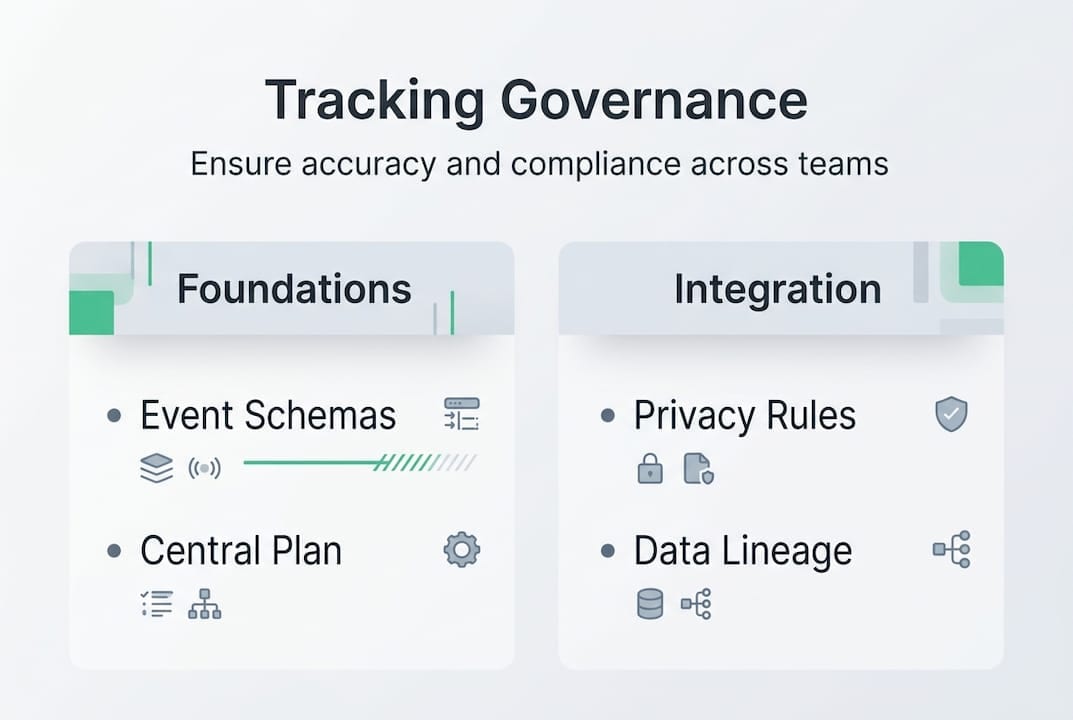
Why does this matter at scale? The data governance market is growing from $4.44 billion in 2024 to $18.07 billion by 2032, and 71% of mid-market firms struggle with data silos. These aren’t just IT problems. They translate directly into wasted ad spend, inaccurate ROAS reporting, and compliance exposure. Following governance best practices is what separates teams that optimize with confidence from teams that debate whether their numbers are even real.
Tracking governance rests on three pillars:
- People: Defined roles including data owners, governance stewards, and cross-functional stakeholders who approve tracking changes and maintain accountability.
- Processes: Documented workflows for creating, validating, updating, and retiring tracking events. This includes change management protocols and QA checkpoints.
- Technology: Automated tools that monitor live implementations, detect schema violations, flag missing pixels, and alert teams in real time when something breaks.
Organizationally, tracking governance breaks down silos between marketing, engineering, and analytics. When a campaign manager changes a UTM parameter structure, governance ensures the analytics team knows about it before it corrupts three months of attribution data. When a developer removes a legacy script, governance catches the broken pixel before it affects paid media reporting.
The ROI case is straightforward. Teams with mature governance spend less time debugging data fires and more time acting on reliable insights. They also face fewer compliance surprises when regulators come knocking.
Core mechanics: How tracking governance works
Understanding the concept is one thing. Knowing how to actually build it is another. Effective tracking governance starts with a centralized tracking plan and builds outward from there.
A centralized tracking plan serves as the single source of truth, defining event schemas with precise formats for properties, parameters, and data types, supported by automated tools for continuous monitoring and validation. This plan documents every event your organization collects, what properties it carries, who owns it, and what downstream systems depend on it.
Here is a simplified view of how a governance framework layers together:
| Layer | Component | Purpose |
|---|---|---|
| Foundation | Event schema library | Defines naming conventions and required properties |
| Oversight | Governance council | Approves new events and changes |
| Execution | Data stewards | Implement and maintain tracking per schema |
| Validation | Automated QA tools | Continuously monitor live implementations |
| Visibility | Tracking lineage maps | Show how data flows from source to destination |
The governance council typically includes representatives from marketing, analytics, engineering, and legal. This cross-functional structure ensures that a new tracking request from a campaign team goes through a review that considers both technical feasibility and compliance implications before anyone writes a single line of code.
Here is how a typical governance workflow runs:
- A stakeholder submits a request for a new tracking event.
- The governance council reviews it against schema standards and compliance requirements.
- A data steward implements the event following approved specifications.
- Automated validation tools confirm the event fires correctly in staging and production.
- The tracking plan is updated to reflect the new event and its ownership.
- Ongoing monitoring alerts the team if the event breaks or drifts from its schema.
Pro Tip: Treat your tracking plan as a living document, not a one-time setup artifact. Teams that review and update their plans quarterly catch schema drift before it becomes a reporting crisis. Pair it with automated data quality tools that scan your implementation in real time so you are not relying on manual spot checks.
Tracking lineage is often overlooked but critical. Knowing that a specific event feeds a Google Ads conversion, a Salesforce CRM field, and a Looker dashboard means you understand the blast radius when something breaks. Change management without lineage is flying blind.

Edge cases, privacy, and compliance integration
The mechanics above work well in controlled conditions. Real-world tracking is messier. Edge cases are not exceptions. They are the norm.
Tracking breaks happen when site updates wipe pixels, consent opt-outs introduce bias, third-party cookie deprecation affects cross-site tracking, and server-side discrepancies emerge from offline conversions or non-redirect payments. Each of these scenarios creates gaps in your data that compound over time if governance isn’t actively catching them.
Consider what happens during a major site redesign. A developer migrates to a new tag management container and accidentally drops three conversion pixels. Without automated monitoring, you might not notice for two weeks. By then, your paid search team has already reallocated budget based on inflated ROAS from the period before the break. That is a real cost, not a theoretical one.
Privacy regulations add another layer of complexity. Compliance requires integrating consent management and PII detection to address GDPR and CCPA requirements while maintaining data utility for campaigns. This means your governance framework must account for what data is collected, how consent is captured, and whether any personally identifiable information is leaking into analytics events where it shouldn’t be.
“Privacy compliance is not a checkbox. It is an ongoing governance function that requires the same continuous monitoring as data quality.”
Key edge cases your governance framework must address:
- Consent-driven data gaps: Users who opt out of tracking create selection bias. Governance helps you model and document these gaps rather than ignore them.
- Cookie deprecation: First-party data strategies and server-side tagging require updated schemas and new validation rules.
- Offline conversion tracking: Payment processors and CRM integrations often introduce discrepancies that only systematic attribution tracking optimization can resolve.
- PII leakage: Form field values sometimes get captured in event properties accidentally. Automated PII scanning catches this before it becomes a compliance violation.
Pro Tip: Connect your consent management data quality workflows directly to your tracking plan. When a user’s consent status changes, your governance system should automatically flag which events are affected and whether your reporting needs adjustment.
Manual vs. automated tracking governance: Key comparisons
With edge cases and compliance requirements in mind, how teams actually implement governance matters enormously. The choice between manual and automated approaches has real consequences for accuracy, speed, and scale.
Automated observability outperforms manual checks by enabling dynamic tracking plans that scan implementations in real time, privacy-first PII detection, data lineage mapping, and cross-team approval workflows for new tracking events.
| Factor | Manual governance | Automated governance |
|---|---|---|
| Speed of error detection | Days to weeks | Minutes to hours |
| Scale | Limited by team size | Scales with implementation |
| Consistency | Varies by reviewer | Standardized rules |
| Privacy compliance | Reactive | Proactive and continuous |
| Cost over time | High (labor intensive) | Lower (tooling investment) |
Manual governance has real strengths. It allows for nuanced judgment calls that automated rules might miss. Small teams with simple implementations can manage it effectively. And it forces human accountability in ways that fully automated systems sometimes bypass.
But manual governance does not scale. As your site grows, your tag count grows, your event library grows, and the number of people touching your tracking implementation grows. The error surface expands faster than any manual QA process can cover.
Centralized vs. federated governance is the other key decision: centralized models work well for small teams, while federated structures suit large organizations where individual business units need autonomy.
For most mid-to-large organizations, the right answer is automated governance with human oversight at key decision points. Automation handles continuous validation, schema enforcement, and alerting. Humans handle judgment calls, exception approvals, and strategic direction.
Additional benefits of automated governance:
- Real-time alerts when events stop firing or fire incorrectly
- Automatic detection of new, undocumented events added outside the governance process
- Continuous privacy scanning without manual audits
- Audit trails that satisfy compliance reviewers
Explore the automated observability guide and analytics automation accuracy resources to see how leading teams structure this in practice. For ongoing validation, data monitoring best practices provide a solid operational framework.
Why most teams underestimate tracking governance—and how to get it right
Here is the uncomfortable truth: most teams treat tracking governance as a setup task, not an ongoing discipline. They build a tracking plan, implement it, and move on. Six months later, the implementation has drifted, new events have been added without review, and the tracking plan is already obsolete.
The “set and forget” mindset is the single biggest risk in analytics operations. Tracking is not static. Your site changes. Your tools change. Privacy regulations change. Your governance approach must change with them.
Manual QA and static documentation cannot keep pace with this reality. The teams that get it right invest in proactive observability, where automated systems continuously verify that what is supposed to fire actually fires, and that what fires matches the approved schema.
Executive buy-in matters more than most practitioners admit. When governance is treated as an IT concern rather than a business priority, it gets underfunded and understaffed. The teams with the most reliable analytics data are the ones where leadership understands that tracking for higher ROI requires sustained investment in governance infrastructure, not just initial setup.
Cross-team commitment is equally critical. Governance fails when it belongs to one person or one team. It succeeds when marketing, engineering, analytics, and legal all have defined roles and shared accountability.
Enhance your tracking governance with advanced solutions
Understanding tracking governance is the first step. Implementing it reliably at scale is where most teams need support.
Trackingplan automates the hard parts: continuous monitoring of your web tracking monitoring implementation, real-time alerts when pixels break or events drift from their schemas, and privacy compliance scanning through the Privacy Hub. It connects directly to your existing digital analytics tools so you get governance coverage without rebuilding your stack. For marketing teams and e-commerce operations that need accurate data to make confident decisions, Trackingplan turns governance from a manual burden into an automated safety net.
Frequently asked questions
How does tracking governance improve marketing campaign results?
Tracking governance prevents “garbage in, garbage out” by automating validation and ensuring campaign performance metrics stay reliable even as privacy changes like cookie deprecation reshape the data landscape. Accurate data means better optimization decisions and less wasted spend.
What are the top risks if I don’t implement tracking governance?
Without governance, 71% of mid-market firms already struggle with data silos, and organizations without mature governance face inaccurate reporting, missed compliance requirements, and lost ROI from broken or inconsistent tracking.
Which tools or methods help enforce tracking governance?
The most effective combination is a centralized tracking plan that defines event schemas as a single source of truth, paired with automated QA platforms for continuous validation and consent management tools for privacy compliance.
How is tracking governance different from regular analytics setup?
A standard analytics setup gets your tags firing. Tracking governance adds automated observability, dynamic tracking plans, PII detection, data lineage mapping, and cross-team approval workflows to ensure your setup stays accurate, compliant, and adaptable over time.