
Applying ALCOA data integrity principles to marketing is all about making sure your analytics are Attributable, Legible, Contemporaneous, Original, and Accurate. This framework, which comes from highly regulated fields, is perfect for turning marketing data from a source of endless confusion into a trustworthy asset that actually drives ROI. It's how you build real confidence in every click, conversion, and campaign metric you track.
Why Your Marketing Data Needs a Higher Standard

Let's be honest, "data integrity" can sound like a compliance headache better suited for the finance department. But what if it’s the secret weapon for unlocking genuine marketing performance? For modern marketing teams, the quality of your input data isn't just a "nice to have"—it's the entire foundation. It’s what fuels your AI personalization engines, automated bidding strategies, and every multi-million dollar campaign decision.
When your data is flawed, the consequences are immediate and painful. Bad data leads straight to misattributed sales, completely skewed A/B test results, and budgets poured down the drain. It creates a vicious cycle of mistrust where no one believes the dashboards, leading to analysis paralysis right when you should be seizing opportunities. The stakes are simply too high to keep operating on guesswork.
The Real-World Cost of Bad Data
In the fast-paced world of digital marketing, integrity issues have been quietly eroding trust for years. We saw this firsthand with a major global brand that was running Google Analytics and Facebook Pixel setups across more than 50 markets. They were stunned to discover that 68% of their tracked events were inaccurate due to rogue tags and inconsistent UTM conventions.
This mess directly compromised the 'Accurate' and 'Original' pillars of ALCOA, leading to seriously misinformed budget allocations.
The core problem is that without a systematic framework, data quality degrades silently. A broken pixel here, an inconsistent UTM parameter there—these small errors compound until your analytics dashboards become a work of fiction.
Connecting Principles to Daily Challenges
To get a handle on this, it's helpful to translate the formal ALCOA principles into the language of marketing analytics. This gives teams a shared vocabulary and a clear set of standards to uphold.
Here's a quick reference for mapping each principle to a common marketing data challenge and its solution.
Translating ALCOA Principles for Modern Marketing Teams
By adopting a framework like ALCOA, you move from reactive firefighting to proactive governance. A core challenge for marketers is identifying issues like when your affiliate data is misleading; exploring methods for fixing misleading affiliate data is critical to ensuring your data meets these higher standards.
This systematic approach is no longer optional; it's a competitive necessity. To learn more about the fundamentals, check out our comprehensive guide on what is data integrity. This shift ensures that every team member, from marketers to developers, contributes to a culture of data excellence.
Building an Attributable and Legible Data Foundation

To build a marketing analytics practice you can actually rely on, you have to start with a solid foundation. This is where the first two principles of ALCOA—Attributable and Legible—come into play. When used together, they create a transparent data pipeline that anyone on your team can understand and trust.
Think of it this way: these principles turn chaotic data streams into a structured, single source of truth. Without them, you're essentially building your entire analytics house on sand. Attributable data tells you the "who" and "when," while Legible data explains the "what" and "why."
Establishing Attributable Data Ownership
The 'Attributable' principle is all about traceability. In the world of marketing analytics, this means knowing exactly who implemented a tracking change, when they did it, and why. The days of digging through messy spreadsheets or chasing down colleagues on Slack to figure out who launched a new pixel are over.
Establishing clear ownership is the first move. Every single update to your tracking plan, whether it's a new event in Google Tag Manager or a revised UTM convention, needs a clear author and a timestamp. This creates an audit trail that is absolutely invaluable for troubleshooting.
For example, if you suddenly see a drop in conversions, an attributable system lets you quickly check if a recent tracking change is the culprit. What used to be a week-long investigation becomes a quick check of the logs.
A system of record for your analytics isn't just a best practice; it's a necessity for collaborative teams. It ensures that every stakeholder, from marketing to engineering, understands the history and context of your data implementation, which is a core part of effective data governance for analytics.
This level of accountability also prevents "rogue" tracking, where well-intentioned team members add tags without documentation and unknowingly pollute your data.
Making Your Data Legible for Humans and Machines
While 'Attributable' covers the origin of data, 'Legible' is all about its meaning. Your data has to be understandable to both the humans who analyze it and the machines that process it. Vague, inconsistent naming conventions are the enemy here—and a very common source of chaos in analytics tools.
We've all seen it: a developer implements an event called btn_click_1. What on earth does this mean? Is it the "Sign Up" button? "Download PDF"? "Contact Us"? Without clear documentation, analysts are left guessing, and any report built on this event is immediately unreliable.
This is why a strict, documented naming convention is so critical. Adopting a clear, descriptive format prevents misinterpretation and makes your data essentially self-documenting.
Common Naming Convention Mistakes
- Vague Names: Using generic terms like
clickorsubmitwithout any context. - Inconsistent Casing: Mixing
camelCase,snake_case, andPascalCaseacross your events and properties. - Lack of Structure: Not following a consistent object-action-context pattern (e.g.,
form_submit_contact).
From Vague to Valuable: An Example
Let's look at a direct comparison. Imagine you want to track clicks on the main call-to-action button that starts a free trial on your pricing page.
The legible version is instantly understandable. Anyone, from a new analyst to a seasoned product manager, can look at that event and know exactly what it represents. This clarity eliminates ambiguity and builds genuine trust in your analytics.
Building this foundation is non-negotiable, and you can see it in practice when you need to answer specific business questions. For example, getting clean data for influencer performance tracking on platforms like TikTok and Instagram is impossible without this level of clarity. By creating a single source of truth for your tracking plan, you make data accessible, trustworthy, and ready for action.
Ensuring Data Is Captured in Real-Time and at the Source

Once you’ve nailed down who is responsible for your data (Attributable) and what it all means (Legible), the next major hurdle is capturing it correctly the instant an interaction happens. This is where two more ALCOA principles are absolutely essential for marketing data integrity: Contemporaneous (recorded as it happens) and Original (the first, unaltered capture).
Getting these two right is the difference between having analytics that reflect reality and basing your strategy on a distorted picture that leads you straight to the wrong conclusions. Any delays or transformations in your data pipeline can completely skew user journey analysis and make your attribution models worthless.
The Critical Need for Contemporaneous Data
The 'Contemporaneous' principle is simple in theory but tricky in practice: data should be recorded the exact moment an action occurs. In marketing, a delay of even a few minutes can strip away crucial context. But the delays of hours or even days—which are far more common than you'd think—can be catastrophic.
Think about a typical user journey. A customer might click a paid ad, browse three product pages, add an item to their cart, get distracted, and then come back hours later to finish the purchase. If your tracking system only logs the final purchase event through a server-side process that runs overnight, you've lost the entire story.
Your attribution model will likely credit "direct traffic" for the sale, completely ignoring the impact of your paid ad spend. This is a classic example of how non-contemporaneous data leads to terrible budget decisions. Real-time, client-side event tracking is designed to capture each step of that journey as it unfolds, preserving the timeline needed for an honest analysis.
The goal is to close the gap between when a user acts and when your system records that action. The smaller the gap, the more trustworthy your analytics become, and the better you can understand the true path to conversion.
This real-time capture is fundamental to ALCOA data integrity for marketing. It's all about ensuring your timestamps are truthful, reflecting the user's actual behavior, not your system's processing schedule.
Preserving the Original Source of Truth
Just as important as capturing data in the moment is ensuring you capture its 'Original' form. This means recording the data directly from its source, before it gets modified, enriched, or filtered by any intermediary tools. In a web environment, the purest source of this data is almost always the dataLayer.
The dataLayer acts as the first, untransformed record of a user interaction. It's the raw payload of information your website generates before that data is mapped and sent off to various destinations like Google Analytics, Facebook Ads, or your CRM.
Problems start creeping in when data is transformed before it reaches all its destinations. For instance, one analytics tool might automatically change a product_id field to productId, while another tool receives the original product_id. This creates frustrating discrepancies where your platforms report different numbers for the same event, causing endless reconciliation headaches for your team.
Spotting Data Transformation Issues
Maintaining the integrity of the original event requires constant vigilance. You need to be sure that the data pushed to the dataLayer is the exact same data that arrives at every single one of your marketing and analytics platforms.
Here are a few common ways the 'Original' principle gets violated:
- Tag Management System Logic: Complex rules inside Google Tag Manager or a similar system might alter data for one tag but not another, creating subtle inconsistencies.
- Server-Side Transformations: A server-side container might enrich an event with additional data before forwarding it, but if this isn't done uniformly for every destination, discrepancies will pop up.
- Pixel-Specific Formatting: Some marketing pixels demand data in a specific format, forcing a transformation that makes the event payload different from the original dataLayer push.
To fight this, you need a system that gives you observability across your entire pipeline. By using a platform like Trackingplan, you can continuously monitor data from its source (the dataLayer) all the way to its final destinations. This allows you to automatically detect when a payload has been altered, flagging the exact point where the transformation occurred.
This continuous verification is key. It ensures that the 'Original' data you intended to collect is what you're actually analyzing, preserving the integrity of your reports and the accuracy of your strategic decisions.
Achieving True Accuracy in Your Marketing Analytics
Out of all the ALCOA principles, Accurate is the one that hits your bottom line the hardest. The other principles make sure your data shows up, is understandable, and comes from a trusted source. But accuracy is the final boss: it’s where you stop asking, "Is the data there?" and start asking, "Is the data right?"
Inaccurate data isn’t just about messy dashboards. It’s a silent killer of good strategy, triggering a domino effect of poor business decisions. It can make a failing campaign look like a wild success, hide your most valuable customer segments, or make your ROI calculations completely worthless. This is where thinking about ALCOA data integrity for marketing becomes a powerful defense for your budget and your strategy.
Getting to true accuracy isn’t a single step; it’s a multi-layered approach that gets into the weeds of your data’s structure and content. It's about being meticulous and building a system of checks and balances.
Validating Your Event Schemas
The first pillar of accuracy is schema validation. A schema is just the rulebook for an event—what it’s called and what properties (or parameters) it should have. If your purchase event is supposed to include order_id, price, and currency, but the price property is missing half the time, your revenue reports are fundamentally broken.
Think of it as a quality control checklist for every single piece of data you collect. Even a tiny mismatch, like one developer implementing productID while another uses product_id, can splinter your analytics and make it impossible to see a product’s full performance story.
True accuracy isn't a one-time audit; it's a continuous process of enforcement. Your tracking plan should serve as the blueprint, and every event firing in production must be validated against it.
A real-world validation checklist for a product_viewed event might look like this:
- Event Name: Is the event name exactly
product_viewed? - Required Properties: Does it always contain
product_id,product_name, andcategory? - Optional Properties: If
variant_idis included, is it formatted correctly? - Property Types: Is
product_idalways a string? Ispricealways a number?
This kind of detailed scrutiny is what prevents the slow, silent decay of data quality that plagues so many marketing teams.
The High Cost of Inaccuracy
The financial fallout from these "small" errors can be staggering. A Forrester report revealed that 62% of marketing teams in the US and Europe have run into data integrity failures. The consequences? These issues led to an average of $15 million in wasted ad spend per large enterprise. This was mostly because broken pixels and schema errors inflated attribution metrics by as much as 40%. You can explore more about these significant findings and what they mean for data management.
Matching Property Types and Tagging Precision
It’s not enough for a property to just be present; its data type is also critical. If your price property is sometimes sent as a number (19.99) and other times as a string ("19.99"), your analytics platform might not be able to run calculations on it, like summing up total revenue. A seemingly minor inconsistency can bring your entire financial reporting to a grinding halt.
Campaign tagging precision is another massive piece of the accuracy puzzle. Inconsistent UTM parameters—like using utm_source=google on one campaign and utm_source=Google on another—splits your data into different buckets. This makes it impossible to get a clear, accurate view of how a channel is really performing.
Common Accuracy Failures and Their Business Impact
The tangible business consequences of specific data accuracy issues are often underestimated. Here’s a breakdown of common failures and their direct impact.
The table below illustrates just how quickly a small data error can snowball into a major business problem.
These examples show that data accuracy isn't an abstract ideal—it's directly tied to revenue, strategy, and legal compliance.
Ensuring PII Compliance and Consent
Finally, accuracy in the modern era extends to compliance. An "accurate" data point must also be a compliant one. This means actively scanning for and preventing Personally Identifiable Information (PII) from leaking into your analytics tools. An email address accidentally captured as a URL parameter is a massive accuracy—and legal—failure.
This is where automated tools become non-negotiable. A platform like Trackingplan can continuously scan your data payloads for patterns that match PII, like email addresses or phone numbers, and flag them before they become a widespread compliance disaster. It also helps verify that consent flags are configured and respected correctly, ensuring you only collect data from users who have explicitly given you permission. This protects both your customers' privacy and your business from very significant regulatory risk.
Implementing a Continuous Verification Workflow
Turning ALCOA principles from a theoretical framework into a daily reality means making a big mental shift. It’s time to move past sporadic, manual audits and embrace an automated, continuous verification workflow. This is how you change data governance from a reactive chore into a proactive, collaborative habit.
The modern approach is all about real-time observability across your entire stack—web, mobile apps, and server-side. Instead of finding out a pixel broke weeks after a launch, you get an alert the moment it happens. You're building a system that doesn’t just flag problems but helps you trace them back to the source, fast.
From Manual Audits to Automated Observability
Let's be honest, the old way of ensuring data integrity was painful. Teams would burn days, sometimes weeks, manually crawling sites, digging through network requests, and trying to reconcile data in endless spreadsheets. It was slow, riddled with human error, and always out of date. By the time an audit was finally done, a new code release could make it totally obsolete.
Automated observability flips that script completely. It kicks off by creating a full, dynamic map of your entire analytics setup as it exists right now. This discovery phase gives you a comprehensive baseline—every single event, property, and pixel firing across all your digital properties. This becomes your "Original" source of truth.
From that solid foundation, you can start defining what "Accurate" looks like by setting up custom validation rules for your most critical events and campaign parameters.
This shift is fundamental. It changes the conversation from "Is our data broken?" to "Our data is working, and we'll be notified immediately if it's not." This builds trust across marketing, product, and engineering teams, as everyone is working from the same validated information.
Setting Up Your Verification Engine
Building a continuous workflow isn't a single action but a series of layered stages. Each one adds more robust checks that reinforce ALCOA data integrity for marketing.
- Automated Discovery and Baseline Creation: First, you let a tool automatically scan and map out everything you're currently tracking. This creates a living, always-up-to-date tracking plan that reflects reality, not some dusty, forgotten spreadsheet.
- Define Custom Validation Rules: Next, you translate your business logic into code. For a
purchaseevent, you might create a rule that thepriceproperty must always be a positive number and thecurrencyproperty has to be a three-letter string. - Configure Real-Time Alerts: This is where the workflow really becomes proactive. Hook up your monitoring system to tools your team already uses, like Slack or Microsoft Teams. When a validation rule fails—say, a UTM parameter doesn't match your naming convention—the right team gets an instant, actionable alert.
This process flow shows a few of the core checks in an automated data accuracy workflow.
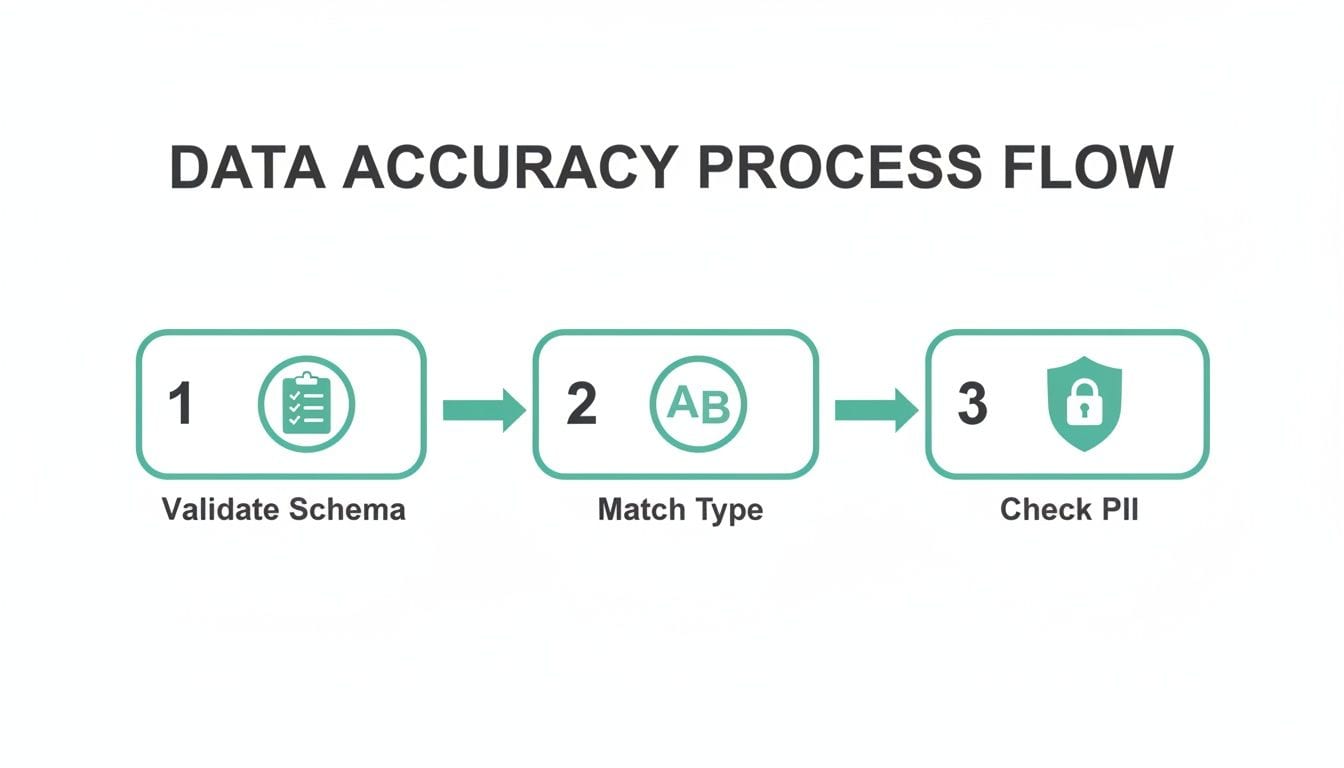
As you can see, automated systems can validate schemas, match data types, and check for PII leaks in one seamless flow, forming the backbone of a trustworthy data pipeline.
Pinpointing Errors with Precision
The real magic of a continuous workflow is its ability to deliver immediate context when something goes wrong. An alert shouldn't just tell you that something broke; it should tell you what broke, where it broke, and ideally, why. This ability to deliver precise, contextual information drastically cuts down the mean time to resolution (MTTR).
Imagine this: a performance marketing team launches a $10M Black Friday campaign across web, mobile, and server-side stacks. Later, they find that 55% of traffic anomalies were caused by inconsistent tagging—a direct violation of ALCOA's 'Consistent' and 'Complete' extensions. That's a huge problem. In fact, a Gartner survey of 500 digital agencies found that such integrity gaps cause 47% of attribution errors in major markets.
With a continuous verification system, that nightmare scenario is avoided. The second a non-compliant UTM is detected, the marketing manager gets a Slack alert with a link to the exact campaign and even the developer who last touched that part of the code. The problem is fixed in minutes, not discovered weeks later when the campaign reports are a mess.
This system effectively weaves data integrity into the fabric of your development and marketing operations, making it a shared responsibility. To go deeper on this, check out our guide on how do you ensure data integrity. It’s all about transforming governance from a siloed, top-down function into a collaborative effort that protects both your data and your bottom line.
Common Questions About ALCOA for Marketing
Bringing a formal framework like ALCOA into the fast-moving world of marketing is bound to raise some questions. It's totally natural to wonder how these principles fit into day-to-day workflows without just adding more red tape. Here, we’ll tackle the most common concerns with clear, practical answers to give you the confidence to get started.
The goal isn't about rigid compliance; it’s about building smarter, more resilient data habits.
Is Implementing ALCOA for Marketing Overkill for a Small Team?
Not at all. For a small team, thinking about ALCOA data integrity for marketing is about starting smart, not starting big. See it as a set of guardrails, not a heavy regulation. You don’t need a massive overhaul—you just need to build good habits from the get-go.
Start by focusing on the quick wins that have the highest impact:
- Legible: Just create a simple, shared document for your event naming conventions. A single source of truth works wonders.
- Attributable: Assign clear ownership for who makes tracking changes and when.
- Accurate: Lean on automated tools to catch those basic but costly errors, like broken pixels or inconsistent UTMs.
For a small team, a lightweight tool that automates discovery and monitoring is a massive time-saver compared to endless manual checks. It’s all about stopping small mistakes from snowballing into expensive problems.
The real "overkill" is spending hours digging through dashboards to troubleshoot bad data that a simple, automated check could have prevented. Adopting these principles early builds a foundation you can actually grow on.
How Does This Fit with Agile Development Cycles?
ALCOA principles are a perfect match for agile teams, especially when you bring automation into the mix. Instead of a long, manual QA process at the very end of a sprint, data integrity checks become a seamless part of the development workflow. This turns data quality into a feature, not a bottleneck.
Picture this: a developer pushes new code with tracking changes for an upcoming launch. An automated platform can instantly validate that new event against your established schema.
If there's an issue—say, a missing price property on a new purchase event—the developer gets an immediate alert right in Slack. They can fix it in minutes, long before it ever hits production and throws off your revenue dashboards. That real-time feedback loop is what agile data governance is all about.
Can We Apply ALCOA Retroactively to Our Messy Analytics Setup?
Absolutely. In fact, that's where most companies start. The trick is to avoid the temptation to boil the ocean and fix everything at once, which just leads to analysis paralysis. The key is a strategic, step-by-step approach.
Your first move is to get a baseline. Use an automated discovery tool to map out your entire analytics implementation as it stands today—every event firing, where it’s coming from, and all its properties. This gives you an Original record of your current state, mess and all.
From there, you prioritize. Zero in on your most critical user funnels, like the checkout flow or a new user signup process. Apply ALCOA principles to these high-value areas first by cleaning up their schemas, enforcing clear naming conventions, and setting up automated monitors. It’s a methodical process of bringing order to chaos, one essential funnel at a time.
Ready to build trust in your marketing data? Trackingplan provides the automated observability you need to implement ALCOA principles effortlessly. Discover tracking errors, validate your data in real-time, and ensure every marketing decision is based on analytics you can rely on. See how it works at Trackingplan.