Learn how to measure marketing effectiveness with proven strategies. Go beyond vanity metrics to validate data, choose the right models, and drive growth.
To get a real handle on marketing effectiveness, you have to look past last-click attribution. It's time to embrace a framework that ties every single marketing action to a real business outcome. This means shifting your focus to data quality, modern measurement models, and a cycle of continuous improvement, rather than clinging to outdated metrics that just don’t reflect today’s complex customer journeys.
Why Old Ways of Measuring Marketing No Longer Work
Let's be honest: the old marketing measurement playbook is broken. For years, we got by with a simple system built on cookies and last-click attribution. But that foundation is crumbling fast, thanks to privacy regulations and fundamental shifts in how people behave online. With third-party cookies being phased out by major browsers and privacy-first updates from companies like Apple, we're left with massive blind spots in our data.
This isn’t a small problem—it completely undermines our ability to understand what’s actually working. When you can't accurately track a customer's journey across different touchpoints, your attribution models become guesswork. Last-click, in particular, paints a misleading picture by giving 100% of the credit to the final interaction, completely ignoring all the critical awareness and consideration stages that came before it.
The Consequences of Flawed Measurement
Relying on this broken model leads to one thing: wasted money and missed opportunities. Marketing teams end up pouring their budgets into channels that are easy to measure (like paid search) while undervaluing the top-of-funnel activities (like content or social media) that build long-term brand equity but don't always lead to an immediate click.
This infographic paints a clear picture of the shift from old, disconnected methods to a modern, integrated approach.
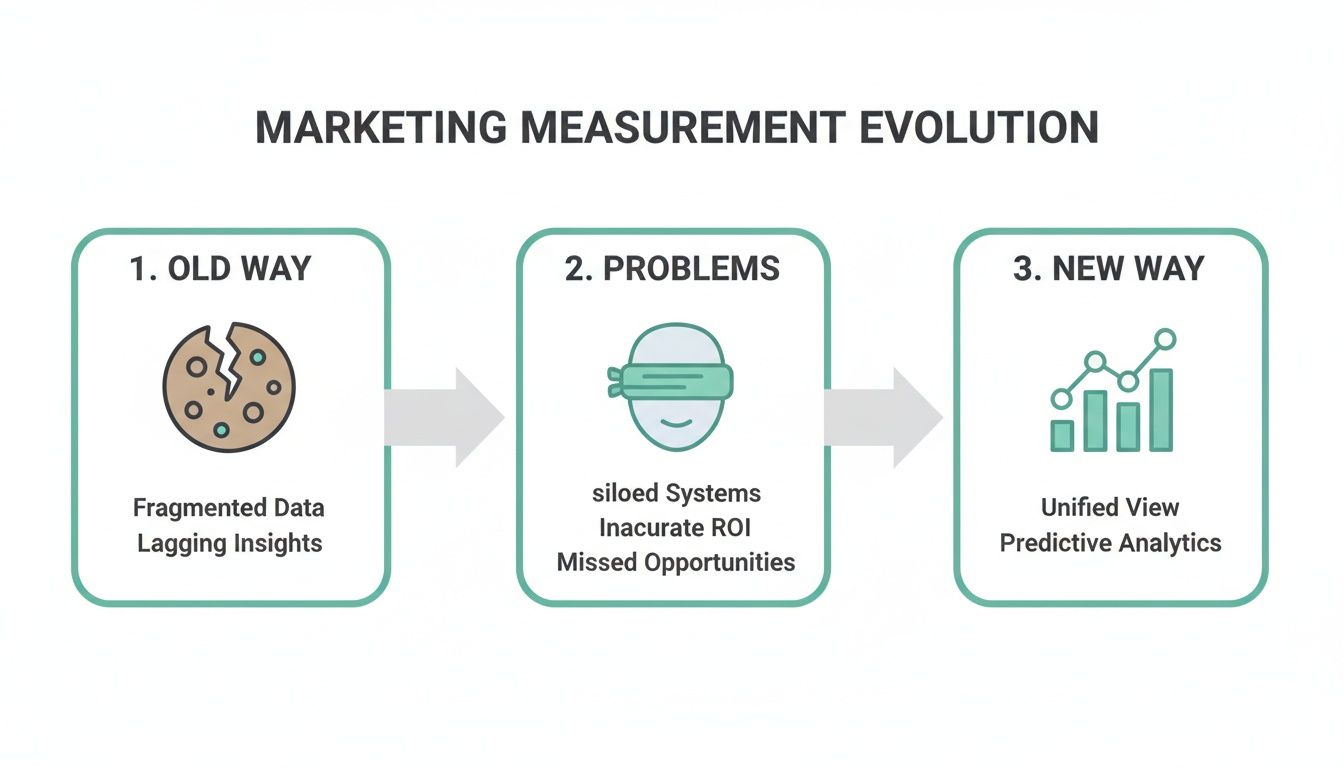
The takeaway here is that legacy tracking creates blind spots. A new, integrated system, on the other hand, brings the true customer journey into focus.
The real problem is a crisis of confidence. When leadership questions marketing spend, presenting a report based on shaky data erodes trust and positions marketing as a cost center, not a revenue driver.
To get ahead, we need a new framework. This one must be built on trustworthy data and a more sophisticated understanding of how different channels work together to drive growth. It demands a change in both mindset and technology, moving away from temporary fixes and toward a sustainable measurement strategy. It's all about building a system that can adapt to whatever comes next, giving you the clear, reliable insights needed to prove marketing's true impact on the bottom line.
Defining What Success Actually Looks Like for Your Business

Before you can measure anything effectively, you have to stop chasing metrics that don't actually matter. Real success isn't about hoarding impressive-looking numbers; it's about hitting specific business outcomes. So, before you even think about building a dashboard or tracking an event, your team needs a rock-solid answer to one question: what does success really look like for us?
This means making a deliberate shift away from vanity metrics and toward meaningful, hard-hitting goals. Clicks, impressions, and follower counts feel good, but they don't pay the bills. The real objective is to draw a straight line from every single marketing activity to a core business objective, like growing annual recurring revenue (ARR) or improving customer lifetime value (LTV).
Moving Beyond Surface-Level Metrics
One of the most common traps is measuring what’s easy instead of what’s important. This is how teams end up optimizing for metrics that have little to no real impact on growth. You’ve seen it before: a campaign generates thousands of likes but fails to produce a single qualified lead.
The way out is to build a measurement framework that starts with your business goals and works backward.
- Business Goal: Increase market share in a new region by 10% in the next fiscal year.
- Marketing Objective: Drive 5,000 demo requests from that region within six months.
- Key Performance Indicator (KPI): Cost Per Qualified Demo Request.
This top-down approach keeps you honest. It ensures every KPI you track is a direct signal of progress toward a goal your executive team genuinely cares about. This clarity is what keeps you from drowning in data and focuses your efforts on delivering tangible results.
Don’t just measure the final outcome. You also need to track intermediate metrics to understand where consumers might be getting stuck—essentially, identifying the bottlenecks in your marketing funnel. This helps you diagnose problems before they derail your entire campaign.
Aligning KPIs with the Customer Funnel
Your KPIs have to evolve with the customer journey. A metric that's crucial for building brand awareness is worlds apart from one that measures purchase intent. When you map specific indicators to each funnel stage, you get a much more nuanced and actionable picture of your performance.
Take an e-commerce brand that lives and dies by its repeat purchase metrics. For them, a top-of-funnel campaign might track Share of Voice to see if they're even on the map. As customers move into the consideration phase, the focus shifts to Add to Cart Rate. Finally, at the conversion and retention stages, they're obsessing over Customer Acquisition Cost (CAC) and Repeat Purchase Rate.
This funnel-based approach lets you pinpoint exactly where things are going wrong. If awareness is high but consideration is flat, you know you have a problem with your mid-funnel content or user experience.
Choosing the Right Indicators for Your Business Model
The right KPIs are completely dependent on your business model. What works for a B2C e-commerce store is going to be wildly different from what a B2B SaaS company needs to watch.
A SaaS company, for instance, might be laser-focused on its Trial-to-Paid Conversion Rate. That single metric tells them how well they’re turning curious prospects into paying customers. They’ll also be tracking Marketing Qualified Leads (MQLs) and Sales Qualified Leads (SQLs) to make sure marketing and sales are speaking the same language.
Here’s a practical table to help you connect your own business goals to the right KPIs across the marketing funnel.
Mapping KPIs to Funnel Stages and Business Goals
This framework is designed to help you select KPIs that directly reflect your marketing objectives at each stage of the customer journey.
By building this solid measurement foundation, you start connecting every marketing dollar to a tangible business result. This is how you move from just reporting on activity to truly demonstrating marketing's contribution to the bottom line—which is the whole point when you set out to measure marketing effectiveness.
Building Trust in Your Data with Automated Analytics QA
Every marketing insight is only as good as the data it’s built on. It’s a simple truth, but one that forms the foundation for any real attempt to measure marketing effectiveness. You can have the sharpest analysts and the most sophisticated models on the planet, but if the raw data feeding your reports is flawed, your conclusions will be, too. This is the classic 'garbage-in, garbage-out' problem that silently sabotages countless marketing teams.
Most marketers don't even realize how fragile their data pipeline is. Common issues like broken tracking pixels, inconsistent UTM parameters from a new agency partner, or rogue events fired by a recent app update can go unnoticed for weeks. These small errors quietly corrupt your datasets, leading to misattributed conversions, skewed ROI calculations, and ultimately, poor strategic decisions.
The old way of dealing with this—tedious, manual audits—just doesn’t cut it anymore. It’s slow, prone to human error, and simply can’t keep pace with modern development cycles. We need a new approach, one that shifts from reactive spot-checking to proactive, continuous monitoring.
The Shift to Automated Analytics Observability
The answer lies in a modern solution: automated analytics observability. Think of it as a dedicated watchdog for your entire marketing technology stack. Instead of manually digging through reports to find anomalies, an observability platform continuously monitors every single piece of your analytics implementation in real time.
This technology acts as an automated QA layer, observing the flow of data from its source (like the dataLayer on your website) all the way to its destinations—think Google Analytics, Amplitude, or your ad platforms. It's designed to catch problems the moment they happen, not weeks later during a quarterly review.
This proactive stance ensures the data you rely on for big decisions is consistently clean, reliable, and trustworthy. It's the only way to build a measurement foundation strong enough to support the advanced models we’ll get into later. For a deeper dive, you can learn more about the principles of comprehensive data quality monitoring in our dedicated article.
How Automated QA Pinpoints Critical Issues
An automated platform acts like a security system for your data, constantly scanning for anything that looks out of place. When it detects an issue, it doesn't just raise a generic flag; it provides the context your team needs to resolve it fast.
Here’s a look at how Trackingplan provides a clear, high-level overview of your data's health, making it easy to spot and diagnose issues.
This dashboard gives you an immediate health check, showing validated events and destinations at a glance. By centralizing this information, teams can quickly identify where data breakdowns are happening without having to log into a dozen different platforms.
But the real power comes from its ability to detect a wide range of problems automatically.
- Traffic Anomalies: Sudden drops or spikes in key events that could signal a broken user flow or a technical glitch.
- Schema Mismatches: When the structure of an event (like
product_added_to_cart) changes unexpectedly, breaking your reports. - Broken or Missing Pixels: Identifying when a crucial attribution pixel from a platform like Meta or TikTok stops firing.
- Campaign Tagging Errors: Catching inconsistent or malformed UTM parameters that muddy your channel attribution.
- Potential PII Leaks: Alerting you if personally identifiable information is accidentally being sent to your analytics tools.
When an anomaly is detected, the system sends an immediate alert via tools your team already uses, like Slack or Microsoft Teams. This alert includes root-cause analysis that pinpoints exactly where the problem originated, allowing developers to fix issues in minutes, not days.
By automating the detection of these common but critical errors, you free up your analytics and marketing teams to focus on strategy and insight generation instead of constant data firefighting. This is a fundamental shift that empowers you to trust your numbers.
Feeding Clean Data into Modern Measurement Ecosystems
This need for pristine data is becoming even more critical as the industry evolves. Top-performing brands are moving toward advanced hybrid measurement strategies that combine different models to get a complete picture.
Recent research from Deloitte Digital highlights that leading brands using these advanced methods—which triangulate data from marketing mix models, incrementality tests, and platform analytics—are achieving 2-3x higher revenue growth. This approach creates a resilient strategy that can withstand market shifts and platform changes. But it only works if the underlying data is impeccable. As you can discover in the full research about marketing measurement, automated QA platforms are essential for feeding clean, reliable data into these sophisticated, multi-method ecosystems.
Ultimately, you cannot effectively measure marketing effectiveness without first establishing trust in your data. Automated analytics QA provides the continuous validation needed to ensure every report, dashboard, and strategic decision is based on information that is accurate, complete, and reliable. It transforms data quality from a periodic, painful chore into a seamless, automated process that safeguards your most valuable marketing asset.
Choosing the Right Measurement Models for a Modern World

Once your data is clean and reliable, you can finally ditch the outdated measurement tactics that hold so many teams back. For far too long, marketers have clung to last-click attribution, a simple but deeply flawed method that gives 100% of the credit to whatever a customer clicked last. This approach completely ignores the entire journey that led them there, painting a distorted picture of what’s actually driving growth.
Modern measurement demands a more sophisticated view. It’s about embracing models that account for privacy regulations, signal loss, and the messy, non-linear paths real customers take. This isn’t just a technical fix; it's a strategic pivot toward truly understanding the incremental value of every marketing dollar.
The Comeback of Marketing Mix Modeling
One of the most powerful tools making a resurgence is Marketing Mix Modeling (MMM). Far from being a dusty relic, MMM is having a renaissance because it’s inherently privacy-friendly. It relies on aggregated, top-down statistical analysis to figure out how different marketing channels impact a specific KPI, like sales or sign-ups, over time.
Instead of tracking individual users, MMM crunches historical data to find correlations between marketing spend and business outcomes. It can factor in everything from TikTok ads to TV commercials, and even external influences like seasonality or economic shifts. This makes it an incredibly valuable tool for high-level budget allocation.
For instance, an e-commerce brand might use MMM and discover that while paid search delivers consistent, measurable conversions, their podcast sponsorships are creating a huge lift in brand awareness that leads to more direct traffic weeks down the line. Without MMM, that impact would be nearly invisible.
Pinpointing True Impact with Incrementality Testing
While MMM gives you the big-picture strategy, incrementality testing offers a more granular, tactical way to measure causal impact. This technique boils down to answering one simple but critical question: what happened because of my marketing that wouldn't have happened otherwise?
Incrementality tests work by splitting your audience into two groups: a test group that sees a specific ad or campaign and a control group that doesn’t. By comparing the conversion rates between them, you can isolate the true "lift" your marketing generated. It’s the gold standard for proving causality.
Imagine a mobile gaming app running a retargeting campaign. They could hold back 10% of their target audience as a control group. If the test group converts at 5% and the control group converts at 2%, the campaign’s real, incremental lift is 3%. This proves the ads generated conversions that would not have happened organically. You can explore different marketing attribution models and their nuances in our guide.
The biggest mistake marketers make is confusing correlation with causation. Just because a customer clicked an ad before converting doesn't mean the ad caused the conversion. Incrementality testing is the antidote to this flawed assumption.
Overcoming Measurement Bias with a Hybrid Approach
The sharpest measurement strategies today don't just pick one model and stick with it. They use a hybrid, or "triangulated," approach that pulls insights from multiple sources to build a complete picture. This balanced strategy is your best defense against the common biases that lead to bad budget decisions.
For example, many teams overvalue channels that are easy to measure while undervaluing those with a less direct attribution path. A recent Nielsen report highlighted this perfectly, showing a major gap between marketer perception and reality. While marketers planned to cut spending on traditional channels, data revealed that radio offers one of the highest ROIs globally, second only to social media. Discover more insights about how measurement bias affects channel performance on Nielsen.com.
This bias comes from the false belief that easy measurement equals effectiveness. A triangulated model helps you see past that. When choosing the right measurement models for a modern world, understanding how to measure marketing ROI is paramount.
Here is how a hybrid model works in practice:
- Marketing Mix Modeling (MMM): Use this for top-down, strategic budget planning across all your channels, including offline.
- Incrementality Testing: Deploy these tests for tactical validation of specific digital campaigns to prove causal lift and fine-tune performance.
- Platform-Level Data: Lean on data from Google Analytics, ad platforms, and other tools for real-time monitoring and day-to-day optimizations.
By blending the strategic direction of MMM with the causal proof of incrementality and the daily signals from your platforms, you create a robust system for measuring marketing effectiveness. This approach ensures you're not just measuring what’s easy, but what truly matters for sustainable growth.
Turning Your Insights into Actionable Growth Strategies
Measurement without action is just a dashboard collecting dust. After all the heavy lifting—cleaning your data, picking the right models, and analyzing performance—comes the most critical part: putting those insights to work. This is where you turn numbers and charts into real, tangible growth and build a culture of continuous improvement that actually fuels the business.
The goal here is to build a tight, closed-loop feedback system that connects your marketing, data, and development teams. When everyone is working from the same playbook and relying on the same trusted data, you break down silos and move a whole lot faster. It’s about shifting from just reporting on what happened yesterday to proactively learning and iterating for tomorrow.
Establishing a Single Source of Truth
It all starts with alignment. Nothing kills momentum faster than when the marketing team sees one conversion number in their ad platform, and the analytics team sees a completely different one. Trust in the data erodes, and progress grinds to a halt. This is why having a platform that acts as a single source of truth is non-negotiable.
For example, an observability tool like Trackingplan gives everyone a unified view of your analytics health, making sure the data flowing into every destination is consistent and correct. This shared reference point puts an end to the endless debates over whose numbers are "right" and lets your teams focus on what the data actually means for the business.
The real power of a single source of truth isn't just about data consistency; it's about building organizational trust. When teams trust the data, they trust each other's conclusions, leading to faster, more confident decision-making.
Iterating with an Agile Mindset
The insights you get from modern measurement models are the fuel for agile marketing. This isn't about some static, quarterly report. It’s an ongoing, dynamic process that should inform weekly sprints, campaign tweaks, and budget shifts in near real-time.
Think of it as a constant cycle:
- Analyze: Your models flag an underperforming channel or a high-potential audience segment.
- Hypothesize: You form a clear hypothesis, like, "Increasing spend on Channel X for Segment Y will lower our overall CAC by 10%."
- Experiment: Run a controlled test—maybe an incrementality lift study—to see if you're right, using a limited budget.
- Measure & Learn: Check the results against your baseline. Did you get the lift you expected?
- Scale or Pivot: If the experiment worked, roll it out more broadly. If not, document what you learned and move on to the next idea.
This iterative loop stops you from making massive, risky bets based on gut feelings. It replaces guesswork with a systematic process of discovery, helping you find and capitalize on new growth opportunities while keeping waste to a minimum.
Reallocating Budgets Intelligently
One of the most powerful actions you can take is to reallocate your budget based on solid data. Marketing Mix Modeling (MMM) is a beast for this, giving you a top-down view of how shifting spend between channels will likely impact your main KPIs. It’s the strategic guidance you need to pull money from channels with diminishing returns and pump it into those with untapped potential.
This isn’t just a nice-to-have anymore; it's quickly becoming the new standard. A recent EMARKETER study found that over 61% of marketers globally are adopting faster, more modern MMM approaches. This shift is happening for a reason—privacy regulations are getting stricter, and the pressure for higher ROI is intense, making old-school attribution less and less reliable. You can read more about this pivotal shift in measurement trends on analytic-edge.com.
Fostering a Culture of Experimentation
At the end of the day, turning insights into action is more of a cultural challenge than a technical one. You need leadership to champion a test-and-learn environment where "failed" experiments are seen as valuable learning opportunities, not mistakes to be punished. It’s about empowering your teams to be curious, ask tough questions, and challenge the status quo with data. For a deeper look at how to structure your findings, check out our guide on approaching marketing data analysis.
By creating these clear feedback loops, getting your teams aligned around trusted data, and embracing an agile mindset, you transform measurement from a simple reporting function into the true engine of your growth. That’s how you maximize the return on every dollar you spend and build a competitive advantage that lasts.
Frequently Asked Questions About Marketing Measurement

Jumping into a modern measurement strategy always brings up a lot of questions. We get it. Here are some direct, actionable answers to the most common hurdles marketers face when they start trying to measure what's really working.
What Is the First Step to Improve Marketing Measurement?
Before you even think about building a dashboard, you have to guarantee your data quality. It's the most critical first step, period. If the data feeding your reports is unreliable, any analysis you do on top of it is flawed from the get-go.
This is where automated analytics QA tools become fundamental. You need a system that continuously monitors your tracking for errors—catching things like broken pixels or messy campaign tags before they pollute your data. A proactive approach here is non-negotiable; it ensures the insights you generate are built on a rock-solid foundation of trustworthy information.
How Do I Measure Offline Channels Like TV or Radio?
Measuring offline channels means you have to look beyond the typical digital-only models. The best method for this is Marketing Mix Modeling (MMM), which uses statistical analysis to figure out the incremental impact of each channel—online and offline—on your goals over time.
Beyond MMM, you can get a clearer picture with a few other techniques:
- Geo-lift studies: Compare performance in markets where you ran a campaign to control markets where you didn't. This helps isolate the lift.
- Brand lift surveys: Measure shifts in key brand metrics like awareness, consideration, and purchase intent.
- Unique coupon codes or vanity URLs: These create a simple digital trail from an offline source, making attribution much more direct.
These methods help bridge the gap between your offline spend and its real-world business results.
Don’t let measurement difficulty lead to undervaluing a channel. Some of the most impactful marketing efforts, like brand-building TV ads or radio spots, are harder to track but essential for long-term growth. Use models like MMM to give them the credit they deserve.
Can I Still Rely on Google Analytics 4 for Measurement?
Yes, absolutely—but it shouldn't be your only source of truth. Google Analytics 4 is an incredible tool for understanding user behavior on your digital properties, but it's inherently limited by things like signal loss and user consent settings.
The smart move is to use GA4 as a key input into a broader, hybrid measurement framework. This means you're supplementing your GA4 data with insights from other models to get the full picture.
A truly robust strategy looks something like this:
- Marketing Mix Modeling (MMM) for high-level, strategic budget allocation.
- Incrementality testing to validate the causal impact of specific campaigns.
- GA4 and platform data for real-time, tactical performance monitoring.
By combining these sources, you can cross-validate your findings and really understand the full impact of all your marketing activities. This triangulated approach gives you the confidence to make smarter decisions and accurately measure effectiveness across your entire ecosystem.
Ready to build a foundation of trustworthy data? Trackingplan automatically monitors your entire analytics setup, detects critical errors in real time, and helps your team fix issues before they corrupt your reports. Ensure your measurement strategy is built on data you can trust by exploring Trackingplan.