
Cookies are the small text files that websites drop into a user's browser, and their connection to marketing is the bedrock of modern digital advertising. They're the engine behind everything from personalized ad campaigns to granular performance measurement, making them an indispensable tool for marketers trying to connect with their audiences.
What Cookies Are and Why They Matter for Marketing

At its heart, a cookie is just a simple text file stored on your browser by a website you visit. Think of it as a digital ticket stub. When you go to a concert, that stub proves you've been there and might even let you back in. In the same way, a cookie tells a website that your browser has visited before, helping it remember who you are.
This simple memory function powers so much of what we experience online. Without cookies, every single visit to a website would feel like the first time. You’d have to log in over and over, and your shopping cart would reset every time you navigated to a new page. It’s this technology that creates a seamless, continuous user experience.
The Role of Cookies in Personalization and Analytics
The real magic of cookies and marketing happens when we look at the data these little files collect. Marketers use this information to build experiences that feel uniquely relevant to each user. By getting a sense of someone's browsing habits and preferences, businesses can tailor their messaging and offers to be far more effective.
This data is the lifeblood for several key marketing activities:
- Personalized User Experiences: Cookies remember your settings, like your preferred language or items you've previously viewed, allowing a site to serve up content you’re actually interested in.
- Targeted Advertising: They are the core mechanism behind retargeting—you know, when ads for a product you just looked at seem to follow you across the web.
- Performance Measurement: Analytics platforms use cookies to track user journeys, measure how well campaigns are doing, and figure out which marketing channels are actually driving sales.
- Audience Segmentation: Marketers can group users based on their behavior, creating distinct segments for more focused and efficient ad campaigns.
Understanding Different Types of Cookies
Not all cookies are built the same; they're designed for different jobs. Some are absolutely essential for a site to work properly, while others are created specifically for marketing and analytics. For instance, a session cookie might just remember your login details for a single visit and then disappear the moment you close your browser.
A persistent cookie, on the other hand, sticks around for a while. It stays on your browser for a set period, enabling things like remembering your login information across multiple sessions. Another huge distinction is between first-party cookies (set by the website you're on) and third-party cookies (set by other domains), a topic we’ll get into much more detail on later.
To help clarify, here’s a quick breakdown of the most common cookie types you'll encounter.
Key Cookie Types at a Glance
This table gives you a snapshot, but the key takeaway is that each cookie has a specific purpose, from basic site functionality to complex cross-site advertising.
Cookies transform the anonymous web into a personalized journey. They are the bridge between a user's actions and a marketer's ability to deliver a relevant, helpful experience, turning raw data into meaningful engagement.
Getting these fundamentals down is the first step for any digital strategist. A solid grasp of how cookies work isn't just a technical detail anymore—it's a strategic necessity for navigating the world of online advertising and analytics. It’s the foundation that effective, data-driven marketing is built upon.
First-Party vs. Third-Party Cookies Explained
To really get what’s happening with cookies and marketing today, we have to talk about the two main players: first-party and third-party cookies. They might sound similar, but they operate in completely different worlds when it comes to their purpose, where they come from, and what they mean for user privacy. This isn't just a technical detail—it's the core issue driving the entire privacy-first shift in digital advertising.
Think of it like this: you walk into your favorite coffee shop, and the barista remembers your usual order. That’s a first-party interaction. The website you’re on (the coffee shop) puts a small file, a cookie, on your browser to remember you. It makes for a smoother, more personal experience, built on a direct relationship.
Now, imagine someone from a totally different company is standing in the corner of that same coffee shop, quietly taking notes on your order, what you're wearing, and what you're reading. Then they follow you to the bookstore and the grocery store, piecing together a detailed file on your habits. That’s a third-party cookie. It’s placed by a domain you aren't visiting, usually an ad or analytics platform, to track your behavior all over the web.
How First-Party Cookies Fuel User Experience
First-party cookies are set by the website you’re actually visiting. Their main job is to make your time on that specific site better. They're the reason you don't have to log back in on every page or why your shopping cart doesn't empty itself if you accidentally close a browser tab.
For marketers and analysts, these cookies are the foundation for essential functions:
- Personalization: They recall user preferences, like your language setting or products you’ve recently looked at, so each visit feels like it was made for you.
- Core Analytics: They help site owners see how people navigate their site, which pages get the most traffic, and where visitors tend to leave.
- Functionality: They power critical features like shopping carts and user logins, basically making a website work the way you expect it to.
Because they’re tied to a direct relationship with the user, first-party cookies are considered stable and much more privacy-friendly. Browsers have no problem with them, and most users get why they’re useful.
The Power and Peril of Third-Party Cookies
Third-party cookies, on the other hand, are the engine that has powered a huge chunk of the programmatic advertising world for years. They're created by external domains—think ad tech platforms or social media networks—and then placed on a publisher's site. Their sole purpose is to gather data on your browsing habits across tons of different, unrelated websites.
This kind of cross-site tracking is what makes some powerful marketing tactics possible:
- Ad Retargeting: Ever look at a product on one site, then see ads for it everywhere you go? That's third-party cookies at work.
- Behavioral Advertising: They help build detailed user profiles based on interests shown across the web, which are then used to serve super-targeted ads.
- Complex Attribution: They're used to try and figure out which ad or touchpoint across many different sites ultimately led to a sale.
But this widespread, often invisible, tracking is exactly what’s drawn fire from consumers and regulators. The lack of transparency and control for users has pushed major browsers like Safari and Firefox to block them by default, with Google Chrome finally making the same move.
The core conflict is simple: first-party data is about enhancing the user's experience on your site, while third-party data is about tracking the user's experience across everyone else's sites. This distinction is driving the future of digital marketing.
Even with their days numbered, a massive part of the ad industry still leans on them heavily. Recent studies show that 75% of marketers in major economies remain deeply dependent on third-party cookies. This shows just how big the gap is that businesses need to fill as they shift toward more sustainable, first-party data strategies. You can explore the full cookie tracking report for a closer look at the numbers.
As browsers clamp down, marketers are being forced into a new reality. Understanding the death of third-party cookies and why you should care about first-party data isn't just a good idea anymore—it's critical for building a marketing strategy that can survive and thrive while respecting user privacy.
Navigating Global Privacy Laws and Consent
The days of cookies and marketing operating in the Wild West are long gone. A wave of global privacy laws has completely rewritten the rulebook, putting user consent front and center. For marketers, this means the simple act of dropping a cookie is now tangled in a complex web of international regulations.
These aren't just legal documents—they represent a fundamental shift in how businesses must treat their users. The old approach of silently collecting data in the background is over. Today, transparency and explicit permission are the only way to build a compliant and trustworthy marketing strategy.
The Great Divide: GDPR vs. CCPA
The two heavyweights in this arena are Europe's General Data Protection Regulation (GDPR) and the California Consumer Privacy Act (CCPA), which has since been beefed up by the CPRA. While both are designed to protect consumer data, they take very different approaches to cookie consent, creating distinct challenges for marketers.
- GDPR (The Opt-In Model): In the European Union, the default answer is "no." You absolutely cannot place non-essential marketing or analytics cookies on a user's browser until they've given clear, affirmative consent. Forget pre-checked boxes—users must actively agree, and rejecting cookies must be just as easy as accepting them.
- CCPA/CPRA (The Opt-Out Model): California takes a different route. Businesses can place cookies when a user lands on their site, but they must offer a clear and easy way for them to opt out of their personal information being sold or shared. You'll typically see this as a "Do Not Sell or Share My Personal Information" link.
This opt-in versus opt-out distinction is a massive headache for global campaigns. A consent banner that’s perfectly fine in the United States could get you in hot water in Germany. This reality forces businesses to get smart with geo-targeted consent strategies to sidestep massive penalties. Getting a handle on understanding GDPR compliance is a non-negotiable part of modern, responsible data handling.
The global privacy shift has turned the cookie banner from a simple heads-up into a critical piece of the user experience. Its design now directly impacts your data volume, campaign performance, and legal exposure.
The Business Impact of Consent Rates
How you ask for consent has a direct, measurable impact on how much data you can actually collect. The numbers show a stark divide across the globe, and it's a real problem for analytics reliability.
To give you a clearer picture, let's look at how these regulations shape what marketers can and can't do. The table below breaks down the key differences.
Global Privacy Regulations and Their Impact on Cookies
What this means in practice is a major "consent gap" that creates huge data discrepancies. A marketing analyst might look at their dashboard and see traffic from France has fallen off a cliff. It's not because fewer people are visiting the site; it's because the majority of them have rejected the tracking cookies needed to even measure their sessions, making accurate attribution nearly impossible.
Avoiding Deceptive Dark Patterns
In a desperate attempt to juice up their opt-in rates, some companies turn to "dark patterns"—shady UI tricks designed to nudge or outright fool users into giving consent. Regulators are cracking down on these tactics, and they’re not messing around.
Here are a few common examples of non-compliant dark patterns:
- Hidden Reject Buttons: Making the "Accept All" button big, bright, and beautiful while the "Reject" option is tiny, gray text tucked away in a settings menu.
- Misleading Wording: Using confusing language like "Accept to Enhance Your Experience," which implies the site will break if you say no.
- No Clear Way Out: Forcing users to click through a maze of menus to deny consent, while accepting is just one click away.
Building a compliant, user-friendly consent experience isn't optional anymore. It’s how you avoid crippling fines, but just as importantly, it's how you build trust with your audience. To get a better sense of the stakes, it's worth learning how you can prevent privacy fines under CCPA and GDPR by making sure your tracking actually respects user choices. At the end of the day, a transparent approach is the only one that will last.
How Cookie Changes Impact Your Analytics and Pixels
All the shifts in privacy rules and browser tech have a real, direct impact on your marketing stack. Every time a user says "no" to cookies or a browser blocks a third-party script, a critical piece of data never makes it to your analytics and ad platforms. This is what we call signal loss, and it's the central problem for marketers today.
Think of your marketing pixels—like the ones from Google or Meta—as tiny digital messengers. Their job is to run back to their home platforms and report what a user did: who visited, what they looked at, and if they bought something. But when consent is denied, that messenger gets stopped at the front door. The platform never gets the message, leaving a gaping hole in your data.
This isn't just some minor headache. It fundamentally breaks the feedback loop that powers almost all digital marketing. Without reliable signals, the whole system starts to fall apart, leading you to make bad decisions based on a picture that's missing half its pieces.
The Real-World Consequences of Signal Loss
Signal loss isn’t just some abstract term for a conference talk; it has very real consequences that pop up in your daily reports and campaign dashboards. The damage is felt across your entire marketing operation, from high-level strategy down to the performance of a single ad.
Here’s what that data decay actually looks like in practice:
- Broken Attribution: Your attribution models need to connect the dots between touchpoints and conversions. When pixels don’t fire, you can't see the full customer journey. It becomes impossible to know which channels or campaigns are actually doing the heavy lifting.
- Inaccurate Conversion Tracking: A campaign could be driving a ton of sales, but if the conversion pixel is blocked for a big chunk of those buyers, your reported ROI will look terrible. This is how you end up cutting the budget for what might actually be your best-performing channel.
- Unreliable Audience Segments: Retargeting and lookalike audiences are built directly from pixel data. With signal loss, these audiences get smaller and less accurate, which tanks the effectiveness of your paid ad campaigns.
This diagram shows how the major privacy regulations are the root cause of these consent requirements, which in turn drives the data collection issues you're facing.
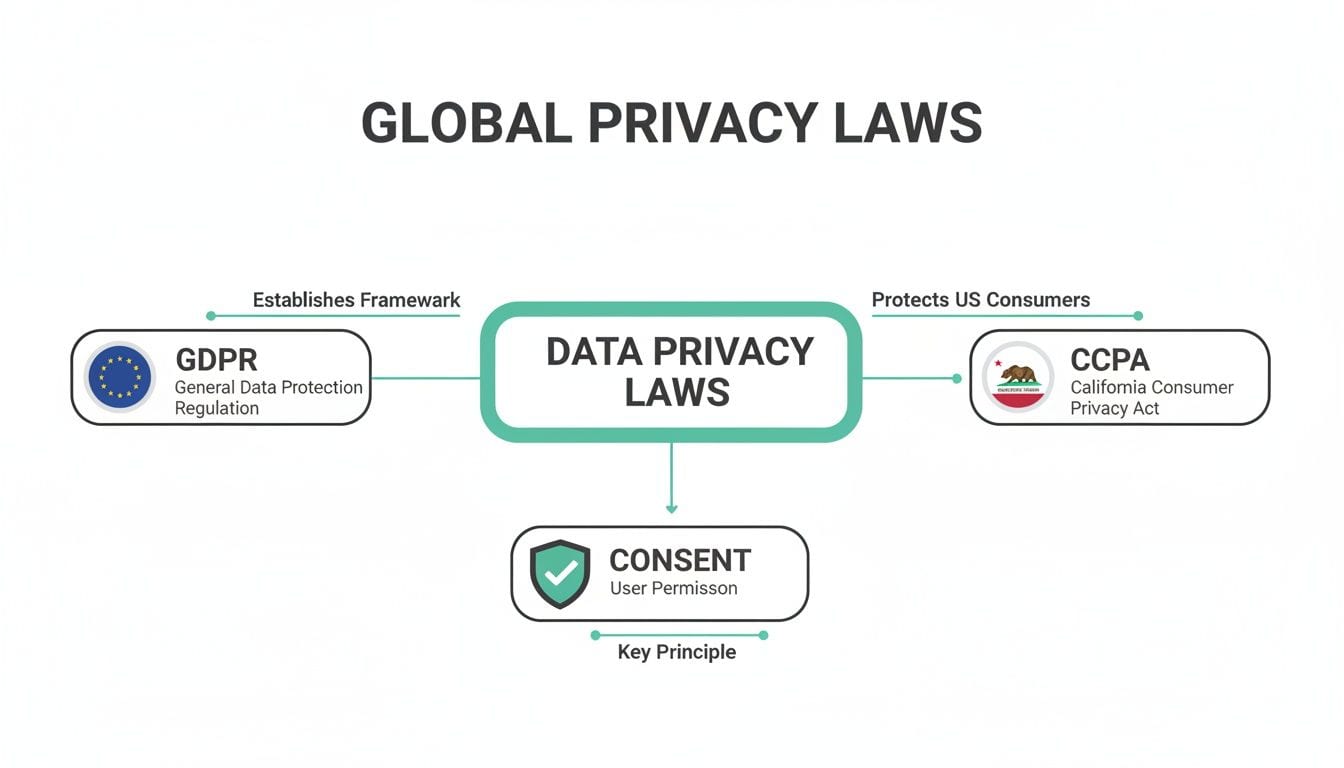
You can see how foundational laws like GDPR and CCPA have completely reshaped the consent landscape. This is the primary driver of signal loss for both your analytics tools and your marketing pixels.
Signal loss means your analytics tools are operating with blindfolds on. You're still getting some data, but you're missing huge parts of the picture, leading to misguided optimizations and wasted ad spend.
How Pixels and Analytics Platforms Are Affected
Different platforms get hit in different ways, but the core issue is always the same: a lack of complete, trustworthy data. For developers and QA teams, understanding these platform-specific impacts is key to troubleshooting problems and building more resilient tracking setups.
Take Google Analytics. When a user rejects analytics cookies, their entire session might just... disappear. It's never recorded. This obviously deflates your user counts, but it also skews all your behavioral metrics like bounce rate and makes it nearly impossible to understand your true site traffic. As teams look to migrate to GA4 with Trackingplan, making sure consent choices are correctly handled and measured is more critical than ever for maintaining data you can actually trust.
For ad pixels, like the Meta Pixel, the consequences are even more immediate and painful. Let’s walk through a super common scenario:
- Campaign Launch: You kick off a Facebook campaign for a new product.
- User Clicks Ad: A potential customer in Germany clicks your ad and lands on your site.
- Consent Banner Appears: Your GDPR-compliant banner pops up, asking for consent to use marketing cookies.
- User Rejects Cookies: The user, being privacy-savvy, clicks "Reject All."
- Pixel Fails to Fire: Because consent was denied, the Meta Pixel is blocked. It can't report the page view. It can't report the "Add to Cart" event. And it certainly can't report the final purchase.
From Meta's point of view, that user simply vanished into thin air after clicking the ad. The platform sees a click but zero conversion, so it flags the ad as ineffective. Now, multiply this exact scenario by thousands of users. Your entire campaign's performance data becomes wildly unreliable, forcing you to make decisions based on just a fraction of the real results.
Auditing Your Marketing Tech for Data Reliability
With so many potential points of failure—from browser updates to consent banners and tangled tech stacks—keeping your data clean has become a monumental task. The days of "set and forget" for your marketing pixels and analytics tools are long gone. To build your marketing efforts on a solid foundation, you need a proactive approach to auditing and quality assurance.
The old way of doing things just doesn't cut it anymore. Running a few manual spot-checks or waiting for a dashboard to break is a recipe for disaster in an environment that changes by the minute. A single website update or a small tweak to your consent banner can silently shatter your tracking, leading to weeks of bad data before anyone even spots the problem.
This reactive fire-drill wastes time, burns through resources, and erodes trust in your data. The only way to get ahead is to shift toward automated observability—a system that constantly watches your data pipelines and flags issues the second they pop up.
Common Data Integrity Issues to Find and Fix
Once you start digging into your marketing tech, you’ll likely uncover a few usual suspects behind your data decay. These silent saboteurs can quietly tank campaign performance and chip away at the accuracy of your analytics. Spotting them is the first step toward building a single source of truth everyone can rely on.
Your audit should zero in on a few critical areas:
- Missing or Mismatched Events: Are key conversion events, like
purchaseorlead_submission, firing reliably for every user who gives consent? A classic issue is a schema mismatch—a developer updates an event name in the code (say, fromaddToCarttoadd_to_cart), but nobody updates the analytics platform. Just like that, the event vanishes from your reports. - Broken Campaign Tagging: Inconsistent or busted UTM parameters are a marketer's nightmare. A simple typo in a
utm_sourceor a forgottenutm_campaigncan misattribute thousands of dollars in revenue, leaving you guessing which of your efforts are actually moving the needle. - Personally Identifiable Information (PII) Leaks: This isn't just a data problem; it's a major compliance risk. Your audit has to check if sensitive user data, like email addresses or names, is accidentally getting scooped up in non-secure fields like URL parameters or custom event properties. A leak here can lead to serious privacy violations.
Data reliability isn't a one-and-done project. It's an ongoing discipline. In a constantly changing digital world, the only way to trust your data is to continuously validate that it's being collected correctly, from the user's browser all the way to your dashboards.
Creating a Plan for Continuous Quality Assurance
Building a rock-solid QA process requires marketing, analytics, and development to be in sync. The mission is to move from chaotic, manual fire-fighting to a streamlined, automated system that acts as a reliable source of truth for the entire organization.
For a deeper look into making your marketing data more accurate and trustworthy, check out these practical strategies for improving data quality.
Putting this system in place involves a few key steps. First, you need to document your tracking plan, defining every single event, property, and parameter you intend to collect. This document becomes the blueprint for your validation rules. Next, you implement automated monitoring that continuously checks the data you’re actually collecting against that plan.
When the system spots a discrepancy—like a missing property or a broken tag—it should immediately ping the right team through tools like Slack or email. This proactive approach stops bad data at the source, ensuring that when you pull up your performance reports, you’re making decisions based on information you can actually trust.
Future-Proofing Your Marketing in a Cookieless World

As third-party cookies crumble, the marketing world isn't just getting a facelift—it's being rebuilt from the ground up on a new foundation of trust, transparency, and direct customer relationships. This isn't some fleeting trend; it's a permanent shift in how we connect with people online. To keep up, we have to move past borrowing data from others and start building our own sustainable data assets.
The most durable strategies in this new era all point back to two core pillars: collecting high-quality first-party data and adopting tougher tracking tech like server-side tagging. Think of these less as workarounds and more as fundamental upgrades to your entire marketing engine. They deliver better accuracy, stronger security, and finally, freedom from relying on other platforms.
Building Your First-Party Data Strategy
First-party data is simply the information you collect straight from your audience, with their permission. It’s like having a real conversation with your customers instead of listening to secondhand whispers. This data is inherently more accurate and relevant, making it the single most valuable asset in your marketing toolkit.
But to get people to share their information, you need to offer a clear value exchange. No one gives their email address away for nothing.
- Offer Exclusive Content: Gate your best stuff—ebooks, webinars, or deep-dive guides—behind a simple sign-up form.
- Create Loyalty Programs: Reward your repeat customers with special discounts, early access, or personalized perks they can't get anywhere else.
- Use Interactive Tools: Build fun quizzes, handy calculators, or product finders that deliver instant value while gathering useful preference data.
In a cookieless world, your first-party data strategy is your business's direct line to its customers. It's the difference between renting an audience and owning your relationships.
Embracing Server-Side Tracking
If first-party data is the what, then server-side tracking is the how. It’s a technical shift where instead of sending data from a user's browser directly to platforms like Google or Meta, you send it from your own web server first. It sounds small, but the implications for data quality and control are massive.
Imagine your website is a retail store. Client-side tracking is like letting every vendor put their own scanner at the front door, where they can easily be blocked by ad blockers or privacy settings. With server-side tracking, you have one secure scanner inside your store. It collects the data, and you decide what information gets shared with which vendor. Nothing gets lost or blocked on the way in.
This approach gives you a few major advantages:
- Improved Data Accuracy: Server-side tags aren't affected by browser ad blockers or tracking preventions, which dramatically cuts down on signal loss.
- Enhanced Security: You’re in the driver’s seat, controlling exactly what data gets sent to each platform. This helps prevent accidental PII leaks and gives you full ownership over your data stream.
- Better Site Performance: Shifting tracking scripts off the browser and onto the server can speed up your page load times, which is always a win for user experience.
Even industries that seem miles away from tech are feeling the impact of cookies and marketing. Take the actual edible cookies market—it's projected to explode from USD 26.90 billion to USD 43.49 billion by 2032. That growth is fueled by digital campaigns that use first-party data to personalize ads for specialty treats. It’s proof that direct data relationships drive results, no matter what you're selling. You can explore more data on the global cookie market's growth and trends. This pivot isn't just for tech giants; it's the blueprint for building a marketing future that lasts.
Got Questions About Cookies and Marketing? We've Got Answers.
The world of cookies and marketing can feel like a maze of technical jargon and shifting rules. If you're a marketer, analyst, or developer trying to navigate it, you're not alone. Let's clear up some of the most common questions we hear every day.
Are Advertising and Tracking Cookies the Same Thing?
Pretty much, yes. Think of advertising cookies as a specialized type of tracking cookie. Their whole job is to follow you across different websites to stitch together a profile of your interests. That profile is then used to show you ads you’re actually likely to care about.
What Really Happens When Third-Party Cookies Go Away?
When browsers block third-party cookies, marketers lose one of their go-to tools for cross-site tracking. This hits core activities hard—things like ad retargeting, behavioral advertising, and many of the attribution models we've relied on for years are directly impacted. It forces a pivot to other strategies, like building out first-party data and getting smarter with contextual advertising, just to keep reaching the right audiences.
The end of third-party cookies isn’t the end of digital marketing. It's a much-needed push toward building real customer relationships and showing genuine respect for user privacy.
How Does Cookie Consent Actually Affect My Analytics?
Cookie consent is the gatekeeper for your data. When a user says "no" to non-essential cookies, their entire session—and everything they do in it—might just disappear from your analytics. This is what we call "signal loss." It leads to underreported traffic, conversions that seem to vanish into thin air, and behavioral metrics you can't trust, making it nearly impossible to prove your campaign ROI.
So, What's the Best Alternative to Third-Party Cookies?
There’s no single magic bullet, but the most powerful and future-proof alternative is a solid first-party data strategy. This is all about collecting data directly from your audience with their full consent—think email sign-ups, loyalty programs, or exclusive content. When you pair that with privacy-first tech like server-side tracking and smart contextual ads, you're not just surviving the shift; you're building a marketing approach that's built to last.
Trackingplan gives you a fully automated observability platform, so you can finally trust that your analytics are accurate. Stop wasting time chasing down broken tracking and start making decisions with confidence. See how Trackingplan can protect your data integrity today.