
A data process agreement (DPA) is a legally binding contract that lays out the rules for how a third-party vendor can handle personal data on your behalf. Think of it as the official playbook for data protection when you bring in outside help. It ensures that vendors—from your analytics platform to your CRM—are protecting your customers’ information exactly as you’ve instructed and as the law requires.
Why a Data Process Agreement Is Non-Negotiable

Whenever personal data is shared between two businesses, two distinct roles come into play: the data controller and the data processor. Getting these straight is the first step to understanding why a DPA is so important.
-
The Data Controller: This is you. Your organization collects personal data from customers and decides why and how it should be processed. If you’re using a martech tool to send email newsletters, you’re the controller.
-
The Data Processor: This is the vendor you hire. They process personal data only on your behalf and based strictly on your instructions. In our example, the email marketing platform is the processor.
The DPA is what formalizes this entire relationship. It’s far more than a legal formality; it's a critical operational safeguard. This contract legally binds your vendors to handle data securely, confidentially, and only for the reasons you’ve approved. Without one, you’re basically handing over sensitive customer information and just hoping for the best, leaving your company exposed to massive risks.
The Driving Force Behind DPAs
To really get why DPAs are mandatory, you have to look at the powerful data privacy laws that require them. Regulations like Europe's GDPR and California's CCPA have turned these agreements from a "nice-to-have" into a legal must.
When the General Data Protection Regulation (GDPR) came into force on May 25, 2018, it completely rewrote the rules for data handling. Under Article 28 of the GDPR, data controllers are legally required to have a DPA in place with every one of their processors. This single mandate has fueled explosive growth in the GDPR services market, which was valued at USD 2,234 million in 2024 and is projected to hit USD 31,435 million by 2033. That’s a compound annual growth rate of 28.64%, a clear signal of how central these agreements have become.
More Than Just a Legal Checkbox
Ultimately, a DPA is about more than just dodging fines. It’s about building a foundation of trust and security. For marketing, analytics, and data teams, it sets clear guardrails for every tool in the martech stack.
A strong DPA ensures that your analytics tools, ad platforms, and cloud services are all aligned with your company’s data governance standards, preventing unauthorized data use and protecting your brand's reputation.
This legal framework is essential for maintaining data integrity and building the trust that keeps customers loyal. It ensures every vendor relationship strengthens, rather than weakens, your privacy posture. Managing these agreements proactively is a key part of preventing costly privacy fines under CCPA and GDPR and building a resilient data strategy.
The Core Components of a Robust Data Process Agreement
Think of a solid Data Processing Agreement like the detailed blueprint for a house. A quick sketch might show you the rooms, but the blueprint lays out everything—from the foundation's depth to the electrical wiring specs. In the same way, a strong DPA goes far beyond general statements, clearly defining every single aspect of how a vendor will handle your data.
Every clause has a job to do, and together, they build a framework of accountability and security. Getting familiar with these components is non-negotiable for anyone on your team responsible for bringing in or managing vendors.
Defining the Scope of Data Processing
The first, most fundamental part of any DPA is nailing down the "what, why, and how" of the data processing. This section should leave zero room for interpretation. It’s simply not enough to say a vendor will process "customer data"—the agreement has to get specific.
This clause typically spells out:
- The Subject Matter: What the processing is all about (e.g., managing customer support tickets, sending marketing emails).
- The Duration: How long the vendor is allowed to process the data, which usually lines up with your service contract.
- The Nature and Purpose: The specific reasons for processing (e.g., to analyze user behavior for product improvement, to personalize ad campaigns).
- Types of Personal Data: A clear list of the data categories involved, like names, email addresses, IP addresses, or cookie IDs.
- Categories of Data Subjects: Who the data belongs to—is it website visitors, registered users, or newsletter subscribers?
By documenting these elements with this level of detail, you create a legal boundary around the vendor's activities. This ensures they only process data for the explicit purposes you've authorized, preventing scope creep and sketchy data use.
Security, Audits, and Sub-Processors
Once you’ve defined the scope, the DPA has to get into the nitty-gritty of how the data will be handled responsibly. These clauses are the structural supports that give the agreement its real strength.
A well-written DPA will include specific rules for marketing database management, detailing exactly how data must be collected, stored, and protected. The demand for these services is exploding; the data processing and hosting market was valued at USD 110 billion in 2023 and is expected to more than double to USD 223.9 billion by 2030. This incredible growth shows just how critical DPAs are for securely outsourcing data work, as they legally bind processors to notify you about sub-processors and grant you audit rights under GDPR. You can learn more about this trend from the data services market report at Grandview Research.
There are three critical pillars here:
- Security Obligations: The vendor must commit to specific technical and organizational security measures. This isn’t a vague promise; it means things like encryption, access controls, and regular security testing to shield data from breaches.
- Right to Audit: This is a powerful clause. It gives you the right to actually verify that the processor is compliant. You or a third-party auditor can inspect their security practices to make sure they’re sticking to the DPA's terms.
- Sub-Processor Management: Vendors almost always use other companies (sub-processors) to help deliver their services. The DPA must require the vendor to get your written consent before bringing on a new sub-processor and ensure that any sub-processor is held to the exact same data protection standards.
Handling Incidents and Data Subject Rights
Finally, a truly robust DPA doesn't just hope for the best; it prepares for the worst. It establishes clear protocols for what happens when things go wrong and outlines how the vendor must help you meet your own compliance duties.
Key provisions to look for include:
- Data Breach Notifications: The DPA must legally require the processor to notify you "without undue delay" after discovering a data breach. This is crucial for giving you enough time to meet your own reporting deadlines, which can be as tight as 72 hours under GDPR.
- Assistance with Data Subject Rights: When your customers exercise their rights (like requesting to see or delete their data), the processor must provide the necessary help so you can respond to those requests on time.
- Data Return and Deletion: When your contract ends, what happens to your data? This clause ensures the vendor must either securely delete all of it or return it to you, based on what you decide. It stops vendors from holding onto your data forever.
A DPA isn't just a formality; it's a critical tool for protecting your data, your customers, and your business. The table below breaks down the essential clauses you'll find in almost any agreement and explains why each one is so important for your team.
Essential Clauses in a Data Process Agreement
By ensuring these clauses are clearly defined and robust, you can confidently partner with vendors while knowing your data governance is on solid ground.
How DPAs Impact Your Analytics and Martech Stack
A Data Processing Agreement isn't just another legal document filed away in a digital folder. Think of it as the operational rulebook for every single tool in your analytics and marketing stack. From Google Analytics and Segment to your advertising platforms and CRM, any vendor that touches personal data needs to be governed by a DPA. This is where legal theory gets real for data and marketing teams, fast.
Without a solid DPA, you’re essentially operating on blind faith. You assume your analytics vendor is only using session data for your benefit, or that your ad platform isn't cross-referencing your customer lists for its own projects. A well-written DPA replaces guesswork with certainty, creating a legally binding contract that forces your vendors to process data strictly on your terms.
The Real-World Risks in Your Stack
Picture this: a junior developer accidentally configures a new event that pipes personally identifiable information (PII), like an email address, directly into your analytics platform. If your DPA with that vendor doesn't explicitly forbid processing PII and require immediate notification, that sensitive data could sit on their servers for months, completely undetected. That's no longer just a mistake—it's a massive compliance breach.
These kinds of tangible risks are lurking all over a modern martech stack:
- Accidental PII Leaks: Simple tracking misconfigurations can send sensitive user info to platforms that aren't designed or secured to handle it.
- Consent Violations: A vendor might use your data for purposes your users never agreed to, like training their own AI models or sharing it with third parties.
- Rogue Events: Unplanned tracking events can capture and send data that violates the processing terms you've agreed upon, putting you in breach of your own policies.
These aren't just hypotheticals; they carry serious financial weight. By mid-2024, EU regulators had already issued €2.7 billion in GDPR fines. The telling part? Data processors were found responsible in 35% of those cases because their DPAs outlined inadequate security measures. The numbers prove why robust agreements are non-negotiable. For more on this trend, Fortune Business Insights offers a deep dive into the data privacy software market.
Enforcing Your DPA with Data Observability
A signed DPA is a great first step, but how do you make sure your vendors are actually following the rules day-to-day? This is where data observability becomes a total game-changer, transforming your DPA from a static document into a dynamic, enforceable shield.
Think of an observability platform as an automated security guard patrolling your data pipelines. It constantly monitors the data flowing to and from every tool in your stack, checking that all activity aligns perfectly with the terms of your data process agreement. This isn't just good practice; it's a core pillar of modern data governance best practices.
By monitoring your analytics and martech implementations in real time, you can instantly detect anomalies that signal a potential DPA violation. This proactive approach protects your data integrity, your marketing ROI, and your company's reputation.
For instance, a good observability solution can automatically flag:
- Schema Mismatches: If a vendor suddenly starts collecting a new data point you never authorized, you'll get an alert immediately.
- Rogue Events: An unexpected event popping up could be a sign of a misconfiguration or unauthorized data collection that violates your DPA.
- PII Leaks: Advanced systems can spot patterns that look like PII and warn you before a minor leak becomes a major compliance disaster.
By integrating data observability, you’re moving beyond just trusting your vendors to do the right thing—you’re actively verifying it. This creates a powerful feedback loop that brings your DPAs to life, ensuring the legal protections you fought for are actually reflected in your daily operations. In the end, this alignment doesn't just protect your data; it secures your marketing performance.
Your Practical Checklist for Reviewing Any DPA
A Data Processing Agreement is a dense legal document, but you don’t need a law degree to understand what’s inside. Everyone on your team—from the marketer launching a new campaign to the developer integrating a tool—should know what they’re signing up for. This checklist is designed to cut through the legalese and empower your whole team to vet a vendor’s DPA and ask the right questions before anyone signs.
Think of it like a quality control inspection. You wouldn’t accept a shipment of faulty parts for your product, so why would you accept a weak or vague DPA for your data? The goal isn’t just to check a box for compliance; it's to make sure a vendor’s promises actually line up with your own data protection standards.
Data Scope and Purpose
First things first: what data are they processing and why? This is the foundation of the entire agreement. Any ambiguity here is a massive red flag because it opens the door to scope creep, where your data gets used for things you never agreed to.
Get specific with these questions:
- Is the type of data clearly listed? The DPA needs to name names: "email addresses," "IP addresses," "user behavior data," "transaction history." A generic term like “customer data” is just too vague.
- Is the purpose crystal clear? The agreement has to spell out exactly what the vendor will do with the data. Look for explicit language like “for the purpose of sending marketing emails” or “to provide analytics reporting.”
- Is the duration defined? The DPA should tie the processing period to your main service agreement. This is crucial—it stops vendors from hanging onto your data forever after you’ve parted ways.
Security and Confidentiality Measures
Once you know the what and why, you need to get into the how. A DPA must commit the vendor to concrete technical and organizational security measures. A vague promise to “keep data secure” is basically worthless. You need to see the specifics.
A vendor’s hesitation to detail their security protocols in the data process agreement is a clear warning sign. Transparency here is not optional—it’s a direct reflection of their commitment to protecting your most valuable asset.
Drill down on their security commitments by asking:
- Does the DPA mention specific security measures like encryption of data at rest and in transit?
- Are there firm commitments to access controls to ensure only authorized personnel can get near your data?
- Does the agreement mention regular security testing or certifications you can verify, like SOC 2 or ISO 27001?
Sub-Processors and International Transfers
Let's be real: vendors rarely work in a vacuum. They almost always use other companies, known as sub-processors, for things like cloud hosting or email delivery. Your DPA needs to give you full visibility and control over this entire data supply chain. Without it, your data could get passed to a fourth or fifth party without you ever knowing.
This is a make-or-break area for negotiation. Push for clarity with these questions:
- Do you have the right to approve new sub-processors? The best DPAs require the vendor to get your written consent before bringing on someone new.
- Does the vendor maintain an up-to-date list of current sub-processors? You have every right to know exactly which companies will be handling your data.
- How are international data transfers managed? If data is moving outside of a protected region like the EU, the DPA must specify the legal mechanism protecting it, such as Standard Contractual Clauses (SCCs).
Breach Notifications and Audit Rights
Finally, a strong DPA has a plan for when things go wrong. It must spell out precisely what happens in a data breach and give you the power to verify they're actually doing what they promised. These clauses are your safety net.
Make sure the DPA gives you clear answers on these points:
- What is the timeframe for breach notification? Look for language like “without undue delay.” Anything vague here is a problem because it can leave you scrambling to meet your own legal deadlines, which can be as short as 72 hours under GDPR.
- Does the DPA grant you audit rights? This clause is non-negotiable. It gives you the legal right to inspect a vendor’s practices (or hire a third party to do it) to confirm they’re holding up their end of the bargain.
Putting Your DPA into Action for Ongoing Compliance
Signing a Data Processing Agreement is a huge step, but it’s the starting line, not the finish. To really stay compliant, you have to turn that legal document from a piece of paper in a filing cabinet into a living, breathing part of your data governance strategy. This means actually operationalizing its terms so they are actively monitored and enforced across your entire martech stack.
First things first: create a centralized repository for all your DPAs. This isn’t just about storage; it's about making these agreements easy to find and understand for the teams who work with these vendors every day. Each DPA should be linked to its vendor, with key obligations—like breach notification windows and sub-processor approval rights—summarized for a quick gut check.
Establishing Internal Workflows
Once your DPAs are organized, it's time to build the internal processes to back them up. This is where the legal promises you've made translate into day-to-day actions. A signed DPA isn't a "set it and forget it" solution; it demands active management and clear, repeatable workflows.
To put your agreements to work, focus on these core areas:
- Data Subject Requests: Map out a clear workflow for handling data subject access requests (DSARs) that a processor forwards to you. This ensures you can act fast on user demands for data access or deletion, which is a must-have under regulations like GDPR.
- Processing Activity Records: Keep detailed, up-to-date records of all processing activities. This documentation is your proof of compliance and will be your best friend if an auditor ever comes knocking.
- Regular DPA Reviews: Put calendar reminders in place to periodically review your DPAs. This is especially important when a vendor updates their services or your contract is up for renewal, ensuring the terms still fit your needs and the latest privacy laws.
The diagram below breaks down the basic flow of turning a DPA from a document into an active compliance program.
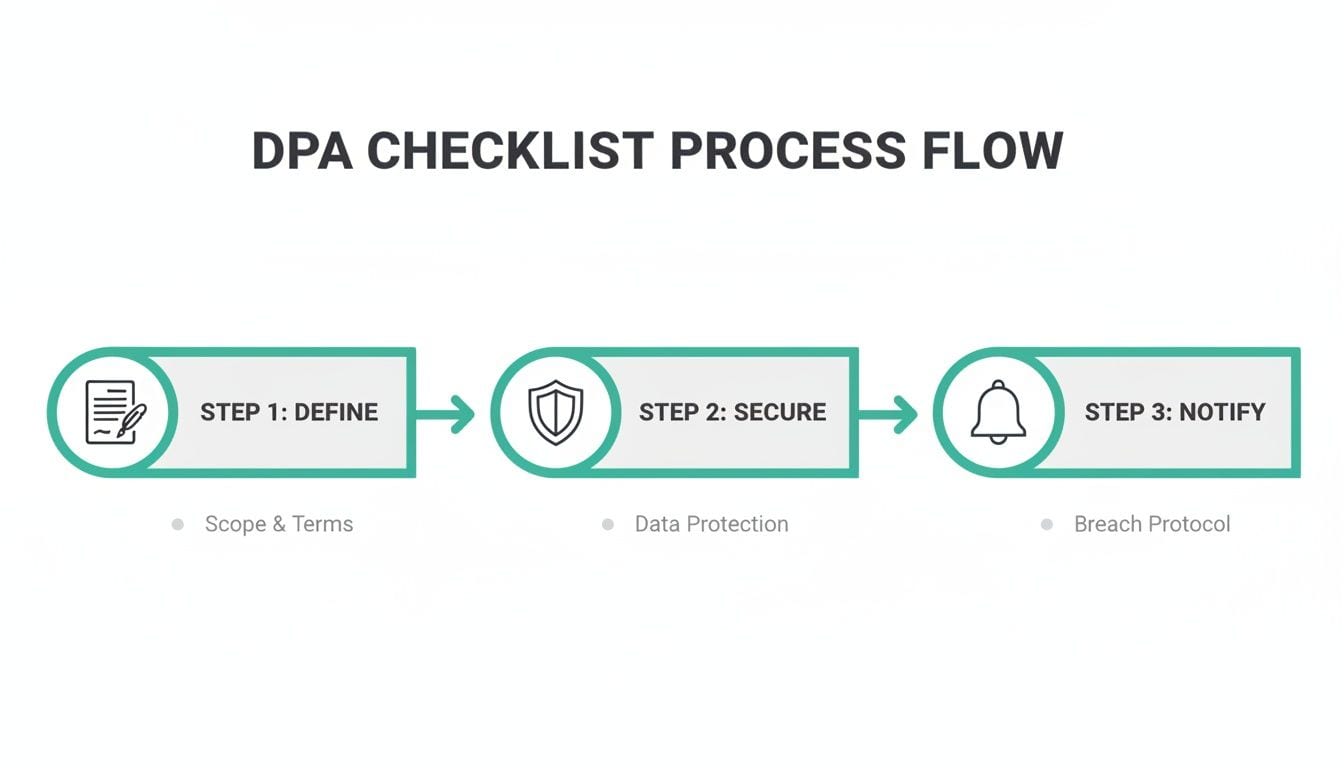
As you can see, a solid DPA strategy is a cycle: you define the terms, secure the data through active measures, and have clear notification protocols ready to go.
Using Technology to Verify Compliance
Internal processes are essential, but they often boil down to trusting that your vendors are doing what they said they would. To move from trust to verification, you need technology that gives you real-time visibility into your data flows. This is where data observability tools become non-negotiable for enforcing your data process agreement.
An observability platform acts as your eyes and ears, continuously monitoring the data exchanged with each vendor to ensure their actual processing activities align perfectly with the DPA's contractual terms.
These tools can automatically flag anomalies that point to a potential violation, like a vendor suddenly collecting unauthorized data points or a misconfiguration causing an accidental data leak. Catching these issues early is a cornerstone of a strong PII data compliance strategy, letting you fix problems before they snowball into serious breaches. By combining clear internal workflows with powerful monitoring technology, you ensure your DPAs are actively protecting your data around the clock.
Common Questions About Data Process Agreements
Even after you get the hang of what a data process agreement is all about, a few practical questions always seem to pop up. Let's tackle the most common ones head-on, so you can handle these everyday situations with confidence.
Do I Need a DPA for Every Vendor I Use?
The short answer is yes—if a vendor processes any personal data on your behalf, a DPA isn't just a good idea; it's a legal must-have. And this rule doesn’t just apply to the big-name data platforms. It covers your entire tech stack.
Think about the tools you probably use every day:
- Analytics Platforms like Google Analytics or Amplitude that track user behavior.
- CRM Systems that hold customer contact details and interaction histories.
- Email Marketing Services that handle your subscriber lists and campaign sends.
- Cloud Hosting Providers that store your application and all its user data.
If a service touches personal information at your direction, regulations like the GDPR legally require you to have a DPA in place. It's always smart to review each vendor relationship. If personal data is in the mix, a DPA is absolutely essential to protect both your company and your customers.
What Is the Difference Between a DPA and a Privacy Policy?
This is a super common point of confusion, but the difference is actually pretty simple. It all comes down to audience and purpose.
Your Privacy Policy is your public-facing promise to your customers. It's where you transparently explain how your company collects, uses, and protects their personal data. Think of it as the "here's what we do with your information" statement for your users.
A Data Process Agreement (DPA), on the other hand, is a private, legally binding contract between two businesses: you (the controller) and a vendor (the processor). It lays down the strict rules the vendor must follow when handling the data you've entrusted to them.
To put it simply: a Privacy Policy is for your customers, while a DPA is for your vendors. One builds public trust, and the other enforces private accountability.
What if a Vendor Refuses to Sign a Compliant DPA?
A vendor's refusal to sign a solid, compliant DPA should be a massive red flag. Under GDPR and similar laws, you, as the data controller, are on the hook for making sure any processor you work with meets data protection standards.
If a vendor won't put those guarantees in writing with a legally binding DPA, they're essentially refusing to be held accountable for data security. That hesitation often signals a casual attitude toward privacy laws, putting your organization at serious legal and financial risk.
In a situation like this, the only responsible move is to find an alternative provider who takes data protection as seriously as you do. Using their service without a proper DPA is a compliance gamble you simply can't afford to lose.
A signed data process agreement is just the start. To ensure your vendors truly comply with its terms, you need real-time visibility into your data flows. Trackingplan provides automated observability to monitor your entire Martech stack, detecting anomalies, PII leaks, and schema mismatches that could signal a DPA violation. Transform your DPAs from static documents into an active defense. Discover how Trackingplan enforces compliance at trackingplan.com.