
A user arrives with Global Privacy Control enabled. Your homepage loads, the CMP appears, Google Tag Manager initializes, several pixels queue in the browser, and a server-side endpoint starts enriching events. The legal question is simple enough: should you honor that signal? The operational question is where many organizations get stuck: which systems must stop, which systems may still run, and how do you prove the implementation keeps working after the next release?
That gap matters because GPC isn't just a privacy concept anymore. It affects collection logic, audience qualification, attribution, QA, and the trustworthiness of every dashboard that depends on behavioral data. For marketers, the risk is silent audience shrinkage and broken campaign measurement. For analysts, it's unexplained reporting gaps. For developers, it's another state to manage across client-side tags, APIs, and consent tooling. The teams that handle this well treat Global Privacy Control as a data governance workflow, not as a one-time legal patch.
Why Global Privacy Control Is Now a Must-Know
Many teams have heard of Global Privacy Control. Far fewer have traced what transpires after the signal enters their stack.
A browser sends GPC. The page still loads. Tags may still evaluate. A CMP may or may not override browser intent. Server-side collection may continue unless someone added explicit suppression logic. This is the fundamental problem. As Nelson Mullins notes in its discussion of the downstream operational question, digital teams have to decide what should happen across tag managers, pixels, and server-side collection when the browser sends the signal.
The problem isn't awareness. It's execution
Many organizations already have privacy banners, preference centers, and legal language in place. That doesn't mean their implementation is coherent.
Common failure patterns look like this:
- Client-side only handling: The browser signal stops a few tags in Google Tag Manager, but backend forwarding still sends data to ad platforms.
- CMP mismatch: The CMP stores one consent state while GPC implies another, and the site applies whichever state loads first.
- Property drift: One brand site honors GPC, another subdomain ignores it, and mobile web behaves differently from desktop.
- QA blind spots: A release changes tag sequencing, and no one notices that a marketing pixel now fires before privacy checks.
Practical rule: If you can't describe your GPC behavior at the browser, tag manager, and server levels, you don't have an implementation. You have assumptions.
Why it belongs on the data governance agenda
Global Privacy Control now sits at the intersection of privacy compliance and measurement quality. The legal side creates urgency. The analytics side creates complexity. If you suppress collection too broadly, reporting degrades in ways the business doesn't understand. If you suppress too narrowly, privacy risk remains.
That's why this work usually lands with cross-functional owners, not one team. Legal can define the requirement. Product and engineering can enforce it. Marketing and analytics have to understand the impact. A practical reference point is a dedicated privacy operations library such as Trackingplan's privacy hub, which is useful when teams need shared terminology for compliance and instrumentation discussions.
Understanding Global Privacy Control at a Glance
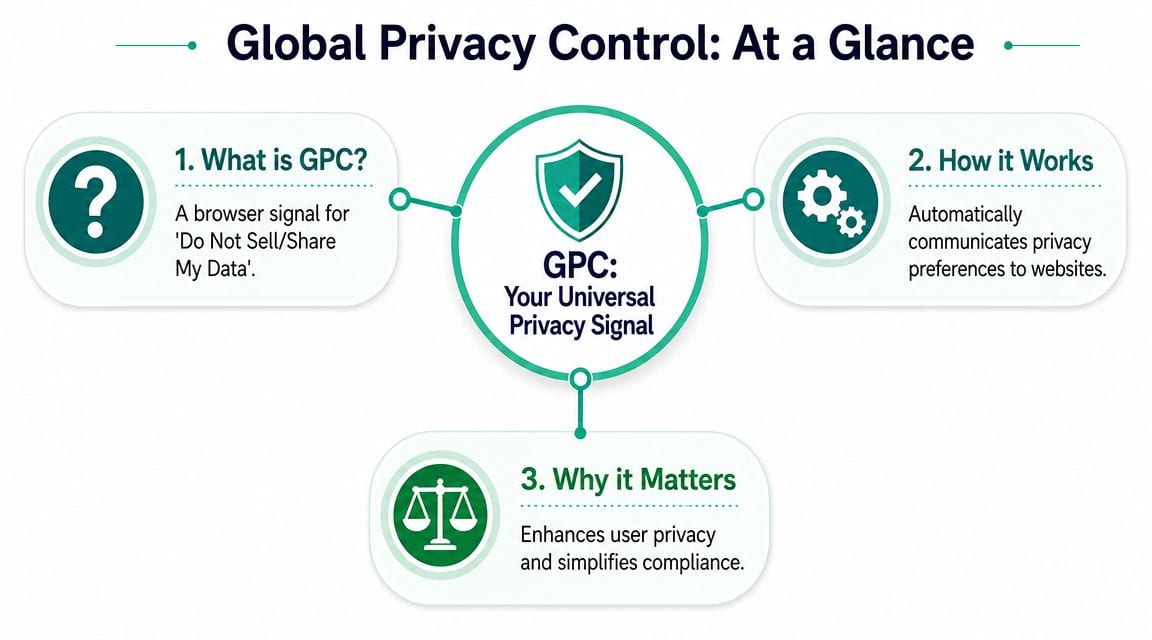
Global Privacy Control is a browser-level signal that tells websites a person doesn't want their personal information sold or shared. It was formally introduced in April 2020 at the W3C Privacy Community Group, and the specification defines a signal sent through HTTP and the DOM for that purpose, as described in the W3C GPC specification.
Think of it as a universal browser preference
The simplest analogy is a universal privacy sign. Instead of visiting each site and toggling separate "do not sell" or "do not share" controls, the browser communicates the preference automatically.
That changes the shape of implementation work. A site no longer receives only locally stored consent choices from its own interface. It may also receive an external machine-readable preference before the site has asked the visitor anything.
For teams that already maintain detailed privacy disclosures, reviewing examples like our data privacy practices can help frame the broader governance side of the problem. The signal itself is technical, but the response has to align with policy, disclosures, and downstream processing.
What the signal looks like in practice
From the user's point of view, GPC is usually just a browser or extension setting. From the website's point of view, it's an incoming flag that should influence data collection logic.
That makes it different from a banner click in one important way: the signal can exist before your own UI appears. If your implementation waits until after tags load, you've already lost the cleanest compliance path.
A lot of teams find that GPC exposes weaknesses they already had in consent orchestration. If your current setup doesn't clearly separate strictly necessary processing from analytics, advertising, and data sharing behavior, GPC will force that separation. A useful companion topic is what consent management actually needs to control, because browser-level preferences only work cleanly when your internal consent model is structured enough to receive them.
GPC is easy to understand conceptually. The hard part is turning that single browser signal into consistent behavior across every collection layer.
The Legal Mandates Driving GPC Adoption
The legal environment is what moved Global Privacy Control from a privacy feature into an engineering requirement.
California made the early shift. The California Attorney General publicly signaled in January 2021 that a browser-based GPC request would be recognized as a valid opt-out under the CCPA, and California later confirmed covered businesses must honor it as a valid request to stop sale or sharing. Broader adoption followed. As of January 1, 2025, Connecticut requires businesses subject to its privacy law to honor universal opt-out preference signals, and Maryland follows on October 1, 2025. A Securiti analysis also notes coverage including Delaware, Montana, Nebraska, New Hampshire, New Jersey, Oregon, Texas, and Minnesota in its overview of Global Privacy Control requirements and adoption.
A practical reading of the legal shift
For most digital teams, the takeaway isn't to memorize every statute. It's to recognize that browser-level opt-out handling now has to be treated as a standard privacy control in a growing set of U.S. jurisdictions.
That changes prioritization in three ways:
- Multi-state relevance: This isn't a California-only implementation anymore.
- Cross-property consistency: Enterprises need the same logic across brands, domains, and collection methods.
- Auditability: You need a defensible record of what your systems do when the signal appears.
If your stack includes experimentation or personalization tools, it's worth checking how those vendors describe their own practices. References like understanding Otter A/B data handling are helpful because experimentation systems often sit close to consent and audience logic.
GPC legal requirement deadlines by US state
| State | Law | Effective Date for GPC Recognition |
|---|---|---|
| California | CCPA and CPRA framework | January 2021 recognition signaled publicly by California Attorney General |
| Connecticut | Connecticut privacy law | January 1, 2025 |
| Maryland | Maryland law | October 1, 2025 |
| Delaware | State privacy law referenced in Securiti overview | Effective date not specified in the verified data |
| Montana | State privacy law referenced in Securiti overview | Effective date not specified in the verified data |
| Nebraska | State privacy law referenced in Securiti overview | Effective date not specified in the verified data |
| New Hampshire | State privacy law referenced in Securiti overview | Effective date not specified in the verified data |
| New Jersey | State privacy law referenced in Securiti overview | Effective date not specified in the verified data |
| Oregon | State privacy law referenced in Securiti overview | Effective date not specified in the verified data |
| Texas | State privacy law referenced in Securiti overview | Effective date not specified in the verified data |
| Minnesota | State privacy law referenced in Securiti overview | Effective date not specified in the verified data |
Adoption matters too
The GPC project says 40 million consumers use browsers and tools supporting the signal, while Securiti reports over 50 million users in its adoption overview linked above. You don't need to resolve that difference to reach the practical conclusion: the installed base is large enough that teams should expect to encounter the signal in normal traffic.
Practical Steps for GPC Implementation
The cleanest implementation starts with one principle: detect GPC as early as possible, then apply collection rules before downstream tags or sharing logic fire.
The signal can be detected via an HTTP header or a JavaScript object. The W3C explainer for GPC implementation notes that sites can detect either mechanism and enforce logic at request time before downstream tags or third-party sharing fire. That early timing is what makes the difference between a compliant setup and a leaky one.
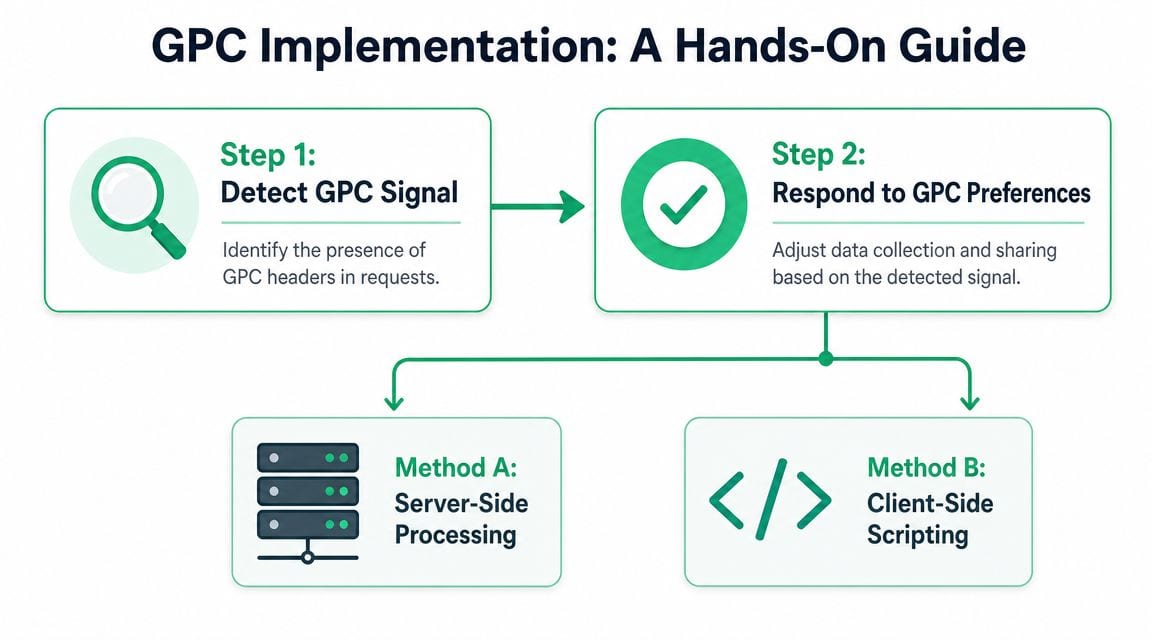
Detect the signal on the client
For browser-side logic, check the DOM-exposed property:
<script>const gpcEnabled = navigator.globalPrivacyControl === true;if (gpcEnabled) {window.dataLayer = window.dataLayer || [];window.dataLayer.push({event: 'gpc_detected',gpc: true});}</script>That snippet does one useful thing immediately: it makes the signal visible to tools like Google Tag Manager without waiting for a banner interaction.
In GTM, teams usually translate this into blocking conditions for advertising and sharing-related tags. Analytics handling is more nuanced. Some organizations suppress analytics entirely for GPC traffic. Others keep limited measurement for strictly necessary operational purposes and remove downstream sharing. The right line depends on your legal interpretation and data architecture, but the implementation should be explicit.
A related operational discipline is making sure tags don't fire before privacy logic evaluates. If that's still a weak spot in your setup, auditing tags that fire before consent is directly relevant to GPC readiness.
Detect the signal on the server
For server-side handling, inspect the request header:
app.use((req, res, next) => {const gpcHeader = req.get('Sec-GPC');req.gpcEnabled = gpcHeader === '1';next();});Then use that state before forwarding events or personal data to downstream systems:
app.post('/collect', (req, res) => {if (req.gpcEnabled) {return res.status(204).end();}// continue with normal event processingres.status(200).end();});A common oversight in many implementations occurs when teams block client-side pixels but continue sending events through server-side tagging, CDPs, or internal data pipelines. If your server receives identifiers, ad click data, or behavioral events that would support sale, sharing, or targeted advertising, GPC logic must be considered there too.
Here's a useful walkthrough from Trackingplan's channel on managing consent and collection controls in practice:
Connect GPC to your consent model
A strong implementation doesn't treat GPC as a side script. It maps the signal into your central consent state.
That usually means:
- Set precedence rules: Decide whether GPC overrides local defaults automatically for unknown users.
- Normalize categories: Map GPC to the categories your CMP and tag rules use, such as advertising, sharing, or analytics.
- Persist carefully: Store the resulting state so the site behaves consistently across pageviews without repeatedly recalculating exceptions.
- Handle conflicts deliberately: Logged-in preference centers, existing consent records, and browser-level signals shouldn't compete without explicit resolution.
Treat GPC as an input to your consent orchestration layer, not as a standalone exception bolted onto a few tags.
Testing and Monitoring Your GPC Implementation
Most GPC issues don't show up during implementation. They appear later, after a redesign, a CMP update, a new agency container, or a harmless-looking marketing request.
That's why manual testing is necessary but insufficient. Manual QA can tell you whether the current build seems right. It can't guarantee the logic will still hold across every page template, subdomain, release, and tag change.
Start with manual verification
Before automating anything, validate the basics in a browser that supports GPC or with an extension that exposes it. Open developer tools and inspect:
- Request behavior: Confirm the browser sends the signal.
- Tag execution: Check whether advertising and sharing-related requests still fire.
- Data layer state: Verify that consent state reflects GPC before dependent tags evaluate.
- Network calls after interactions: Make sure later clicks, form submits, and page transitions don't reintroduce suppressed endpoints.
This work should happen on more than the homepage. Product pages, checkout, account areas, embedded forms, localization variants, and SPA route changes often behave differently.
Then look for the quiet failure modes
The most common production problems aren't dramatic. They're subtle.
A server endpoint starts forwarding hashed identifiers after a backend refactor. A pixel blocked on landing pages still fires from a third-party widget. A CMP update changes event timing. A marketing team publishes a new tag template that bypasses existing triggers.
Manual checks catch known scenarios. Monitoring catches the regression you didn't think to test.
Why automated monitoring becomes the control layer
Once GPC is live, effective maintenance is key. An observability layer is crucial in this effort.
One option is Trackingplan, which monitors web, app, and server-side analytics implementations, discovers what tags and destinations are active, and helps teams spot missing events, rogue pixels, consent misconfigurations, and potential PII leaks. In the context of GPC, that kind of monitoring is useful because it can reveal when a previously suppressed destination starts receiving traffic again after a deployment or tag manager change.
A workable monitoring program usually includes:
- Expected tag baselines: Define which tools should never fire when GPC is present.
- Schema checks: Ensure no blocked flow reappears under a renamed event or new property structure.
- Environment coverage: Compare production, staging, and localized variants.
- Alert routing: Send failures to the teams that can fix them, whether that's engineering, analytics, or the agency managing the container.
Build repeatable QA scenarios
Instead of one-off checks, define reusable scenarios:
| Scenario | What to verify |
|---|---|
| New anonymous visitor with GPC enabled | No blocked pixels fire before or after page interaction |
| Logged-in visitor with GPC enabled | Account-level logic doesn't silently override browser signal |
| SPA navigation with GPC enabled | Route changes don't reactivate suppressed tags |
| Server-side event forwarding path | Backend collection respects the same suppression logic as client-side tags |
| Cross-domain flow | Preference handling remains consistent between domains and subdomains |
That framework turns GPC from a launch task into an operating control.
Managing GPCs Impact on Analytics and Marketing
When you honor Global Privacy Control correctly, your data changes. That isn't a bug. It's the expected result of respecting a browser-level opt-out signal.
The mistake many teams make is treating the resulting gaps as random data loss. They aren't random. They are privacy-driven exclusions, and they need to be modeled, communicated, and monitored differently from broken tagging.

What changes downstream
The impact shows up unevenly across functions:
- Attribution gets thinner: Campaign touchpoints may no longer connect cleanly when ad-platform and site analytics signals are suppressed.
- Funnels become partial: Some visitors still convert operationally, but their behavioral steps don't appear in analytics.
- Audience pools shrink: Retargeting and activation lists lose users who would previously have been addressable.
- Experiment readouts get noisier: Exposure and conversion analysis can drift when privacy states vary by browser, state, or property.
This is why GPC should be discussed with marketers and analysts before rollout, not after executives spot changes in dashboards.
What smart teams do instead of fighting the signal
The practical response is to separate three questions:
- What data collection should stop?
- What operational measurement can continue under your privacy model?
- How will reporting teams interpret the missing population?
That often leads to a measurement design with stricter audience and advertising controls, paired with more careful aggregate reporting. Teams also revisit how they use consent-aware measurement techniques and privacy-conscious architecture. If you're already adapting to a world with less browser-level persistence, cookieless tracking approaches are part of the same conversation.
Protect reporting quality with explicit annotations
Dashboards need context. If a business sees lower attributed conversions after GPC enforcement and no one explains why, the analytics team gets blamed for inconsistency.
Use release notes, dashboard annotations, and governance documentation to record:
- which properties began honoring GPC,
- which destinations were suppressed or modified,
- whether server-side forwarding changed,
- and which KPIs are most exposed to privacy-driven undercounting.
The reporting risk isn't that data gets smaller. It's that teams confuse privacy-aware measurement with broken measurement.
A Recommended Workflow for GPC Rollout
The cleanest GPC rollouts look like privacy projects at the governance level and QA projects at the execution level.
Use a cross-functional sequence
Start with legal and privacy owners. They need to define where the business must honor GPC and what "stop sale or sharing" means in your actual stack. That interpretation should be translated into system rules, not left as general guidance.
Then map the implementation surface. Include browser-side tags, CMP logic, tag manager rules, server-side collection, CDPs, ad platform connectors, and any third-party widgets that collect or transmit user data. Most surprises show up in systems that weren't in the original scope.
Roll out in this order
- Assess applicability: Identify jurisdictions, properties, and processing activities affected by GPC.
- Define behavior: Decide what happens for analytics, advertising, audience syncing, and backend forwarding when the signal appears.
- Implement early detection: Read the signal before downstream tools fire.
- Synchronize consent states: Make the CMP, data layer, and backend logic agree.
- Test critical journeys: Validate anonymous, logged-in, SPA, checkout, and cross-domain scenarios.
- Launch with monitoring: Watch for regressions, rogue tags, and inconsistent suppression across properties.
Treat rollout as an ongoing control
The strongest teams assign an owner after launch. Someone needs responsibility for change review, monitoring alerts, and ongoing QA as the martech stack evolves.
Global Privacy Control doesn't create complexity by itself. It exposes the complexity you already had.
Global Privacy Control FAQs
| Question | Answer |
|---|---|
| What is Global Privacy Control in simple terms? | It's a browser- or device-sent signal that tells websites a person doesn't want their personal information sold or shared. |
| When was GPC introduced? | It was formally introduced in April 2020 at the W3C Privacy Community Group. |
| Is GPC a browser setting or a website banner choice? | It starts as a browser or extension preference, but websites still have to detect it and apply the resulting rules in their own systems. |
| How can a site detect GPC? | A site can detect it through the HTTP header or the JavaScript object exposed in the browser environment. |
| Does GPC only matter for California? | No. California was the early legal milestone, but multiple states now recognize or require honoring universal opt-out signals. |
| What usually breaks during implementation? | The most common issues are inconsistent behavior between CMP logic, client-side tags, and server-side forwarding, plus regressions after site or tag changes. |
| Should analytics always stop when GPC is present? | That depends on your legal interpretation and data architecture. The important part is to define the rule clearly and enforce it consistently across all collection layers. |
| Why isn't manual QA enough? | Because privacy logic can drift over time. A new tag, template, plugin, or backend change can reintroduce collection without anyone noticing. |
If your team needs a repeatable way to validate GPC behavior across web, apps, and server-side endpoints, Trackingplan can help by monitoring tags, destinations, consent behavior, and data quality changes over time so privacy compliance doesn't rely on one-off manual checks.