
Most advice on how to optimize Facebook ads starts in the wrong place. It tells you to test more hooks, refresh creatives faster, tweak bids, and hunt for cheaper audiences. That advice isn't useless. It's incomplete.
If your Pixel misses purchases, your Conversions API sends duplicates, or your lead event fires on the wrong step, every optimization decision gets distorted. A “winning” ad can be a tracking artifact. A “bad” audience can be fine. Your reported ROAS can look healthy while your CRM says the opposite.
That's the playbook in 2026. Creative matters. Bidding matters. Account structure matters. But measurement quality comes first. Great media buying on top of bad data is still bad media buying.
Stop Optimizing Your Ads and Start Optimizing Your Data
Ad accounts rarely stall because a buyer forgot one bidding trick or one creative test. They stall because the account is learning from bad inputs.
Ads Manager gives useful operating signals. Impressions show whether delivery is happening at all. CTR helps judge whether the message earns attention. Conversion rate shows whether the click turns into a business action. ROAS is the number everyone wants to scale against. But every one of those metrics depends on event quality. If purchase events are missing values, if leads fire too early, or if browser and server events are duplicated, the account starts rewarding the wrong ads, audiences, and placements.
That changes how optimization should be handled. Creative testing, bid strategy, and budget shifts only work when the conversion signal is clean enough for Meta to learn from and for your team to trust.
Bad tracking creates fake winners and fake losers.
I see the same pattern in underperforming accounts. A team finds a strong-looking ad, increases spend, and calls the test a win. A few days later, pipeline quality drops or finance reports lower revenue than the platform shows. The issue was never the scaling decision by itself. The issue was that conversion reporting had already drifted away from reality.
That is why teams should monitor ad pixels before optimization decisions, not after a reporting dispute or a sudden CPA spike. Trackingplan matters here because it helps catch broken events, missing parameters, destination mismatches, and unexpected tracking changes before they contaminate optimization. Great creative can improve an account. It cannot rescue an account that is optimizing against flawed measurement.
If the signal is wrong, every later decision gets more expensive.
The Pre-Optimization Audit A Technical QA Checklist
Before changing creatives or budgets, audit the measurement stack. The workflow that makes the most sense is simple: find tracking gaps first, implement server-side Conversions API alongside the browser Pixel, then allocate budget using revenue-based metrics such as true ROAS and customer lifetime value instead of CTR or CPC alone, as described in Cometly's Facebook ads optimization workflow.
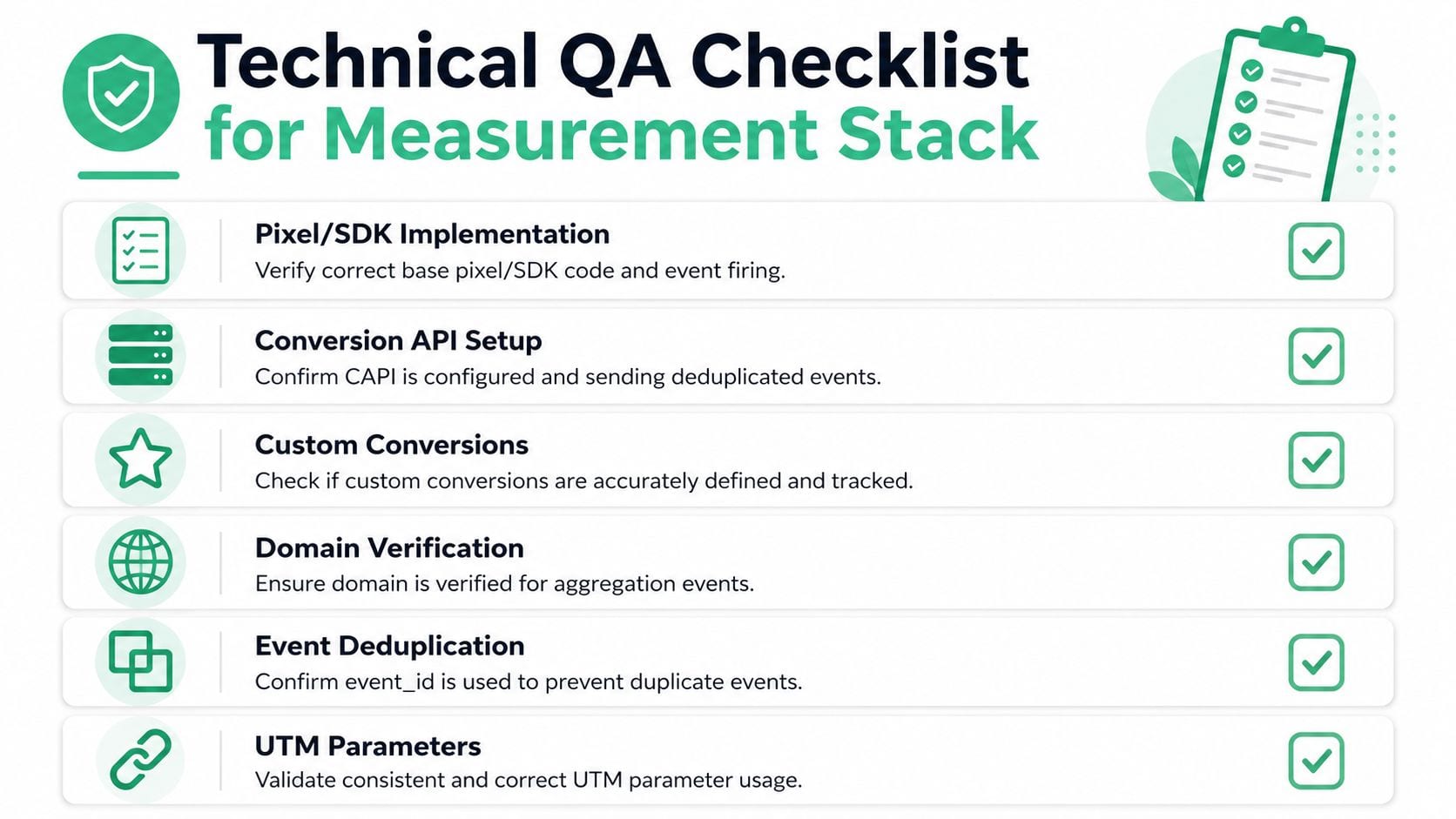
Check the event path, not just the tag
A lot of teams confirm that “the Pixel is installed” and stop there. That's not an audit. The question is whether the right events fire, with the right properties, at the right moment, and reach the right destinations consistently.
Use this checklist:
- Base implementation: Confirm the Meta Pixel or app SDK is present on the intended pages and environments.
- Event logic: Verify that events such as lead, add-to-cart, or purchase fire only when the user completes that action.
- Parameter quality: Check values, currency, content identifiers, and other event fields for completeness and consistency.
- Custom conversions: Make sure they map to real business milestones, not vanity actions.
- UTM hygiene: Validate naming conventions so campaign analysis doesn't fragment across reporting tools.
- Consent behavior: Confirm events respect consent choices and don't go unrecorded for entire user segments.
One of the fastest ways to lose confidence in Meta reporting is a mismatch between what marketers think is being tracked and what the implementation sends.
Audit Pixel and CAPI together
Server-side tracking isn't optional anymore for serious advertisers. Browser-only setups miss signal because of iOS restrictions, ad blockers, and cookie limitations. But adding CAPI poorly can make reporting worse, not better.
What to verify:
| Area | What to inspect | Common failure |
|---|---|---|
| Pixel event | Browser event fires once on valid action | Event missing or delayed |
| CAPI event | Server event mirrors the same action | Event never arrives |
| Deduplication | Shared event_id between browser and server | Double-counted conversions |
| Match quality | Customer data fields are populated correctly | Weak attribution and poor optimization signal |
| Schema consistency | Event names and parameters match across sources | Split reporting and broken optimization |
Practical rule: If Pixel and CAPI don't describe the same conversion the same way, don't use the output to judge campaign performance.
If you need a repeatable process, this Facebook Pixel audit guide is the right kind of starting point because it focuses on what breaks measurement in practice, not just whether a tag exists.
Treat analytics QA as an ongoing process
Manual checks catch snapshots. They don't protect production. That matters because event integrity breaks unnoticed. A checkout update changes a selector. A consent banner changes event timing. A developer renames a property. Suddenly the campaign didn't get worse. The measurement did.
For teams that want continuous observability, Trackingplan is one option that monitors analytics and attribution implementations across web, app, and server-side flows, including broken pixels, schema mismatches, UTM errors, and missing events. That's useful when multiple teams touch the site and no one wants to discover a tracking failure from a spend spike.
The core mindset shift is simple. Don't think of Facebook ads as ads only. Think of them as a data pipeline feeding a bidding system. If the pipeline is noisy, optimization becomes noise with a budget attached.
Structuring Campaigns for Clear Signal and Easy Scaling
A well-designed campaign structure makes performance diagnosis faster. A cluttered one turns every result into an argument about what caused the change.

The goal is simple. Build campaigns so Meta can optimize toward the business outcome you care about, and your team can read the results without guessing. If you want purchases, optimize for purchases. If you want qualified leads, optimize for the qualified lead event your sales team trusts. Traffic campaigns can have a place, but they are a poor substitute for conversion campaigns when the business expects revenue.
This matters more once spend rises. Loose structure can still produce a winner, but it rarely tells you why it won, whether it can scale, or whether the signal was clean in the first place.
Use metrics to isolate the break point
The core metrics are familiar: impressions, clicks, conversions, CTR, CPC, and ROAS. Their value is diagnostic. Read together, they show where the system is failing.
A practical read looks like this:
- Low impressions: delivery constraints, audience size, bid pressure, or a weak optimization event
- Healthy impressions with weak CTR: creative angle, offer framing, or audience mismatch
- Strong click volume with weak conversion rate: landing page friction, offer quality, or broken event firing
- Reported conversions without matching revenue quality: attribution gaps, duplicate events, or poor lead quality
That last point is where campaign structure meets measurement. If reported conversions rise after you duplicate a campaign, but your CRM or backend sales data does not move with it, the fix may sit in tracking, deduplication, or event quality rather than in media buying.
Build around one variable at a time
Campaigns should isolate the question you are trying to answer.
A practical structure looks like this:
- Campaign objective tied to a real business event: purchase, qualified lead, complete registration, or another outcome that maps to revenue
- Ad sets split by one strategic variable: broad versus lookalike, one geo versus another, one funnel stage versus another
- Ads grouped by angle: discount message together, social proof together, product education together
That structure keeps analysis clean. If audience, offer, and message all change in the same ad set, performance can improve and still teach you nothing useful.
I usually prefer fewer ad sets than teams expect. Too much segmentation fragments spend, slows learning, and creates overlapping pockets of traffic that are hard to interpret. Simpler structures are easier to scale because budget moves are easier to read.
For accounts that want to balance cleaner test design with faster budget allocation, this guide to multi-armed bandit testing for paid media experiments is useful.
For a walkthrough on signal quality and analytics foundations, this video is a useful addition:
Broad targeting often produces cleaner reads
The broad-versus-interest debate is usually treated as a targeting preference. It is also a structure and interpretation issue.
Broad targeting often gives Meta more room to find converting users, especially when the conversion signal is strong and measured correctly. It also reduces the noise that comes from stacking interests, narrowing audiences too aggressively, or creating ad sets that compete with each other. Interest targeting still has value when you are testing a specific hypothesis or entering a market with limited data. The trade-off is that tighter targeting can make results look more precise than they really are.
Readable accounts scale better. Under pressure, the winning setup is usually the one that lets you answer three questions quickly: what changed, where it changed, and whether the result is real or a measurement artifact.
A Smarter Approach to Audience and Creative Testing
“Test more creatives” is one of the least helpful pieces of Facebook ad advice. Many teams don't have a creative testing problem. They have a testing design problem.
Recent expert guidance makes a point that more advertisers should adopt: the winning unit is usually the creative angle or message, not the format itself, so advertisers should test angles separately before they test static versus video or other execution changes, as argued in this piece on why creative angle matters more than format.
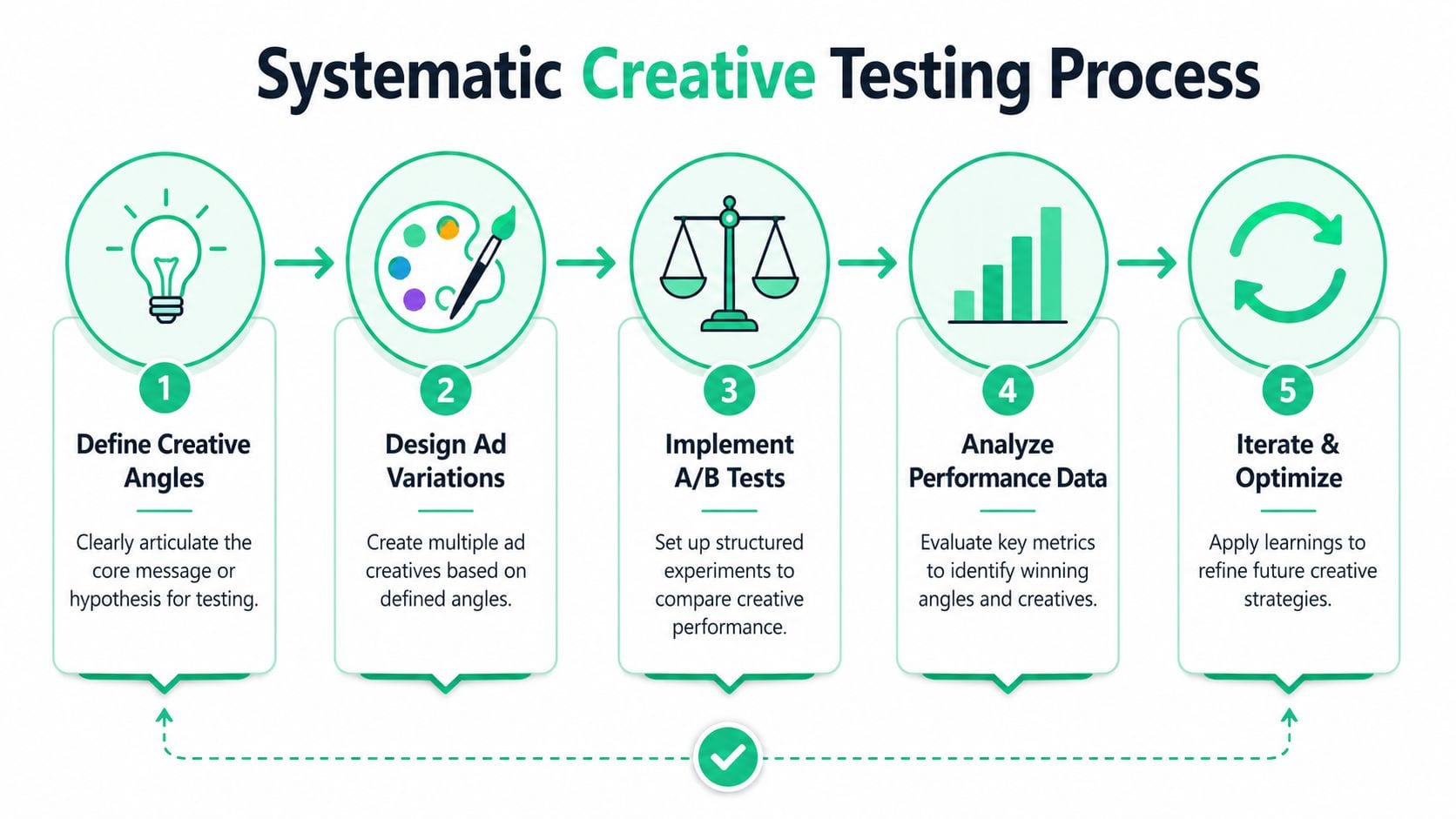
Test the message before the packaging
A creative angle is the core promise or hook. It might be convenience, trust, speed, exclusivity, price clarity, or a specific pain point. Format is how that angle gets expressed.
That distinction matters because a weak angle won't become strong just because it's turned into a video. And a strong angle can work across multiple formats once you've validated the message.
A clean sequence looks like this:
- Choose one angle per test cell. Don't mix discount messaging with social proof in the same concept.
- Keep audience and objective stable. Otherwise you're testing distribution and message at the same time.
- Use downstream conversion quality as the judge. CTR can help with diagnosis, but it shouldn't be the final verdict.
- Only then test execution. Once an angle works, try image, video, carousel, or UGC-style variants.
Isolate one variable or you learn nothing
Often, accounts waste money because marketers launch “creative tests” that change headline, body copy, thumbnail, format, CTA, landing page, and audience in one batch. Something wins, but nobody knows what caused it.
Test one meaningful variable at a time. Otherwise the result is a new ad, not a useful experiment.
The same principle applies to audience testing. If you compare a broad audience against a lookalike but also swap the offer, the comparison is contaminated. Keep the angle, destination, and optimization event matched as tightly as possible.
For teams thinking about more adaptive experimentation methods, this guide to multi-armed bandit testing in marketing experiments is worth reviewing. The main value isn't novelty. It's learning how to reallocate traffic without losing measurement discipline.
Read quality, not just click response
High CTR can mean curiosity. It can also mean loose promise, clickbait framing, or poor qualification. A lower-click ad sometimes wins because it pre-qualifies users better and leads to stronger revenue quality downstream.
That's why good creative testing asks harder questions:
- Does this angle attract qualified intent or just cheap traffic?
- Does the landing page continue the same promise clearly?
- Do reported leads match sales-accepted leads or closed revenue later?
When teams optimize Facebook ads well, they don't celebrate every click spike. They look for angles that survive contact with the sales funnel.
Mastering Bidding Strategies and Budget Allocation
Once the account is producing clean signals and disciplined tests, bidding and budget decisions become much less dramatic. They're still important. They just stop being a guessing game.
The mistake here is impatience. Advertisers see a rough day or two, make a series of edits, and accidentally reset the conditions needed for stable learning. Then they blame the bid strategy.
Respect the decision window
One practical rule is to wait about 7 days before making decisions on an ad set, then keep or scale what stays within KPI over that period and pause what doesn't, based on this campaign tuning guidance.
That rule matters because early data is noisy. An ad set can look strong on day one and mediocre by day four. Another can start slowly and become the better asset once more conversions accumulate. If you edit too early, you don't just interrupt learning. You also lose the chance to see whether the initial signal was real.
Scale in increments, not emotional leaps
The same guidance includes a widely cited scaling rule: raise budgets by roughly 20% when you scale. The point isn't the exact number as dogma. The point is controlled change.
Here's the practical way to understand this:
- Small increases preserve comparability. You can still tell whether the asset remained healthy after the change.
- Large jumps distort delivery. The campaign may chase a different pocket of inventory and performance can shift fast.
- Scaling weak setups amplifies noise. If conversion data is thin or quality is unclear, more spend just buys faster confusion.
A stable campaign usually scales better than a “hot” campaign that hasn't proved itself over a full decision window.
Choose bidding based on control versus exploration
Automated bidding is often the right baseline because it gives Meta room to find results within the objective you've already set. More constrained approaches can make sense when you have a strong handle on economics and want tighter efficiency control, but they also reduce flexibility.
That trade-off is real. If the account doesn't have reliable conversion quality data, adding more bid constraints often makes it worse, not better. Precision only helps when the underlying signal deserves precision.
The strongest operators treat budgets like calibration tools. They don't use them to force performance. They use them to expose whether performance is there.
From Data to Decisions Analyzing Performance and Attribution
The final step is deciding what the numbers mean. During this step, many Facebook ad accounts go off course. Teams look only at Ads Manager, accept the platform view as complete, and optimize toward a partial version of reality.
That approach breaks down quickly in privacy-constrained environments. One of the clearest shifts in recent years is that implementing Conversions API can increase reported conversions by about 10% to 40% compared with pixel-only measurement, according to this roundup of Facebook ads statistics and measurement trends. That doesn't mean every account should celebrate the higher count automatically. It means attribution quality changes when signal recovery improves.
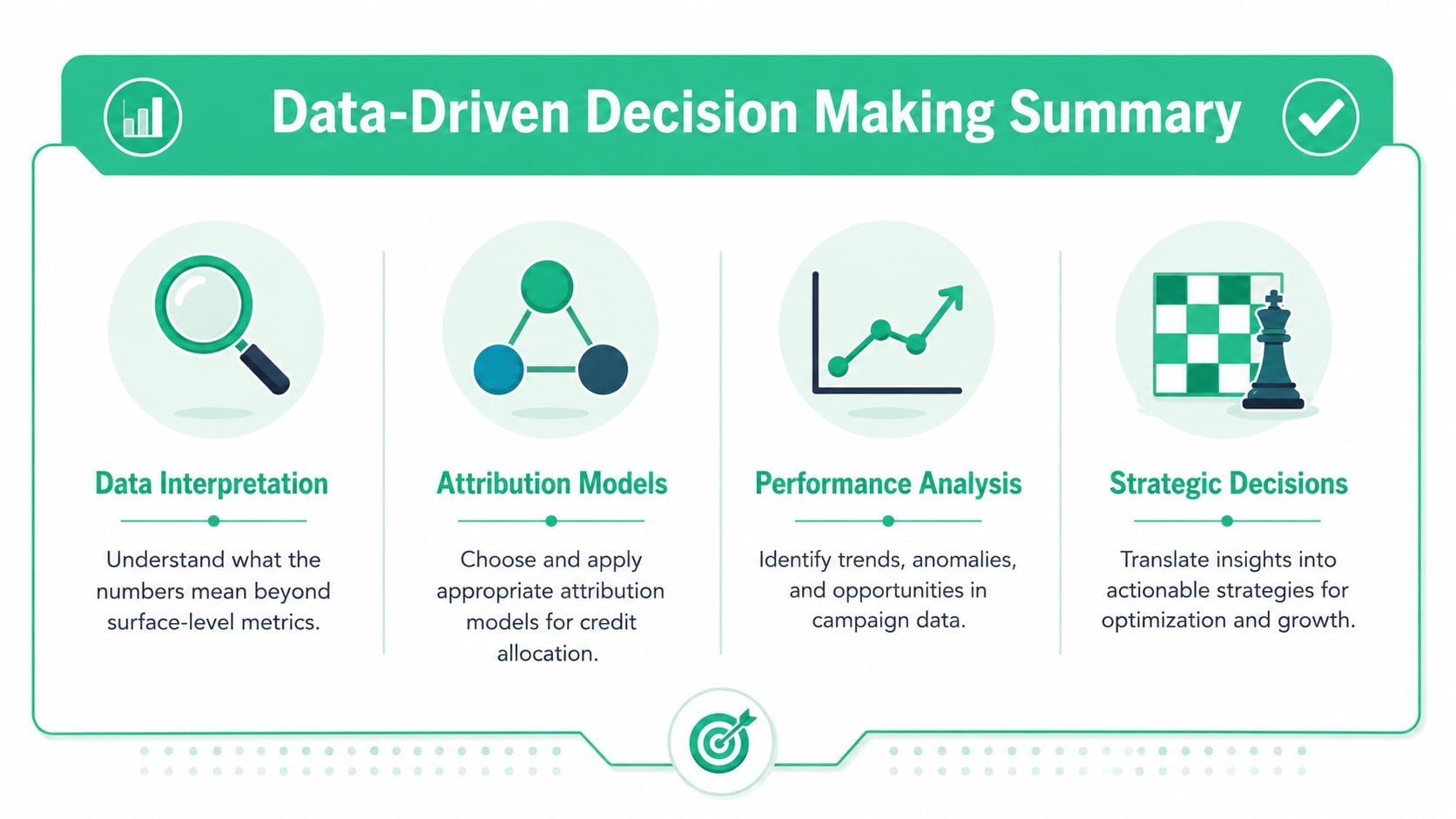
Compare Meta reporting with your source of truth
Ads Manager is necessary. It isn't sufficient. The operational habit that matters most is cross-checking Meta-reported outcomes against the system that owns the business result, usually a CRM, backend order system, or qualified lead workflow.
Look for these patterns:
| Signal in Meta | Check against | What the gap may mean |
|---|---|---|
| Reported leads rising | Qualified leads in CRM | Form spam, duplicate leads, poor event definition |
| Purchases increasing | Actual order records | Attribution inflation or broken purchase logic |
| Strong ad set ROAS | Margin or LTV view | Revenue exists, economics may not |
| Weak Meta conversion count | Backend conversions | Under-reporting caused by browser-side loss |
This is the point where media buying and analytics stop being separate disciplines. If Meta says performance improved but your sales team sees no lift in qualified pipeline, you don't have an optimization win yet.
Use breakdowns to find the real issue
Breakdowns in Ads Manager are useful when you ask narrow questions. Compare placements, audience segments, and creative groups, but don't stop at in-platform metrics. Tie every observation back to conversion quality and revenue reality.
A few examples:
- Placement looks cheap but low quality: that's a qualification issue, not necessarily a bidding issue.
- One audience reports weaker ROAS but stronger closed-won outcomes in CRM: attribution may be undervaluing it.
- Creative drives lots of submissions but poor downstream acceptance: the message may be attracting the wrong users.
This is also where an ad attribution accuracy tool becomes useful conceptually. The question isn't just “which campaign got credit?” It's “which signal chain stayed intact from click to business outcome?”
For teams that want a practical explainer from Trackingplan's side, embedding a video on automated analytics QA and wasted ad spend can help connect the attribution issue back to day-to-day operations. The key idea is simple: if your event pipeline degrades, your analysis degrades before anyone notices in a dashboard.
When teams optimize Facebook ads well, they aren't just editing campaigns. They're maintaining trust in the data that tells them whether a campaign deserves more budget, less budget, or a full rethink.
If your Meta account performance is hard to diagnose because pixels, CAPI, UTMs, or event schemas keep drifting, Trackingplan can help by continuously monitoring your analytics and attribution setup, flagging issues in real time, and giving marketers, analysts, and developers a shared view of what broke and where.