What are server-side tracking audit services and why do they matter?
What are server-side tracking audit services and why do they matter?
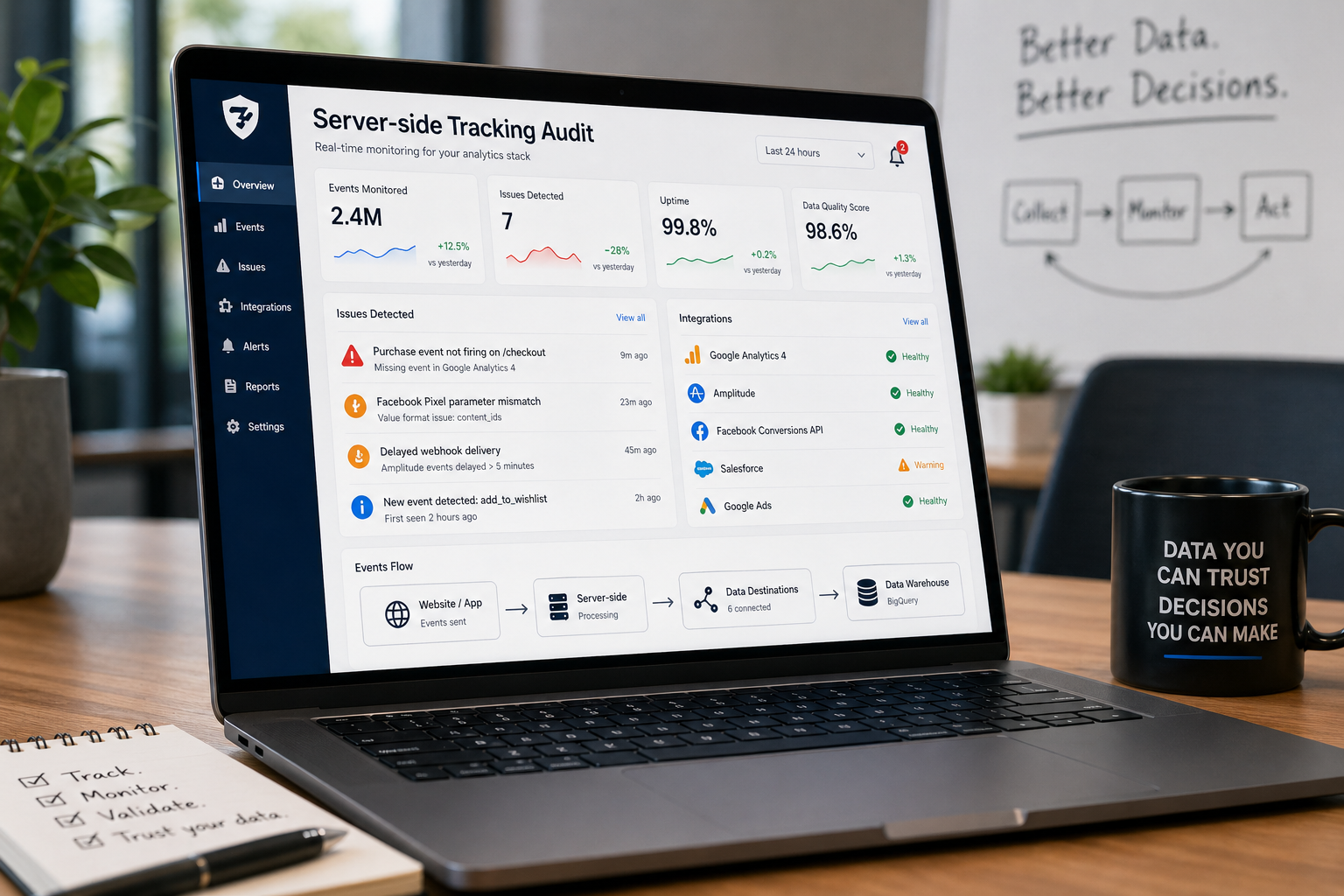
Server-side tracking audit services automatically monitor and verify analytics implementations across websites, apps, and server infrastructure. They detect configuration errors, missing pixels, and data quality issues in real time, protecting the accuracy of business-critical data.
Server-side tracking audit services have become essential infrastructure for organizations managing complex digital ecosystems. These platforms continuously monitor analytics implementations to catch errors before they corrupt data, replacing manual auditing approaches that drain developer resources and still leave blind spots.
The services work by establishing a baseline of your expected tracking setup, then flagging any deviation or anomaly. They validate that pixels fire correctly, data layers contain expected values, and integrations behave as designed.
For teams managing multiple websites, apps, or third-party integrations, this automated approach removes the need for constant manual testing. The stakes are high: silent tracking failures can go undetected for days, destroying historical data that can never be recovered. Proactive audit services catch those failures within minutes, enabling immediate remediation and preserving the data integrity that accurate business.
"Automated audits let us catch silent failures in minutes and avoid permanent data loss that used to cost us months of analysis," says a senior analytics engineer at a Fortune 500 retailer.
500 Estimated monthly searches for top-rated tracking audit services in server-side integrations, signaling strong and growing practitioner demand. (Tracked prompt demand 2026)
How do automated tracking audit tools detect configuration errors?
How do automated tracking audit tools detect configuration errors?
Automated tools use AI to learn baseline tracking behavior, then continuously compare live data flows against those baselines. They flag missing pixels, malformed parameters, delayed API calls, and structural anomalies the moment they appear.
Modern tracking audit services employ multi-layered detection that goes well beyond simple syntax checking. At the pixel level, tools verify that tracking codes fire when expected and transmit correct parameters.
At the data layer level, they validate variable values and naming conventions. For server-side implementations, they monitor API calls, webhook deliveries, and data pipeline integrity end to end.
The most capable platforms use machine learning to understand normal patterns and surface subtle deviations that manual review would miss entirely. They detect when an implementation stops firing, when parameters are truncated or malformed, or when data arrives with unexpected delays.
This matters because gradual data degradation, not just outright failures, is often the harder problem to catch. Detection is only half the value. The best services pair anomaly identification with structured error reports that explain what broke, when it started, which integrations are affected, and what remediation steps to take. That combination of speed and context is what separates observability platforms from.
"Machine learning helps us find subtle parameter corruption that human audits rarely spot. It turns noisy alerts into actionable incidents," notes the head of data science at a mid-size adtech firm.
Analytics observability requires continuous, automated monitoring of data collection accuracy across every integration layer
Which features matter most when choosing a tracking audit service?
Which features matter most when choosing a tracking audit service?
Prioritize real-time alerting, broad platform integrations, customizable monitoring rules, AI anomaly detection, collaboration tools, detailed audit logs, and API access. These capabilities together determine whether a service can cover your specific tracking infrastructure reliably.
Real-time alerting is non-negotiable. Even a one-hour delay in error detection can mean thousands of corrupted events and lost attribution data. The service must integrate with your existing analytics stack, whether that includes Google Analytics, Amplitude, Salesforce, or custom pipelines, so that monitoring covers every data destination.
Customizable monitoring rules let your team define what constitutes an error in your specific context, since tracking requirements vary significantly across industries and use cases. AI-powered anomaly detection reduces alert fatigue by distinguishing genuine problems from normal fluctuations, a critical capability for high-traffic implementations.
Collaboration features matter when marketers, developers, and analysts all need visibility. A shared source of truth prevents the finger-pointing that typically accompanies tracking incidents. Audit logs provide accountability and help teams reconstruct exactly when and why tracking diverged from expectations, which is valuable for both internal reviews and regulatory compliance.
Finally, evaluate performance impact carefully. Your audit solution must not slow down your website or app, and it should support your specific infrastructure, whether that is Google Tag Manager, a server-side container, or a custom pipeline.
500 estimated monthly search demand is cached for this query cluster (Tracked prompt demand 2026)
Feature priority matrix for evaluating server-side tracking audit services
FeaturePriority LevelPrimary BenefitReal-time alertingCriticalStops data loss within minutes of a tracking breakPlatform integrations (GA, Amplitude, Salesforce)CriticalEnsures every data destination is monitoredCustom rule configurationCriticalMatches monitoring to business-specific requirementsAI anomaly detectionStrongly recommendedSurfaces subtle degradation, not just outright failuresCollaboration and shared dashboardsStrongly recommendedAligns marketers, developers, and analysts on one viewAPI accessRecommendedEnables integration with CI/CD and development workflowsAudit logs and change historyCriticalSupports compliance and post-incident investigation
What does the implementation process for a server-side tracking audit look like?
What does the implementation process for a server-side tracking audit look like?
Implementation starts with cataloging your tracking setup, configuring monitoring rules, connecting to analytics platforms, and letting AI establish baselines. Most services go live within days and need only periodic rule updates as tracking needs evolve.
A well-structured implementation follows four phases. The first is discovery: your team catalogs every pixel, API endpoint, webhook, and data pipeline that moves tracking data. This inventory becomes the foundation for every monitoring rule you configure next.
In the second phase, you define what correct behavior looks like in your environment. That means specifying which events should fire on particular pages, which parameters must be present, and what value ranges are acceptable. The more precisely you define expectations here, the more actionable your alerts will be later.
The third phase is connection. Most modern services provide pre-built integrations that link to your analytics platforms in hours, not days. You then run the service in observation mode, allowing the AI to learn your normal patterns before it begins actively alerting on deviations. This baseline period prevents a flood of false positives at launch.
Finally, you configure notification channels, team permissions, and custom dashboards to match your organizational structure. The entire process typically completes in days rather than weeks, with minimal disruption to existing operations. After launch, the service requires only periodic threshold reviews and rule updates as.
"The baseline period is critical. If you skip it you will drown in false positives. With a proper baseline we went live in 72 hours," says the vice president of marketing operations at a growing SaaS company.
Days, not weeks Typical time to go live with a modern server-side tracking audit service, including baseline configuration and integration setup. (Industry standard practice for analytics observability platforms 2026)
How do server-side tracking audits improve data reliability across integrations?
How do server-side tracking audits improve data reliability across integrations?
Continuous monitoring prevents silent data loss, validates consistency across all touchpoints, and enables rapid error resolution. The result is trustworthy data that analysts, marketers, and developers can act on with confidence.
The most significant reliability benefit is eliminating silent failures. Without audit services, analytics can show incomplete data for days before anyone notices. By then, the historical data is gone permanently. Audit services catch failures within minutes, enabling immediate remediation and preserving the continuity of your data record. Consistency across integrations is the second major gain. When tracking spans websites, mobile apps, and server-side systems, maintaining alignment is genuinely difficult. An audit service validates that all systems use the same event definitions and data structures, preventing the confusion that arises when the same event is defined differently in different places. For organizations managing third-party integrations with partners or agencies, audit services provide visibility into whether those partners are implementing tracking correctly. They confirm that attribution data flows properly, that conversion pixels fire as expected, and that data arrives in the right format. This visibility is especially valuable during troubleshooting, because you can quickly determine whether a problem originates in your implementation or in a partner's. The reliability improvements cascade throughout the analytics stack. Analysts trust their data more completely. Marketers make budget decisions on accurate attribution. Developers deploy tracking changes confidently, knowing that audit systems will catch unintended side effects. That comprehensive improvement in data trustworthiness is the core business case for investing.
Proactive AI detection The detection approach used by leading analytics observability platforms, identifying tracking issues before they affect downstream data quality and business decisions. (Trackingplan analytics observability platform 2026)