Go behind the scenes with a conversion optimization expert. Learn the data-driven strategies they use to turn website visitors into loyal customers.
A conversion optimization expert is someone who digs into data, user psychology, and structured experiments to get more website visitors to do what you want them to do. Their job goes way beyond simple tweaks like changing button colors. It’s all about using evidence-based decision-making to systematically make a website a more effective business tool.
What a Conversion Optimization Expert Actually Does

Let's clear up a common myth: conversion rate optimization (CRO) isn't about chasing design trends or just throwing ideas at the wall. Real CRO is a disciplined cycle of research, forming a hypothesis, and then validating it through testing. A true expert is part data scientist, part user advocate, and part business strategist.
Their main job is to answer one critical question for any business: "Why aren't more of our visitors converting?" To figure that out, they have to get into the weeds of the user journey, uncovering all the hidden friction points, moments of confusion, and unanswered questions that make people leave.
The Foundation: Research and Discovery
Good CRO never starts with spitballing A/B test ideas. It kicks off with an immersive research phase where the expert acts like a digital detective, piecing together clues from multiple sources to build a solid case for making a change.
This initial digging usually involves:
- Quantitative Analysis: This is where they jump into analytics platforms like Google Analytics to find out where users are dropping off. They’re hunting for pages with high exit rates or surprisingly low time-on-page metrics that signal a problem.
- Qualitative Analysis: Next, they use tools like heatmaps and session recordings to see how users are actually interacting with a page. This kind of visual data is gold—it shows you exactly where people are clicking, how far they scroll, and where they get stuck.
- User Feedback: Finally, they listen. They’ll comb through customer surveys, support tickets, and online reviews to hear directly from the users. This qualitative feedback adds the "why" to the "what" that numbers alone can't provide.
By blending these different data streams, a conversion optimization expert can pinpoint the biggest barriers. For instance, analytics might show a huge drop-off on the checkout page. But session recordings could reveal the real culprit: users are furiously clicking a non-clickable security badge, getting frustrated when nothing happens, and then bouncing.
A CRO expert’s true value isn't in having all the answers, but in knowing how to ask the right questions and designing experiments to find them. They replace "I think" with "the data shows."
From Insight to Action
Once a problem is clearly identified, the expert switches gears from research to strategy. They don't just point out what's broken; they develop a testable hypothesis to fix it. A weak hypothesis sounds like, "Making the button bigger will probably get more clicks." An expert-level hypothesis is much sharper and rooted in the research.
Here’s an example: "Based on session recordings showing user hesitation, we believe that adding specific trust signals like 'Free Returns' and '24/7 Support' directly below the 'Add to Cart' button will reduce purchase anxiety and increase checkout initiations by at least 5%."
See the difference? This hypothesis is measurable, specific, and directly tied to a business goal. It sets the stage for a meaningful experiment. This structured approach ensures every change is a calculated move toward better performance, not just a random shot in the dark.
The Skills and Tools of a Modern CRO Professional
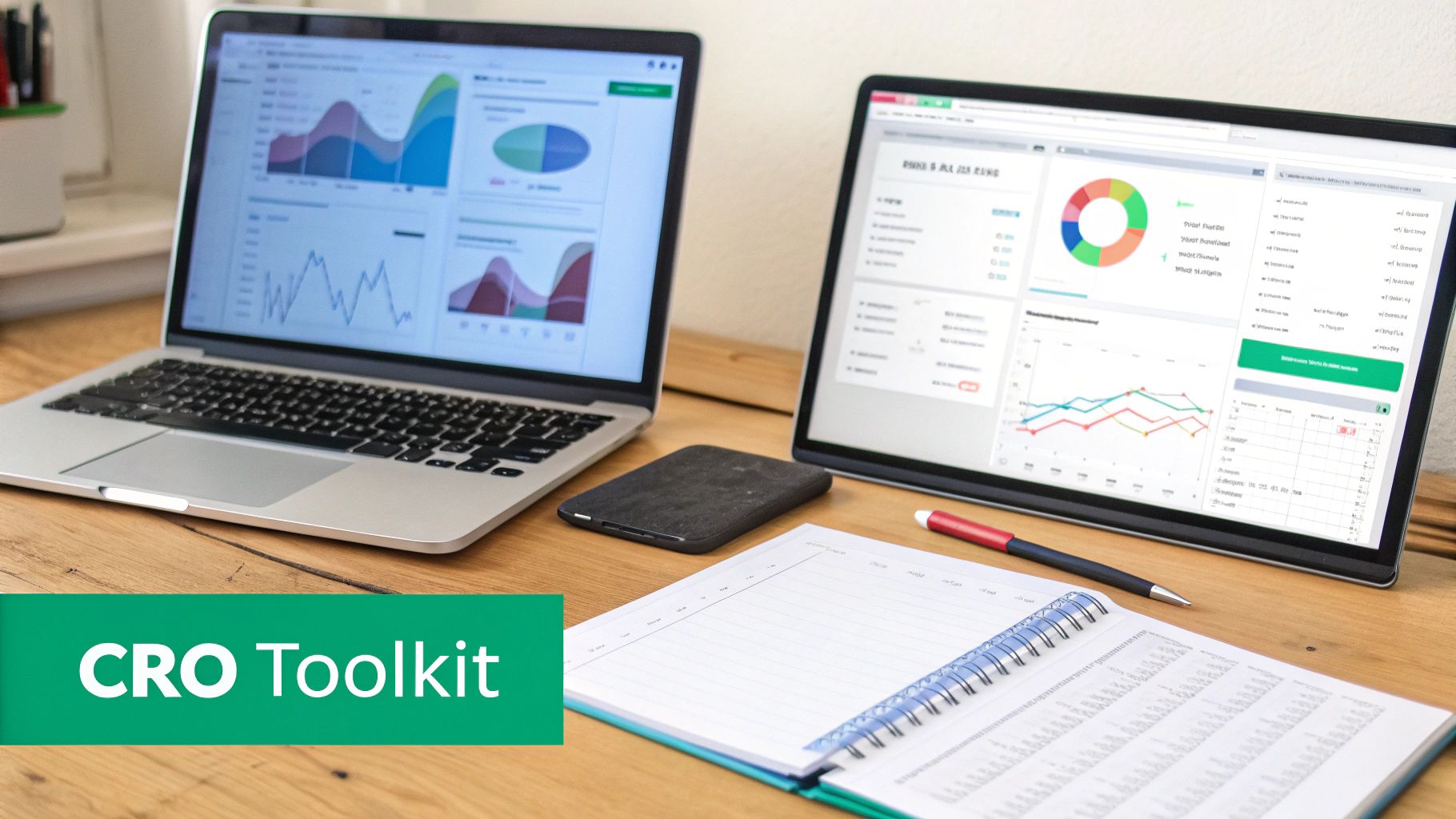
A top-tier conversion optimization expert is a rare breed. They're part scientist, part user advocate, blending a deep analytical mindset with genuine empathy for the customer. They don’t just rely on gut feelings or marketing trends; they operate with a specific set of skills and a powerful toolkit designed to diagnose problems and prove solutions with hard data.
This unique mix of hard and soft skills is what separates a true expert from someone who just runs occasional A/B tests. They can seamlessly shift from a high-level business problem down to the frustrating experience of a single user on a specific device, and most importantly, connect the dots between the two.
Mastering the Art of Quantitative Analysis
At its heart, CRO is a numbers game. An expert has to be fluent in the language of data, able to stare down a sprawling analytics dashboard and pull out the one critical signal from all the noise.
They practically live inside platforms like Google Analytics, but not just to report on traffic. They're there to segment it, dissect it, and uncover the hidden stories. For example, they might spot that mobile users on Android devices have a 30% higher bounce rate on a key landing page compared to iOS users. That one data point is the breadcrumb that kicks off a full-blown investigation.
But finding these anomalies is just the start. A true conversion optimization expert needs a rock-solid grasp of statistics to design experiments that are actually valid. This means knowing how to determine the right sample size and confidently declare a winner without getting fooled by a false positive.
Uncovering the "Why" with Qualitative Tools
Quantitative data tells you what is happening, but qualitative data is where you find out why. This is where the expert puts on their psychologist hat, using tools that capture the human side of the digital experience.
- Heatmaps: Tools like Hotjar create visual maps showing exactly where users click, how they move their mouse, and how far down the page they scroll. A quick look at a heatmap might reveal dozens of users clicking on a non-interactive image, immediately flagging a point of frustration and a design flaw.
- Session Recordings: These are like watching over a user's shoulder as they navigate the site. Seeing someone rage-click a broken "submit" button or hover indecisively over the pricing page for a full minute provides invaluable context that numbers alone just can't deliver.
These qualitative insights are what turn abstract data points into compelling human stories. It's much easier to make a case for a change when you can show a video of a real person struggling.
An expert understands that the most powerful insights often lie at the intersection of numbers and narratives. A drop-off rate is just a statistic until a session recording shows you the confused user behind it.
Wielding the Experimentation Toolkit
With a solid, data-backed hypothesis in hand, the expert turns to their experimentation platform. These tools are the engines of CRO, allowing them to run controlled tests of new ideas against the current user experience.
To pull this off, every CRO expert has a go-to stack of tools for different stages of the optimization process. This isn't just about running tests; it's about having the right instrument for every job, from initial research to final analysis.
The Essential Toolkit for Conversion Optimization Experts
This toolkit is where theory meets practice. It's the final, crucial step in a rigorous process of inquiry, analysis, and validation.
Platforms like Optimizely, VWO, and Convert are industry standards for A/B testing, letting optimizers test everything from a simple button color change to a complete page redesign. An expert knows which type of test to run and how to configure it for clean, reliable results. You can learn more about how to integrate various A/B testing tools in our detailed guide.
Ultimately, the goal isn't just to find "winners." It's about learning from every single experiment—success or failure—to build a deep, institutional knowledge of what truly motivates your specific audience.
Running an Effective Conversion Optimization Program
Forget about random guesses or chasing the latest design fads. Real conversion rate optimization isn't about luck; it's a structured, repeatable system that a seasoned conversion optimization expert uses to get reliable, measurable results.
This process turns vague ideas into a powerful flywheel of continuous improvement. Every experiment—win or lose—makes the business smarter.
It all starts with a deep dive into research. Before a single A/B test is even on the table, an expert gets totally immersed in both quantitative and qualitative data to truly get a handle on user behavior. They blend the "what" from analytics with the "why" from user feedback to build a complete picture of the customer journey and pinpoint the biggest opportunities for growth.
The Research and Discovery Phase
The jumping-off point for any successful optimization program is a thorough investigation. An expert doesn't just skim surface-level metrics; they dig deep to find the friction points that are costing the business money. This process is all about combining two distinct but equally crucial types of data.
First up is quantitative analysis. This means getting into the weeds with platforms like Google Analytics to spot statistical patterns. An expert might find a specific landing page with a bounce rate that's 25% higher than the site average, or a checkout funnel where a huge number of users bail at the shipping info step. These numbers flag where the problems are, but they don't explain why.
That's where qualitative analysis shines. Using tools that provide direct user feedback, like session recordings and heatmaps, the expert can watch actual user sessions unfold. They might see people repeatedly clicking on a non-interactive element out of pure frustration or struggling to find the return policy. This kind of visual evidence provides the critical context that analytics just can't give you.
Crafting a Powerful, Testable Hypothesis
Once the research uncovers a clear problem, the next step is to form a strong, testable hypothesis. This is one of the most critical skills a conversion optimization expert has, as it transforms a simple observation into a structured experiment with a clear business goal.
A weak hypothesis is vague and impossible to test. Think something like, "Making the homepage more engaging will increase conversions." It doesn't define "engaging" or specify which "conversions" it's supposed to improve. Useless.
In contrast, a strong hypothesis is specific, measurable, and tied directly to a business outcome.
Here's a great example: "Based on heatmap data showing users ignore the main call-to-action, we believe that changing the button text from 'Learn More' to 'Get Your Free Demo' and increasing its color contrast will better align with user intent, leading to a 10% increase in demo requests from qualified leads."
See the difference? This hypothesis is built on evidence (the heatmap), proposes a specific change, and predicts a measurable impact on a key business metric. It gives you a clear framework for designing the experiment.
Designing and Launching the Experiment
With a solid hypothesis locked in, the expert moves to the practical stage of designing and launching the test. This involves much more than just mocking up a new version of a page. A few key decisions have to be made to ensure the experiment produces results you can actually trust.
- Choosing the Right Test Type: Is a simple A/B test (comparing two versions) enough? Or is a multivariate test (testing multiple element combos at once) needed? For really big changes, a split URL test, which pits two entirely different pages against each other, might be the best call.
- Ensuring Statistical Significance: Before anything goes live, the expert calculates the sample size and test duration needed to achieve statistical significance. This is non-negotiable. It stops you from making major business decisions based on random chance instead of real user preference.
- Segmenting the Audience: Not all users are created equal. An expert might segment the test to see how a change affects new versus returning visitors, or mobile versus desktop users. This is where you uncover the deeper, more valuable insights.
The Often-Skipped Step: Quality Assurance
One of the biggest mistakes teams make is rushing a test live without rigorous quality assurance (QA). A real conversion optimization expert knows that a single technical glitch can completely invalidate the results.
Before any traffic is sent to an experiment, they run a thorough QA check. This means cross-browser and cross-device testing to make sure the variant looks right for everyone. Even more importantly, it includes verifying that all analytics events are firing exactly as they should. You can learn more about this by crafting a golden baseline for analytics testing.
Interpreting Results and Iterating
After an experiment wraps up, the expert’s job is far from over. They dive into the results to determine the winner and, more importantly, to understand the "why" behind what happened. Whether the test was a win, a loss, or a wash, it provides valuable learnings.
Did you know that across 14 different industries, the average website conversion rate is just 2.9%? Yet top-performing sites hit 11% or higher. That massive gap is often closed by experts who stick to a structured optimization process. This data-driven approach is how some companies achieve things like a 138% conversion lift just by adding more CTAs above the fold.
These learnings are documented and fed right back into the next cycle of experiments. A winning test gets rolled out to all users, while a losing test provides priceless insights into what doesn't work for your audience, preventing you from making the same mistake twice. This iterative loop of research, hypothesis, testing, and learning is the engine that drives sustainable growth.
To keep leveling up your program, check out these proven ecommerce conversion rate optimization tips for some practical strategies you can use.
Why Accurate Data Is the Foundation of Good CRO
A brilliant A/B test is completely worthless if the data behind it is flawed. This is the hard truth every conversion optimization expert has to accept. Analytics integrity isn't some nice-to-have feature; it's the absolute bedrock of any trustworthy CRO program. Without it, you’re just making expensive guesses.
Picture this all-too-common horror story. Your team launches a test for a new checkout page. After two weeks, the results look incredible—a 30% lift in conversions! Everyone celebrates and gets ready to roll out the new design. But then a sharp-eyed analyst spots a problem. The tracking on the original page was broken, failing to fire the "purchase complete" event for half the users. The new design didn't actually win; the data for the old one was just invisible.
This isn't some rare fluke. It happens all the time, derailing experiments and leading to terrible business decisions. What separates a real conversion optimization expert from someone just running tests is building a foundation of trust in their data. It's the only path to making confident, high-impact calls.
The Silent Killers of Your CRO Program
Bad data has a nasty habit of creeping in silently, poisoning your experiments without any obvious red flags until it's way too late. An expert knows to look for these common culprits that can completely invalidate test results and crater the credibility of an entire optimization program.
A few issues pop up again and again:
- Misfiring Analytics Events: An "add to cart" click might not register every time. Or worse, it fires twice for a single user, completely throwing off your conversion counts.
- Consent Mode Glitches: If your consent banner is configured incorrectly, it can lead to massive underreporting of traffic and conversions. Your test results will look way worse than they really are.
- Third-Party Script Conflicts: That new marketing script you just added? It could easily interfere with your A/B testing tool, preventing the test variation from even loading for a segment of your users.
- Tagging and UTM Errors: Inconsistent campaign tagging can misattribute traffic, tricking you into thinking a specific channel is a dud when the data is just a mess.
These aren't just minor technical hiccups. They're fundamental flaws that can make a winning test look like a loser—or, even more dangerously, make a losing test look like a winner.
The Role of Continuous Analytics QA
The antidote to bad data is proactive and continuous monitoring. A conversion optimization expert can't be expected to manually check every single analytics tag on every page for every user session. That’s an impossible task. This is where modern observability platforms become a CRO expert’s most crucial ally.
Think of continuous monitoring as an automated safety net, constantly watching your analytics implementation in the background. Instead of waiting for a post-test analysis to tell you something went wrong, these tools catch data issues the moment they happen. You can get real-time alerts if an event stops firing, if traffic from a key source suddenly tanks, or if a new deployment breaks your entire tracking schema.
Trusting your data is not a one-time audit; it's a continuous process. An expert knows that the health of their analytics is just as important as the creativity of their hypotheses.
The CRO software market is projected to explode to $2.83 billion by 2029, and that growth is fueled by experts who know how to turn traffic into revenue. This boom is driven by real results, like one company achieving a 311% net profit surge just by getting a clear picture of their customer journey. But for data teams, the nightmare is flawed tracking from traffic anomalies or schema mismatches that make dashboards unreliable and doom tests from the start. Platforms like Trackingplan change that, with SDKs that integrate with tools like Google Analytics and Amplitude in minutes. They provide root-cause analysis and cross-team alerts to keep data clean.
This infographic lays out the fundamental workflow of a disciplined CRO program.
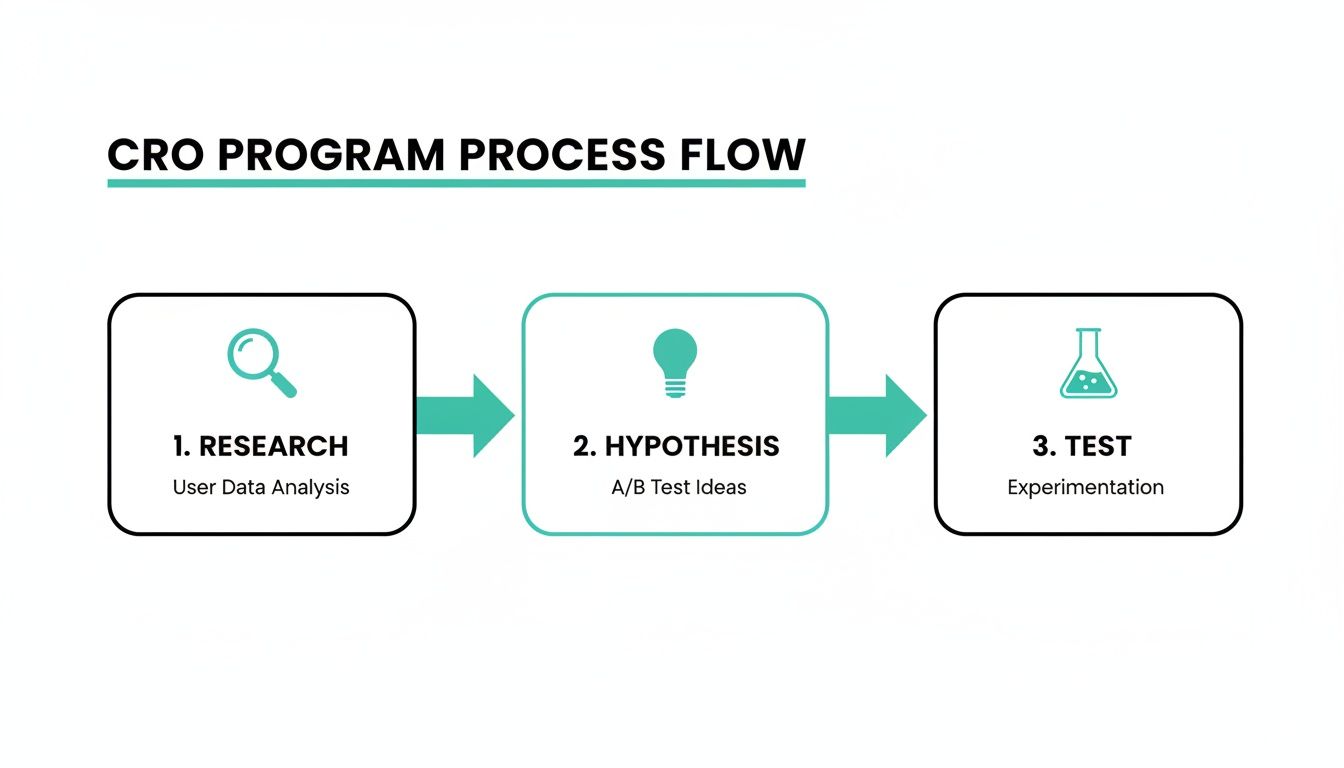
As this flow shows, every single stage—from initial research to the final test—relies entirely on the quality of the data underneath.
Fixing these issues before they can corrupt an entire experiment is a total game-changer. It means every test you run is built on solid ground, allowing you to interpret the results with confidence. If you have even a hint of suspicion that your data might be compromised, conducting a comprehensive web analytics audit is the first essential step. This foundational work ensures your optimization efforts are actually moving you forward, not just spinning your wheels.
How to Hire the Right Conversion Optimization Expert
Bringing a conversion optimization expert into your business can be a genuine game-changer. I’m not just talking about filling a role; this is an investment in a skillset that can completely reshape your company's growth curve. The real challenge, though, is finding someone who gets past the buzzwords and can deliver actual, sustainable results.
Whether you’re hunting for an in-house specialist to build an experimentation culture from the ground up or an agency to put your efforts on the fast track, the vetting process is everything. You're looking for a partner who is process-driven, obsessed with data, and endlessly curious.
Vetting In-House Talent
When you're hiring an in-house expert, you need more than just technical chops. You're really looking for a champion of a data-first culture—someone who can translate complex ideas for different stakeholders and build a program from scratch.
Your interview process should dig deep into their methodology, not just quiz them on tools. A great candidate will light up when talking about their process, eager to share the nitty-gritty details of their wins and their losses.
Key Interview Questions to Ask
- "Walk me through a failed experiment. What was the hypothesis, why do you think it failed, and what did you learn?" This question is gold. It’s far more telling than asking about their greatest hits. It reveals their ability to learn from failure, their intellectual honesty, and whether they value the process over their own ego.
- "How do you prioritize your testing roadmap?" A top-tier conversion optimization expert won't just list ideas. They’ll describe a structured framework that probably weighs factors like potential impact, confidence in the hypothesis, and the resources required. You want to see a strategic plan, not just a list of hunches.
- "Describe a time you had to convince a skeptical stakeholder to approve a test. How did you do it?" This gets to the heart of their communication and persuasion skills. The best in the business use data and solid research to build a compelling case, leaving opinions at the door.
Evaluating Their Portfolio and Past Work
Think of a portfolio as more than a highlight reel. It’s hard evidence of their process and impact. As you review their past work, look for a clear story for each project. You should be able to easily follow the journey from the initial research phase right through to the final business outcome.
Don't get distracted by vanity metrics like "we increased clicks by 50%." A true expert ties every single result back to a core business metric—revenue, qualified leads, or customer lifetime value.
Use this mental checklist when you're looking at their case studies:
- Is the problem clearly defined? Did they start with a specific, data-backed problem or just a vague idea?
- Is the hypothesis strong? Look for a clear, testable statement that connects a proposed change to an expected outcome.
- Are the results statistically sound? They should be talking about statistical significance, confidence levels, and how long the test ran.
- Are the business results clear? The impact needs to be framed in terms of revenue or key performance indicators (KPIs), not just fuzzy engagement metrics.
Choosing the Right CRO Agency
If you’re leaning toward an agency, the evaluation criteria change a bit. You’re not just hiring an individual; you're bringing on an entire team with its own established processes. The goal is to find an agency that feels like an extension of your own team, not just another vendor sending you invoices.
Imagine boosting your conversions by 13.47% just by redesigning CTA buttons and making your content more scannable. That's exactly what B2B software giant SelectHub did, proving that CRO experts can deliver massive results with laser-focused changes. For performance marketers and developers at agencies juggling multiple clients, platforms like Trackingplan are indispensable. They automatically discover martech setups and flag broken pixels, consent issues, or PII leaks that can completely sabotage an experiment.
Picture this: a simple campaign tagging error goes unnoticed, falsely inflating your attribution data. A CRO expert armed with real-time QA tools catches it fast and preserves the integrity of your test. Even a 0.5% lift translates to serious revenue, but only if the data is pristine. When CRO experts are paired with robust observability, they don't just hit benchmarks—they beat them, delivering trusted insights for growth teams worldwide. You can see more about how industry benchmarks highlight the value of CRO on speedcommerce.com.
Look for an agency partner that’s committed to transparent reporting and has a crystal-clear methodology for ensuring data accuracy. An agency that obsesses over analytics integrity understands the foundation of good CRO. Finding the right fit is all about equipping yourself to spot true expertise, ensuring you hire a partner who will drive meaningful and lasting growth for your business.
Common Questions About Conversion Optimization
Diving into the world of conversion optimization always brings up a few questions, especially when you're thinking about hiring a pro. Whether you're adding an in-house specialist or bringing on an agency, it helps to know what you’re getting into. Let’s clear up some of the most common ones.
What Is the Difference Between a UX Designer and a CRO Expert
This is a big one, and it’s a fair question since both roles are obsessed with the user. But they come at it from different angles with different end goals.
A UX (User Experience) designer is all about making a product or website easy, intuitive, and even delightful to use. They live and breathe usability and user satisfaction. Is the experience seamless? Can people find what they need without getting frustrated? That's their world.
A conversion optimization expert, on the other hand, is laser-focused on a measurable business outcome—more sales, more sign-ups, more qualified leads. They use A/B testing and rigorous statistical analysis to prove that a specific change directly caused an increase in a key metric.
You could say a UX designer makes sure the user's journey is smooth and pleasant. A CRO expert makes sure that journey ends at a profitable destination for the business.
How Long Does It Take to See Results from CRO
There’s no magic number here. The timeline is almost completely dictated by one thing: your website's traffic volume. A high-traffic e-commerce site might see statistically significant results from an A/B test in just a week or two.
On the flip side, a lower-traffic B2B site might need to let that same test run for a month—or even longer—to get enough data for a confident decision. A seasoned CRO pro will set realistic expectations right from the start. They’ll prioritize tests based on a mix of potential impact and the traffic available, aiming for quick wins while building a long-term roadmap. CRO is definitely a marathon, not a sprint.
Can We Do CRO Without a Dedicated Expert
Sure, you can run simple tests without a dedicated expert, but you're taking on a fair bit of risk. A sharp marketing manager or a talented designer can absolutely launch a basic A/B test using any number of tools out there.
The problem is, a specialist brings a structured process, a deep understanding of user psychology, and a level of statistical rigor that a generalist just won't have.
Without that focused expertise, you can easily fall into common traps. You might run tests that never reach a conclusion, wasting valuable traffic. You could misinterpret the data and make the wrong call. Or you could spend months chasing ideas with little to no real impact. An expert's job isn't just to get wins; it's to prevent you from making costly mistakes based on flimsy data.
Why Is Analytics QA So Important for Conversion Optimization
Because bad data leads to bad business decisions. Full stop.
The entire process of a conversion optimization expert—from spotting problems and forming hypotheses to testing solutions and measuring success—is built on one critical assumption: that the data is accurate.
If your analytics setup is broken—maybe it’s double-counting conversions or misattributing traffic—your test results are completely meaningless. You could roll out a "winning" variation that actually tanks your revenue. Analytics QA is the safety net. It ensures your data foundation is solid, allowing an expert to operate with confidence and deliver results you can actually trust.
At Trackingplan, we believe trustworthy data is the bedrock of any successful optimization program. Our platform provides automated analytics QA to ensure your data is always accurate, so you can test, learn, and grow with confidence. Find out how Trackingplan can protect your CRO efforts.