
Think of a site audit as a comprehensive health check for your website. It’s a deep dive that looks at everything from how you show up in search results to how the site actually performs and whether you can trust the data it’s collecting. It's less about ticking boxes and more about creating a clear roadmap for improvement, making sure your digital presence is findable, functional, and measured correctly.
Understanding the Modern Website Audit
Imagine your marketing team just launched a massive campaign. The budget is spent, the ads are live, but when you look at your analytics dashboard, the numbers are a mess. They just don't add up. This is a painfully common scenario, and it's exactly what a modern site audit is designed to prevent.
It’s no longer just a technical checklist; it’s a critical strategic tool for any business that relies on data. A good audit gives you an honest, objective look at your website’s performance, the experience it provides, and the integrity of your data. Considering that up to 88% of users are less likely to come back after a bad experience, these check-ups are non-negotiable for growth.
More Than Just One Task
A truly thorough audit isn't a single activity but a combination of specialized check-ups that work together. Each one digs into a fundamental question about your website's health:
- SEO Audit: How easily can people actually find you on Google?
- Technical Audit: Is the site built well? Is it fast and free of bugs that drive users away?
- Analytics & Tracking Audit: Can you actually rely on the data you're collecting to make smart business decisions?
By methodically evaluating your site, you can find new ways to improve it. The end goal is a list of actionable insights you can implement to boost your website's overall return on investment.
This holistic approach connects the dots between different parts of your digital strategy. For instance, a technical audit might uncover slow page speeds, which is a huge red flag for both SEO rankings and user patience. In the same way, an analytics audit could reveal that broken tracking is misattributing your marketing efforts, causing you to waste money on the wrong channels.
Ultimately, a site audit reframes this entire process. It stops being a chore and becomes an essential practice that helps you move from guessing what’s wrong to knowing exactly where to focus your time and money for the biggest impact.
The Three Pillars of a Comprehensive Site Audit
When you hear “site audit,” what comes to mind? For many, it's just about SEO. But a real, comprehensive site audit goes much deeper. Think of it like a thorough inspection of a car before a long road trip. You wouldn't just check the engine and call it a day; you'd also inspect the tires, the brakes, and the navigation system to make sure the entire vehicle is road-worthy.
In the same way, a complete website audit rests on three core pillars, each examining a critical piece of your site's health.
Ignoring any one of these leaves you with a massive blind spot. Your site might rank well in search engines but offer a clunky user experience that kills conversions. Or it might look fantastic on the surface but collect flawed data that leads your marketing team astray. Only by looking at all three together can you build a digital asset that’s truly reliable and built for performance.
The SEO Audit: Are You Visible?
First up is the SEO audit. This part answers one simple but critical question: "Can the right people find our website when they search for what we offer?" It's all about your visibility on search engines like Google, which is where the journey starts for most customers.
An SEO audit dives into everything from your keyword rankings and backlink profile to your content quality and the structure of your meta tags. It's about figuring out how well your site communicates its purpose to search engine crawlers. For marketers, this is non-negotiable—organic search drives over 53% of all website traffic for most businesses. Without a solid SEO foundation, even the most brilliant content can end up shouting into the void.
A comprehensive site audit combines SEO, technical, and analytics evaluations to provide a complete picture of website health, ensuring it is discoverable, functional, and accurately measured.
This concept map shows how these three interconnected pillars—SEO, Technical, and Analytics—form the foundation of a complete site audit.
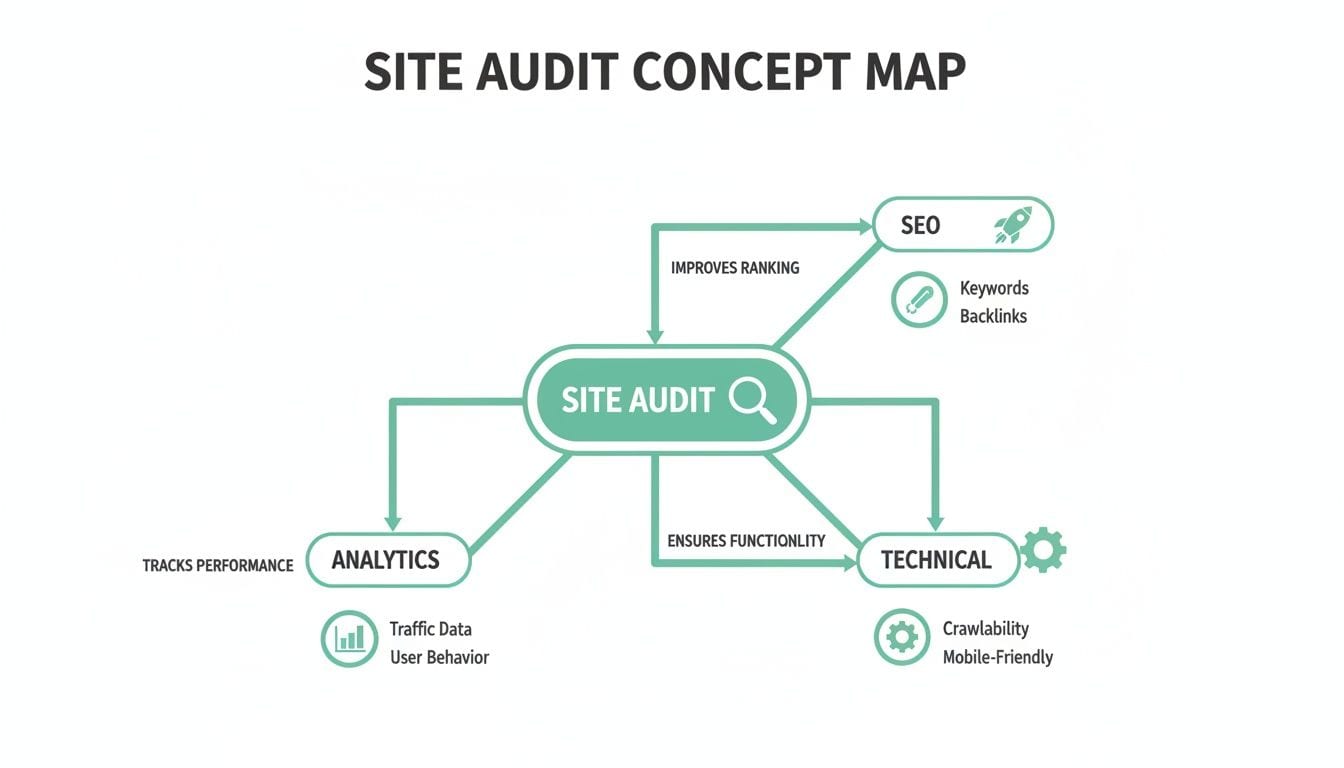
As you can see, each pillar targets a distinct but related area. True performance isn't about excelling in one; it's about making sure all three are working in harmony.
The Technical Audit: Does It Work?
Next is the technical audit, which focuses on a different question: "Is our website built correctly and easy for people to use?" This is the under-the-hood inspection. It’s less about what your site says and more about how it runs.
This audit sniffs out issues like slow page load speeds, broken links (those dreaded 404 errors), poor mobile responsiveness, and crawlability problems that stop search engines from even seeing your pages. A shaky technical foundation leads directly to a frustrating user experience. And that frustration has real consequences—40% of visitors will bounce if a site takes more than three seconds to load. For developers, this audit creates a clear punch list of fixes to build a fast, stable, and user-friendly site.
The Analytics and Tracking Audit: Can You Trust Your Data?
Finally, we have the analytics and tracking audit. This pillar asks what might be the most important business question of all: "Are we measuring what matters, and is our data accurate?" This is your intelligence layer. It ensures the data you rely on to make critical decisions is actually trustworthy.
This audit verifies that your analytics setup, marketing pixels, and event tracking are all firing correctly. Without it, you’re flying blind. You might kill a "failing" ad campaign when, in reality, a broken tracking event was the real culprit. For analysts and marketers, this audit is the secret weapon that guarantees every dollar spent and every strategic move is based on clean, reliable data.
To make these distinctions clearer, let's break down how each audit type serves a different purpose and team.
The Three Core Types of Site Audits Explained
As the table shows, a truly comprehensive audit delivers value across the entire organization. It’s not just an SEO task or a developer chore; it’s a strategic process that ensures your digital presence is firing on all cylinders.
Why Analytics Audits Are Your Secret Weapon for Growth
While SEO and technical check-ups are fundamental, the analytics audit is what turns a good site audit into a great one. It's the most overlooked part of the process, yet it holds the key to unlocking real growth.
Running a website with untracked or broken analytics is like flying a plane without an instrument panel. You’re definitely moving, but you have no clue if you’re headed in the right direction, how much fuel you’ve got left, or if you’re about to fly straight into a storm.
This lack of visibility isn’t just a minor inconvenience—it has serious consequences. It leads to broken marketing pixels that hemorrhage ad spend, inaccurate campaign attribution that derails your strategy, and flawed data that misinforms major business decisions. An analytics audit digs deep, validating your entire data pipeline to make sure every click, conversion, and user action is captured correctly.
The High Cost of Bad Data
Bad data isn't just an annoyance; it's a direct hit to your bottom line. Imagine launching a brilliant marketing campaign only to find out later that 40% of your tracking pixels are misfiring, silently poisoning your data quality and ROI. This isn't a hypothetical—it's the reality for countless teams.
Site audits consistently reveal that while organic search drives up to 53% of all website traffic, businesses are losing out on 51.5% of their potential site traffic simply because of poor SEO implementation and tracking. And in a world where Google has over 90% market share, you can’t afford to fly blind. This is precisely why a dedicated analytics audit is so powerful. It stops these costly errors before they happen, turning your analytics from a potential liability into a genuine competitive advantage.
From Reactive Fixes to Proactive Strategy
A proper analytics audit changes how your teams operate. Instead of reacting to confusing dashboards or manually debugging tracking issues weeks after a problem started, you can proactively ensure your data is trustworthy right from the source. It’s about building a foundation of reliable information so that every team—from marketing to product—can act with confidence.
An analytics audit validates that you are measuring what matters, and that the data is accurate. This is the intelligence layer that ensures every strategic decision is based on truth, not guesswork.
This process involves a meticulous check of every event and user property to confirm it’s being tracked as intended. You can learn more about how to ensure data integrity in our detailed guide on the topic.
To truly make analytics your secret weapon, you can also augment your findings with external data sources. Understanding and using the best data enrichment tools can add valuable demographic and firmographic context, giving you a much richer understanding of user behavior and market potential.
Your Actionable Analytics Audit Checklist

Alright, let's move from theory to practice and get our hands dirty. A solid analytics audit doesn’t need to feel like rocket science. When you break it down into logical steps, you can start spotting problems pretty quickly and see just how valuable a systematic check-up can be.
This checklist splits the process into four key areas. Each one builds on the last, guiding you from the raw technical implementation all the way up to privacy and compliance. For an even deeper dive, check out our comprehensive website audit checklist.
Martech and Pixel Implementation
This is ground zero. Before you can trust a single number in your reports, you have to be sure the tools collecting the data are actually working. This first step is all about verifying that every marketing technology (Martech) tag and tracking pixel is in place and firing correctly across all your pages and user interactions.
Think of it like checking the security cameras in a building. If one is unplugged or pointing at the ceiling, you’ve got a massive blind spot.
- What to check: Are your Google Analytics, ad platform pixels (like Meta and Google Ads), and product analytics tools loading on every single page?
- Why it matters: A missing or broken pixel means you're flying blind. You can't analyze behavior, attribute sales, or optimize campaigns if the foundational tracking is broken from the start.
Data Schema and Properties
Once you know your tools are active, the next question is: are they sending the right information? This is where you audit your data schema—the blueprint for your events—and the properties attached to them. For example, a purchase event is pretty useless without properties like product_id, price, and currency.
A solid data schema is the difference between getting a clean, organized spreadsheet versus a messy shoebox full of unsorted receipts. One is ready for analysis, and the other is a nightmare to sort through.
Here, you’re making sure data is being sent in the correct format and has all the details you need for analysis. Mismatched or missing properties can make your event data completely worthless.
Campaign and UTM Tagging
For any marketing team, accurate attribution is the holy grail. This part of the audit zooms in on your campaign tagging rules, especially your Urchin Tracking Module (UTM) parameters. It’s all about making sure you can confidently trace your traffic and conversions back to the exact source.
When tagging is inconsistent—like using Facebook, facebook, and FB all for the same channel—it shatters your data into tiny, useless fragments, making it impossible to see what's truly performing.
- What to check: Do all marketing links follow a strict, consistent UTM naming convention? Are you capturing source, medium, and campaign for every single initiative?
- Why it matters: Without clean UTMs, you're just guessing which campaigns are driving results. This leads directly to wasted ad spend and bad decisions about where to put your money next.
User Consent and Privacy
Last but certainly not least, you have to verify that your tracking respects user consent and protects their privacy. This means hunting for any accidental Personally Identifiable Information (PII) leaks and ensuring your consent management platform (CMP) is correctly blocking or allowing tags based on what the user chose.
For a more holistic approach that covers more than just analytics, an ultimate website audit checklist can be a lifesaver to ensure you haven't missed any other critical areas.
From Chaos to Clarity: The True ROI of a Site Audit
A site audit does more than just spit out a list of technical fixes. It delivers real business outcomes that ripple across your entire organization. The true return on investment (ROI) isn’t just about having a healthier website—it’s about moving your teams from a state of reactive firefighting to one of proactive, confident decision-making.
For marketers, this kind of clarity is gold. A proper audit gives them unshakable confidence in their campaign performance data. No more second-guessing results. They can optimize ad spend with precision, knowing their tracking pixels and UTM parameters are capturing every single interaction correctly.
This newfound trust in the data translates directly into smarter budget allocation and campaigns that actually perform better.
Empowering Your Teams with Reliable Data
And the benefits don't stop with marketing. For data analysts, a consistent audit process is a complete game-changer. It means they can finally deliver dashboards and reports that everyone trusts, without spending countless hours manually cleaning up messy, inconsistent data. This dramatically speeds up the delivery of insights, letting them focus on strategic analysis instead of what feels like data janitorial work.
Meanwhile, developers see a massive drop in the time they sink into frustrating debugging cycles. Instead of chasing vague reports of "broken tracking," they get precise, actionable alerts that pinpoint the exact root of a problem. This frees them up to spend less time fixing things and more time building new features that push the business forward.
A consistent audit process is the bedrock of a data-driven culture. It transforms data from a source of confusion into an asset that empowers every team to make smarter, faster decisions with confidence.
Real-World Wins and Proactive Problem Solving
The ROI becomes crystal clear when you look at real-world scenarios. Imagine catching a broken checkout event that was silently costing you thousands in lost revenue data. Or what about identifying a PII leak in a user property before it spirals into a costly compliance nightmare? These aren’t just hypotheticals; they're the direct results of a proactive audit strategy.
This systematic approach fundamentally changes your company's culture. It pulls you out of constant crisis management, where teams scramble to fix problems long after the damage is done. Instead, you build a resilient system that anticipates and prevents issues, ensuring your digital operations are built on a foundation of clarity and trust. That's the ultimate answer to "what is a site audit?" for any modern business.
Choosing Your Tools: From Manual Checks to Automated Solutions
Once you know what kind of audit you're running, the next logical question is: how do you actually do it? The right tools can be the difference between a painful, drawn-out process and a smooth, manageable one. Naturally, different audits call for different toolsets.
For most SEO and technical audits, teams tend to lean on a few trusted industry mainstays. Tools like Semrush and Ahrefs are fantastic for digging into keyword rankings and backlink profiles. When it comes to crawling a site to find broken links and other on-page gremlins, nothing beats a tool like Screaming Frog. These are powerful allies for running periodic health checks.
The Unique Challenge of Analytics Audits
But when it's time for an analytics and tracking audit, the game completely changes. The old-school, project-based approach just doesn't cut it anymore. Why? Because data isn't static. It breaks in real time with every code deployment, every new marketing campaign, and every tiny tweak inside your tag management system. If you want to dive deeper into that complexity, our guide to choosing a tag management system is a good place to start.
Trying to audit analytics with manual spot-checks or brittle testing scripts is like trying to find a leaky pipe in a skyscraper by checking every faucet, one by one. It’s painfully slow, incredibly inefficient, and you're almost guaranteed to miss the real problems happening behind the walls. This is where the whole approach to auditing tools has had to evolve.
For analytics, periodic audits are a thing of the past. The only way to guarantee data integrity is with continuous, automated monitoring that catches issues the moment they happen, not weeks down the line.
The Shift to Automated Observability
This is where modern, automated solutions come into play. Instead of running a massive, manual audit every quarter, these platforms give you continuous observability over your entire analytics setup. Think of it as a 24/7 security system for your data, constantly watching every event, pixel, and property for signs of trouble.

With real-time alerts for everything from broken pixels to schema mismatches, these tools completely change the answer to what is a site audit. It’s no longer a laborious, one-off project but a state of continuous confidence in the data you rely on every day.
Got Questions About Site Audits?
Even with a solid game plan, you're bound to have questions. Let's tackle some of the most common ones that come up when people talk about site audits.
How Often Should I Perform a Site Audit?
For the SEO and technical side of things, running an audit once a quarter is a solid rule of thumb. You'll also want to do spot-checks after any big site changes, like a redesign or migration.
But when it comes to your analytics and tracking, that old-school quarterly model is completely broken. Data doesn't break on a schedule; it breaks the second a developer pushes new code.
That’s why the new standard is continuous, automated monitoring. This is how you catch a broken conversion pixel or a mangled event schema the minute it happens, not three weeks later when your reports look weird.
Can I Do a Site Audit for Free?
You absolutely can. Tools like Google Search Console and Google Analytics give you a ton of valuable data for basic SEO and technical health checks. The catch? It's a very manual process, and you have to know exactly what you're looking for.
Free tools are fantastic for scratching the surface, but they won't flag deep, complex implementation errors hiding in your analytics. For that, you need specialized tools that automate the heavy lifting and send real-time alerts to protect your data quality.
What Is the Biggest Mistake with Site Audits?
The most common trap is viewing an audit as a one-and-done project. Your website is a living, breathing thing. It's constantly evolving with new campaigns, content, and code updates, so your auditing process needs to keep up.
But an even costlier mistake? Completely ignoring the analytics audit. Too many companies pour resources into fixing SEO and technical issues while blindly trusting their data is clean. This is a huge oversight. Making business decisions on bad data can do far more damage than a few broken links ever could.
Make sure every strategic move is backed by data you can actually trust. Trackingplan gives you automated, real-time observability over your entire analytics setup, so you can stop putting out fires and start building with confidence. Discover how it works.