Discover how OneTrust pricing works and what factors influence costs. Learn to evaluate value and make informed purchasing decisions.
TL;DR:
- OneTrust pricing is custom and depends on modules, users, data volume, and regions.
- Mid-sized organizations typically spend between $12,000 and $40,000 annually.
- Effective negotiation requires clear scope, competitive quotes, and understanding operational cost drivers.
OneTrust does not publish a standard price list, and that single fact catches most marketing and analytics buyers off guard. Unlike the SaaS tools you can trial for $99 a month, OneTrust operates on a custom-quote model where your final number depends on a matrix of modules, user counts, data volumes, and geographic scope. Third-party market data suggests mid-to-large buyers typically spend $10,000 or more annually, but that figure barely scratches the surface of what actually shapes the contract. This guide breaks down exactly how the pricing model works, what levers drive costs up or down, and how to approach procurement like someone who has been through it before.
Table of Contents
- How does OneTrust price its solutions?
- Key cost drivers for mid-to-large organizations
- Comparing OneTrust pricing: Benchmarks and alternatives
- Procurement tips: Getting reliable pricing during evaluation
- Why most OneTrust pricing advice misses the mark
- Streamline privacy and compliance with the right tracking solution
- Frequently asked questions
Key Takeaways
| Point | Details |
|---|---|
| Custom pricing structure | OneTrust provides tailored quotes based on your specific modules and organization scale. |
| Main cost factors | Key pricing drivers include user count, volume of data, module selection, and support needs. |
| Treat review pricing skeptically | Treat review site price figures as anecdotal unless supported by real transaction data. |
| Negotiate based on scope | Getting accurate pricing requires clear communication about your requirements and expected scale. |
How does OneTrust price its solutions?
OneTrust sells privacy, consent, and risk solutions as a platform made up of distinct modules. You do not buy a single product. You license a combination of capabilities, and that combination is negotiated every time. Understanding this modular structure is the starting point for any realistic budget conversation.
The platform covers a broad range of use cases, including:
- Consent and preference management: The tool most marketing teams interact with first, covering cookie banners, opt-in flows, and preference centers.
- Privacy automation: Covers data subject request (DSR) workflows, privacy assessments, and policy management.
- Data mapping and discovery: Lets teams catalog where personal data lives across systems, a requirement for GDPR Article 30 compliance.
- Vendor and third-party risk: Evaluates the privacy and security posture of your supply chain, relevant to any organization processing shared customer data.
- Ethics and compliance programs: Covers whistleblower reporting, policy attestation, and employee training workflows.
Each of these modules carries its own price tier. You can purchase them individually or bundle them, and bundling often unlocks negotiated discounts that are not advertised anywhere publicly.
Spendflo’s analysis provides some of the clearest module-level benchmarks available, noting that the Consent and Preference Essentials tier runs around $827 per month, while the Privacy Essentials Suite reaches approximately $3,680 per month. Those figures are illustrative baselines, not fixed prices, and your actual quote will shift based on everything from your domain count to the number of admin users.
The core reason pricing is opaque: OneTrust targets a wide range of buyers, from small businesses needing a single cookie banner to Fortune 500 companies running global data governance programs. A single published price list would either underserve enterprise buyers or frighten off smaller organizations. Custom quoting solves that tension, but it puts all the discovery work on you as the buyer.
This is precisely why when you search for OneTrust pricing on G2 or similar review platforms, you find ratings and feature grids but not reliable dollar amounts. Vendors with custom pricing rarely authorize review sites to publish binding figures. The result is a market where buyers negotiate without a price floor or ceiling they can trust.
If you are also evaluating narrower consent-focused tools, looking at how OneTrust compares to Cookiebot is a useful way to understand what you are paying for the additional layers OneTrust brings to the table.
Key cost drivers for mid-to-large organizations
Once you understand that pricing is modular and negotiated, the next question is: what actually pushes your quote higher? The answer is not just which modules you pick. It is a combination of operational variables that most buyers underestimate going into their first request for proposal.
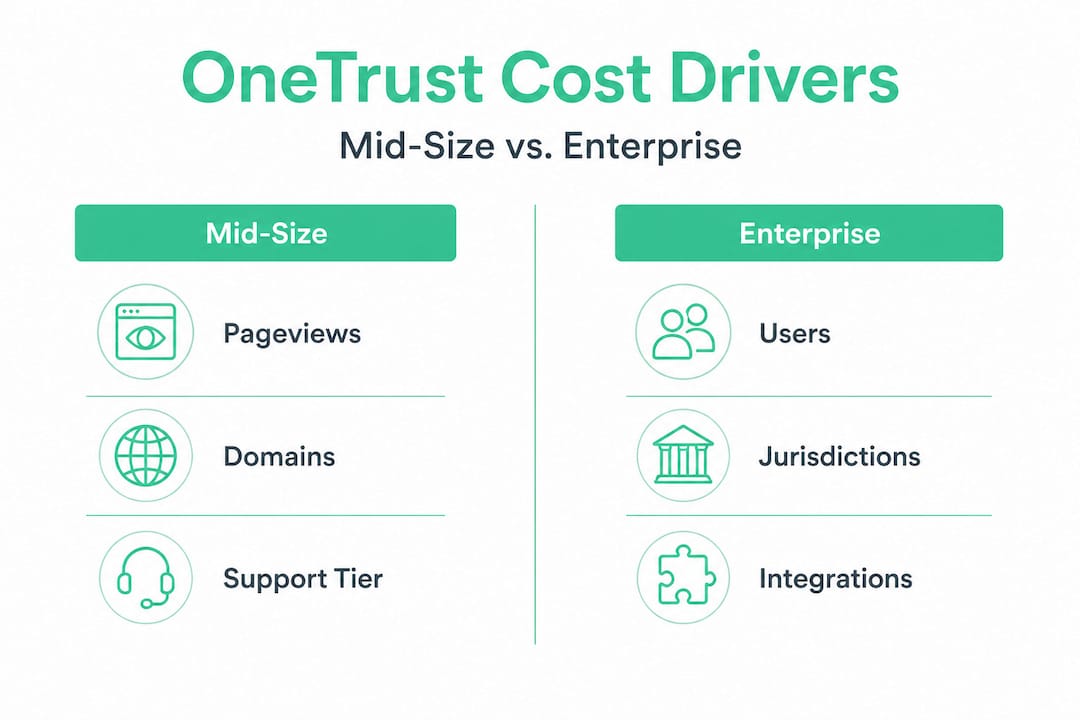
Here are the primary factors that move the price needle for mid-to-large organizations:
- User seat count: Many OneTrust modules are priced per admin user, meaning the larger your privacy, legal, and marketing team, the higher the baseline cost.
- Monthly pageviews or consent volume: The consent management module often scales with traffic. A site handling 50 million monthly pageviews costs more to cover than one with 2 million.
- Number of domains and apps: Organizations managing multiple brands, international domains, or mobile apps pay more because each property may require its own configuration and consent layer.
- Geographic regions covered: GDPR, CCPA, LGPD, PIPEDA, and other regional frameworks each add compliance complexity. The more jurisdictions you operate in, the more module features you activate.
- Support and SLA tier: Standard support, premium support, and dedicated customer success managers each carry different price implications. Enterprise teams almost always end up in the premium tier.
- Integration complexity: Custom API integrations with CDPs, CRMs, and data warehouses are sometimes billed separately or require professional services.
- Contract length: Multi-year commitments typically unlock discounts of 10 to 20 percent compared to annual agreements.
Pro Tip: Before your first call with OneTrust’s sales team, document your pageview counts, domain inventory, user seat requirements, and the specific compliance frameworks you need to satisfy. Walking in with this data puts you in a far stronger negotiating position than walking in with a vague scope.
The Spendflo transaction data referenced in market procurement studies, and corroborated by Vendr’s purchasing data, places the median annual spend for a mid-sized organization in the low five figures. That means anywhere from roughly $12,000 to $40,000 annually is a realistic working range for a company with a single brand, moderate traffic, and two to three core modules. Larger organizations with complex data ecosystems often see quotes that climb well above that.
Marketing teams specifically need to pay attention to how analytics scale affects pricing. If your attribution stack drives significant consent decision volumes, you might trigger a higher consent volume tier even if your overall business size is modest. Reviewing resources on best consent management platforms before your evaluation helps you benchmark what other platforms charge for equivalent consent volumes, which gives you leverage when negotiating.

Organizations that also rely on tag management systems like Tealium should consider how privacy tools integrate with their existing stack. Understanding Tealium’s CCPA tools and how they overlap with OneTrust features can help you avoid paying for redundant capabilities across both contracts.
Comparing OneTrust pricing: Benchmarks and alternatives
With these variables in mind, buyers naturally want a side-by-side comparison. The problem is that most competitor pricing is equally opaque at the enterprise level. What you can do is assemble a credible range from third-party reports, community benchmarks, and your own vendor negotiations.
The table below summarizes reported pricing ranges for leading consent and privacy management platforms. These figures are drawn from procurement databases, review site disclosures, and publicly cited benchmarks. They are not official vendor pricing and should be treated as directional starting points only.
| Platform | Reported annual range (mid-market) | Pricing model | Key modules |
|---|---|---|---|
| OneTrust | $12,000 to $100,000+ | Custom quote | Consent, privacy automation, vendor risk, data mapping |
| Cookiebot (Usercentrics) | $1,200 to $20,000+ | Domain-based tiers | Consent management, scanner |
| TrustArc | $15,000 to $75,000+ | Custom quote | Consent, privacy program management |
| Osano | $5,000 to $30,000+ | Seat or domain-based | Consent, DSR, vendor monitoring |
| Didomi | $8,000 to $40,000+ | Custom quote | Consent, preference management |
A few important caveats when reading any pricing comparison:
- Review platform disclosures are often outdated. G2 and similar sites may display entry-level pricing that reflects older tiers or starter plans not available at enterprise scale.
- “Starting at” prices are almost never your price. They represent the minimum viable configuration, which rarely matches the real-world needs of a mid-to-large organization.
- Bundle discounts are invisible in comparison tables. OneTrust may offer meaningful discounts when you combine three or more modules, but those only appear in your specific negotiation.
- Implementation and professional services costs are often excluded. Many buyers find that their first-year total cost runs 20 to 30 percent higher than the software license alone once onboarding services are factored in.
Public review platforms like G2 frequently show ratings and feature matrices without providing reliable entry-level price points, which is why their data should be treated as anecdotal context rather than procurement intelligence.
When evaluating the field, it helps to go beyond generic category comparisons. Detailed breakdowns of OneTrust against specific alternatives can reveal capability gaps you would not spot in a feature checklist. Similarly, reading deep-dive consent platform comparisons can highlight which platform’s architecture actually fits your tech stack, not just your budget.
For teams that rely heavily on tag management or have complex data pipelines, reviewing Tealium’s competitive landscape gives additional context on where privacy and analytics tooling overlaps and where you might consolidate vendors. Likewise, if your team uses schema management tools, looking at alternatives to Avo can reveal complementary solutions worth folding into your evaluation.
Procurement tips: Getting reliable pricing during evaluation
Whether you are putting together your first RFP or entering a renewal cycle, how you structure your vendor conversations determines whether you get a fair deal or an inflated starting point with no room to negotiate. Here is what experienced procurement teams get right.
-
Define your scope before any vendor conversation starts. Write down your domain count, monthly unique visitors, number of compliance frameworks you need to cover, required integrations, and expected user seats. Vendors who can not see a clear scope will pad quotes to cover ambiguity.
-
Request itemized line-item pricing. Ask OneTrust’s sales team to break down the quote by module, not just as a lump sum. This forces transparency and lets you identify which modules you actually need versus which are bundled in as upsells.
-
Get competitive quotes in parallel. Run evaluations with at least two or three alternatives at the same time. Vendors respond differently when they know they are in a competitive evaluation versus when they think they have a captive audience.
-
Ask specifically about renewal pricing. Many organizations sign attractive first-year deals only to face 15 to 25 percent price increases at renewal. Negotiate renewal caps into your original contract, not after you are already locked in.
-
Demand clarity on volume thresholds. If your traffic grows, at what point does your pricing tier change? How is that measured? Overage charges on consent volume can be significant for organizations with seasonal traffic spikes.
-
Ask for reference customers at your scale. Not names necessarily, but organizations in your industry with comparable user counts and module configurations. Use those conversations to validate whether the quoted price aligns with market reality.
Pro Tip: Treat any pricing you find on review sites as a conversation starter, not a negotiation anchor. As noted by G2’s own platform disclosures, review site pricing should be considered anecdotal unless it clearly ties back to a reproducible pricing mechanism or verifiable transaction dataset. Your leverage comes from your own documented requirements and competitive alternatives.
There is another dimension that marketing and analytics teams often overlook during this process: validating that your existing tracking infrastructure is accurate before you finalize a consent platform selection. If your consent management tool is blocking tags that should fire or allowing data to pass when it should not, you need to know that before you lock in a multi-year contract. Tools that handle conversion tracking validation can surface these issues early. Agencies managing multiple client environments especially benefit from automated error detection workflows that reveal consent-related tracking gaps before they become compliance problems.
Why most OneTrust pricing advice misses the mark
Here is the uncomfortable reality that most pricing guides for OneTrust will not tell you: the published benchmarks are almost never the whole story, and experienced buyers know that what you pay has as much to do with how you buy as what you buy.
Most publicly available cost guides rely on the same recycled data points: a Spendflo estimate here, a Vendr benchmark there. These numbers are useful starting points, but they describe the average buyer, not a buyer who has prepared well. The buyer who walks into an OneTrust negotiation with a vague scope and no competitive alternatives will almost always pay more than the published benchmark. The buyer who arrives with documented requirements, competing quotes, and a clear walk-away position often lands considerably below it.
There is a deeper issue that most guides miss entirely. OneTrust pricing advice tends to focus on the software cost in isolation, as if consent management exists in a vacuum separate from your broader marketing and analytics stack. In practice, the total cost of managing privacy compliance includes not just the platform license but the hidden cost of tracking errors that consent tools introduce when they are misconfigured. A cookie banner that fires too aggressively will suppress legitimate analytics events. One that is too permissive exposes you to regulatory risk. Neither problem shows up in your OneTrust invoice, but both have real financial consequences.
Experienced buyers who have been through multiple enterprise privacy platform evaluations consistently mention one thing they wished they had done differently: they focused too early on price and not enough on integration accuracy. The Consent and Cookie Checker tooling available today can validate whether your privacy layer is actually performing as configured before and after you deploy a new consent platform. That validation step protects your analytics accuracy, which in turn protects the marketing attribution data your team depends on for budget decisions.
The other thing seasoned buyers wish they had known: the first-year deal is rarely your most expensive year. Renewal cycles, user seat expansions, and new compliance framework requirements drive costs up in ways that are hard to predict from the initial quote. Building that expectation into your procurement model from day one, rather than discovering it at renewal time, changes how you structure the contract.
Streamline privacy and compliance with the right tracking solution
Understanding OneTrust’s pricing model is only half the work. The other half is making sure the tools around it are accurate, monitored, and actually delivering value to your marketing and analytics team.
Trackingplan is built for exactly this scenario. As you evaluate consent platforms and finalize your compliance stack, Trackingplan gives you real-time visibility into whether your digital analytics implementations are functioning correctly, including whether your consent layer is affecting tracking in ways you did not intend. Automated monitoring for web tracking performance surfaces issues like blocked pixels, schema mismatches, and event failures the moment they happen. And for teams managing privacy compliance at scale, Trackingplan’s privacy hub connects data quality assurance directly to your compliance workflows. Evaluate smarter, deploy confidently, and keep your attribution data clean.
Frequently asked questions
What is the typical annual cost for OneTrust at a mid-sized company?
Most transaction data suggests a typical annual spend in the low five figures, often starting around $10,000 or more depending on which modules you license and the scale of your operations.
Why isn’t OneTrust pricing available on review sites like G2?
OneTrust uses a custom-quote model, so review platforms rarely display reliable official pricing, and any figures shown should be treated as anecdotal rather than binding benchmarks.
What factors most affect OneTrust price quotes for enterprise users?
User seat count, consent transaction volume, number of domains, geographic jurisdictions covered, and support tier are the primary drivers, per OneTrust’s module variability across different buyer profiles.
Is there a OneTrust price list for all their modules?
OneTrust does not publish an official, public price list. All pricing is structured per-client based on your specific module selection, scale, and contract terms, which is why direct vendor engagement is required to get an accurate number.