
A typical failure starts after the consent banner is already live. Marketing sees clean reporting in Tealium. Legal sees an approved opt-out flow. Then a vendor tag is updated, an event mapping changes, or a downstream destination keeps receiving data after a preference change. Nobody notices until an access request, deletion request, or audit forces the team to trace what happened.
That is the core problem with most roundups of tealium ccpa compliance tools. They treat privacy as a single-tool purchase. In a Tealium environment, CCPA compliance is a stack design problem. You need one set of tools to capture and enforce consent, another to govern identities and consumer-rights workflows, and another to verify that the implementation still behaves correctly after every publish.
Tealium already gives teams a strong operating layer for collection, event routing, identity stitching, and policy enforcement across web, server-side, and downstream destinations. The gap usually appears between systems. Consent choices must propagate cleanly. Suppression logic must stay aligned with event schemas. Deletion and access requests must reach every system that received the data. Proof matters as much as policy.
That is why this list is organized around function inside a Tealium stack, not vendor category alone. Some of these tools are best used as consent managers. Some are stronger for governance and rights orchestration. Others are there to catch production failures that a CMP dashboard will never show.
If your team is also defining deletion standards across broader U.S. privacy obligations, it helps to understand the Right to be Forgotten in the US before you wire request handling into Tealium and its connected systems.
The tools below were chosen for a practical reason. They can work with Tealium, around Tealium, or as a control layer on top of Tealium, so you can build a privacy program that captures preferences, enforces them across channels, and verifies that the implementation still holds up in production.
1. Trackingplan
If your Tealium stack is already live, Trackingplan is the fastest way to find out whether your CCPA controls work in production instead of just in documentation.
The reason I put it first is simple. Most privacy failures in tag-managed environments aren’t policy failures. They’re implementation failures. Someone updates a load rule. A consent variable changes format. A vendor template gets republished. Then a pixel fires when it shouldn’t, or an event stops carrying the field that downstream suppression logic expects.
Trackingplan is strong because it monitors real traffic across web, mobile, and backend implementations, not just staged tests. For a Tealium-heavy team, that makes it a practical guardrail around consent logic and data collection behavior.
Where it fits in a Tealium stack
Use Trackingplan as the QA and observability layer around Tealium iQ, EventStream, and your downstream tools.
That’s especially useful when Tealium is orchestrating a large vendor environment. Tealium supports over 1,300 integrations in its privacy and governance approach, which is powerful, but it also creates more places for configuration drift. Trackingplan helps you see when that drift affects consent enforcement, schema consistency, tag firing, UTMs, or possible PII exposure.
A practical setup usually looks like this:
- Consent monitoring: Validate that tags stop firing when a user opts out and resume only when the right consent state exists.
- PII leak detection: Watch for personal data entering analytics or ad destinations through unexpected parameters.
- Release protection: Catch regressions after Tealium publishes, CMP updates, or app releases.
- Cross-team routing: Send alerts to Slack, Teams, or email so analysts, developers, and marketers work from the same signal.
Practical rule: If you can’t prove your opt-out logic works on real user traffic, you don’t have a reliable CCPA process yet.
A helpful walkthrough from Trackingplan’s channel can make this easier to visualize:
https://www.youtube.com/@Trackingplanco/videos
What works and what doesn’t
What works is the always-on approach. Instead of waiting for someone to notice a broken dashboard or a legal complaint, teams get alerted when data collection behavior changes. That’s exactly where many Tealium implementations need backup.
What doesn’t work is treating it like a substitute for a CMP or a DSAR workflow. Trackingplan won’t replace consumer-rights intake, preference UX, or legal policy management. It complements those systems by checking whether your implementation behaves the way your policy says it should.
The deployment profile is also friendly. Trackingplan says it can be installed through a lightweight tag or SDK, which aligns well with teams that don’t want another heavy implementation cycle. The trade-off is that low-traffic properties may take longer to surface a full picture of issues than high-traffic sites.
For technical marketing teams, this is the tool I’d add when the question is, “How do we know our Tealium privacy controls are still working after the next release?”
Website: Trackingplan
2. OneTrust
OneTrust is usually the choice when the consent problem is bigger than the website banner.
If your team manages multiple domains, apps, preference centers, and legal workflows across regions, OneTrust gives you a broader privacy operating model than many CMP-first tools. In a Tealium environment, that matters because the consent banner is only the front door. The harder part is making sure the resulting signal gets normalized, stored, and enforced consistently across the rest of your stack.
Best use case with Tealium
OneTrust works best when Tealium is your collection and activation layer, while OneTrust handles preference capture and broader privacy operations.
Tealium’s own tooling already supports integrated consent prompts inside Tealium iQ and lets brands prompt for CCPA or GDPR consent before data collection, as outlined in Tealium’s CCPA compliance resource. But many enterprise teams still choose a dedicated CMP like OneTrust because legal, compliance, and product want a specialized system of record for notices and preference management.
That combination can work well, but only if the integration is disciplined:
- Map categories carefully: OneTrust categories need a clean translation into Tealium load rules and consent conditions.
- Sequence scripts correctly: Tealium tags can’t assume OneTrust has already finalized the state unless your firing logic enforces that order.
- Test state persistence: Cross-domain or app-to-web journeys often expose consent mismatches first.
In practice, OneTrust is strongest when privacy, legal, and engineering all need a shared platform. It’s weaker when a smaller team just needs fast Tealium enforcement without a large operating model around it.
The downside is complexity. OneTrust can become heavy if all you need is straightforward CCPA opt-out handling. Quote-based pricing also means it’s usually better suited to organizations that already expect enterprise procurement and implementation work.
Website: OneTrust Universal Consent & Preference Management
3. TrustArc
A common enterprise scenario looks like this. Tealium is already running web collection, event routing, and connector logic, while privacy operations sit with legal and governance teams that need more than a front-end banner. TrustArc fits that setup well because it connects consent management to broader privacy workflows instead of treating consent as a single website control.
That matters in a Tealium stack. This list is not just about picking a CMP. It is about building a stack where consent capture, policy governance, and downstream enforcement work together. TrustArc is strongest for the governance side of that equation.
Where TrustArc helps most
TrustArc makes sense when consent choices need to tie into documented processes for consumer requests, vendor review, and policy management. Tealium can enforce collection and distribution rules, but many teams still need a separate operating layer where privacy staff can manage notices, assess vendors, and track obligations without living inside tag management.
I usually recommend TrustArc for organizations with shared ownership across marketing, engineering, and privacy operations. In that environment, the product value is not just the consent UI. The value is the workflow around it.
The trade-off is operational complexity.
TrustArc works best when someone owns the handoff between privacy definitions and Tealium execution. If TrustArc defines categories one way and Tealium load rules interpret them another way, the banner may look correct while data still flows to the wrong destinations. That is the failure pattern to avoid.
A practical setup is straightforward:
- TrustArc manages category definitions, notice content, and governance records
- Tealium reads the approved consent state
- Tealium iQ, EventStream, or connector logic applies the actual enforcement
- QA validates that blocked categories stay blocked across domains, apps, and downstream tools
That division of labor is why TrustArc belongs in a Tealium-specific roundup. It fills a different role than lighter CMPs. Teams that need a full privacy operating model often get more value from it than teams that only need a basic CCPA opt-out mechanism.
Website: TrustArc Cookie Consent Manager
4. Osano
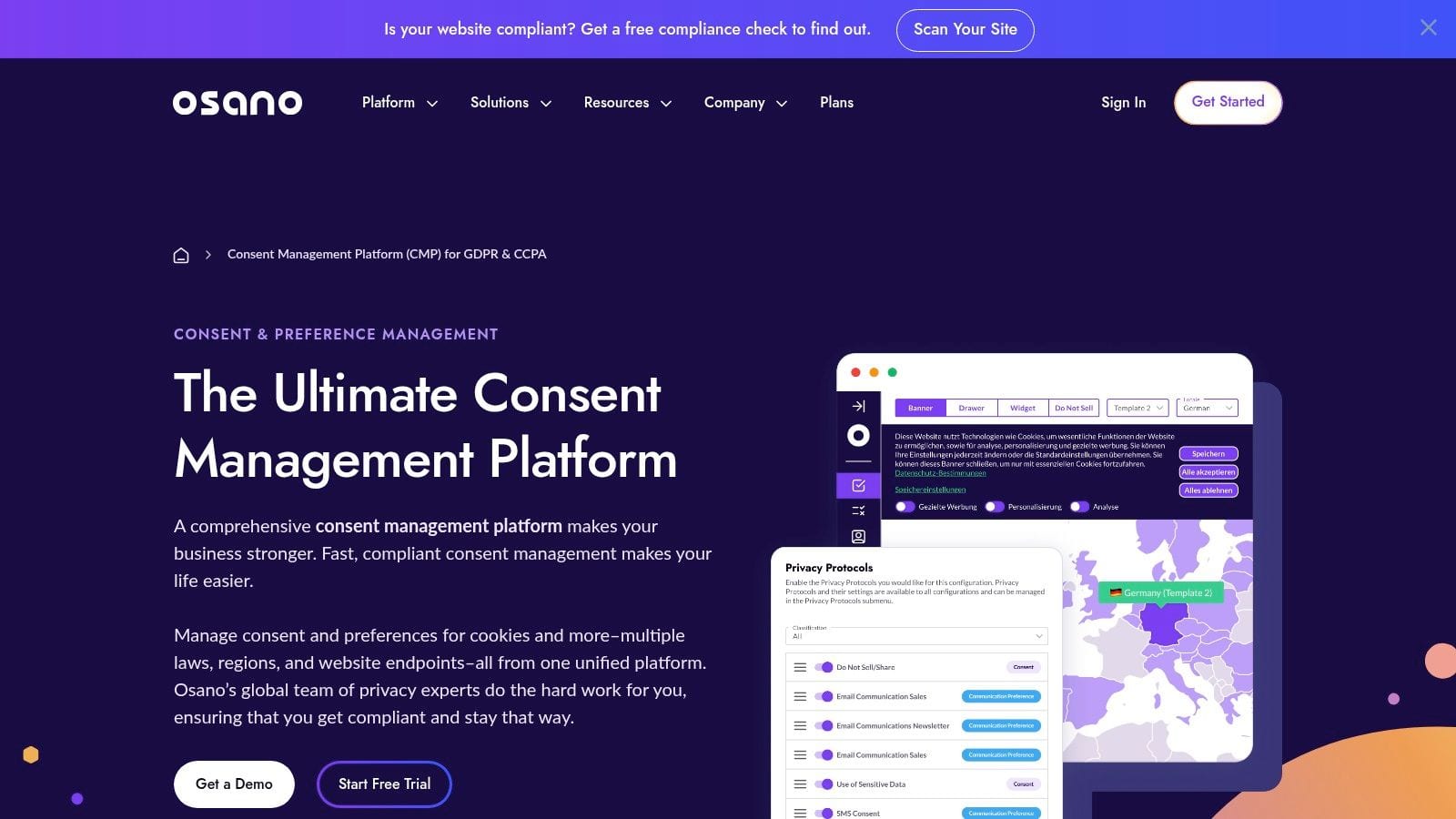
A common Tealium problem looks like this: marketing wants a consent banner live this sprint, engineering wants minimal site impact, and privacy wants proof that the choice controls downstream collection. Osano fits that situation well.
It is a practical CMP for teams that need a usable consent layer without buying a larger privacy operations platform on day one. That makes it a good fit for mid-market brands, smaller implementation teams, and companies where Tealium already handles most of the enforcement logic.
Best used as the consent layer, not the policy engine
Osano works best in a Tealium stack when roles are kept clear. Osano should capture and store the user’s choice. Tealium should apply that choice across tags, event flows, and vendor destinations.
That split matters. If the CMP owns too much exception logic, troubleshooting slows down fast. Privacy updates end up buried in banner settings, while Tealium load rules and connector behavior drift out of sync.
A cleaner setup looks like this:
- Osano presents the notice and records the preference
- Tealium iQ or event logic reads the consent state
- Load rules, extensions, and connectors enforce collection and sharing rules
- QA checks that consent behavior holds across templates, domains, and release cycles
This is why Osano belongs in a Tealium-specific roundup, not just a generic CMP list. It is strongest as the front-end consent component inside a broader stack that also needs governance and QA discipline. Teams comparing tools should review the basics of consent management in practice before deciding how much logic to place in the CMP versus Tealium.
The trade-off is depth. Osano is easier to roll out than heavier platforms, but that simplicity also means teams with complex internal approval flows, vendor assessments, or formal privacy operations may outgrow it.
For a technical marketing team with a mature Tealium setup, that is often acceptable. Osano keeps the consent experience manageable, while Tealium remains the place where enforcement is configured, tested, and maintained.
Website: Osano Consent Management Platform
5. Usercentrics
A common Tealium problem looks like this. The website shows one privacy experience, the app shows another, and the consent state lands in Tealium with gaps or inconsistent labels. Usercentrics is a strong option for teams trying to prevent that drift, especially when brand control and multilingual experiences matter.
Its value in a Tealium stack is straightforward. Usercentrics handles the user-facing collection layer well across web and app surfaces, while Tealium handles the downstream enforcement logic. That split is useful for marketing and product teams that care about design quality but still need engineering and privacy operations to keep consent behavior consistent across tags, audiences, and destinations.
A good fit for brand-heavy and multi-surface teams
Usercentrics fits organizations that need more control over the front-end experience than a basic banner tool usually gives them. That includes teams managing multiple domains, mobile properties, regional language variants, or stricter brand requirements from design and legal.
The practical question is not whether the banner looks polished. The practical question is whether the consent signal reaches Tealium in a format your team can use. For Tealium users, the test is whether preference changes alter downstream tag behavior, profile handling, and audience activation in a predictable way.
If your team is still defining roles between the CMP and Tealium, it helps to review what consent management means in practice before you decide how much logic should live in the banner layer versus your event and tag orchestration layer.
The trade-off is cost and complexity. Usercentrics makes sense when customization, language support, and cross-platform consistency are real requirements. If you only need a basic U.S. opt-out flow, the extra flexibility may be more than your team needs, and a simpler CMP can be easier to maintain.
Website: Usercentrics pricing and plans
6. Ketch
A common Tealium problem shows up after the banner goes live. Marketing sees the opt-out flow working on the page, but engineering still has to decide how that choice should affect event collection, server-side routing, profile enrichment, and downstream activation. Ketch is a strong fit for teams that want those decisions handled as part of system design, not left as manual cleanup across tags and destinations.
That matters most in Tealium stacks with custom data layers, EventStream connectors, multiple brands, or separate business units sharing one privacy program.
Where Ketch fits in a Tealium compliance stack
Ketch belongs in the consent and policy layer of a Tealium-centered stack. Its role is to capture and manage privacy choices with enough structure that engineering can map them to real controls. Tealium then uses those signals operationally, whether that means suppressing a tag, changing enrichment logic, or preventing an audience from being sent to an ad platform after a Do Not Sell or Share request.
This split is practical. Ketch handles preference and policy management. Tealium handles collection, orchestration, and activation.
Teams usually get the most value from Ketch when they already know that browser-level consent alone will not be enough. If your implementation includes web, app, and server-side collection, you need a consent system that can feed a consistent signal into Tealium rather than forcing each channel owner to interpret privacy rules separately.
There is a trade-off. Ketch tends to make more sense for teams with technical ownership and clear implementation discipline. If nobody owns the mapping between Ketch consent states and Tealium rules, the stack can still drift. The tool helps, but it does not remove the need for a consent model, naming standards, and QA around how preferences affect tags and connectors.
Another advantage is flexibility. Ketch generally appeals to teams that want API-friendly privacy infrastructure and less dependence on a one-size-fits-all CMP workflow. The downside is familiar to anyone who has deployed privacy tooling in a large organization. More flexibility means more design decisions, more coordination with legal and engineering, and more work during implementation.
Website: Ketch Consent Management
7. Transcend
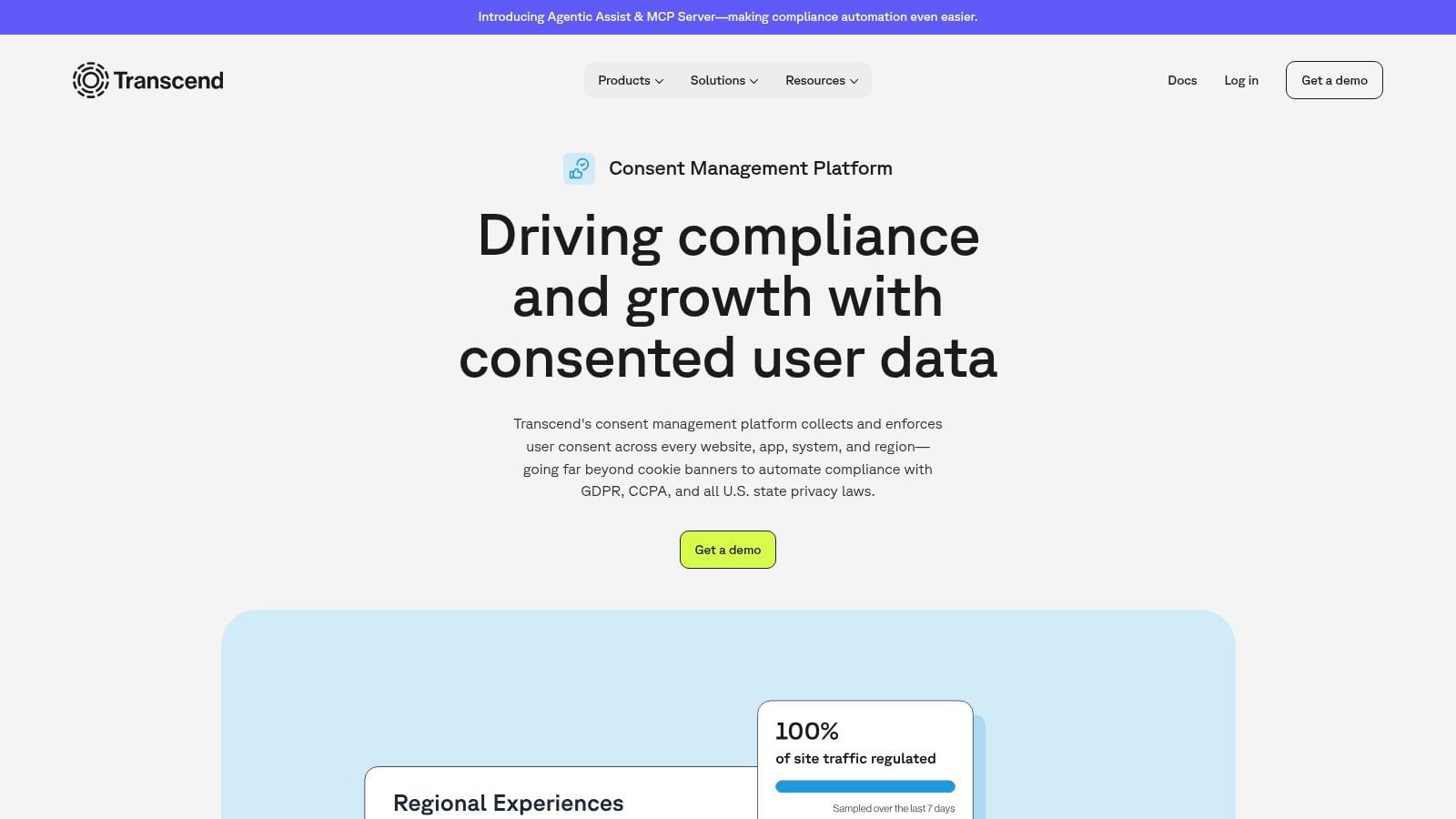
Transcend is the right kind of tool when your main privacy risk is no longer browser-only.
A lot of Tealium users have already moved beyond client-side tagging. They stream events server-side, enrich profiles, and activate data in downstream systems that users never see. That’s where a backend-aware consent tool matters more than another polished banner.
Why backend enforcement matters
CCPA compliance breaks down fast if opt-out handling stops at the cookie layer.
Transcend’s value is in pushing enforcement deeper into systems and workflows, including signals like Do Not Sell or Share and Global Privacy Control handling. That aligns well with Tealium stacks using EventStream or AudienceStream, because user preference needs to influence what gets routed, stored, and activated after collection starts.
Tealium’s automated consent orchestration tool, launched in 2022, was built around collecting, orchestrating, and auditing preferences across channels, with automation replacing manual privacy processes that often become inconsistent, as covered in TechCrunch’s report on Tealium’s consent orchestration tool. If your team wants that same principle extended across non-Tealium systems and internal workflows, Transcend becomes more compelling.
Backend suppression is where mature privacy programs separate themselves from banner-only compliance.
The catch is that Transcend usually makes the most sense when engineering is available. If your team expects a no-code setup and minimal technical ownership, this won’t feel lightweight.
Website: Transcend Consent Management
8. Didomi
Didomi is a strong option when your consent problem spans channels, not just websites.
That includes mobile apps, web properties, AMP experiences, and connected TV environments. If Tealium is already aggregating data from several touchpoints, Didomi gives you a practical way to centralize consent capture across those surfaces without forcing each channel into a separate tool choice.
Best for multi-channel consent operations
Didomi makes the most sense when your marketing and product teams operate across multiple digital environments and need a unified consent layer that still plays nicely with a broader Tealium stack.
Tealium can support real-time data orchestration and preference management across systems. Didomi’s strength is turning those requirements into a channel-spanning consent operation with APIs, scanning, and governance support. In practice, I’d look at Didomi when a team has already outgrown a website-only CMP and needs one platform to support broader digital estate management.
This is also a good fit when mobile matters. Consent inconsistencies often show up first between app SDK implementations and web tag management. Didomi is built for that reality.
The trade-off is cost transparency. Pricing is quote-led, and usage patterns can shape the final package. That’s normal in this segment, but it means the business case should be tied to operational complexity, not just “we want a better banner.”
Website: Didomi Consent Management Platform
9. Sourcepoint
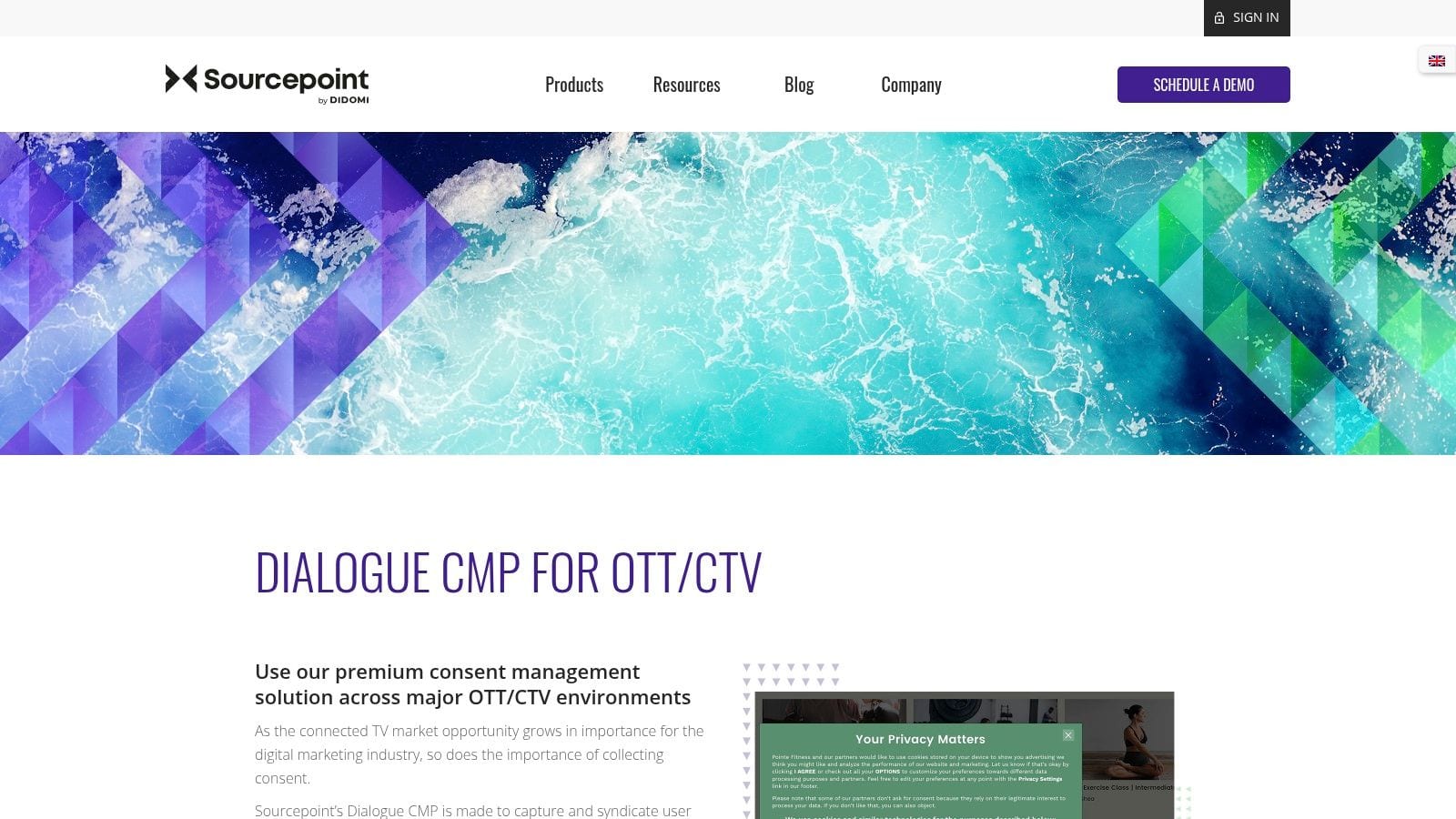
Sourcepoint is worth a hard look if your Tealium deployment touches publishing, OTT, or CTV.
That’s a very different operating context from a standard brand site. Consent is tied to monetization, geotargeting, and device-specific user journeys. A generic CMP often feels stretched there.
Why it matters for CTV and publisher environments
Sourcepoint’s practical advantage is breadth across platforms like web, app, and OTT or CTV. For teams trying to maintain consent logic consistently while Tealium collects and routes data behind the scenes, that cross-platform support can reduce a lot of custom handling.
I’d especially consider Sourcepoint when your business model depends on ad-supported experiences or regional monetization strategies. In those environments, privacy choices don’t just affect compliance. They affect revenue pathways, audience eligibility, and how demand partners are allowed to operate.
The caution is straightforward. Rich monetization features can also increase operational complexity. If your team doesn’t have a clear owner for privacy plus monetization logic, Tealium enforcement rules can drift away from what the CMP presents to users.
A publisher or streaming team can get real value from Sourcepoint. A simpler brand site usually won’t need that level of specialization.
Website: Sourcepoint OTT and CTV consent solutions
10. Crownpeak
Crownpeak, through the former Evidon platform, is one of the more established names for organizations that care about scanning, inventories, and multi-site deployment discipline.
That’s useful in large Tealium estates. Once you’re managing multiple domains, separate business units, or inherited vendor sprawl, a mature inventory and notice platform can save a lot of manual cleanup.
Where Crownpeak fits best
Crownpeak is particularly useful when your challenge is governance consistency across many properties.
Tealium helps by standardizing deployments and reducing reliance on custom code through its broad integration library and governance controls. Crownpeak complements that with technology inventories, scanning, and deployment support that help teams understand what is present on their sites before they try to govern it.
CCPA work often fails at the discovery stage. Teams can’t govern what they haven’t inventoried. They can’t write accurate notices if vendors or trackers appear outside approved processes.
What works well here is the maturity. What doesn’t is speed for smaller teams. If you run one or two properties and need a lightweight route to Tealium enforcement, Crownpeak may feel too enterprise-shaped for the job.
Website: Crownpeak
Top 10 Tealium-Compatible CCPA Compliance Tools
| Product (Category) | Core focus & features | UX & quality metrics | Unique selling points | Price & target fit |
|---|---|---|---|---|
| Trackingplan (Compliance Observability & QA) | Always-on analytics observability; auto-discovery of events, datalayer, pixels, SDKs & server hits; lightweight 10KB tag/SDK | Real-time alerts (email/Slack/Teams); AI root-cause + impact scoring; 24/7 monitoring; <500ms async load | AI-assisted debugging; real-user traffic monitoring (not just synthetic); privacy-first (PII & consent checks) | Free tier + 14-day Growth trial; Enterprise PoC; ideal for analysts, marketers, devs, agencies |
| OneTrust, Universal Consent & Preference Management (CMP) | Centralized consent & preference management across web/mobile/apps; preference center & integrations | Enterprise notice UIs; unified profiles; governance workflows | Broad privacy suite (DSAR, data mapping, vendor risk); vendor consolidation | Quote-based (typically high-end); best for large enterprises and legal/privacy teams |
| TrustArc, Cookie Consent Manager (CMP) | Cookie consent banners, policy management, automated vendor scans; legal updates | Enterprise-grade consent flows; implementation support & guides | In-house legal curation; mature enterprise consent tooling | Sales-led pricing; suited to enterprises with compliance teams |
| Osano, Consent Management (CMP) | Multi-regulation consent banners, automated enforcement, reporting; Google-certified | Clear self-serve plans; upgrade path to enterprise; reporting dashboards | Self-serve on-ramp with enterprise upgrade; U.S.-centric support | Public plans with variable pricing; SMBs to mid-market with growth path |
| Usercentrics, Web & App CMP (CMP) | Web & mobile CMP, multi-language, Consent Mode & API integrations | Highly customizable UI; multi-language support; strong legal-text coverage | Rich customization and integrations; scalable for SMB→Enterprise | Traffic/feature-based pricing; fits companies needing advanced UX and legal controls |
| Ketch, Consent Management (CMP) | Developer-first CMP with templates, SDKs, multi-state support; free tier available | Fast implementation with templates; enforcement across systems | Free CMP tier; strong U.S. multi-state templates & SDKs | Free tier for starters; enterprise features sales-led; good for engineering-led teams |
| Transcend, Consent Management (CMP) | Full-stack consent with backend enforcement; honors GPC/Do Not Sell signals | Branded consent experiences; developer tooling for backend enforcement | Emphasis on backend enforcement beyond cookies; modern U.S. privacy flows | Demo/quote-based pricing; best for teams with engineering resources |
| Didomi, Consent Management Platform (CMP) | Multi-platform consent (web, mobile, CTV), tracker scanning, consent analytics | Multi-channel support incl. CTV & mobile SDKs; built-in scanning & history | Strong CTV/mobile coverage; integrated tracker/vendor scanning | Usage/traffic-based quotes; publishers and large brands |
| Sourcepoint (Dialogue CMP), Universal Consent & CTV Focus (CMP) | CMP for publishers with OTT/CTV support; geotargeting and monetization options | Geotargeted experiences; consent-paywall (Consent or Pay) | Broadest OTT/CTV coverage; monetization features for publishers | Tiered pricing with enterprise add-ons; ideal for publishers and OTT apps |
| Crownpeak (Evidon), Universal Consent Platform (CMP) | Consent platform with auto vendor/technology inventories, scanning & notices | Mature tooling with developer docs; multi-site management | Automated vendor inventories and scanning; strong multi-domain support | Sales-led pricing; suited for large enterprises managing many properties |
Building a Resilient, Future-Proof Privacy Foundation
The best tealium ccpa compliance tools don’t compete for the same role. They cover different failure points.
Tealium itself is already a serious privacy foundation. It gives teams control over data collection through Tealium iQ and EventStream, supports consent prompts, tracks data flows, and helps manage access and erasure workflows across systems. AudienceStream adds identity resolution and preference management at the individual level. For many organizations, that’s the backbone.
What Tealium doesn’t remove is operational risk. Consent still has to be captured clearly. Vendor tags still need to respect that choice. Data still has to be monitored after releases. Consumer-rights workflows still need ownership. That’s why the strongest privacy stacks usually combine categories of tools instead of betting on one platform to do everything.
A practical Tealium stack usually looks like this:
- Tealium as the control plane: Use it to govern event collection, tag firing, routing, and profile-level preference handling.
- A dedicated CMP for preference capture: Pick OneTrust, TrustArc, Osano, Usercentrics, Ketch, Transcend, Didomi, Sourcepoint, or Crownpeak based on your complexity, legal model, and channels.
- An observability layer like Trackingplan: Use it to detect whether your intended privacy logic works in production.
That last layer is the one many teams skip. It’s also the layer that exposes the truth fastest. A documented consent process means very little if a pixel still fires after opt-out, if a new app release drops a suppression flag, or if PII starts leaking into analytics tools through an unexpected parameter.
For teams with a heavy regulatory burden, the bigger lesson is that privacy architecture should reduce fragmentation. Tealium has explicitly positioned fragmented technology stacks as a major source of compliance failure, especially around rights fulfillment and consent enforcement. I agree with that framing. In practice, most CCPA incidents I see don’t come from one catastrophic mistake. They come from small disconnects between systems that nobody noticed in time.
Good privacy operations are observable, enforceable, and auditable. If one of those pieces is missing, the stack is fragile.
The right tool choice depends on your environment.
If you’re a lean team with a mature Tealium implementation, a lighter CMP plus strong QA may be enough.
If you’re a large enterprise with legal, compliance, and engineering all involved, OneTrust or TrustArc may fit better.
If backend enforcement and engineering-led privacy matter most, Ketch or Transcend can make more sense.
If your world includes apps, CTV, or publishing monetization, Didomi or Sourcepoint become more relevant.
If estate-wide governance and inventory discipline are key concerns, Crownpeak deserves attention.
Whatever mix you choose, the goal is the same. Build a stack that captures consent clearly, enforces it consistently, monitors it continuously, and supports rights workflows without heroic manual effort. That’s how you reduce legal exposure, preserve data quality, and earn the trust that privacy programs are supposed to protect in the first place.
If your broader compliance work also touches health data workflows, these considerations overlap with the requirements behind HIPAA compliant online forms.
If you want to pressure-test your Tealium privacy implementation in practice, start with Trackingplan.com). It’s the most practical way to catch consent regressions, broken pixels, schema drift, and possible PII leaks before they turn into reporting issues or compliance problems.