
Digital marketers in 2026 face a persistent challenge: analytics problems that silently distort campaign performance and waste ad budgets. From workflows that overwrite critical UTM data to broken conversion tracking that masks true ROI, these issues remain hidden until they’ve already damaged decision-making. Understanding the most common analytics failures and how to identify them is essential for maintaining accurate attribution, optimizing spend, and driving genuine marketing results. This article walks through real-world examples of analytics issues encountered in 2026 and provides actionable insights to address them before they compromise your campaigns.
Table of Contents
- 1. Data Overwriting And Broken Tracking Workflows
- 2. Broken Conversion Tracking That Misleads Campaign Performance
- 3. The Inherent Challenges And Failures Of Attribution Models
- 4. Practical Criteria For Evaluating And Preventing Analytics Issues
- Improve Your Tracking With Proactive Monitoring Tools
Key takeaways
| Point | Details |
|---|---|
| Common analytics issues | Data overwriting, broken tracking, and attribution model limitations compromise campaign accuracy. |
| Poor data integrity impact | Flawed analytics tools lead to misguided decisions and wasted marketing budgets. |
| Prevention strategies | Proper setup, monitoring, and integration across platforms prevent costly errors. |
| Attribution model limits | Models approximate causality but require triangulation and strong data integrity. |
| Resolution benefits | Fixing analytics issues improves ROI measurement and campaign optimization. |
1. Data overwriting and broken tracking workflows
Workflows designed to automate marketing tasks can inadvertently destroy the very data you need for accurate attribution. When automation platforms overwrite UTM parameters or session data, you lose the ability to trace conversions back to their true sources. This creates a blind spot in your reporting that leads to budget misallocation and incorrect performance assessments.
A striking example involves UTM data overwriting by HubSpot workflows that severely compromised attribution reporting. In this case, 19 separate workflows were systematically overwriting UTM parameters, making it impossible to accurately assess ROI across campaigns. The marketing team believed certain channels were underperforming when, in reality, their tracking system was erasing the evidence of success.
This type of workflow conflict creates several cascading problems:
- Campaign attribution becomes unreliable as source data disappears
- Budget decisions rely on incomplete or false performance signals
- High-performing channels may be defunded due to missing credit
- Marketing teams waste time investigating phantom performance issues
- Cross-channel analysis becomes impossible without consistent parameters
Pro Tip: Schedule monthly payload audits to catch workflow conflicts before they accumulate. Review every automation that touches contact properties or session data to ensure UTM parameters remain intact throughout the customer journey.
Preventing these issues requires clear data governance and systematic monitoring. Establish rules about which workflows can modify tracking parameters and document every automation that touches attribution data. Integrate tools that can detect tracking issues automatically rather than relying on manual spot checks. When multiple team members create workflows independently, conflicts become inevitable without centralized oversight and validation processes that protect critical tracking data while ensuring data integrity across your entire marketing stack.
2. Broken conversion tracking that misleads campaign performance
Conversion tracking failures represent one of the most expensive analytics issues because they directly distort the metrics you use to allocate budget. When tracking breaks, conversions go unrecorded, making successful campaigns appear to fail while you continue spending on channels that seem more effective only because their tracking still works. This creates a systematic bias in your data that leads to progressively worse decisions over time.
A documented case study revealed how broken conversion tracking led to significant revenue loss and inefficient ad spend. After fixing the tracking implementation, measured purchases increased by 288%, conversion rates nearly doubled, and Performance Max campaigns showed a 920% jump in conversion value. These weren’t actual performance improvements. The campaigns had been delivering results all along, but broken tracking made them invisible.
The financial impact of this single tracking failure included:
- Months of wasted spend on campaigns that appeared more effective due to working tracking
- Opportunity cost from underfunding high-performing campaigns with broken measurement
- Incorrect strategic decisions based on systematically biased performance data
- Lost competitive advantage as competitors with accurate tracking optimized faster
Pro Tip: Implement conversion validation checks that compare platform-reported conversions against actual business outcomes in your CRM or order system. Discrepancies exceeding 10% signal tracking problems that require immediate investigation.
| Metric | Before Fix | After Fix | Change |
|---|---|---|---|
| Measured Purchases | Baseline | +288% | Tracking was missing most conversions |
| Conversion Rate | Baseline | +95% | Nearly doubled when properly measured |
| Performance Max Value | Baseline | +920% | Campaign was successful but invisible |
The most dangerous aspect of broken conversion tracking is how long it persists undetected. Without systematic monitoring, these issues can continue for months while you make increasingly poor decisions based on corrupted data. Implementing analytics monitoring steps and using tools to debug analytics problems helps catch tracking failures before they accumulate into major strategic errors that compromise your competitive position and waste significant marketing investment.
3. The inherent challenges and failures of attribution models
Attribution models attempt to assign credit among multiple marketing touchpoints that influence a conversion, but they face fundamental limitations that no amount of technical sophistication can fully overcome. The core problem lies in the difference between correlation and causation. Standard attribution models calculate observational probabilities, essentially measuring which touchpoints were present before conversions occurred, not which touchpoints actually caused those conversions.

As one analysis explains, attribution models often fail because they rely on observational data that cannot definitively establish cause and effect. The mathematical distinction matters: models calculate P(Y|X), the probability of conversion given exposure to a touchpoint, when what marketers really need is P(Y|do(X)), the probability of conversion caused by that touchpoint. Without randomized experiments, this causal relationship remains fundamentally unknowable through passive observation alone.
This creates several practical challenges for digital marketers:
- Different attribution models produce wildly different credit allocations for the same data
- Last-click attribution ignores the customer journey but provides clear, actionable signals
- Multi-touch models appear sophisticated but rest on unprovable assumptions about influence
- Attribution windows arbitrarily exclude touchpoints outside defined timeframes
- Cross-device journeys break attribution chains when users aren’t consistently identified
Marketing expert perspective on attribution limitations:
Attribution is fundamentally a system design challenge, not just a model selection problem. The question isn’t which model is correct, but rather how to build measurement systems that acknowledge uncertainty while still enabling decisions.
The solution isn’t to abandon attribution but to use it more intelligently. Triangulate insights from multiple models rather than treating any single model as truth. Run incrementality tests and holdout experiments to validate attribution assumptions. Recognize that attribution provides useful approximations for optimization, not definitive answers about causality. Understanding these limits helps you interpret marketing data analysis more accurately and make better decisions about resource allocation across channel marketing examples in your specific business context.
| Attribution Model | Strength | Limitation |
|---|---|---|
| Last-click | Clear, actionable, matches revenue timing | Ignores all earlier touchpoints in journey |
| First-click | Credits awareness and discovery | Ignores nurturing and conversion touchpoints |
| Linear | Acknowledges full journey | Assumes equal influence across all touchpoints |
| Time-decay | Weights recent touchpoints higher | Arbitrary decay function, still observational |
| Data-driven | Uses machine learning on your data | Black box, requires significant volume, still correlational |
4. Practical criteria for evaluating and preventing analytics issues
Preventing analytics issues requires systematic evaluation criteria and proactive monitoring rather than reactive troubleshooting after problems have already damaged your data. The most effective approach integrates analytics platforms with clear business goals, ensuring every tracking implementation serves a specific decision-making purpose rather than collecting data for its own sake.
Research shows that setting up integrated analytics environments with clear business alignment significantly improves your ability to detect issues early. Organizations that treat analytics as a strategic capability rather than a technical function catch problems faster and maintain higher data quality over time.
Use this evaluation framework to assess and maintain your analytics setup:
- Validate that every tracked event maps to a specific business question or decision
- Verify UTM parameters follow consistent naming conventions across all campaigns
- Confirm workflows and automations preserve tracking data rather than overwriting it
- Test conversion tracking against actual business outcomes in your CRM or order system
- Monitor attribution windows to ensure they capture your typical customer journey length
- Reconcile data across platforms to identify discrepancies that signal integration problems
- Audit payload structures regularly to catch schema changes that break downstream analysis
- Document who can modify tracking implementations and require review before changes
Pro Tip: Create a tracking change log that records every modification to analytics implementations, workflows, or integrations. When issues appear, this log helps you quickly identify what changed and when, dramatically reducing troubleshooting time.
Implementing automated monitoring eliminates the manual burden of constant validation while catching errors before they accumulate into major data quality problems. The key is shifting from reactive firefighting to proactive prevention through systematic checks that run continuously. This approach requires initial setup effort but pays dividends through consistently reliable data that supports confident decision-making. Following an analytics implementation guide and understanding how to ensure data integrity creates the foundation for analytics systems that remain accurate and actionable over time.
Improve your tracking with proactive monitoring tools
The examples throughout this article highlight a common theme: analytics issues persist undetected until they’ve already compromised your data and decisions. Manual audits catch some problems, but they’re too infrequent and labor-intensive to prevent the ongoing stream of tracking failures that plague modern marketing stacks.
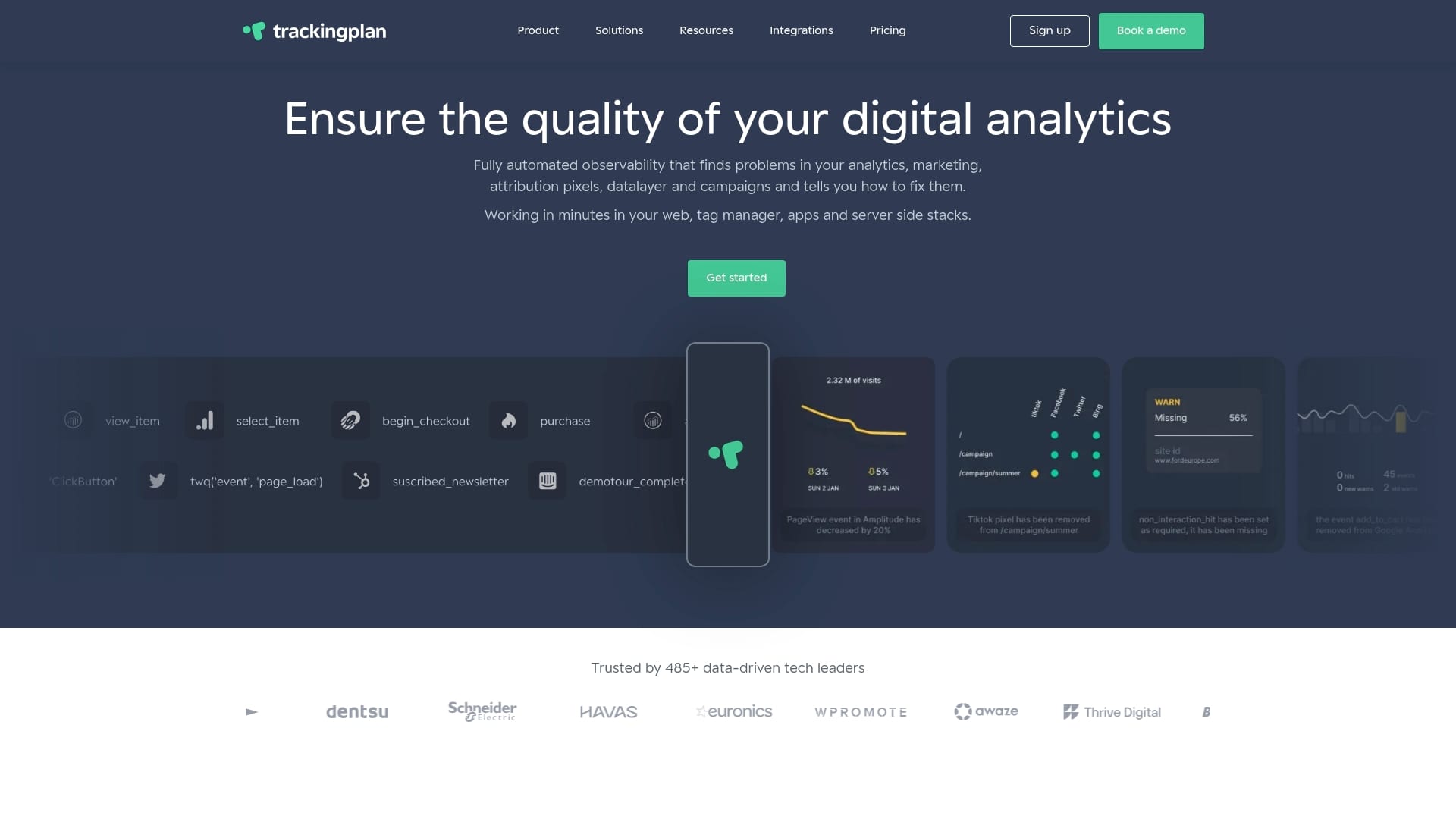
Trackingplan offers automated monitoring specifically designed for digital marketing analytics needs. The platform continuously validates tracking implementations, detects workflow conflicts that overwrite attribution data, and alerts you to conversion tracking failures before they distort campaign performance. By integrating with your existing digital analytics tools, Trackingplan provides the systematic oversight needed to maintain data integrity across complex, multi-platform marketing environments. Teams using automated web tracking monitoring catch issues in hours rather than months, preventing the cascading problems that result from decisions based on corrupted data. For organizations evaluating monitoring solutions, Trackingplan provides comprehensive alternatives to ObservePoint with advanced capabilities tailored for modern marketing analytics challenges.
FAQ
What are the most common analytics tracking issues in marketing?
The most frequent problems include workflows that overwrite UTM parameters, broken conversion tracking that undercounts results, schema mismatches between platforms, and attribution model limitations that produce inconsistent credit allocation. These issues often persist for months because they don’t trigger obvious errors, they simply produce plausible but incorrect data. Regular monitoring helps detect tracking issues before they accumulate into major strategic problems.
How can I tell if my attribution model is reliable?
Compare attribution results against incrementality tests and holdout experiments that measure actual causal impact. If different attribution models produce vastly different credit allocations for the same campaigns, treat all results as approximations rather than truth. Reliable attribution requires clean underlying data, so validate that tracking implementations work correctly before trusting any model’s output.
What steps should I take if I discover data overwriting in workflows?
Immediately document which workflows are overwriting data and what parameters they’re affecting. Pause or modify workflows to preserve UTM parameters and session data. Audit all automations that touch contact properties or tracking fields to identify additional conflicts. Implement governance rules about who can create workflows that modify attribution data and require review before deployment.
Why is it important to integrate all marketing data sources?
Integration enables cross-channel analysis and helps identify discrepancies that signal tracking problems. When data sources remain siloed, you can’t reconcile conversions across platforms or detect when one system reports dramatically different results than another. This fragmentation hides issues and prevents the holistic view needed for accurate attribution and optimization decisions.
How often should I audit my analytics setup for errors?
Conduct comprehensive manual audits quarterly, but implement automated monitoring that runs continuously. Manual audits catch systematic issues and validate overall data quality, while automated monitoring detects specific failures as they occur. Prioritizing marketing over analytics creates technical debt that compounds over time, making regular validation essential for maintaining reliable measurement systems.
Recommended
- Data and Analytics Challenges for Digital Marketing in 2024 | Trackingplan
- The 10 Martech Changes That Defined 2025 | Trackingplan
- Analytics in growth: optimize 2026 marketing strategies | Trackingplan
- How to Detect Tracking Issues for Reliable Analytics Data | Trackingplan
- Protect Your Online Privacy in 2026: Key Data Tips