
TL;DR:
- A martech stack is an integrated ecosystem of marketing tools, data flows, and automation that enables campaign execution across the customer journey. Its architecture, including core components like CRM, automation, and analytics, influences data consistency, integration quality, and overall effectiveness. Regular audits, strong data governance, and strategic planning ensure the stack supports business goals and adapts to evolving marketing needs.
A martech stack is defined as an integrated ecosystem of marketing software tools, data flows, and automation that teams use to plan, execute, measure, and optimize campaigns across the full customer journey. The term “martech” combines marketing and technology, and the “stack” refers to how these tools layer on top of each other to create a connected system. Platforms like Salesforce, HubSpot, Marketo, Google Analytics 4, and WordPress are the named anchors most teams build around. When these tools share data cleanly, your marketing operation runs with precision. When they don’t, you’re making decisions on broken signals.
What is a martech stack and what does it include?
A martech stack is an integrated ecosystem connecting CRM, marketing automation, analytics, and customer data tools through APIs to enable campaign execution and measurement. This definition matters because the stack is not just a list of software licenses. It’s the architecture that determines how data moves, who owns it, and how reliably it reaches the people making decisions.

The minimum viable B2B martech stack includes three core layers. First, a CRM like Salesforce or HubSpot stores contact records and tracks pipeline. Second, a marketing automation platform like Marketo handles automation for email, lead nurturing, and scoring. Third, an analytics tool like Google Analytics 4 measures traffic, conversions, and campaign performance. Everything else builds on top of these three.
Beyond the core, most stacks expand into customer data platforms (CDPs) like Segment, content management systems like WordPress, social media management tools, and advertising platforms like Google Ads and Meta Ads Manager. Each addition creates new data relationships that need to be managed. The stack grows in complexity faster than most teams anticipate, which is why architecture decisions made early have outsized consequences later.
Core functional categories of a martech stack
Martech stack components fall into six categories: advertising and promotion, content and experiences, social and relationships, commerce and sales, data management, and marketing operations and finance. This taxonomy, popularized by the Chief Martec landscape, gives teams a framework for auditing what they have and identifying what’s missing.
| Category | Function | Example Tools |
|---|---|---|
| Advertising & Promotion | Paid media buying and campaign management | Google Ads, Meta Ads Manager |
| Content & Experiences | Website, CMS, and personalization | WordPress, Optimizely |
| Social & Relationships | Community, CRM, and social publishing | HubSpot, Sprout Social |
| Commerce & Sales | E-commerce and revenue enablement | Shopify, Salesforce |
| Data Management | CDPs, data warehouses, and enrichment | Segment, Snowflake |
| Marketing Operations | Attribution, reporting, and finance | Marketo, Looker |
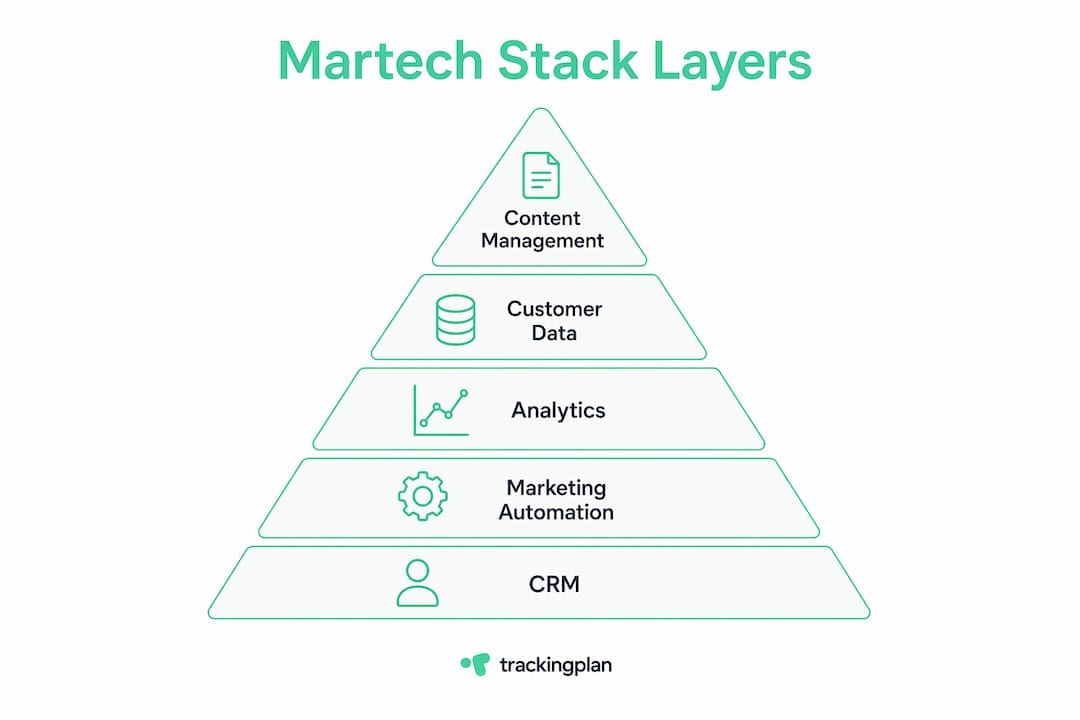
Most teams underinvest in the data management and marketing operations categories. These are the connective tissue of the stack. Without them, the advertising and content tools produce data that never gets reconciled or acted on.
How does data flow and integration work within a martech stack?
Data flow in a martech stack moves prospect actions through analytics, CRM, enrichment, scoring, and automation platforms via APIs and webhooks. A visitor fills out a form on your website. That event fires into Google Analytics 4, the contact record lands in HubSpot, an enrichment tool like Clearbit appends firmographic data, and a lead score triggers a Marketo workflow. This chain happens in seconds when integration is healthy. When one link breaks, the entire sequence fails silently.
The most common failure point is one-way data syncing. Bidirectional sync between core systems is required to prevent compounding data inconsistency problems that degrade lead management and customer experience over time. If your CRM updates a contact’s stage but that change never writes back to your automation platform, you’ll send the wrong emails to the wrong people. This is not a theoretical risk. It’s the most frequent cause of attribution errors in mid-market stacks.
An integration map is the document that prevents this. It records every data connection in your stack: which fields sync, in which direction, how frequently, and who owns each connection. Most teams skip this step because it feels like overhead. It’s actually the single most valuable artifact your marketing operations team can maintain.
Pro Tip: Build your integration map in a shared spreadsheet or tool like Notion before you add any new platform to your stack. Document the source system, destination system, fields transferred, sync direction, sync frequency, and the name of the person responsible. Revisit it every quarter.
What are the top martech stack trends shaping 2026?
The martech ecosystem shows near-flat growth in 2026, with approximately 15,500 total tools, over 1,400 products added, and 1,300 removed. This churn signals that the market is realigning rather than expanding. Teams that treat their stack as a stable asset are falling behind teams that treat it as a living system requiring regular maintenance.
The most significant architectural shift is the move toward governed universal data layers and semantic consistency. Modern martech architectures increasingly employ a governed universal data layer and semantic metrics layers to provide consistent KPI definitions and trusted data governance across tools. This prevents the scenario where your Looker dashboard shows a different conversion rate than your Google Analytics 4 report. When every tool reads from the same governed definitions, your team stops arguing about numbers and starts acting on them.
Semantic consistency is not just a reporting convenience. Tools like Databricks Unity Catalog exemplify how shared metric definitions reduce the effort of reconciling conflicting KPI figures across dashboards and AI tools. As AI-powered analytics become standard, the quality of your semantic layer determines whether AI outputs are trustworthy or misleading.
Here are the four trends defining martech stack strategy in 2026:
- Universal data layers are replacing point-to-point integrations as the preferred architecture for large stacks.
- AI augmentation is being added on top of existing platforms rather than replacing them, making data quality foundational for AI effectiveness.
- Stack consolidation is accelerating as teams cut redundant tools to reduce cost and integration complexity.
- Governance artifacts including audit trails, permissions, and data lineage are becoming standard requirements rather than optional additions.
“Teams should prioritize establishing clean, integrated data before implementing AI enhancements.” This is the single most repeated finding in the 2026 martech research. AI does not fix bad data. It amplifies it.
Pro Tip: Run a quarterly stack audit using a simple spreadsheet. List every tool, its monthly cost, its primary owner, and whether it had an active integration failure in the past 90 days. Any tool with no clear owner and no measurable output is a candidate for removal.
You can track recent martech ecosystem changes to understand which categories are consolidating and where new tools are emerging.
How to build a martech stack aligned with business goals
Building a martech stack starts with defining what you need the stack to do, not with evaluating tools. Most teams make the mistake of buying platforms before mapping the customer journey those platforms need to support. The result is a collection of disconnected tools that each do their job in isolation.
A six-phase framework for building a martech stack covers planning, tool selection, integration architecture, ownership assignment, testing, and ongoing review. The phases are sequential for a reason. Skipping integration architecture to get to tool selection faster is the most common cause of stacks that work individually but fail collectively.
The practical steps for building or rebuilding your stack:
- Map your customer journey first. Identify every touchpoint from first awareness to closed deal and post-sale retention. Each touchpoint that requires data capture or automated response needs a tool.
- Audit what you already have. Before buying anything, document every current tool, its cost, its owner, and whether it’s actively used. Stack hygiene through eliminating redundant tools and fixing broken integrations drives more value than acquiring new platforms.
- Prioritize integration capability over feature breadth. A tool with 80% of the features you want but native integrations with your core stack beats a feature-rich tool that requires custom API work to connect.
- Assign clear ownership for every tool. Each platform needs one named owner responsible for its performance, data quality, and ROI. Shared ownership means no ownership.
- Validate data quality before going live. Use marketing analytics validation processes to confirm that data flowing between systems is accurate before campaigns depend on it.
- Schedule quarterly reviews. Regular audits improve attribution accuracy and workflow efficiency by catching idle tools and failing integrations before they compound into larger problems.
The role of martech stack in data analysis is often underestimated at the build stage. Every tool you add is also a data source. If those sources don’t share a common schema or sync bidirectionally, your analytics layer will produce conflicting reports. Design for data consistency from the start, and you’ll spend far less time debugging dashboards later. For teams focused on demand generation strategies, a well-integrated stack is the difference between attribution clarity and guesswork.
Key takeaways
A martech stack succeeds when integration architecture, data governance, and clear tool ownership are treated as foundational requirements, not afterthoughts.
| Point | Details |
|---|---|
| Define before you buy | Map customer journeys and business goals before evaluating any new platform. |
| Integration is the core challenge | Bidirectional sync and an integration map prevent compounding data inconsistencies across tools. |
| Semantic consistency matters | Shared KPI definitions across tools prevent conflicting reports and make AI outputs trustworthy. |
| Quarterly audits are non-negotiable | Regular stack reviews catch idle tools, broken integrations, and missing ownership before they damage performance. |
| AI requires clean data first | AI augmentation only works when the underlying data layer is accurate, governed, and well-integrated. |
The part most martech guides skip
I’ve reviewed dozens of martech stacks for teams ranging from 5-person startups to enterprise marketing departments with 50-tool ecosystems. The pattern that separates high-performing stacks from expensive ones is not the tools they chose. It’s whether they treated integration as a first-class discipline or an afterthought.
Most teams buy a new platform because a vendor demo looked impressive. They connect it to their CRM with a one-way sync, assign it to whoever championed the purchase, and move on. Six months later, the data in that tool diverges from the data in every other system. Nobody knows which number to trust. The team stops using the tool but keeps paying for it.
The shift toward universal data layers and semantic consistency is the most important architectural development in martech right now. It’s not glamorous. It doesn’t make for exciting conference keynotes. But it’s the foundation that determines whether your AI investments produce insight or noise. I’ve seen teams spend six figures on AI-powered analytics tools that produced garbage outputs because the underlying event data had schema mismatches nobody had caught.
My honest recommendation: before you add anything to your stack, spend one sprint on marketing observability. Understand what data you’re actually collecting, where it’s breaking, and whether your integrations are bidirectional. That work will save you more money than any new tool purchase.
— David
How Trackingplan keeps your martech stack accurate
Martech stacks generate value only when the data flowing through them is accurate. Trackingplan monitors your entire marketing technology implementation automatically, detecting broken pixels, schema mismatches, failed integrations, and campaign misconfigurations across websites, apps, and server-side environments. Real-time alerts via Slack, email, or Teams notify your team the moment something breaks, so you fix issues before they corrupt attribution data or waste ad spend.
Trackingplan’s automated monitoring platform covers the full stack: from Google Analytics 4 and Meta pixel validation to CRM data quality checks and privacy compliance audits. If you’re building or optimizing a martech stack and want measurement you can trust, explore how Trackingplan works and see how teams reduce manual QA effort while improving campaign accuracy.
FAQ
What is a martech stack in simple terms?
A martech stack is the collection of software tools a marketing team uses together to run, measure, and improve campaigns. These tools share data through integrations to create a connected system rather than isolated applications.
What are the core components of a martech stack?
The core components are CRM (Salesforce or HubSpot), marketing automation (Marketo), and analytics (Google Analytics 4). Most stacks also include a CMS, a CDP, and advertising platforms depending on business needs.
How many martech tools exist in 2026?
The martech ecosystem contains approximately 15,500 tools in 2026, with over 1,400 products added and 1,300 removed in the past year, reflecting ongoing category consolidation and realignment.
What is martech stack monitoring?
Martech stack monitoring is the practice of continuously checking that all tools, integrations, pixels, and data flows in your stack are functioning correctly. Platforms like Trackingplan automate this process and alert teams to failures in real time.
How often should you audit your martech stack?
Quarterly audits are the recommended standard. Each review should identify idle or redundant tools, failing integrations, and tools without clear ownership or measurable ROI.