
Marketing analytics validation is all about ensuring the data you use for marketing is accurate, complete, and trustworthy. It’s the systematic process of checking everything from your event definitions to your campaign tagging. Think of it as quality control for your data, preventing flawed information from poisoning your reports and leading to misguided strategic decisions.
Why Flawed Analytics Threaten Your Marketing ROI
Let's be blunt: bad marketing data is a silent killer for your bottom line. Every day, teams make huge calls on budgets, campaign strategy, and resource allocation. Too often, they're unknowingly building those decisions on a foundation of bad data. Without a solid process for marketing analytics validation, teams can operate with a dangerous, false sense of confidence, completely unaware their insights are built on sand.
I’ve seen this happen firsthand. A company once spotted a massive, sudden spike in conversions from one of their marketing channels. The team, thinking they’d struck gold, immediately began shifting more ad spend to that channel. Weeks later, they discovered the truth: a duplicate pixel was firing on their confirmation page, counting every single conversion twice. The result? Heaps of wasted ad spend and missed opportunities on the channels that were actually working.
The Disconnect Between Your Tools
A big part of the problem is that your marketing tools rarely speak the same language right out of the box. Your CRM, your ad platforms, and your web analytics each have their own definitions for a "session" or a "conversion." This creates a messy, often contradictory, picture of performance. This is precisely where validation becomes mission-critical.
We've all seen the reports that just don't line up. Marketing says one thing, sales says another, and finance is looking at a completely different number. The downstream impact of these discrepancies is huge, affecting everything from performance reviews to multi-million dollar budget allocations.
The table below breaks down some of the most common data errors I've encountered and the real-world business headaches they cause.
Common Data Errors and Their Real-World Business Impact
| Data Error | Real-World Example | Impact on Your Business |
|---|---|---|
| Duplicate Conversions | A pixel fires twice on your "Thank You" page, recording two sales for every one transaction. | Inflated ROAS leads to over-investing in underperforming campaigns. Your CAC looks amazing, but your bank account disagrees. |
| Inconsistent UTM Tagging | Different team members use utm_source=facebook, Facebook, and FB, splitting traffic from a single source into three separate lines in your reports. | You can't get a clear picture of channel performance, making it impossible to properly allocate your marketing budget. |
| Missing Event Properties | A purchase event is tracked, but the revenue and product_id properties are missing. | You know a sale happened, but you don't know its value or what was sold, rendering the data useless for LTV or product analysis. |
| Cross-Domain Tracking Issues | A user clicks an ad to your landing page, then moves to your main domain to purchase, but the journey is broken into two separate sessions. | The initial touchpoint (the ad) doesn't get credit for the conversion, leading you to mistakenly believe your top-of-funnel campaigns aren't working. |
These aren't just technical glitches; they are fundamental business problems that distort reality and lead to poor decision-making.
Marketing analytics validation isn't just about ticking technical boxes. It's about protecting your budget and empowering your team to make decisions with confidence, knowing the data they rely on is a true reflection of reality.

Protecting Decisions from Invisible Errors
So, why does marketing analytics validation matter so much? Because bad data quietly corrupts your campaign decisions at scale. The best practice for modern teams is to establish a single source of truth by centralizing data from all marketing and sales channels into one governed dataset. This stops the finger-pointing over conflicting reports and gets every stakeholder aligned on the same numbers.
This is especially critical for the metrics that justify budgets, like CAC, ROAS, and CLV. In the end, validation is about safeguarding your strategy from invisible flaws like broken UTMs, mis-tagged campaigns, or attribution black holes.
Ultimately, committing to validation means you can finally trust your numbers—and more importantly, the strategic bets you make based on them. If you want to dig deeper into the "why," you can learn more about why tracking marketing data is key to unlocking better ROI.
Marketing analytics isn't what it used to be. Not long ago, the job was done when you produced a dashboard showing what happened last month—how many clicks, what the conversion rate was, and where the traffic came from. While that's still a starting point, it's just the first step in a much longer journey.
The field has grown up. Today, modern analytics isn’t just about describing the past; it's about predicting the future and actively shaping strategy. This evolution brings new layers of complexity—and with them, new risks. As our models get smarter, the need for rigorous marketing analytics validation becomes non-negotiable.
From Description to Prediction
The first major leap was from descriptive to predictive analytics. This is where we stop asking "What happened?" and start asking, "What's likely to happen next?" By digging into historical data to find patterns, predictive models can forecast future behavior.
Think about it this way: a predictive model might analyze past purchase behavior to flag customers who are at a high risk of churning in the next 90 days. This gives marketers a critical window to launch a retention campaign before the customer is gone, instead of just reporting on last quarter's churn rate after it's too late.
But here’s the catch: those forecasts are only as good as the data they're built on. If your underlying event data—like subscription_cancelled or last_login_date—is broken, your predictions will be dangerously wrong. This is one of the core challenges modern marketing analytics validation has to solve.
The Rise of Prescriptive Guidance
The final frontier in this evolution is prescriptive analytics. It goes a step further to answer the question, "What should we do about it?" These models take predictive insights and recommend specific actions to hit a desired goal.
- Real-World Scenario: A prescriptive model might not only predict that a customer segment is likely to churn but also recommend the specific offer most likely to keep them. For instance, it might suggest, "Offer a 20% discount to Segment A, but give a free upgrade to Segment B."
This level of automated decision-making is incredibly powerful, but it also carries immense risk. A single bad recommendation, scaled across thousands of users, can burn through your budget or alienate customers in minutes. The entire system relies on the assumption that every piece of input data, from customer touchpoints to cohort definitions, has been meticulously validated.
Modern marketing analytics isn’t just about collecting data; it’s about managing, questioning, and stress-testing it at every single turn. The reliability of your forecasts and recommendations depends entirely on the quality of your foundational data.
This progression has fundamentally changed what we do. As industry leaders and educational resources like Coursera point out, the core function of marketing analytics has expanded from explaining past results to actively forecasting behavior and recommending actions. This framework—moving from descriptive to predictive, and finally to prescriptive models—is now central to the discipline, making validation more critical than ever. After all, your outputs are only as good as your inputs.
Building Your End-to-End Analytics Validation Workflow
Moving from theory to practice is where analytics validation really starts to pay off. A solid, end-to-end workflow stops you from just fighting fires and turns data quality into a proactive, systematic part of your operations. This process has a few connected stages, from figuring out what you’re even tracking to creating a system for fixing problems fast. When you build this workflow, you create a safety net that catches errors before they mess up your reports, throw your strategy off course, and damage trust with stakeholders.
To get there, you need to think beyond simple reporting and adopt a more advanced, prescriptive approach to your analytics. The field has matured quite a bit, which is why a modern validation process is so critical.
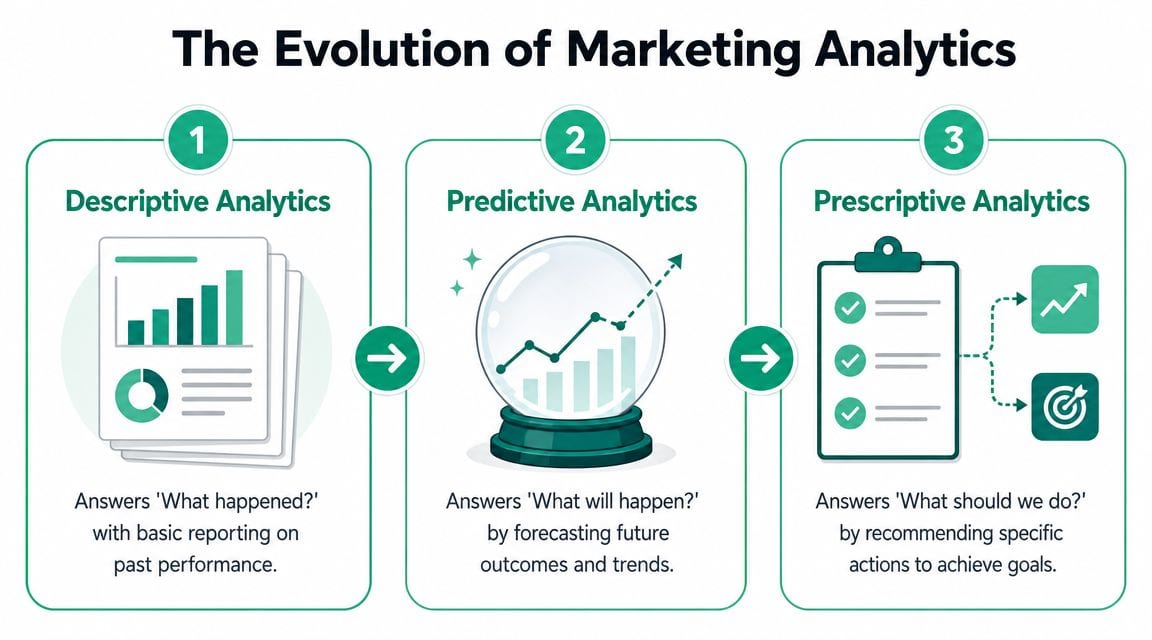
This evolution from descriptive to prescriptive analytics makes one thing clear: a structured validation workflow isn’t a nice-to-have anymore. It's essential if you want to get the most out of your data.
Discovery and Schema Creation
You can't validate what you don't know exists. The first real step in any good workflow is discovery—that means making a full inventory of every single event, property, and pixel firing across your websites and apps. It’s always a surprise. Most teams find a graveyard of redundant, old, or "rogue" tracking tags left over from past campaigns or forgotten tool trials.
Once you have that complete picture, it’s time to create a tracking plan, or schema. Think of this document as your single source of truth for all things analytics. It spells out exactly what each event means, what properties it needs to have, and what data types are expected (like a string, integer, or boolean).
A well-defined tracking plan is the constitution for your analytics. It aligns marketing, development, and data teams on a common language and set of rules, eliminating the ambiguity that so often leads to data quality issues.
For instance, the schema for a purchase event would probably require properties like these:
order_id: A unique string for the transaction.revenue: A number showing the total value, minus taxes and shipping.currency: A three-letter ISO code string (e.g., "USD").product_ids: An array of strings with the IDs of all items in the order.
This schema becomes the blueprint that all your incoming data is measured against. Without one, you’re just guessing.
Designing Meaningful Tests
With a schema in hand, you can start designing tests that actually mean something. This is about more than just checking if an event fired. You need to verify the context and accuracy of the data itself. A good test plan will cover a few critical areas.
Key Validation Checks to Implement:
-
Event and Property Validation: This is the baseline. Did the
purchaseevent fire on the confirmation page? Even more important, did it include all the properties from your schema, and are they in the right format? Apurchaseevent without arevenueproperty is practically useless. -
UTM and Campaign Tagging Conventions: Messy UTM tagging is a classic way to create data silos. Your tests have to enforce strict naming conventions, like ensuring
utm_sourceis always lowercase. This simple rule prevents traffic from "facebook," "Facebook," and "FB" from being split into three different sources in your reports. -
Pixel and Attribution Model Validation: Are your ad pixels firing correctly on key conversion pages? You also need to test your attribution model. For example, if a user clicks a paid ad and later converts, does that channel get the right credit according to your model (last-click, linear, etc.)? For a closer look at this, our guide on conversion tracking validation goes into much more detail.
Automated Monitoring and Alerting
Let’s be honest: manual testing is slow, full of human error, and just can't keep up with how fast development teams move today. The only way to make marketing analytics validation scale is through automation. Automated monitoring tools act as a constant watchdog, observing your data streams in real-time and checking every event against your tracking plan.
The moment a problem is found—a broken pixel, a missing event property, or a weird dip in traffic—the system should fire off an alert. These alerts can be sent right to your team in Slack, Microsoft Teams, or email, so the right people know about the problem instantly. This changes data validation from a painful quarterly audit into an always-on "immune system" for your analytics.
Root-Cause Analysis and Remediation
Getting an alert is just the first step. A truly effective workflow also makes it easy to figure out why something broke and how to fix it. Modern validation platforms give you context with every alert, which helps you quickly get to the root-cause analysis.
For example, an alert about a broken add_to_cart event might point to the exact software deployment or code change that caused the problem. It could show you the issue is only happening on a specific browser (like Safari on iOS 17) or device. This is gold for your developers. Instead of getting a vague ticket that just says "analytics is broken," they get a precise bug report: "The add_to_cart event is missing the product_name property since the v2.3.1 front-end release." That level of detail cuts down remediation time dramatically, so you can restore data quality before it has a chance to affect any major decisions.
Implementing Continuous Validation Across Your Martech Stack
If you're tired of putting out data fires and want to move from one-off fixes to a truly sustainable data quality process, it’s time to build a continuous QA system. This isn't about running a single project; it's about establishing an always-on "immune system" for your marketing data that spots issues before they ever hit your dashboards.
Ongoing marketing analytics validation is a discipline. The real goal is to create a system that detects and responds to data threats in real time, safeguarding your analytics and giving every stakeholder confidence in the numbers they’re using to make decisions.

Spotting Insidious Data Quality Issues
The most dangerous data problems are rarely the big, obvious ones. More often, it's the silent corruption from seemingly minor issues that erodes trust and causes the most damage over time. Your continuous validation process has to be tuned to catch these subtle but destructive errors.
A great place to start is by looking for missing data. This can show up as gaps where events like add_to_cart stop firing for certain users, or when key properties like revenue vanish from your purchase events. These little gaps can completely deflate performance metrics and make a successful campaign look like a total failure.
Just as damaging are duplicate entries. I’ve seen it happen where a simple bug caused a single purchase to be recorded twice, instantly inflating revenue and conversion metrics by 100%. Another classic issue is the appearance of suspicious zeros, where a price or quantity property that should never be zero suddenly is. These problems completely throw off your averages and totals, making any analysis unreliable. This is why it’s critical to constantly check for these inconsistencies, a point reinforced by industry experts at outlets like MarketingProfs.
Analytics validation is a discipline, not a project. It demands a cultural shift from periodic fire-fighting to continuous, proactive data quality management. It's the only way to build lasting trust in your data.
Investigating Outliers and Anomalies
Your validation system will inevitably flag outliers—those sudden spikes and dips in your key metrics. The real work begins when you investigate why it happened. Is that sudden surge in traffic and conversions a genuine win from a viral post, or is it just bot traffic from a technical glitch?
Here are a few common scenarios that demand a closer look:
- A Spike in "Direct" Traffic: This often points to a broken tracking implementation on a new landing page that's stripping referrer information. It’s probably not a sign that your brand awareness just exploded overnight.
- A Sudden Drop in Mobile Conversions: Before you assume a change in user behavior, check if a recent app update broke the checkout button for a specific screen size.
- Unusually High Engagement Metrics: A high number of
page_viewevents from a single user in a short time might look great, but it could be a sign of a redirect loop, not a highly engaged visitor.
Distinguishing between a real performance shift and a technical error is the core job of continuous validation. This process stops you from making knee-jerk decisions based on bad data, like cutting the budget on a campaign that only looks like it's failing because of a tracking bug. For a deeper dive, our automated marketing observability guide offers more strategies on this front.
Performing Cross-System Validation Checks
Finally, your data doesn't exist in a silo. True validation means looking across your entire martech stack to make sure everything is consistent. A major blind spot for many teams is reconciling data between their Consent Management Platform (CMP) and their downstream analytics tools.
Start by asking the hard questions. If a user denies consent for tracking in your CMP, are all non-essential marketing and analytics tags truly blocked from firing? You need to validate that a user's choice is respected across their entire data journey.
Your key cross-system validation checks should include:
- Consent Reconciliation: Compare the consent status for a user ID in your CMP with the data collected for that same user in your analytics platform.
- Storage Integrity: Verify that the cookies and local storage items being set actually align with the user's given consent level.
- Tag and Script Behavior: Use browser developer tools or a monitoring solution to confirm that tracking tags and third-party scripts are loading or staying dormant based on the consent provided.
This level of validation ensures you're not just collecting accurate data, but also doing so in a way that respects user privacy and complies with regulations.
Integrating Data Governance and Privacy Checks
Great marketing analytics validation goes far beyond just data accuracy—it’s also about security and compliance. Weaving data governance and privacy checks directly into your validation workflow isn’t just a nice-to-have; it's essential for building trust with your customers and dodging hefty regulatory fines. This means moving away from reactive data cleanup and embracing proactive prevention.
This whole process begins when you make governance a core piece of your analytics foundation, not just something you tack on at the end. A well-oiled system should be able to automatically flag potential red flags, from private user data accidentally slipping into your tools to misconfigurations that ignore user consent choices.
When you get this right, governance stops being a bureaucratic headache and becomes a real strategic advantage. You can be sure your data is not just accurate, but also ethically and legally sound.
Preventing PII Leaks with Automated Checks
One of the biggest landmines in marketing analytics is accidentally collecting Personally Identifiable Information (PII). An email, phone number, or full name captured as an event property or hidden in a URL parameter can trigger serious privacy breaches and violate laws like GDPR and CCPA. Relying on manual checks to catch these issues in real-time is a losing game.
This is where automated validation truly shines. You can set up your system to constantly scan all incoming data for patterns matching common PII formats, like email addresses or even credit card numbers.
For instance, you could create a rule that automatically flags any event property containing an "@" symbol followed by a domain. If an event like search_performed is sent with a search_term property containing "jane.doe@email.com" instead of "running shoes," an alert is fired immediately. This gives your team a chance to fix the root cause before that sensitive data pollutes your analytics platforms or gets passed along to third-party tools.
Data governance is not about locking data down; it's about liberating it responsibly. By automating privacy checks, you empower your team to use data confidently, knowing that guardrails are in place to prevent costly mistakes.
Validating User Consent Configurations
Honoring user consent is completely non-negotiable. When a user says no to tracking cookies on your consent banner, your systems have to respect that choice, full stop. But misconfigurations are surprisingly common, and it’s easy for tags to fire when they shouldn't. Validating your consent management setup is a critical piece of any modern analytics validation workflow.
Your validation process needs to actively test the handshake between your Consent Management Platform (CMP) and your tag manager. This involves simulating how users interact with your consent banner and checking that everything behaves as it should.
Key Consent Validation Scenarios:
- When a user accepts all cookies: Your tests should confirm that all your analytics and marketing tags fire exactly as you expect.
- When a user rejects non-essential cookies: The validation must prove that only strictly necessary tags are loaded. All marketing, analytics, and advertising pixels should remain dormant.
- When a user provides partial consent: If your banner lets users pick and choose categories (like "Analytics" but not "Advertising"), your tests need to verify that only the tags for the approved categories are activated.
Running these checks confirms your implementation aligns with both user preferences and regulatory demands, shielding you from major compliance risks.
Creating a Single Source of Truth for Governance
Solid data governance is built on clarity and teamwork. Things get messy when marketing, development, and legal teams are all working from different scripts. Establishing a single source of truth for your tracking is the only way to get everyone on the same page about what data is collected, why it's collected, and how it should be handled.
A shared, living tracking plan or data dictionary is perfect for this. This document defines every single event and property, including a clear description, its data type, and—most importantly—its PII status. It becomes the central playbook that ensures everyone in the organization is speaking the same data language. If you're looking for more ways to improve your data handling, you might be interested in our guide on data governance best practices.
When you integrate this single source of truth with your automated validation tools, you create a powerful feedback loop. Any deviation from the plan—like a new, undocumented event or a property that looks like it contains PII—is flagged instantly. This fosters a culture where everyone shares responsibility for data quality and privacy.
Your Top Questions on Marketing Analytics Validation, Answered
Getting started with marketing analytics validation always brings up a few key questions. It's a big step toward building a truly data-driven culture, but it can feel like a lot to take on. We’ve pulled together the most common questions we hear from teams to give you clear, straightforward answers.
Let's clear up the confusion so you can move forward with confidence.
How Often Should We Validate Our Analytics?
The best way to handle validation is to make it a continuous, automated process—not just a one-off manual audit. A deep-dive audit every quarter is great for strategic reviews, but it won’t catch the daily issues that pop up from new website deployments, app updates, or sneaky changes from third-party scripts.
Real-time monitoring is the only way to catch these problems the moment they happen. For your most critical user flows, like your checkout process or lead forms, validation should be built right into your CI/CD pipeline. This stops data-breaking errors from ever reaching production and protects your analytics from the get-go.
What Are the Most Common Analytics Errors?
While the specifics can differ, most analytics issues fall into a few familiar buckets. Knowing what they are helps you prioritize your validation efforts and spot trouble faster.
Here are the top five culprits we see all the time:
- Schema Violations: This happens when an event is tracked with missing properties, the wrong data types (like sending a
priceas a string instead of a number), or simple typos in event names. - Inconsistent Tagging: Broken UTM parameters and messy campaign naming are classic offenders. They fracture your traffic data, making it impossible to get a clear picture of channel performance.
- Broken or Missing Pixels: It’s incredibly common for ad or analytics pixels to break, fail to fire on key pages, or just stop sending data. This creates huge gaps in your conversion and attribution reports.
- Duplicate Events: A bug might cause a single
purchaseevent to fire twice, which instantly inflates your revenue and conversion metrics and gives you a false sense of success. - PII Leaks: This one is serious. It's when sensitive user data like an email or phone number is accidentally captured in an event property or URL parameter, creating a major privacy and compliance risk.
Who Is Responsible for Marketing Analytics Validation?
The short answer? Everyone. Data quality is a team sport. Making it one person’s job is a surefire way to fail. A real validation strategy needs a cross-functional effort where every team has clear ownership over their part of the process.
Marketing analytics validation isn't one person's job; it's a shared responsibility. The best results come when a centralized platform provides a single source of truth, empowering every team to own their part of the data quality chain.
Here’s how the responsibilities usually break down:
- Digital Analysts often take the lead, defining the tracking plan and setting data governance standards.
- Marketers are on the hook for making sure all their campaigns are tagged correctly based on the established rules.
- Developers and QA Teams are accountable for implementing the tracking code correctly across websites and apps.
When everyone is on the same page and working from the same playbook, you build a powerful culture of data accountability.
Can We Actually Automate the Validation Process?
Yes, and you absolutely should. Manual testing and spot-checking are just too slow and error-prone. They can't keep up with the pace of modern development. Automation is the only way to build a marketing analytics validation program that is both sustainable and effective.
Modern observability platforms can automatically discover your entire analytics setup, from your site’s data layer to all your downstream destinations. They then compare your live data against your tracking plan in real-time. The moment an issue is detected—a traffic anomaly, a broken pixel, or a schema violation—alerts are sent straight to your team via Slack, email, or Microsoft Teams.
This automated approach turns data validation from a painful, reactive chore into a proactive, always-on safety net. It gives your team the power to find and fix problems before they corrupt your dashboards and lead to bad business decisions.
Ready to stop trusting bad data and start making decisions with confidence? Trackingplan offers a fully automated observability platform that discovers your entire marketing and analytics implementation, validates it in real time, and alerts you before issues impact your business. Get your free account and ensure your data is always accurate.