
Let’s get one thing straight: if you’re a growing business, your customer data is probably a mess. It’s not your fault. That data is scattered everywhere—your website, mobile app, email platform, social media ads, and even your in-store POS system.
Each tool generates its own little pocket of information, but none of them talk to each other. Your marketing team sees one version of the customer, sales sees another, and your analytics tools see something else entirely. It’s like trying to solve a puzzle with half the pieces missing. This is where Tealium steps in.
At its core, Tealium acts as the central nervous system for your customer data. Think of it as a universal translator that allows all your different marketing, sales, and analytics tools to finally speak the same language. The goal? To build a single, unified view of each and every customer.
The Mission Control Center for Your Customer Data

Unifying a Fragmented Picture
The problem of scattered data is what Tealium was built to solve. It’s a Customer Data Platform (CDP), a central hub designed to collect all that messy, fragmented data from every touchpoint.
It then goes to work, piecing together all that information in real time to build a rich, comprehensive profile for each individual. This isn't just basic contact info. We're talking about everything from browsing history and purchase behavior to loyalty status and past support tickets.
This leadership in the CDP space isn't just talk. Research In Action's Vendor Selection Matrix™ named Tealium the #1 global leader in customer data management for two years running. That's a huge vote of confidence, backed by its strong market presence and the trust of over 1,000 global businesses. You can read the full breakdown of their market leadership report here.
By connecting fragmented data, Tealium provides a single source of truth. This empowers businesses to understand their customers deeply and make smarter, data-driven decisions across all departments.
With this unified profile, you can finally deliver the kind of personalized experiences that actually work. For example, you can show a returning visitor product recommendations based on their last purchase, or automatically send a perfectly timed discount to a user who just abandoned their cart.
To help you quickly grasp how Tealium can impact different parts of your organization, here's a quick summary.
Tealium at a Glance
| Key Aspect | What It Means for Your Business |
|---|---|
| Centralized Data Hub | For marketers, this means all your campaign data lives in one place. No more switching between ten different tools to see what’s working. |
| Real-Time Profiles | For sales teams, this means having up-to-the-minute context on a prospect’s interests and behavior before you even make the call. |
| Universal Connectivity | For analytics teams, this means clean, standardized data flowing into your BI tools, making reports more accurate and reliable. |
| Privacy & Governance | For IT and legal, this means enforcing consent and data policies from a central point, making compliance much easier to manage. |
This table just scratches the surface, but it illustrates how a unified data strategy benefits everyone. For a deeper look into the platform's specific features and how they fit together, check out our complete guide on Tealium's capabilities and benefits.
Exploring the Tealium Customer Data Hub
To really get what Tealium is, you have to look under the hood. The platform isn't just one single tool; it's a suite of connected products that make up the Tealium Customer Data Hub. Each piece has a very specific job, but they all work together to collect, clean up, and activate your customer data.
You can think of the Customer Data Hub as a specialist team. Every member has their own role, but they all collaborate toward one common goal: building a single, usable view of each customer. Let's introduce the key players.
Tealium iQ Tag Management: The Foundation
Everything starts with Tealium iQ Tag Management. This is the foundational layer of the entire hub. In simple terms, it's a powerful control panel that lets you manage all the third-party tracking tags on your website and mobile apps without constantly needing to file a ticket with your developers.
Before tools like Tealium iQ came along, adding or removing a simple marketing pixel—like a Facebook Pixel or Google Analytics tag—meant changing the code and pushing a new deployment. That process was incredibly slow and often introduced new bugs.
Tealium iQ frees your marketing and analytics teams from being stuck in the developer queue. It gives them a user-friendly interface to add, remove, and set up over 1,300 pre-built vendor integrations, which dramatically speeds up how fast you can move.
This part of the platform solves a huge operational headache. But its real strength is as a data collection engine. It standardizes all the data coming in from your digital properties, making sure it's clean and consistent before it moves on to the rest of the hub.
Tealium AudienceStream: The CDP Core
Next up is Tealium AudienceStream, which is the true heart of the Customer Data Platform (CDP). This is where all the raw data gathered by Tealium iQ gets smart. AudienceStream pulls in event-level data from every source—web, mobile apps, CRM, even offline systems—and starts stitching it all together.
It's smart enough to recognize the same person across different devices and sessions, building a single, unified profile that updates in real time. As users continue to interact with your brand, AudienceStream keeps enriching their profiles with new attributes, behaviors, and affinities.
These rich profiles are what allow you to create incredibly dynamic audience segments. For instance, you could build an audience of "High-Value Shoppers Who Viewed a Specific Product Category in the Last 7 Days." This kind of powerful segmentation is the key to true personalization. Understanding how Tealium unifies customer data is crucial for implementing an effective data-driven marketing strategy.
EventStream and DataAccess: The Connectors
To round out the picture, Tealium has two other components that are just as critical for moving data around:
-
Tealium EventStream: This is a server-side data collection and delivery tool. It can grab data directly from your servers, mobile apps, or IoT devices and forward it to other server-side destinations. This approach is much lighter, improves your site's performance, and offers a more secure way to handle sensitive data.
-
Tealium DataAccess: This component works like a high-volume data pipeline. It takes all your clean, enriched event and audience data and ships it directly to your data warehouse (like Google BigQuery or Amazon Redshift) for long-term storage, deep analysis, and business intelligence.
Together, these four parts create a complete data infrastructure. Tealium iQ collects the data, AudienceStream turns it into smart profiles, and EventStream and DataAccess make sure that valuable data gets exactly where it needs to go.
How Your Data Flows Through the Tealium Ecosystem
To really get what Tealium does, it helps to follow your data on its journey through the platform. The whole process is built for speed, turning raw event data into the fuel for immediate, relevant customer experiences. Think of it as a continuous loop: collect, unify, and activate.
The journey kicks off at the first touchpoint. A customer might land on your website, open your mobile app, or even use a connected device. Tealium scoops up data from all these places using a standardized data layer—a structured blueprint for all the information you want to track.
This is where Tealium’s real-time architecture really stands out. Data isn’t held in a queue and processed hours later; it flows into the system the moment it happens. The diagram below shows exactly how this works, moving data from collection to unification and, finally, to activation.
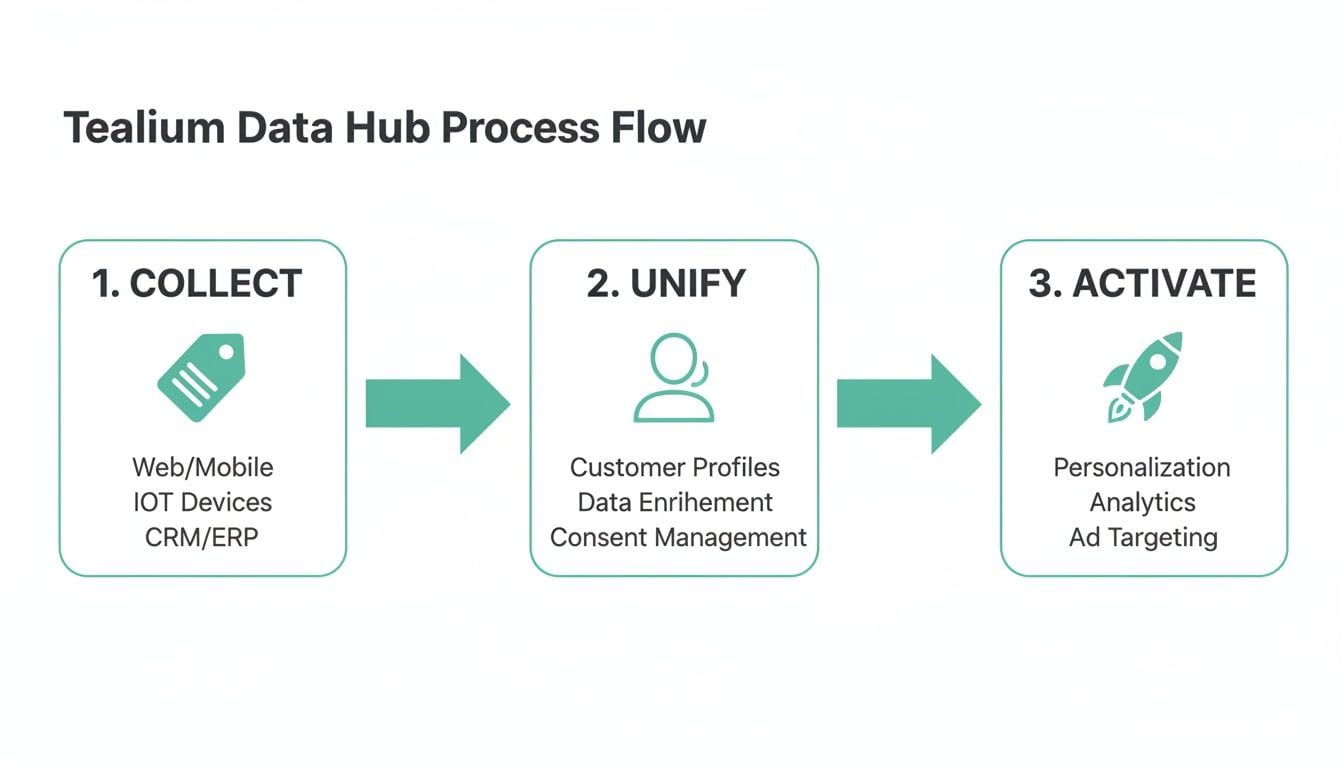
As you can see, the moment data is collected, it’s ready for the next stage. It’s this real-time capability that sets a true CDP apart from slower, more traditional data warehouses.
From Raw Data to a Unified Profile
From that initial collection point, data streams into Tealium AudienceStream, the heart of the Customer Data Hub. This is where the magic really happens. AudienceStream grabs the incoming flow of events and starts stitching identities together. It figures out when a single user interacts with your brand across different devices—like their work laptop and their personal phone—and merges all those activities into one single, unified profile.
Think of it like a detective building a case file. Each new clue—a page view, a purchase, an app session—adds another layer of detail, creating an increasingly rich and accurate portrait of the customer.
This isn’t a one-and-done snapshot. The profile is a living thing, constantly updated with every new interaction. New attributes get added, behaviors are logged, and audience segments are updated on the fly based on the rules you define. For example, a user who views three different running shoe pages could be automatically added to your "Running Enthusiast" audience.
Activating Your Data Across Every Tool
Once the data is unified and enriched, the final step is to put it to work. This is where Tealium’s massive integration ecosystem comes into play. With over 1,300 built-in connections, Tealium can push this freshly enriched profile data to virtually any tool in your tech stack. Its powerful infrastructure gathers data from web, mobile, and server-side sources, unifies profiles with predictive machine learning, and triggers actions at speeds under 100ms. This capability is a key reason why 92% of CDP users successfully hit their business goals. You can learn more about how Tealium's real-time infrastructure drives business growth.
This activation can take all kinds of forms:
- Sending a personalized email offer through your marketing automation platform.
- Powering a hyper-targeted ad campaign on a social media site.
- Updating a customer record in your CRM with their latest activity.
- Delivering a unique website experience for a returning VIP customer.
This seamless flow—from collection to unification to activation—is what lets you move from having scattered bits of data to orchestrating truly personalized customer experiences in real time.
Real-World Examples of Tealium in Action
Theory is great, but where does the rubber meet the road? Seeing how real companies use Tealium’s Customer Data Hub to tackle everyday business headaches is where its value really clicks. Let's walk through a few scenarios to see how these tools turn data chaos into real results.
Imagine a big e-commerce retailer bleeding money from abandoned carts. Shoppers load up their carts, get distracted, and leave. The follow-up email that arrives 24 hours later is so generic it’s instantly ignored. This isn’t just a small leak; it's a major drain on revenue.
This is where Tealium comes in. The moment a shopper with three specific items in their cart closes the browser, Tealium’s real-time event tracking kicks in. It captures that "cart abandonment" event on the spot.
Within minutes, that event data is fired off to the company's email platform. A highly personalized email is triggered immediately—not a day later. Instead of "You left something behind," the message shows the exact products the user almost bought and maybe throws in a small, time-sensitive shipping discount to nudge them over the finish line.
This is a fundamental shift from delayed, generic marketing to immediate, relevant action. You’re no longer just sending a reminder; you’re acting on the customer's intent in the exact moment it matters, turning a likely lost sale into a recovered one.
Personalizing the Travel Booking Experience
Now, picture a travel company. Their website is a massive catalog of destinations, and blasting every visitor with the same generic homepage deals just doesn't work. The goal is to make every visitor feel like the site was built just for them, with offers matching their travel history and current searches.
This is a perfect job for Tealium AudienceStream. It stitches together a customer's entire profile: past trips to the tropics, their loyalty program status, and those recent searches for flights to Hawaii. When this customer lands on the site, Tealium instantly identifies them and tells the personalization engine what to do.
So, instead of a random banner for a ski trip in July, our sun-seeking customer sees:
- Exclusive Offers: Tailor-made packages for resorts in Maui and Kauai.
- Relevant Content: Blog posts like "The Best Snorkeling Spots in Hawaii."
- Loyalty Perks: A quick reminder of their VIP status and the points they have available.
The experience feels bespoke and intuitive, like the company actually knows them. By connecting past behavior with present intent, the travel company makes a booking far more likely and starts building a relationship that turns casual browsers into loyal customers.
Engaging Anonymous Users in Media
Finally, let's think about a digital media publisher. A huge chunk of their traffic is anonymous—people who read a few articles and disappear, never to be seen again. The publisher's challenge is to find the most engaged readers within that unknown crowd and figure out how to turn them into paying subscribers.
Using Tealium, the publisher can track behaviors that signal high interest. They look at how many articles someone reads per week, the topics they gravitate toward, and whether they watch the embedded videos. An anonymous user who reads 10+ articles about finance in a single month is clearly a good prospect.
Tealium automatically groups this user into an "Engaged Finance Reader" audience segment. The next time they visit the site, Tealium triggers a targeted overlay with a special discount for a premium finance newsletter. This simple strategy lets the publisher intercept high-potential readers with a relevant offer right before they bounce, turning what was once anonymous traffic into a brand-new revenue stream.
Why Data Quality Is the Key to Your Tealium Success

Investing in a powerful platform like Tealium is a huge step toward building a data-driven culture. But the truth is, the success of that investment comes down to one thing: the quality of the data you feed it. The old saying, "garbage in, garbage out," has never been more accurate.
Even the most advanced Customer Data Platform can't spin gold from straw. If your data is inaccurate, inconsistent, or just plain broken, your customer profiles will get polluted, your audiences will be unreliable, and your personalization efforts will fall flat. Ultimately, your entire investment is at risk.
This is why data governance isn't just a technical checkbox. It's a core business priority for any team using a solution like Tealium.
The Hidden Risks of Bad Data
Poor data quality can cripple a Tealium implementation in ways that are subtle but devastating. These issues often fly under the radar, quietly causing damage to your marketing campaigns, analytics reports, and even customer trust.
Common problems that eat away at data integrity include:
- Inconsistent Naming Conventions: One team tracks a purchase as
product_purchasedwhile another usespurchase_complete, fragmenting your reports. - Broken Tracking: A new website release or app update silently breaks a critical event, leaving a huge gap in your behavioral data.
- Accidental PII Leaks: A developer unintentionally exposes personally identifiable information (PII) in a data layer, creating a serious compliance nightmare.
- Schema Changes: A property's data type changes out of the blue—for example,
priceswitches from a number to a string—and breaks all your downstream automations.
These might look like minor glitches, but they add up. Over time, they lead to a complete loss of trust in your data.
The Role of Analytics Observability
This is where an analytics observability platform becomes your most important ally. While Tealium is brilliant at orchestrating data, a tool like Trackingplan acts as an automated security guard, constantly watching the data before it ever flows into your CDP.
Think of it as having a dedicated quality control specialist for every single data point. It automatically scans your data streams in real time to spot errors, anomalies, and compliance risks, alerting you the moment something goes wrong.
A powerful data platform like Tealium requires a reliable team and robust governance. The team behind Tealium's innovations is a global workforce of 750 employees, powering its #1 ranking for customer satisfaction. As 68% of organizations ramp up their first-party data strategies and 88% prioritize real-time data, this combination of platform and governance is critical for managing PII and consent. Discover more about the diverse team driving Tealium's success on Zippia.com.
Instead of your teams manually chasing down bugs, they get immediate notifications about issues like broken tracking or schema drift. This proactive monitoring ensures that only clean, accurate, and compliant data makes its way into your Tealium instance.
For any organization serious about maximizing its Tealium investment, ensuring data quality from the very start is non-negotiable. You can learn more by checking out our guide on ensuring data quality in Tealium with these strategies and best practices.
Frequently Asked Questions About Tealium
Even after seeing how the pieces fit together, you probably still have some questions. Let's tackle a few of the most common ones we hear from teams who are either kicking the tires on Tealium or already using it.
Is Tealium a CDP or a Tag Manager?
It's easy to get this one mixed up because Tealium is really both, and its history explains why. The company first made its name with Tealium iQ, a powerful, enterprise-grade tag management system that’s still a central piece of its platform today. This is the part that handles data collection from your websites and apps.
Over time, though, Tealium built out a much more comprehensive solution. Today, its main offering is the Tealium Customer Data Hub, a full-blown Customer Data Platform (CDP). The engine behind that CDP is AudienceStream, which is responsible for creating those unified customer profiles and activating audiences. So, while you can absolutely start with just tag management, the platform's true power lies in its complete CDP capabilities.
How Is Tealium Different from Google Tag Manager?
This question comes up all the time, and it’s a good one. Google Tag Manager (GTM) is an excellent tool for what it does, but its scope is limited strictly to tag management. It helps you deploy and manage tracking scripts on your site, and it does that job very well.
Tealium iQ, its own tag management solution, offers more advanced, enterprise-level features. But the real difference is what happens after the tag. Tealium is a complete CDP.
Unlike GTM, Tealium can ingest data from offline sources (like a CRM or call center), stitch customer identities together across devices, build persistent profiles that grow over time, and send that unified data to hundreds of other tools in real time. GTM manages tags; Tealium manages the entire customer data lifecycle.
Of course, to build trusted profiles and make reliable decisions, you first need to establish a solid data quality framework. This ensures the information you're unifying is accurate right from the source.
Do I Need a QA Tool if I Use Tealium?
Yes, absolutely. This is a critical point that often gets missed. Tealium and an analytics QA tool have two different, but incredibly complementary, jobs. Tealium is built to collect, unify, and activate your data, but it works on the assumption that the data it receives is accurate and structured correctly.
An analytics observability platform, like Trackingplan, works as an automated auditor for your data before it ever reaches Tealium. It’s constantly scanning for problems, such as:
- Broken tracking after a developer pushes a site update
- Inconsistent event naming conventions from different teams
- Unexpected changes in data formats (schema drift)
- Missing data that creates holes in your customer profiles
Think of it this way: a QA tool protects your Tealium investment. It ensures your CDP is running on clean, reliable data, which stops data integrity issues from derailing your campaigns or eroding trust in your analytics.
How Long Does It Take to Implement Tealium?
The timeline really depends on what you're trying to achieve. A basic implementation of Tealium iQ for tag management can often be up and running in a few weeks, solving some of your most immediate data collection headaches.
A full-scale CDP implementation with AudienceStream, on the other hand, is a much more strategic project. This can take several months because it involves careful planning around your data layer, defining business rules, and mapping out all your integrations. The most successful companies we see take a phased approach, starting with a few high-impact use cases and then expanding from there.
Trackingplan provides an automated observability and QA platform to ensure your analytics are always accurate and trustworthy. By continuously monitoring your tracking implementation from data layer to destination, it alerts you to issues before they corrupt your reports and impact your business decisions. Secure your data quality with Trackingplan.