
You're staring at the same mess many teams hit sooner or later. Marketing launches a campaign, but the UTMs are inconsistent. Analytics shows two different numbers for the same journey. A developer is in Slack trying to figure out why an event disappeared after a tag change, and someone else is rebuilding a dashboard by hand because nobody trusts the current one.
That's the point where data governance automation stops sounding like a nice-to-have and starts looking like basic infrastructure. The pressure behind that shift is showing up in enterprise priorities and market growth, where governance is being treated less like a review cycle and more like an always-on control system (2025 enterprise governance survey, market overview). For analysts, marketers, devs, and QA teams, the practical question isn't whether governance matters. It's how to make it work when data keeps changing faster than people can keep up.
Why Manual Data Governance Fails at Scale
Broken campaign data rarely looks dramatic at first. Someone notices a dip in conversions, then realizes the landing page pixel never fired, or a schema change renamed a key property and the dashboard gradually drifted. By the time the issue reaches a weekly review, the team has already spent hours cleaning up reports, debating definitions, and backfilling missing context.
Manual governance depends on people noticing problems after the fact. That works when the stack is small and the pace is slow. It falls apart when data flows through web, apps, warehouses, CDPs, ad platforms, and BI tools at once, because no spreadsheet can keep up with that volume of change. The pressure is visible in the way leaders now rank governance itself as a top priority, ahead of other modernization goals in a 2024 data-leader benchmark (market analysis).
Why audits miss what observability catches
Audits are episodic. Observability is continuous. That difference matters because the most expensive governance failures usually happen between review cycles, not during them.
Practical rule: if a control can fail between Monday and Friday, it shouldn't depend on a Friday meeting to catch it.
Manual checks also create a false sense of confidence. A clean review today doesn't protect tomorrow's event stream if a developer ships a schema change tonight or a marketer updates a tag template tomorrow morning. That's why the shift toward embedded enforcement matters so much, especially in digital analytics and marketing operations, where event volume and implementation churn make manual audits impractical (enterprise survey).
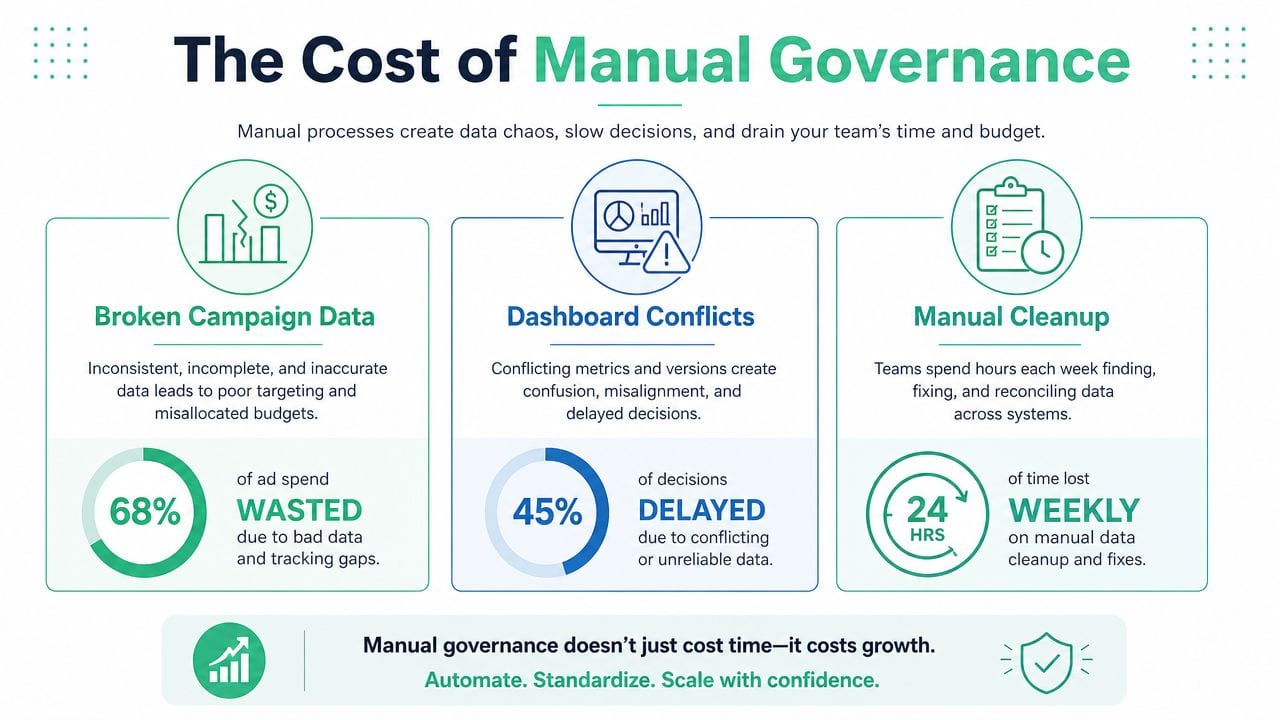
The failure isn't just missing data. It's the compounding cost of uncertainty. When dashboards conflict, teams hesitate. When campaign data looks unreliable, budget gets rechecked instead of reallocated. When cleanup is manual, every new release increases the backlog.
If you've seen that pattern, the underlying problem is usually the same. Governance lives outside the workflow, so it arrives too late to prevent the issue it's meant to control. That's why the smarter move is to push governance into the systems that create and move the data in the first place. The same data-debt logic shows up clearly in Trackingplan's breakdown of the true costs of data debt, where broken instrumentation becomes an operational problem, not just a reporting one.
A Phased Roadmap to Automated Governance
A useful rollout does not start with a grand redesign. It starts with a small, high-risk slice of the business where governance pain is already visible and the payoff is easy to prove. That approach matches the staged path recommended in implementation guidance, which begins with a narrow domain, assigns owners, ingests metadata from the first sources, then layers in lineage, quality thresholds, and alerts in the first weeks of the project (Actian rollout guidance).
The best way to think about data governance automation is as a sequence of control layers. First you define the policy. Then you connect it to the data flows. Then you watch the signals and react automatically when something drifts. The order matters because teams that buy tools before they define scope usually end up with more configuration than control.
Phase 1 Build a controlled foundation
Start with the highest-value domains, not the broadest ones. That usually means the customer, revenue, or marketing datasets where errors create immediate business noise. The maturity-path guidance in the provided sources recommends identifying the 3–5 priority domains, naming owners and stewards, ingesting metadata from the top 2–3 systems, and defining the top 20 business terms before expanding scope (Actian rollout guidance).
Treat policy as something that can be versioned, reviewed, and changed deliberately. This sounds technical, but the operational benefit is simple. People stop arguing over tribal knowledge and start enforcing agreed rules.
A practical first win is automated observability on the fields teams rely on every day. If event names, source fields, or required tags drift, the system should flag it before the issue spreads into reporting, QA, or spend decisions. That gives analysts and marketers a common signal to act on, instead of a pile of disconnected checks.
Phase 2 Connect policy to workflow
Once the scope is defined, wire the rules into the actual tools the teams use. That means governance checks where tags are deployed, where data lands, and where business users consume the output. Workday's description of governance automation as code-driven workflows is useful here because it makes the operating model concrete, not abstract. Policies, lineage, metadata, and controls become part of the workflow instead of a separate review ritual (Workday).
At this stage, start with a pilot that is visible but bounded. A marketing analytics domain is often a good candidate because the feedback loop is short and the blast radius is understandable. Build the pilot around clear checks, ownership, and escalation paths, then compare the result with a manual process so the team can see where automation saves time and where human review still matters.
If your organization is already trying to automate adjacent operations, a resource like automate candidate screening shows a similar pattern in a different function, where repeatable rules handle the predictable work and humans step in when judgment is needed.
Phase 3 Monitor, then scale
After the pilot works, add continuous alerting and remediation. The key is to move from passive visibility to active control. That is where observability platforms, warehouse checks, and workflow automation start working together instead of separately. For tool selection, a practical comparison like data quality tool options helps teams separate generic monitoring from systems that can fit into daily governance work.
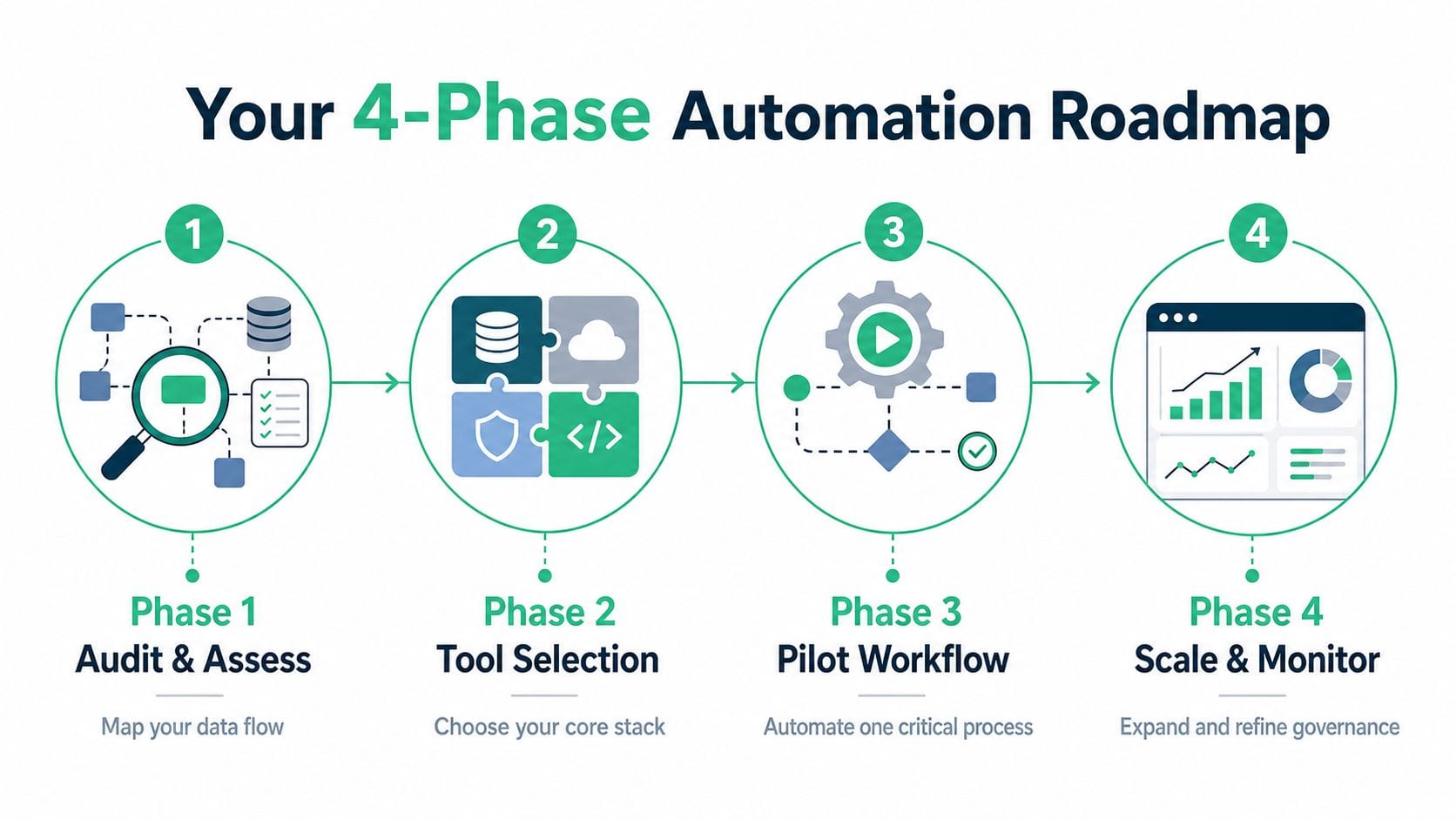
You can treat the final stage as operational hardening. The first version catches obvious issues. The scaled version catches drift, routes exceptions, and keeps the governance layer current as schemas, ownership, and business terms evolve. One practical way to judge readiness is whether alerts lead to action, not just notification. If the team can trace a failing check to an owner, a policy, and a remediation step, the automation is doing real work.
The implementation logic is iterative, which is exactly how one classic automation framework describes it, define the goal, map pain points, match them to capabilities, change the process, then repeat for the next priority (Eckerson framework.pdf?1588170116)).
The most important lesson is to make the rollout measurable from day one. A narrow pilot with visible feedback beats a sprawling program with vague progress every time.
Building Your Data Governance Automation Stack
A data governance automation stack should do four jobs well. It needs to discover what exists, monitor what changes, enforce policy, and keep the context around each asset current. In practice, that means combining discovery, observability, enforcement, and metadata so the team can manage real data flows instead of static documentation.
The stack also has to work across tools. A catalog that never feeds the quality layer, or a quality layer that cannot trigger a stewardship workflow, leaves the team with disconnected systems rather than governance. The source material makes the same point, automation scales only when metadata and workflow state move together.
What each layer should do
Discovery and cataloging should show what data exists, where it came from, and who owns it.
Observability and quality should show whether tracked events, schema fields, and business-critical values are behaving as expected.
Policy enforcement should apply rules consistently, including access and compliance controls.
Metadata management should keep definitions, lineage, and stewardship context current.
That is the architecture. The challenge is whether the platform can surface drift, route exceptions, and refresh context without turning every change into a manual project. For marketing and product analytics teams, that matters because the first failure often shows up in the path from browser or app events into downstream tools.
Trackingplan fits here as one option for the observability layer because it continuously discovers and monitors analytics implementations from the data layer to downstream destinations. It does not replace the rest of the governance stack, but it can sit in the control loop where tracking plans, event validation, and issue detection need to happen in real time.
For teams comparing adjacent tooling, a comparison of top data quality tools helps show how observability fits beside broader quality systems.
Good governance stacks do not replace people. They remove repetitive checks so stewards and analysts can focus on exceptions that actually need judgment.
The tooling layer also has to support cross-functional work. Analysts need reliable definitions. Marketers need confidence that campaigns are tracked correctly. Developers need actionable failures, not vague complaints. A platform demo can help with that, and Trackingplan's video walkthroughs on its YouTube channel are worth reviewing if you want to see how observability surfaces errors before they affect reporting.
One more useful comparison point comes from another workflow-heavy function. Recruitment teams trying to automate candidate screening face the same decision, which parts can be handled by rules and which still need review. Governance tooling should be evaluated with that same discipline.
High-Impact Automation Workflows to Implement First
The first workflows should be the ones that keep people from wasting time on the same failure patterns over and over. In analytics and marketing environments, that usually means schema drift, missing pixels, broken event naming, and sensitive data slipping into fields that were never meant to hold it. Once those are controlled, the rest of the governance program becomes easier to justify.
A practical rollout doesn't try to automate everything. It automates the highest-friction checks first, then adds routing and remediation when the team trusts the alerts. That's how observability shifts from passive reporting to active QA.
Start with the issues that create downstream noise
A GA4 schema change is a classic example. One renamed property can throw off event mapping, attribution, and dashboard logic before anyone notices. Automated monitoring catches the drift quickly, which prevents the same issue from surfacing repeatedly in reporting and stakeholder meetings.
Missing marketing pixels belong in the same category. A landing page can look finished in QA and still fail in production if one tag doesn't fire, or fires on the wrong condition. A good observability setup checks the live implementation, not just the expected spec.
Potential PII leaks need a tighter path. If a team starts sending email addresses, IDs, or other sensitive values into event properties, the governance response should not depend on someone spotting the mistake during a weekly audit. The safer design is to flag the issue immediately, route it to the right owner, and preserve an audit trail of what happened.
The incident-response angle is especially important here, because governance only helps if someone knows what to do when a control fails. Trackingplan's incident response guidance is relevant for that operational handoff, since teams need alerts that connect directly to triage and correction.

What to automate first in practice
Schema drift alerts should go to the teams that own the event source, not just a general inbox.
Missing tag detection should validate the live page or app behavior, not a QA checklist alone.
Sensitive-field checks should trigger escalation when PII appears in the wrong place.
QA workflow routing should send the issue to analysts, marketers, or developers based on the failure type.
That last piece matters more than people expect. Alerts without ownership create alert fatigue. Alerts with clear routing create accountability.
Practical rule: if an alert can't reach the person who can fix it, it's just noise with a timestamp.
The business payoff here is operational, not theoretical. Teams spend less time reconciling broken reports and more time responding to the root cause. That's the point where automated observability starts acting like governance instead of just QA.
Measuring the ROI of Automated Governance
The strongest business case for governance automation isn't a story about software adoption. It's a story about fewer mistakes, faster resolution, and less manual effort spent proving that the data is usable. The metric framework in the provided sources is refreshingly practical, because it focuses on outcomes like accuracy, completeness, duplicate reduction, compliance violations, report-preparation time, data-retrieval time, and audit readiness rather than activity volume (Acceldata ROI metrics).
You can build that case without inventing a vanity score. Start by comparing the time teams spend before and after automation on the tasks that used to require human review. Then look at how often issues are caught early enough to avoid rework. The goal is to show that governance is helping the business move faster with fewer corrections.
| Key Metrics for Measuring Data Governance ROI | ||
|---|---|---|
| Metric Category | KPI Example | Business Impact |
| Data quality | Accuracy and completeness | Fewer broken dashboards and cleaner downstream reporting |
| Operational efficiency | Report-preparation time | Less manual cleanup and faster delivery to stakeholders |
| Compliance | Compliance violations | Lower risk exposure and fewer escalations |
| Access and retrieval | Data-retrieval time | Faster analysis and reduced waiting on approvals |
| Audit readiness | Audit-readiness score | Easier evidence collection and less scramble during reviews |
The right KPI mix depends on who owns the budget. Finance teams care about reduced rework and cleaner controls. Marketing teams care about reliable campaign measurement. Engineering teams care about fewer false alerts and less time spent chasing phantom issues.
The ROI conversation also improves when observability feeds the metrics automatically. Manual reporting on governance usually defeats the purpose, because the same people who need governance are forced to prove governance worked. A relevant perspective is laid out in Trackingplan's ROI guide for automated analytics error detection, which shows why error detection is valuable when it reduces repeat work, not just when it flags problems.
One useful way to frame the result is this. If the team can show that issues are found earlier, routed faster, and resolved with less manual digging, the program is earning its keep. That's the kind of evidence executives understand.
Common Pitfalls in Data Governance Automation
The biggest mistake is automating judgment-heavy decisions too early. Deterministic checks belong in software. Ambiguous cases, high-stakes access decisions, and policy exceptions still need humans in the loop. The provided guidance on over-automation makes this split explicit, especially with recommendations like advisory mode, escalation thresholds, and decision receipts for every automated action (Acceldata over-automation risks).
That caution matters because governance failures aren't always technical. Sometimes the rule is correct but the context is missing. A bot can flag a field, but it can't always tell whether the field is a temporary test artifact or a real compliance issue. If your automation makes every edge case look like a hard failure, the team will start ignoring the alerts.
The second failure is treating policy like a one-time setup
Governance programs decay when the policy layer freezes. Data models change. Event schemas evolve. Ownership shifts. If the rules aren't versioned and retested, the automation becomes stale and eventually misleading. The source material repeatedly emphasizes policy-as-code, staged rollout, and continuous improvement for exactly this reason (Workday, Eckerson framework).
A healthy operating model keeps three things visible:
- Policy versioning so changes are traceable.
- Exception handling so humans can override when context demands it.
- Observability signals so the automation adapts when the stack changes.
The final pitfall is over-scoping the first release. Teams often try to govern every asset at once and end up governing nothing well. A narrower rollout, tied to the highest-risk workflow, gives you a real learning loop and a stronger path to scale.
Governance automation works best when it removes repetitive work, not when it tries to replace accountable people.
That mindset is what keeps the program durable. The goal is not maximum automation. The goal is reliable control, clear ownership, and less time spent cleaning up avoidable mistakes.
If you're building your first governance automation project, Trackingplan can help you monitor analytics implementations, catch schema and property mismatches, and surface missing pixels or tracking issues before they spread into reporting. Visit Trackingplan to see how automated observability fits into a governance workflow that analysts, marketers, and developers can use.